
ACEMAGIC AM08 Pro Mini PC
Updated on

Most mini PCs at this price point ask you to pick a lane. You can have desktop-class CPU performance from a Ryzen 9 in a chassis the size of a paperback novel, or you can have integrated graphics that actually run modern games at playable framerates, or you can have a real upgrade path; you do not usually get all three. The ACEMAGIC AM08 Pro is one of the few sub-9-inch mini PCs that delivers on every column of that wish list. It runs an 8-core Ryzen 9 6900HX with a Radeon 680M iGPU, pairs the chip with 32GB of DDR5 in dual channel, and hides the M.2 slot and 2.5-inch SATA bay under a magnetic top cover that pops off without a single screwdriver.
ACEMAGIC has since refreshed this same chassis around the newer Ryzen 7 8845HS, so the 6900HX configuration documented on this page is the original 2023 trim. Both versions ship under the same model name on Amazon and ACEMAGIC’s own site, and the older 6900HX usually sells for $80 to $150 below the 8845HS refresh. That price gap is the entire reason this older trim still has a place in the 2026 mini PC market.
Pros and Cons of the ACEMAGIC AM08 Pro
| Pros | Cons |
|---|---|
| Ryzen 9 6900HX delivers desktop-class multi-thread performance in a paperback-sized chassis | Costs $300 to $500 more than N100 / N150 mini PCs at the same RAM and storage tier |
| Radeon 680M (12 CU, RDNA 2) genuinely plays modern games at 1080p medium settings | Not enough GPU for 4K gaming or sustained 1440p high-refresh |
| Magnetic top cover lets you swap RAM (to 64GB) and add a 2.5-inch SATA drive without tools | Larger footprint than NUC-class mini PCs; no VESA mount in the box |
| Triple 4K display output via 2 HDMI 2.0 + USB-C DisplayPort | RGB-heavy gamer aesthetic may not suit office or home theater placement |
| Three-mode hardware switch caps the TDP for silent office use or unlocks full boost for gaming | Fans are audibly louder in Performance mode under sustained load |
| Copper-heatpipe dual-fan cooler holds boost clocks better than competing 45W Ryzen mini PCs | Now sold alongside the AM08 Pro 8845HS refresh; check both prices before buying |
| Wi-Fi 6, Bluetooth 5.2, 2.5Gb Ethernet, and a USB 4 port that handles eGPU enclosures | No SD card reader on either face of the chassis |
Related Videos
ACEMAGIC AM08 Pro Mini PC Comparison Chart
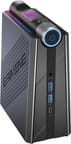 ACEMAGIC AM08 Pro Mini PC | ACEMAGIC AM08 Pro Mini PC | |
| Price | List Price: $869.00 Amazon Prices: | List Price: $899.00 Amazon Prices: |
| Version | 32GB/512GB/Ryzen 9 6900HX | 32GB/1TB/Ryzen 9 6900HX |
| Performance Rating | 8.5 | 8.5 |
| Operating System | Windows 11 Pro | Windows 11 Pro |
| Processor | Octa-core 3.30 Ghz (max 4.90 Ghz) AMD Ryzen 9 6900HX | Octa-core 3.30 Ghz (max 4.90 Ghz) AMD Ryzen 9 6900HX |
| GPU | Integrated AMD Radeon 680M | Integrated AMD Radeon 680M |
| RAM | 32 GB | 32 GB |
| Internal Storage | 512 GB | 1 TB |
| Dimensions width x length x thickness | 5.89 x 7.42 x 3.06 inches (149.61 x 188.47 x 77.72 mm) | 5.89 x 7.42 x 3.06 inches (149.61 x 188.47 x 77.72 mm) |
| Weight | 1.9 lbs (0.86 kg) | 1.9 lbs (0.86 kg) |
| WiFi | Wi-Fi 6 (802.11ax) | Wi-Fi 6 (802.11ax) |
| Bluetooth | Bluetooth 5.2 | Bluetooth 5.2 |
| Ethernet | 1 Ethernet port at 2.5 Gbps | 1 Ethernet port at 2.5 Gbps |
| HDMI | 2 Full-Size HDMI Ports | 2 Full-Size HDMI Ports |
| DisplayPort | DisplayPort over USB-C | DisplayPort over USB-C |
| VGA | No VGA Ports | No VGA Ports |
| USB Ports | 4 USB 3, 1 USB 4, 1 USB-C (USB-C port is USB 4) | 4 USB 3, 1 USB 4, 1 USB-C (USB-C port is USB 4) |
| Thunderbolt Ports | No | No |
| OCuLink | No | No |
| Internal SATA Ports | 1 SATA port, includes 2.5" drive bay (2.5" SATA SSD/HDD Bay) | 1 SATA port, includes 2.5" drive bay (2.5" SATA SSD/HDD Bay) |
| Card Reader | No Card Reader | No Card Reader |
| Headphone Jack | combo | combo |
| Fanless | No | No |
| VESA Mount | No | No |
| In the Box | 1 x Mini PC, 1 x User Manual, 1 x Power Adapter, 1 x HDMI cable | 1 x Mini PC, 1 x User Manual, 1 x Power Adapter, 1 x HDMI cable |
| Expandability | RAM upgradable to 64GB, expandable with 2.5" HDD/SSD | RAM upgradable to 64GB, expandable with 2.5" HDD/SSD |
Related Mini PCs
-
 ACEMAGICIAN AD08 Mini PCThe ACEMAGICIAN AD08 is a compact mini PC sold with Intel Core i9-11900H, i9-12900H, or i7-11700B…
 -
 ACEMAGIC M1The ACEMAGIC M1 is a 5-inch square Windows 11 Pro box sold in two very different Intel builds: a…
 -
 Beelink EQR6The Beelink EQR6 is a quiet, compact mini PC sold in several AMD configs (Ryzen 9 6900HX down to…
 -
 Beelink SEI14 Mini PCThe Beelink SEi14 runs Intel's Core Ultra 5 125H with Arc graphics, DDR5 (up to 96GB), and two PCIe…
 -
 GEEKOM A7The GEEKOM A7 runs an AMD Ryzen 9 7940HS with Radeon 780M graphics in a 0.5-liter aluminum case,…
 -
 GEEKOM IT1 MegaCompact yet powerful, the GEEKOM IT1 Mega boasts up to 64GB DDR5 RAM, dual M.2 storage slots, Intel…
What the Hardware Actually Does
The Ryzen 9 6900HX is the part doing most of the heavy lifting here. It is an 8-core, 16-thread Zen 3+ mobile chip with a 3.3 GHz base and a 4.9 GHz boost, and it lands a PassMark multi-thread score around 24,800. To put that in context: it sits ahead of every popular Intel N-series mini PC by a factor of three or four, and it is roughly equivalent to a desktop Ryzen 5 5600G in heavily threaded work like video transcoding, code compilation, or running half a dozen browser tabs alongside a couple of Docker containers. This is not a mini PC that asks you to compromise on CPU work for its size; it is one that asks you to pay a few hundred dollars more than the N100 crowd in exchange for a real generational jump in capability.
The integrated Radeon 680M graphics are the part that makes the AM08 Pro stand out from other Ryzen-equipped mini PCs at the same price. RDNA 2 with 12 compute units clocked up to 2200 MHz puts the 680M roughly on par with a discrete GeForce GTX 1050 Ti, which sounds like faint praise until you remember that no mini PC in this size class has any discrete GPU at all. In practice, that translates to playable framerates in current esports titles (Counter-Strike 2, League of Legends, Valorant, Rocket League) at 1080p with medium settings, and to acceptable performance in older AAA games like the Witcher 3 or Borderlands 3 if you are willing to drop to low. Demanding 2024 and 2025 releases with ray tracing or Unreal Engine 5 streaming are off the table; for that you want a desktop tower with a real GPU.
What the AM08 Pro gives you that most competitors do not is a serious upgrade path. The magnetic top cover lifts off in one motion, exposing two SO-DIMM slots (DDR5-4800 up to 64GB total), an M.2 2280 NVMe slot wired to PCIe Gen4, and a 2.5-inch SATA bay underneath. There is no screwdriver step, no warranty-voiding sticker to peel, and no tucked-away ribbon cable to disconnect. For a small machine that already costs more than the lowest end of this market, that maintenance posture matters: you can buy the 512GB SKU today, drop in a 2TB NVMe and another 32GB of RAM a year from now, and still have spent less than the equivalent prebuilt desktop. The Tech Brothers review video below walks through the upgrade in about ninety seconds end to end, which is a fair representation of how it actually goes.
Networking covers the modern bases: Wi-Fi 6 with Bluetooth 5.2 on the wireless side, and a single 2.5Gb Ethernet jack on the back for wired use. There is one USB 4 port over the front-panel Type-C connector, which is enough for an external GPU enclosure if you eventually want to escape the 680M’s gaming ceiling, plus four USB 3.2 Type-A ports spread across the front and back. The two HDMI 2.0 outputs combine with the USB-C DisplayPort lane to drive up to three 4K displays at 60 Hz, which is more multi-monitor headroom than most home offices will ever use. The chassis lacks an SD card reader and ships without a VESA mount in the box, two small omissions worth knowing about before you order.
Where It Sits for AI and LLM Work
The 6900HX is competent for small-model local inference but not the right tool for ambitious AI work. Through Ollama with 4-bit quantization, a 7B-parameter model runs at usable speed (around 15 tokens per second on most hardware in this class), which covers most personal coding-assistant or document-summarization use cases. The ceiling shows up quickly at the 13B and 70B tiers, where the lack of unified memory bandwidth becomes the bottleneck. For large-model work that needs more unified memory bandwidth, the AM08 Pro is the wrong machine; for everything short of that, it is fine.
Reviewer Insights on the ACEMAGIC AM08 Pro
Every reviewer below tested the Ryzen 9 6900HX trim documented on this page, not the later 8845HS refresh, so the numbers line up with the chip’s PassMark multi-thread score of 24,887. That figure was upper-mid-range when the Rembrandt-based 6900HX launched in early 2022; by 2026 it sits a clear tier below the Zen 5 Strix Point parts (Ryzen AI 9 HX 370 and friends) now headlining new mini PCs, which is exactly why the older trim survives on price rather than raw speed. The encouraging part is how tightly the four reviews agree with one another, which is a good sign that the measured data is real and not a single outlier bench.
Deal Unboxing
Deal Unboxing runs the widest synthetic suite of the four. Their measured numbers: Cinebench multi-core 12,176 and single-core 1,522; CPU-Z 5,757 multi and 609 single; Geekbench 2,170 single and 10,469 multi, with the Radeon 680M scoring 30,196 in the Geekbench GPU compute test; and a PassMark PerformanceTest 11 overall of 6,429, including a CPU mark of 25,264, a 3D Graphics mark of 5,941, and a DDR5 memory mark of 2,930. The 25,264 CPU result corroborates this page’s reference PassMark of 24,887 almost exactly. They also measured the bundled 512GB NVMe SSD at roughly 3,100 MB/s read and 2,450 MB/s write. On thermals, the reviewer reports that during their stress test the CPU temperature never crossed 80 degrees Celsius, which they call a strong result for an 8-core, 16-thread chip in this footprint. The closing framing is that the AM08 Pro is for buyers who want desktop-class CPU performance and can live with integrated graphics for casual gaming.
Tech Brothers
Tech Brothers contributes the power and acoustic data the other reviews skip, measured directly against the three-mode dial. They report the AM08 Pro drawing about 25W in Silent mode, 35W in Auto, and the full 45W in Performance mode, with maximum fan noise in Performance mode landing around 45 decibels (quiet enough to be unobtrusive in Silent and Auto, audible under sustained Performance load). On the CPU side they recorded Geekbench 6 scores of 2,079 single-core and 10,227 multi-core, and a productivity highlight worth more than any synthetic number: exporting one minute of 4K footage in Adobe Premiere Pro took 28 seconds. They frame the AM08 Pro as the moment ACEMAGIC’s AM line crossed into genuine gaming territory, contrasting it directly with its predecessor, the AMR5, which their Geekbench comparison shows the 6900HX roughly doubling in multi-core throughput.
The Retro Tech Dad
Rob at The Retro Tech Dad runs the deepest gaming and emulation gauntlet, all of it with the dial set to the 45W Performance mode. His synthetics: Geekbench 6 of 2,083 single-core and 10,107 multi-core, and a 3DMark Time Spy overall of 2,754 (graphics 2,456, CPU 8,877). On native 2023 PC titles at 1080p he measured Diablo 4 holding 60 fps on High with FSR 2 set to Performance, Star Wars Jedi Survivor reaching about 45 fps unlocked with FSR Performance and approaching 60 fps on Ultra Performance, and Ratchet and Clank Rift Apart playing smoothly at a 30 fps lock on Medium with no upscaling. On emulation the 680M cleared GameCube and Wii through Dolphin at four-to-eight times native resolution near 60 fps, PS2 through PCSX2 at three times native (1080p) near 60 fps, and PS3 through RPCS3 on lighter titles such as Wipeout HD at 1080p 60 fps; he flags God of War 3 as still out of reach because the 6900HX lacks the AVX-512 instructions the newer Ryzen 7000 APUs use to brute-force RPCS3. A useful BIOS detail from his teardown: the default thermal junction limit is 87 degrees Celsius, and the power cap can be lifted from 45W to 54W for users who want to push it. He notes the dual fans stayed quieter at full tilt than other mini PCs he has tested.
Alastair Jennings, TechRadar
TechRadar’s Alastair Jennings approaches the AM08 Pro as a productivity and content-creation machine and publishes a full benchmark table. His measured results: Cinebench R23 multi-core 12,478 and single-core 1,602; Geekbench 5 multi-core 10,532 and single-core 2,184; 3DMark Time Spy graphics 2,435 and CPU 9,448, with Fire Strike graphics at 6,523 and Wild Life at 15,500; CrystalDiskMark read of 2,800.72 MB/s and write of 2,423.33 MB/s; PCMark 10 of 6,740; and a Windows Experience Index of 8.2. His Time Spy and Cinebench figures track Deal Unboxing’s and The Retro Tech Dad’s closely, which is the cross-source agreement that gives the whole picture confidence. He scores the machine 3.5 out of 5 overall, praising quiet gaming, the expansive connectivity, and decent graphics performance, while marking it down for being pricey and not ultra compact. His verdict calls it a good choice for more intensive everyday work such as graphics and video alongside its gaming focus.
What Buyers on Amazon Say
The pattern across owner reviews on the 6900HX variant is consistent. The positives cluster around three points: how quickly the machine boots and feels in daily use, how straightforward the upgrade path is under the magnetic cover, and how generous the port layout is for a chassis this size. The complaints cluster too. The loudest is fan noise in Performance mode under sustained load; most owners settle on Auto mode for day-to-day use and only switch to Performance for gaming sessions where the audio is already coming through headphones. The second is occasional first-boot Windows hiccups that resolve after the initial update wave lands; this is unfortunately common across the entire Chinese mini PC market and not specific to ACEMAGIC. The recurring positive note that lines up with reviewer testing is that the chassis stays measurably cooler than competing 45W mini PCs, which buyers notice when the machine is on for a full workday rather than just for a benchmark run.
Who Should Buy It
Buy the AM08 Pro if you want a mini PC that handles real desktop workloads (video calls plus twenty browser tabs plus a couple of IDEs plus a Docker container), can run current esports titles or older AAA games at 1080p without an external GPU, and gives you a real upgrade path for RAM and storage you can execute without tools. The price premium over an N100 or N150 mini PC is real (typically $300 to $500 at the same RAM and storage tier), but you are paying for a generational leap in CPU and GPU capability, not for branding.
Skip it if your workloads sit at the low end (web, email, document work, light video streaming), where the AMD Ryzen 9 horsepower is wasted and an N100 mini PC at $200 to $250 will feel identical in daily use. Skip it if you want 4K or high-refresh gaming, where you genuinely need a desktop tower with a discrete GPU. And skip it if the AM08 Pro 8845HS refresh is priced within $50 to $100 of the 6900HX version; in that case the newer chip is a small but real upgrade worth the difference. Starry Hope’s Mini PC Comparison Chart is the fastest way to triangulate the AM08 Pro against current AMD and Intel mini PCs in this class.
Frequently Asked Questions
How does the AM08 Pro 6900HX compare to the newer 8845HS refresh?
ACEMAGIC sells both versions side by side under the same model name. The 8845HS is a Zen 4 / Rembrandt-R refresh: same 8 cores and 16 threads, same Radeon 680M graphics, with roughly 10 to 15 percent better single-thread performance and slightly better power efficiency. The 6900HX usually lists for $80 to $150 less. If the price gap is under $100, the 8845HS is the better long-term buy; if it is wider, the 6900HX still represents strong value for the older silicon.
Can the AM08 Pro actually run current games?
Yes, with the settings tuned. The integrated Radeon 680M handles modern esports titles (CS2, Valorant, League of Legends, Rocket League) at 1080p medium settings with playable framerates. Older AAA titles like the Witcher 3 or Borderlands 3 run on low settings at 1080p. Demanding 2024 and 2025 releases with ray tracing or Unreal Engine 5 streaming need a discrete GPU; if that is your use case, the USB 4 port supports an eGPU enclosure as an escape hatch.
How easy is the RAM and storage upgrade?
Genuinely easy. The top cover is magnetic and lifts off in one motion with no tools or screws. Underneath are two SO-DIMM slots (DDR5-4800, up to 64GB total), an accessible M.2 2280 NVMe slot wired to PCIe Gen4, and a 2.5-inch SATA bay with a short ribbon cable. End-to-end an upgrade takes about two minutes; the Tech Brothers review video walks through it in real time.
What does the performance-mode switch actually do?
It is a hardware switch on the chassis that caps the chip’s TDP. Silent mode pulls the TDP target down for quiet office use; Auto lets the firmware decide based on load; Performance unlocks the full 45W boost envelope at the cost of audibly louder fans under sustained load. Most owners settle on Auto for daily use and flip to Performance only when gaming or running long renders.
How many displays can it drive?
Three 4K displays at 60 Hz: two via HDMI 2.0 on the back, plus a third via DisplayPort alt-mode on the front USB-C port. The USB-C port is also the system’s USB 4 connector, so if you want to use it for a dock or eGPU instead, you are limited to dual 4K via the HDMI outputs.
Does it have a VESA mount or SD card reader?
No to both. The chassis ships without a VESA mount bracket in the box (third-party kits exist for around $10 to $15), and there is no SD or microSD card reader on either the front or back face. If either is a hard requirement, look at a different chassis.
Is it worth the price premium over an N100 mini PC?
Only if your workload uses the Ryzen 9 horsepower. For web browsing, email, video calls, and document work, an N100 mini PC at $200 to $250 will feel indistinguishable in daily use. For video editing, code compilation, gaming, virtualization, or any workload that benefits from 8 fast cores and a real iGPU, the AM08 Pro’s $300 to $500 premium is justified. The dividing line is whether your CPU is regularly maxed out; if not, save the money.