
Beelink SER8
Updated on

The Beelink SER8 is a compact AMD mini PC built on the Ryzen 7 8845HS (8 cores, Radeon 780M graphics), with an 8745HS option at a lower price. It is the model in Beelink’s SER line that reviewers keep singling out for one thing in particular: how quiet it runs for its performance, thanks to a vapor-chamber cooler in an aluminum chassis. It suits everyday work, content creation, and 1080p light gaming.
Pros and Cons
| Pros | Cons |
|---|---|
| 8-core Ryzen 7 8845HS (or cheaper 8745HS) | No VESA mount |
| Near-silent under load (low-30s dBA) | Wi-Fi performance reviewers found weak |
| Aluminum chassis with vapor-chamber cooler | Bundled SSD slower than expected |
| USB4, HDMI 2.1, DisplayPort 1.4 (4K up to 144Hz) | Single 2.5GbE port; no SD reader |
| DDR5 to 64GB and a second M.2 slot | Realtek audio can be low after sleep (owner report) |
| Strong Linux support; 89ns memory latency | Priced at the high end for the class |
Related Videos
Beelink SER8 Comparison Chart
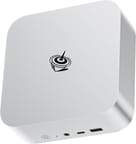 Beelink SER8 | Beelink SER8 | Beelink SER8 | |
| Price | List Price: $749.00 Amazon Prices: Loading prices... | List Price: $499.00 Amazon Prices: Loading prices... | List Price: $599.00 Amazon Prices: Loading prices... |
| Version | 32GB/1TB/AMD Ryzen 7 8845HS | 32GB/1TB/AMD Ryzen 7 8745HS | 24GB/1TB/AMD Ryzen 7 8745HS |
| Performance Rating | 9.0 | 9.1 | 8.9 |
| Operating System | Windows 11 Pro | Windows 11 Pro | Windows 11 Pro |
| Processor | Octa-core 3.80 Ghz (max 5.10 Ghz) AMD Ryzen 7 8845HS | Octa-core 3.80 Ghz (max 4.90 Ghz) AMD Ryzen 7 8745HS | Octa-core 3.80 Ghz (max 4.90 Ghz) AMD Ryzen 7 8745HS |
| GPU | Integrated AMD Radeon 780M | Integrated AMD Radeon 780M | Integrated AMD Radeon 780M |
| RAM | 32 GB | 32 GB | 24 GB |
| Internal Storage | 1 TB | 1 TB | 1 TB |
| Dimensions width x length x thickness | 5.31 x 5.31 x 1.97 inches (134.87 x 134.87 x 50.04 mm) | 5.31 x 5.31 x 1.97 inches (134.87 x 134.87 x 50.04 mm) | 5.31 x 5.31 x 1.97 inches (134.87 x 134.87 x 50.04 mm) |
| Weight | unknown | unknown | unknown |
| WiFi | Wi-Fi 6 (802.11ax) | Wi-Fi 6 (802.11ax) | Wi-Fi 6 (802.11ax) |
| Bluetooth | Bluetooth 5.2 | Bluetooth 5.2 | Bluetooth 5.2 |
| Ethernet | 1 Ethernet port at 2.5 Gbps | 1 Ethernet port at 2.5 Gbps | 1 Ethernet port at 2.5 Gbps |
| HDMI | 1 Full-Size HDMI Port | 1 Full-Size HDMI Port | 1 Full-Size HDMI Port |
| DisplayPort | 1 DisplayPort (DisplayPort 1.4 supports up to 144Hz at 4K) | 1 DisplayPort (DisplayPort 1.4 supports up to 144Hz at 4K) | 1 DisplayPort (DisplayPort 1.4 supports up to 144Hz at 4K) |
| VGA | No VGA Ports | No VGA Ports | No VGA Ports |
| USB Ports | 2 USB 2.0, 2 USB 3, 1 USB 4, 1 USB-C USB-C is 4.0 and has Thunderbolt functionality | 2 USB 2.0, 2 USB 3, 1 USB 4, 1 USB-C USB-C is 4.0 and has Thunderbolt functionality | 2 USB 2.0, 2 USB 3, 1 USB 4, 1 USB-C USB-C is 4.0 and has Thunderbolt functionality |
| Thunderbolt Ports | 1 | 1 | 1 |
| OCuLink | No | No | No |
| Internal SATA Ports | No SATA ports | No SATA ports | No SATA ports |
| Card Reader | No Card Reader | No Card Reader | No Card Reader |
| Headphone Jack | combo | combo | combo |
| Fanless | No | No | No |
| VESA Mount | No | No | No |
| In the Box | Mini PC, Power Supply, User Manual | Mini PC, Power Supply, User Manual | Mini PC, Power Supply, User Manual |
| Expandability | Expandable to 64GB RAM and additional M.2 storage | Expandable to 64GB RAM and additional M.2 storage | Expandable to 64GB RAM and additional M.2 storage |
Related Mini PCs
-
 Beelink EQR6The Beelink EQR6 is a quiet, compact mini PC sold in several AMD configs (Ryzen 9 6900HX down to…
 -
 Beelink SEI14 Mini PCThe Beelink SEi14 runs Intel's Core Ultra 5 125H with Arc graphics, DDR5 (up to 96GB), and two PCIe…
 -
 ACEMAGICIAN AD08 Mini PCThe ACEMAGICIAN AD08 is a compact mini PC sold with Intel Core i9-11900H, i9-12900H, or i7-11700B…
 -
 ACEMAGIC AM08 Pro Mini PCThe ACEMAGIC AM08 Pro packs a Ryzen 9 6900HX, Radeon 680M, and 32GB of DDR5 into a sub-9-inch…
 -
 GEEKOM A7The GEEKOM A7 runs an AMD Ryzen 9 7940HS with Radeon 780M graphics in a 0.5-liter aluminum case,…
 -
 GEEKOM IT1 MegaCompact yet powerful, the GEEKOM IT1 Mega boasts up to 64GB DDR5 RAM, dual M.2 storage slots, Intel…
Specs and Cooling
The SER8 runs the 8-core Ryzen 7 8845HS (up to 5.1GHz) or the closely related 8745HS, both with Radeon 780M graphics, paired with 32GB of DDR5 and a 1TB NVMe SSD; RAM goes to 64GB and there is a second M.2 slot. Ports cover USB4, USB 3.2, HDMI 2.1, DisplayPort 1.4 (4K at up to 144Hz), and a 2.5GbE jack, with Wi-Fi 6 and Bluetooth 5.2 for wireless.
The headline is the cooling. The SER8 uses a vapor-chamber cooler in an aluminum chassis, and the reviewers below measured the result directly: it holds performance under load while staying near-silent, in the low-30s dBA, which is the trait that sets it apart from most mini PCs at this performance level.
What Reviewers Said About the Beelink SER8
Mark Pickavance from TechRadar praised the Beelink SER8 for its improved design and performance. He noted that the slightly larger case allowed for better cooling, resulting in near-silent operation. Pickavance highlighted the high-quality engineering, stating, “the enclosure’s engineering delivers styling and refinement that even Apple would admire.” However, he also pointed out that the price might be a bit high, suggesting it’s “about $50 too high by our reckoning.”
ETA PRIME focused on gaming and cooling, noting that “their new cooling system is working out quite well for 65 watts.” He tested several games and found performance solid for a mini PC, summing it up as “a very snappy system.”
Lawrence Systems’ review on YouTube focused on the SER8’s compatibility with various operating systems and its potential for future AI applications. If local AI is part of your plan, our guide to which Gemma 4 variant a mini PC can run maps a box like this to the right model size. Lawrence was impressed with the device’s out-of-the-box performance, stating, “I was shocked at how well it worked right out of the box.” He also praised the quiet operation and efficient heat dissipation, noting that “this thing is quiet” and “it seems to work well.”
Robtech singled out the noise levels, saying “this is finally a high-end Mini that is quiet enough for me,” and rated the rest highly: “performance is top-notch, and it doesn’t miss a beat.” His criticisms were the weak wireless and the missing VESA mount.
Mash IT zeroed in on the quiet-under-load behavior, saying that “being able to use this little computer on your desk, full tilt, right beside you, yet hardly hear any sound, is an impressive feat.” He also valued the USB-C power delivery.
PC Perspective’s YouTube review emphasized the SER8’s excellent build quality and performance. Sebastian Peak was impressed with the cooling system and low noise levels, noting, “32 dBA from about 18 inches away is excellent.” He praised the high-quality components and competitive pricing, concluding, “overall, this is a very well realized mini PC. And I can’t really fault it for anything.”
On Level1Techs, Wendell framed the Ryzen 7 8845HS “Hawk Point” as an incremental step over the 7000 series, with most of the gain in NPU-based AI acceleration rather than raw CPU, and praised the SER8’s Linux support, upgradability, and low power: “15 watts power usage would idle a desktop. I mean, that’s, it’s hard to beat that.” He measured DDR5 memory latency at 89ns out of the box (well under 100ns) with extensive BIOS tuning options, and called the fan-noise profile the best of any mini PC he had tested, a low hum rather than a high-pitched whine. His one knock was the SSD, which he found underwhelming.
The thread across all seven reviews is consistent: the SER8’s defining trait is quiet operation for its performance, on top of a solid aluminum build, with the recurring caveats being the price, the wireless performance, and the lack of a VESA mount.
One Owner Caveat Worth Knowing
There are too few owner ratings on Amazon to draw a meaningful average, and the listing pools the 8845HS and 8745HS configurations together, so this section skips a star score. One verified-buyer report is specific enough to flag, though: a buyer named Alforno documented that the Realtek audio output can be very low after the machine wakes from sleep, that the usual fixes did not help, and that a reboot was the only reliable way to restore normal volume. If you sleep and wake this box often, that quirk is worth knowing going in.
Conclusion
The SER8 makes the most sense if quiet matters to you. It is a fast 8845HS box with 32GB of DDR5, a 1TB NVMe SSD, USB4, and triple-display output, but the reason reviewers keep recommending it over similar mini PCs is the near-silent cooling in a solid aluminum case. It is a strong fit for a quiet home office or living-room desktop, light gaming and esports, content creation, and Linux use. Gamers cross-shopping it against Valve’s upcoming console can read our take on whether to wait for the Steam Machine or buy a mini PC now, which uses this exact box as a reference point.
Look elsewhere if you need high-end AAA gaming, more than one Ethernet port, an SD reader, a VESA mount, or fully fanless silence. The other things to weigh are the price (reviewers called it about $50 high) and the weak Wi-Fi. A box like the SER8 also makes a capable base for an offline AI survival computer. To compare it with other models, use Starry Hope’s Mini PC Comparison Chart.