
Bmax MaxMini B1 Pro
Updated on

The Bmax MaxMini B1 Pro is an ultra-budget, fanless mini PC for light, space-constrained use. It runs Intel’s Celeron N4000 with Intel UHD graphics, which is enough for web browsing, media playback, and basic office work but not much more. It pairs 8GB of soldered LPDDR4 with 128GB of eMMC storage (slower than an SSD) and runs Windows 11, with an M.2 2280 SATA slot if you want to add a faster drive. Connectivity is dual-band Wi-Fi 5, Bluetooth 4.2, Gigabit Ethernet, USB 2.0/3.0, a microSD reader, and both HDMI and VGA for old and new displays. The fanless design keeps it silent, which suits a media endpoint or a quiet desk.
Pros and Cons of the Bmax MaxMini B1 Pro
| Pros | Cons |
|---|---|
| Compact and lightweight design | Limited internal storage capacity |
| Silent, fanless operation | May struggle with intensive tasks |
| Lots of connectivity options | eMMC storage, slower than SSD |
| Pre-installed with Windows 11 | Not suitable for gaming or heavy graphics work |
| Expandable storage via M.2 SSD slot | Older Bluetooth 4.2 version |
| Dual-band Wi-Fi for better network performance |
Related Videos
Bmax MaxMini B1 Pro Comparison Chart
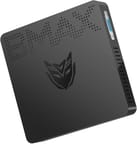 Bmax MaxMini B1 Pro | |
| Price | List Price: $119.99 Amazon Prices: |
| Version | 8GB/128GB/Intel N4000 |
| Performance Rating | 3.6 |
| Operating System | Windows 11 |
| Processor | Dual-core 1.10 Ghz (max 2.60 Ghz) Intel Celeron N4000 Processor |
| GPU | Integrated Intel UHD Graphics |
| RAM | 8 GB |
| Internal Storage | 128 GB eMMC |
| Dimensions width x length x thickness | 4.72 x 4.72 x 0.87 inches (119.89 x 119.89 x 22.1 mm) |
| Weight | 0.485 lbs (0.22 kg) |
| WiFi | Wi-Fi 5 (802.11ac) |
| Bluetooth | Bluetooth 4.2 |
| Ethernet | 1 Ethernet port at 1 Gbps |
| HDMI | 1 Full-Size HDMI Port |
| DisplayPort | No DisplayPort |
| VGA | 1 VGA Port |
| USB Ports | 2 USB 2.0, 2 USB 3 |
| Thunderbolt Ports | No |
| OCuLink | No |
| Internal SATA Ports | No SATA ports |
| Card Reader | microSD Card Reader |
| Headphone Jack | combo |
| Fanless | Yes |
| VESA Mount | Yes |
| In the Box | B1 Pro MINI PC, Power Adapter, User Guide, HDMI Cable, Metal Bracket |
| Expandability | M.2 2280 SSD Slot |
Related Mini PCs
-
 MeLE PCG02 ProThe MeLE PCG02 Pro Mini PC offers portability and silent operation, packing an Intel Celeron N5105,…
 -
 Bmax B3With the Bmax B3 Mini PC, multitask with ease using the Intel Celeron N5095, dual HDMI, and…
 -
 MeLE PCG02The MeLE PCG02 is an ultra-compact fanless PC stick powered by an Intel N100 processor. Its…
 -
 Bmax B2 PowerThe Bmax B2 Power delivers budget-friendly computing in an ultra-compact package. With its Intel…
 -
 MINIX Z100-0dBSilent and powerful, the fanless MINIX NEO Z100-0dB Mini PC packs an Intel N100 processor, 16GB…
 -
 WVX N100 Mini PCThe WVX N100 is a tiny fanless Intel N100 mini PC (4GB to 12GB of soldered RAM, up to a 512GB SSD)…
Detailed Information on the Bmax MaxMini B1 Pro
At roughly 300 grams and just 0.87 inches thick, the B1 Pro is small and light enough to sit behind a monitor on the included bracket. The fanless design keeps it silent and removes a common failure point.
The Celeron N4000 runs at 1.10 GHz base and boosts to 2.60 GHz. It is a dual-core, 6W Gemini Lake chip from 2017, energy-efficient but slow by current standards; the integrated Intel UHD graphics handle video streaming and basic tasks. The HDMI and VGA outputs cover both modern and legacy displays, and the USB 2.0/3.0 ports take everyday peripherals. The M.2 2280 SATA slot lets you add a faster drive beyond the 128GB of eMMC, which fills up quickly after Windows.
Reviewer Insights on the BMAX MaxMini B1 Pro
The major tech press has not put the MaxMini B1 Pro on a test bench. As of mid-2026 there is no TechRadar, Tom’s Hardware, or NotebookCheck review of it, and most of the written “reviews” that surface in search are auto-generated affiliate pages with no real testing behind them. What does exist is a small set of genuine hands-on YouTube videos, and they split along one line: what you ask the box to do.
The most pointed take comes from JayzTwoCents, who bought the unit for $109 and framed it as “a hundred and nine dollar all-in-one little thin client PC.” He read the chip off the device as “a Intel Gemini Lake N4000 Celeron processor” and was blunt about the class of machine: “this is like bottom of the bottom of the bottom.” His Windows 11 testing matched that framing. YouTube played back at 1080p and even 4K, but the desktop itself dragged under everyday clicks, and he closed with the verdict that “a hundred and nine bucks is a complete waste of money.” He also knocked the build, calling the plastic shell “like hollow.” No watt meter, thermal probe, or synthetic benchmark was run in the video; the criticism rests on real-time responsiveness, not measured figures.
A far more favorable read comes from Chase Brogan, who tested the same $99 box as a retro emulation machine rather than a daily Windows desktop. On that narrower job he called it “a phenomenal mini PC” for the price. Working through emulators, he reported that Nintendo 64, PlayStation 1, and Dreamcast each delivered a “really smooth gameplay experience,” and that “Sega Saturn actually worked pretty well.” The ceiling showed at the heavier systems: PlayStation 2 ran but with “little lags and delays that kind of pop up randomly,” and GameCube he “didn’t find to be a great experience,” noting “it’s playable but the audio is a little bit crunchy.” He agreed with the build criticism, observing that “the entire thing here is plastic” and that “it doesn’t feel terribly high quality.” His verdict was essentially the inverse of the Windows test: the same hardware that frustrates as a general-purpose desktop is fair value for light retro gaming.
A third hands-on look from Mini PC Tech treats it as a tiny set-and-forget Windows box. The reviewer said “I own five mini PCs” and called this one his “fave,” valuing the footprint above all: “this thing doesn’t even take up space on your desk.” He confirmed the practical basics on camera, that “it is a full Windows mini PC” with 8GB of memory, and that “you can pop in an SSD” through the bottom M.2 slot, but ran no benchmarks or thermal tests of his own.
The throughline is that nobody who actually used the machine measured power draw, heat, or noise, so this page does not quote figures that were never taken. What every reviewer agreed on instead is the chip. The Celeron N4000 is a Gemini Lake part Intel launched in late 2017, a dual-core, two-thread design rated at a 6W TDP. By 2026 that is roughly nine-year-old silicon sitting well below the Alder Lake-N (N100) and Twin Lake (N150) chips that now anchor the budget mini-PC shelf. That gap is the context for the split verdicts above: the B1 Pro stays competent at fixed, lightweight jobs (a media endpoint, an emulator front-end, a kiosk) and visibly strains the moment a modern Windows workload asks more of it.
Customer Reviews of the Bmax MaxMini B1 Pro
Across 9 ratings on Amazon, the Bmax MaxMini B1 Pro averages 3.9 stars, and the spread is genuinely mixed: about 57 percent of raters give it five stars while another 18 percent give it one star, so opinions sit at the extremes rather than in the middle. The buyers who are happy use it for light, low-stakes tasks. A verified buyer named chaos connected it to a TV in place of the built-in apps and reported that “it is enough to watch videos and do some office works,” and a verified buyer named V. Wires set one up to run an emulator in a public waiting room, valuing how small and unobtrusive it is: “This thing doesn’t even look like a computer.”
The negative reviews point at a real stability problem rather than vague disappointment, and they should not be glossed over. Chris Royce, installing Ubuntu to run a Plex server, hit repeated freezes during setup and then found that “the system will just completely lock up after idling for more than a few hours,” requiring a hard reset and time unplugged before it would power back on. Another verified buyer, rex, left a one-star review titled “How to return to didn’t work” after troubleshooting failed. If you plan to run this around the clock or under a Linux server load, weigh those lock-up reports; the lighter media and office use cases are where the five-star owners landed.
Read more owner reviews on Amazon.
Conclusion: Who Would Benefit from the Bmax MaxMini B1 Pro?
The Bmax MaxMini B1 Pro makes sense only as a cheap, silent box for fixed, light jobs: a media endpoint, a kiosk, or a retro-emulation front-end up to the PS1/Dreamcast era, ideally found at a low price. Its fanless design and HDMI-plus-VGA outputs suit a living-room or presentation setup, and the M.2 SATA slot lets you grow past the cramped 128GB eMMC.
It is the wrong machine for anything demanding: the 2017-era Celeron N4000 strains under a modern Windows desktop, gaming, or creative work, and owner reviews flag lock-ups under all-day or Linux-server use. Newer N100 and N150 boxes (such as the BMAX B4 Plus) cost a little more and run far better, which is worth weighing since every Amazon listing for the B1 Pro was showing as currently unavailable when checked. To compare current options, see Starry Hope’s Mini PC Comparison Chart.
Frequently Asked Questions
Can the Bmax MaxMini B1 Pro handle 4K video playback?
Yes, the Bmax MaxMini B1 Pro can handle 4K video playback, making it suitable for home theater setups and media centers.
What type of storage expansion options are available for this Mini PC?
The Bmax MaxMini B1 Pro comes with an M.2 2280 SSD slot, allowing you to upgrade the storage with a larger or faster M.2 SATA SSD if needed.
Does this Mini PC come with Windows 11 pre-installed?
Yes, the Bmax MaxMini B1 Pro ships with Windows 11 Pro pre-installed.
Is the RAM upgradable on the Bmax MaxMini B1 Pro?
The Mini PC comes with 8GB of RAM, which is hard-wired, meaning it is not user-upgradable. However, this amount of RAM should be sufficient for the device’s intended use.
What are the connectivity options for this Mini PC?
The Bmax MaxMini B1 Pro offers a variety of connectivity options, including USB 2.0 and 3.0 ports, HDMI, Ethernet, MicroSD, a headphone jack, VGA video output, dual-band Wi-Fi, and Bluetooth 4.2.
Is the Bmax MaxMini B1 Pro fanless?
Yes, this Mini PC is fanless, so it runs silently, which suits noise-sensitive environments.
Can I mount the Bmax MaxMini B1 Pro behind a monitor or TV?
The Bmax MaxMini B1 Pro supports VESA mounting, and it even includes a metal bracket in the box, making it easy to attach to the back of a monitor or TV.
What is the weight of the Bmax MaxMini B1 Pro?
The Bmax MaxMini B1 Pro weighs approximately 0.485 kilograms (1.07 pounds), emphasizing its portability and ease of installation in various settings.
Does this Mini PC support Ethernet connections?
Yes, the Bmax MaxMini B1 Pro has an RJ45 port that supports wired Ethernet connections up to 1 Gbps for reliable and fast internet access.