
Reatan Alloy 9
Updated on

The Reatan Alloy 9 is a compact AMD mini PC from the small brand Reatan, built around the Ryzen 9 7940HS (8 cores, Radeon 780M graphics) with 32GB of DDR5 and a 1TB NVMe SSD. It runs Windows 11 Pro and is aimed at productivity, creative work, and 1080p gaming on the integrated GPU, with the option to attach an external GPU over its USB4 ports, though Robtech saw an RTX 3070 eGPU bottlenecked, which he put down to limited USB4 bandwidth. Robtech found it one of the quietest high-end mini PCs he had tested in the default balanced mode; performance mode adds fan noise.
| Pros | Cons |
|---|---|
| 8-core Ryzen 9 7940HS with Radeon 780M | Pricey for a small brand with little support history |
| All-metal chassis with effective cooling; quiet in balanced mode | No barebones option; comes only fully configured |
| Dual USB4 (8K 60Hz out), dual HDMI, 2.5GbE | No VESA mount in the box |
| RAM to 64GB and two Gen 4 M.2 slots | Bundled SSD is a slower Gen 3 NVMe |
| 1080p gaming on the integrated GPU | BIOS offers only balanced and performance modes |
| Weak Wi-Fi and Bluetooth signal through the metal case (Team Pandory) | |
| Currently unavailable on Amazon |
Related Videos
Reatan Alloy 9 Comparison Chart
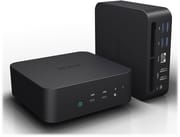 Reatan Alloy 9 | |
| Price | List Price: $759.00 Amazon Prices: |
| Version | 32GB/1TB/AMD Ryzen 9 7940HS |
| Performance Rating | 5.7 |
| CPU Mark | 29,700 |
| Operating System | Windows 11 Pro |
| Processor | Octa-core 4.00 Ghz (max 5.20 Ghz) AMD Ryzen 9 7940HS |
| GPU | Integrated AMD Radeon 780M |
| RAM | 32 GB |
| Internal Storage | 1 TB |
| Dimensions width x length x thickness | 4.61 x 4.14 x 1.85 inches (117.09 x 105.16 x 46.99 mm) |
| Weight | 1.25 lbs (0.57 kg) |
| WiFi | Wi-Fi 6E (802.11ax) |
| Bluetooth | Bluetooth 5.3 |
| Ethernet | 1 Ethernet port at 2.5 Gbps |
| HDMI | 2 Full-Size HDMI Ports |
| DisplayPort | DisplayPort over USB-C |
| VGA | No VGA Ports |
| USB Ports | 4 USB 3, 2 USB-C (2 USB4) (USB4 ports capable of 8K 60Hz video output and power input) |
| Thunderbolt Ports | No |
| OCuLink | No |
| Internal SATA Ports | No SATA ports |
| Card Reader | No Card Reader |
| Headphone Jack | combo |
| Fanless | No |
| VESA Mount | No |
| In the Box | Mini PC, manual, power supply, HDMI cable |
| Expandability | Dual M.2 Gen 4 slots, RAM upgradeable to 64GB |
See every AMD Ryzen 9 7940HS configuration in the chart
Related Mini PCs
-
 AOOSTAR MACOThe AOOSTAR MACO is a 5.9-inch aluminum mini PC with OCuLink, two USB4 ports, two 2.5GbE ports and…
-
 Beelink EQI13 PROThe Beelink EQI13 PRO pairs an Intel Core i7-13620H (10 cores, 16 threads) with 32GB of DDR4 and a…
-
 Beelink GTi14The Beelink GTi14 pairs an Intel Core Ultra (9 185H or 7 155H) and Arc graphics with up to 96GB…
-
 GEEKOM A7The GEEKOM A7 runs an AMD Ryzen 9 7940HS or Ryzen 7 7840HS with Radeon 780M graphics in a 0.5-liter…
-
 GEEKOM XT12 ProThe GEEKOM XT12 Pro is a compact aluminum mini PC with an Intel Core i9-12900H (or i7-12650H), 32GB…
-
 GMKtec NucBox K11The GMKtec NucBox K11 is a Ryzen 9 8945HS mini PC with Radeon 780M graphics, two DDR5 slots (96GB…
A small metal box with two USB4 ports and room to upgrade
At 4.61 x 4.14 x 1.85 inches and about 1.25 pounds, the case is small enough to sit beside a monitor and solid enough that it does not flex. Ports run to dual HDMI (4K at 60Hz), a Realtek 2.5GbE LAN port, four 10Gbps USB-A ports, and two USB4 ports that double as display outputs (up to 8K at 60Hz, per Robtech) and as power inputs. Wireless is Wi-Fi 6E (Team Pandory’s unit had an Intel AX210) and Bluetooth 5.3, though Team Pandory found the signal weak through the metal case; the Realtek 2.5GbE port covers wired networking.
Cooling comes from a larger fan and a heatsink with thermal pads, including a pad over the NVMe drive, and the BIOS exposes balanced and performance modes so you can trade fan speed for sustained clocks. Memory is DDR5 SO-DIMM and goes to 64GB, and there are two PCIe 4.0 M.2 slots for storage. The bundled drive is a slower Gen 3 NVMe, which leaves the faster of the two slots underused until you swap it, so budget for a Gen 4 drive if you care about load times.
Reviewer Insights
Robtech
Robtech titled his review “The BEST Mini PC I’ve Tested” and praised the Apple-like metal design and the 7940HS performance. He rated the CPU and graphics benchmarks highly and ran demanding games at workable frame rates. He found the bottom lid tricky to pry off without the suction cup Reatan supplied; after that, four screws release the heatsink to reach the two DDR5 SO-DIMMs and both M.2 slots. He listed the USB4 ports as rated for 8K at 60Hz and powered the PC from one of them. The BIOS has balanced and performance modes, and he recommended balanced, which made it one of the quietest high-end minis he had tested. His criticisms were the Gen 3 bundled NVMe, no barebones option, and no VESA mount; he also saw an RTX 3070 eGPU over USB4 reach only about 30 FPS at 1080p high with DLSS on, and said the bottleneck was likely the limited USB4 bandwidth.
Team Pandory
Team Pandory saw the CPU sit around 81C under load in the default mode while the system pulled around 95W from the wall. Switching the BIOS to performance mode raised the TDP to 65W and made the fan work harder, for lower temperatures and a bit more noise. In a Cyberpunk 2077 session the system stayed cool with no slowdown. He was impressed by the heatsink, which has thermal pads over the NVMe and direct fan airflow over the memory, and said the tall feet and wedge-shaped case should help keep it cool. He rated it strong for office work, creative tasks, and 1080p gaming, and compared it favorably to the Geekom A7, noting the A7’s metal feels a bit plasticky next to the Alloy 9. His main complaint was wireless signal: Wi-Fi measured only 50% strength through the metal case and Bluetooth controller connections were unreliable, so he used Ethernet and suggests a USB dongle for controllers. He also found the BIOS clunky and wished one of the four rear USB-A ports were on the front.
Verify any listing before you buy one
The Amazon listing that carried the Alloy 9 is currently unavailable, with no date for its return.
Search for the Reatan Alloy 9 (Ryzen 9 7940HS) by name, then read the title, the chip, and the memory on whatever listing comes back and confirm it is a new-condition unit before ordering. Reatan is a small white-label brand, so a listing that matches on brand alone is not enough.
A good box for someone comfortable with an obscure brand
Anyone buying for the silicon gets what they paid for. The 7940HS runs cool in a metal case you can open for more memory or a faster Gen 4 drive, and both reviewers praised the build and the cooling.
Reatan is a small white-label outfit with little support history, and its Amazon listing is currently unavailable. If you can find one in new condition, the machine behind it is good for the money. If you want assured support and a stable buy path, a 7940HS machine from a more established brand such as Beelink, GEEKOM, or Minisforum is the safer call. To compare options, use Starry Hope’s Mini PC Comparison Chart.
Frequently Asked Questions
What operating system does the Reatan Alloy 9 come with?
It ships with Windows 11 Pro preinstalled.
Can the RAM be upgraded?
Yes. The memory is DDR5 SO-DIMM and tops out at 64GB; Robtech reached it by prying off the bottom lid and removing a four-screw heatsink.
Does it have a dedicated GPU?
No. Graphics come from the integrated AMD Radeon 780M. For heavier graphics work you can attach an external GPU over one of the USB4 ports, though Robtech saw an RTX 3070 eGPU reach only about 30 FPS at 1080p high with DLSS on, likely limited by USB4 bandwidth.
What are the dimensions and weight?
It measures 4.61 x 4.14 x 1.85 inches and weighs about 1.25 pounds, small enough to share a desk with a monitor stand.
What wireless does it support?
Wi-Fi 6E and Bluetooth 5.3 are built in, alongside the 2.5GbE port for a wired connection. Team Pandory found the Wi-Fi signal weak through the metal case and Bluetooth controller connections unreliable.
How many and what type of ports are available?
Two USB4 ports capable of 8K 60Hz video output, two HDMI ports that support 4K 60Hz, a Realtek 2.5Gb LAN port, and four USB3 10Gb ports.
Is it fanless?
No. A fan works with the heatsink and thermal pads to hold the 7940HS steady, and the BIOS balanced mode keeps it quiet.
Can I mount it behind a monitor?
Not with what comes in the box, since no VESA mount is included. The compact case does sit easily on a desk or a media shelf.
What storage options does it have?
Two PCIe 4.0 NVMe M.2 slots, one of them filled with the bundled Gen 3 drive, so there is room to add capacity or replace it with a faster one.
Is the Reatan Alloy 9 good for gaming?
Yes at 1080p, which is where the Radeon 780M is comfortable and where Robtech ran demanding games at workable frame rates. Anything more demanding wants an external GPU over USB4, though Robtech saw an RTX 3070 eGPU bottlenecked, which he put down to limited USB4 bandwidth.