

If you’ve seen headlines screaming that ChromeOS is dying, take a breath. Yes, court documents from Google’s ongoing antitrust case confirm that ChromeOS has an expiration date. But the actual details tell a far more nuanced story than the clickbait suggests, and for most Chromebook owners, the practical impact is essentially zero for the better part of a decade.
Here’s what the court filings actually reveal, where the headlines go wrong, and what all of this means if you’re using a Chromebook right now or thinking about buying one.
What the Court Documents Say
The revelations come not from a Google product announcement but from legal filings in the U.S. Department of Justice antitrust case, where a federal judge ruled that Google holds an unlawful monopoly in web search. During remedy discussions about what to do about that monopoly, internal Google transcripts and legal arguments surfaced in reporting by 9to5Google that spell out Google’s plans for ChromeOS in unusually concrete terms.
The key facts: Google’s lawyers confirmed that the “timeline to phase out ChromeOS is 2034.” That date isn’t arbitrary. Google is legally and contractually obligated to maintain ChromeOS “at least through 2033 to meet its 10-year support commitment to existing users.” Once the last supported Chromebook reaches its end-of-life date, ChromeOS as we know it will be retired. The replacement, Aluminium OS, will be offered to “commercial trusted testers” in late 2026, with a full release not expected until 2028.
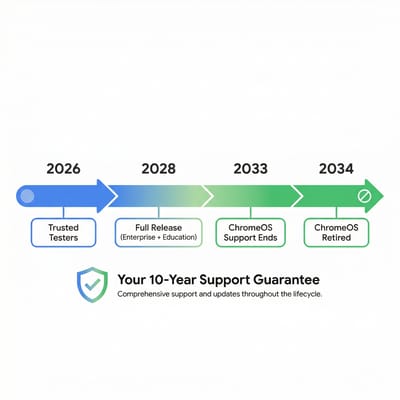
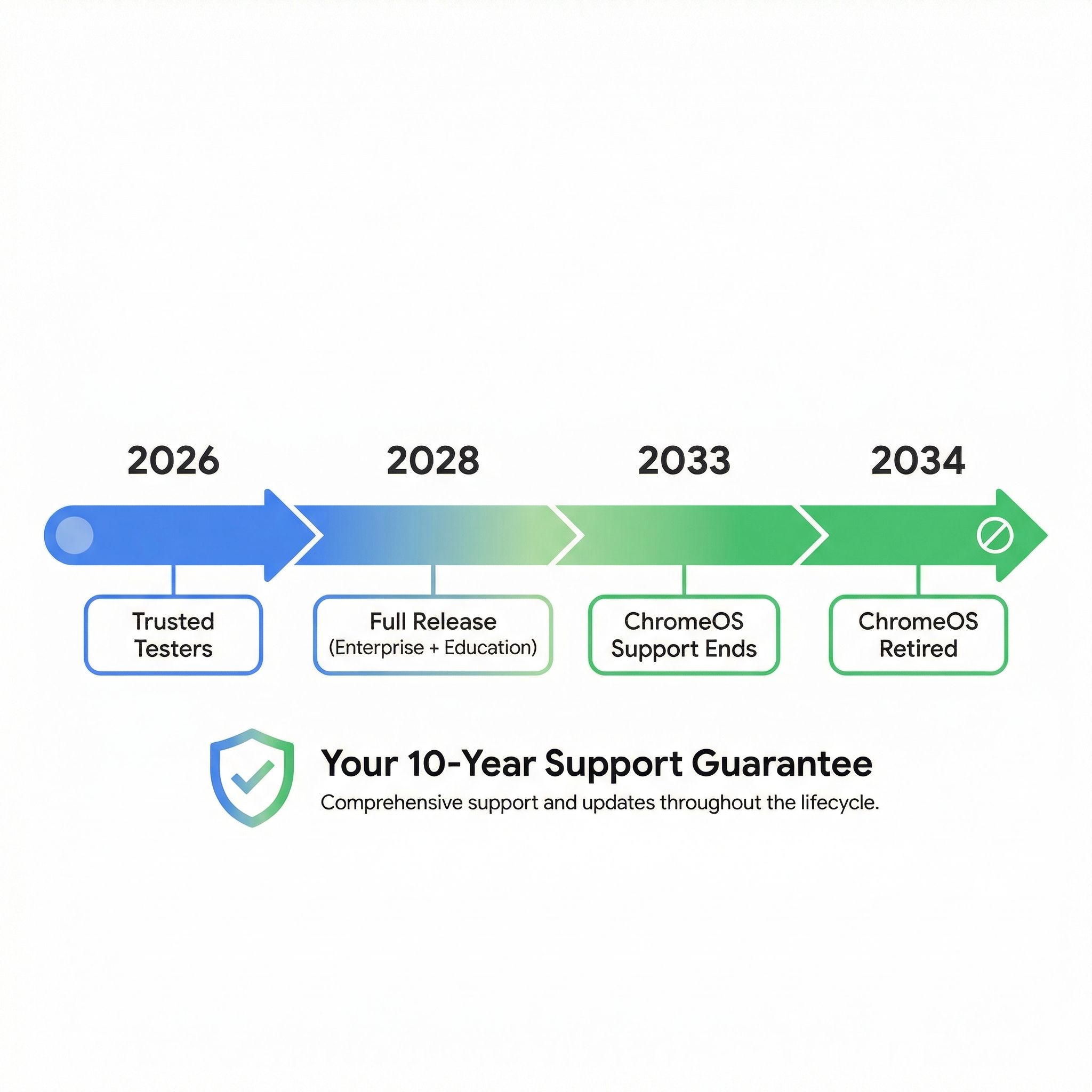
That last point is worth emphasizing because it contradicts Google’s own public messaging. At Qualcomm’s Snapdragon Summit in September 2025, Android Ecosystem President Sameer Samat said Google was “combining ChromeOS and Android into a single platform” launching in 2026. But according to the court transcripts, Samat only said Google hopes to launch Aluminium in 2026. The full release, including enterprise and education support, is two years behind what many people expected.
Why These Timelines Came from a Courtroom
It matters that these details emerged through adversarial legal proceedings rather than a carefully managed product announcement. Google’s lawyers had specific incentives during the antitrust case. They needed to argue that forcing Google to sell the Chrome browser would cause enormous disruption because of how tightly Chrome, ChromeOS, and the forthcoming Aluminium OS are intertwined. The longer and more complicated Google could make the transition sound, the stronger their argument for keeping Chrome.
That context matters when interpreting the timelines. Chrome Unboxed has noted that Google had legal reasons to paint a conservative picture. The 2028 full release date might represent a worst-case scenario presented to a judge, not necessarily Google’s internal target. The actual timeline could move faster. Or it could slip further. The point is that these are legal arguments, not product commitments, and they deserve a healthy dose of skepticism in both directions.
What we do know for certain is that Google is committed to supporting every existing Chromebook for its full 10-year lifecycle. That commitment predates the court case and has been repeatedly affirmed by Google VP John Maletis. Whether ChromeOS is retired in 2034 or some other year, your device’s guaranteed support window doesn’t change.
What This Means for Your Current Chromebook
Here’s the practical reality: if you bought a Chromebook in the last few years, nothing changes for you. Your device will continue receiving ChromeOS updates for its entire Auto Update Expiration (AUE) period, which extends 10 years from the hardware platform’s release. A Chromebook purchased in 2024 will receive updates through at least 2034. A device bought in 2026 will be supported until at least 2036, well past the proposed ChromeOS phaseout.
The “phased out” language in the court documents almost certainly means that Google will stop making new ChromeOS devices and stop developing new ChromeOS features, not that existing devices will suddenly lose support. Think of how Apple handles older iPhones: they don’t get the latest iOS version, but they continue receiving security updates for years after the last feature update.
For the roughly 242 Chromebook models currently on the market, the transition is designed to be invisible. If your hardware qualifies for Aluminium OS, you’ll eventually get it as an update. If it doesn’t meet the requirements, likely due to having less than 8GB of RAM or an older processor, you’ll stay on ChromeOS with continued security patches until your AUE date. We covered the hardware requirements and technical details of the Aluminium OS transition in January if you want the full breakdown.
The Antitrust Angle Nobody Is Talking About
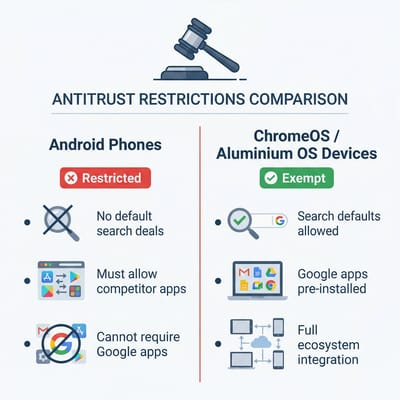
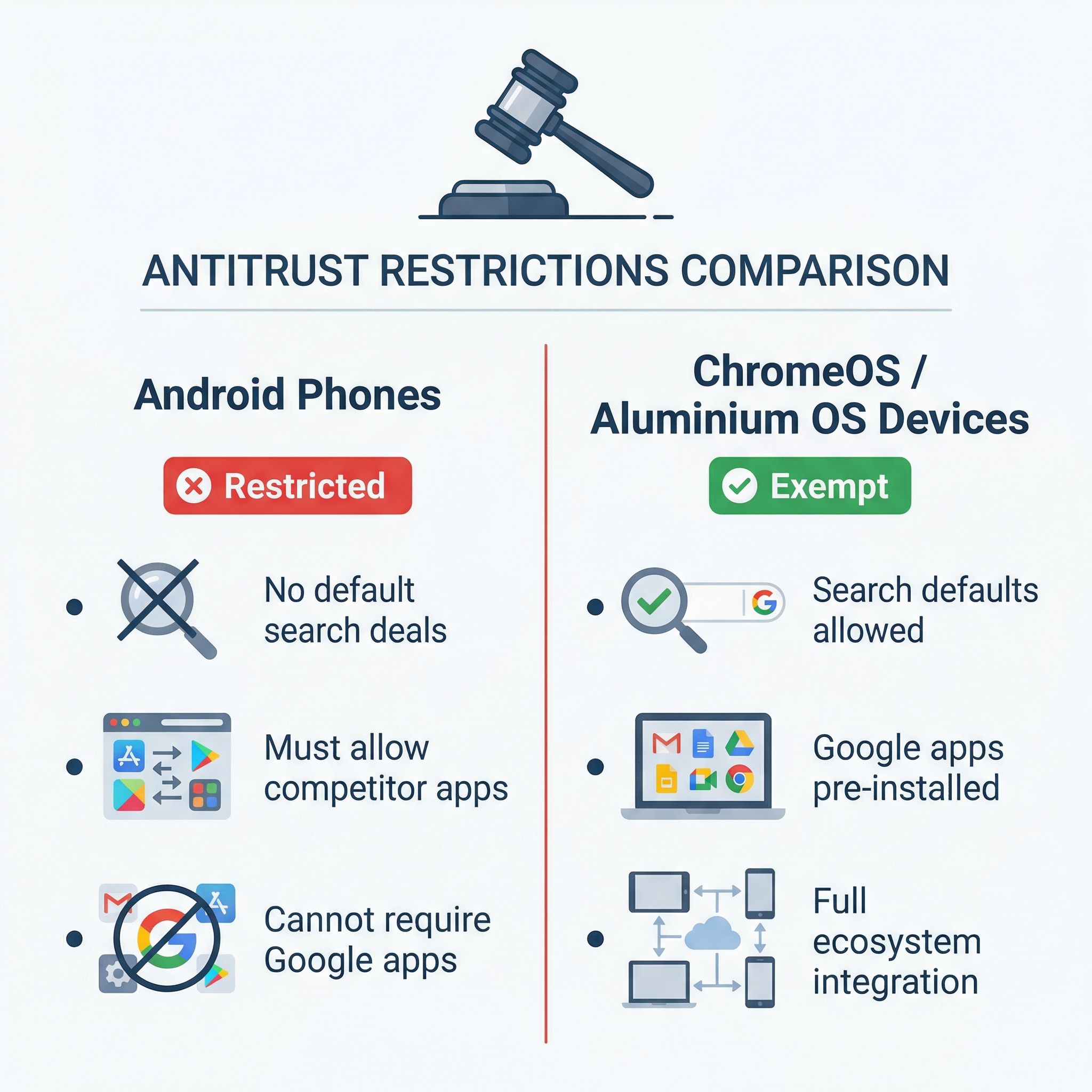
There’s a dimension to this story that most coverage has glossed over, and it’s arguably the most consequential detail in the entire court filing. Judge Mehta’s ruling restricts Google from making deals that prioritize or require Google apps on Android phones. But devices “on which the ChromeOS operating system or a successor to the ChromeOS operating system is installed” are explicitly exempt from those restrictions.
Read that again carefully. Aluminium OS is described in the court documents as “ChromeOS built on the Android stack.” If it qualifies as a ChromeOS successor, then Aluminium OS laptops and desktops could ship with Google Search locked in as the default, Google apps pre-installed without competitor alternatives, and Gemini deeply integrated at the system level. These are exactly the practices the court is trying to restrict on Android phones.
This exemption explains why Google fought so hard to retain Chrome during the antitrust proceedings and why ChromeOS’s continued existence, even with an expiration date, was legally valuable. It also means the Chromebook platform could become the one place where Google can freely bundle its entire ecosystem without antitrust constraints. Whether that’s good or bad for consumers depends on your perspective, but it’s a detail worth understanding as you evaluate the long-term direction of Chromebook hardware.
Should You Buy a Chromebook Right Now?
The court documents actually make the buying decision easier, not harder. With Aluminium OS confirmed as not fully ready until 2028 and ChromeOS guaranteed through at least 2033, buying a Chromebook today gives you a minimum of seven years of guaranteed ChromeOS support. That’s a longer runway than most people keep any laptop.
If you want the best chance of eventually upgrading to Aluminium OS, look for Chromebooks with at least 8GB of RAM, 128GB or more of storage, and a processor from 2021 or newer. Models like the Acer Chromebook Plus 516 GE or the Lenovo Chromebook Plus 14 OLED already meet those specs comfortably. But honestly, even if your Chromebook never gets Aluminium OS, the ChromeOS experience isn’t suddenly going to degrade. Google has every business incentive to keep millions of education and enterprise devices running smoothly through their support windows.
If you’re considering waiting for an Aluminium OS device, you’re looking at late 2026 at the earliest for consumer testers and likely 2028 or later for the kind of mature, widely available hardware that most people should buy. That’s a long time to go without a laptop, and the first generation of any new platform always has rough edges. The people who bought the first Chromebooks in 2011 can tell you about that.
What We Know Now That We Didn’t in January
When we wrote about the ChromeOS and Android merger in January, the timeline was still based on Google’s public statements at the Snapdragon Summit. The court documents have shifted the picture in three important ways.
First, we now have a concrete end date for ChromeOS. January’s article quoted Google VP John Maletis saying “ChromeOS isn’t going anywhere.” The court filings say it’s going somewhere specific: retirement in 2034. Both statements can be true simultaneously, ChromeOS isn’t going anywhere soon, but it does have a defined endpoint. Second, the full Aluminium OS release has been pushed from the implied 2026 timeframe to 2028. That gives Google two more years to get things right, which is arguably better for users than a rushed launch. Third, the antitrust exemption for ChromeOS successor devices wasn’t part of the public conversation in January and adds a significant new dimension to how we should think about the platform’s future.
None of this should cause panic. If anything, the court documents confirm what Google has been saying publicly: existing Chromebooks are fully supported, the transition will be gradual, and ChromeOS isn’t disappearing overnight. The 2034 date is eight years away. That’s longer than the entire lifespan of most laptops and longer than most people keep any single piece of technology. The Chromebook you buy today will almost certainly be replaced by choice long before ChromeOS stops receiving updates.


