
GMKtec NucBox 5
Updated on
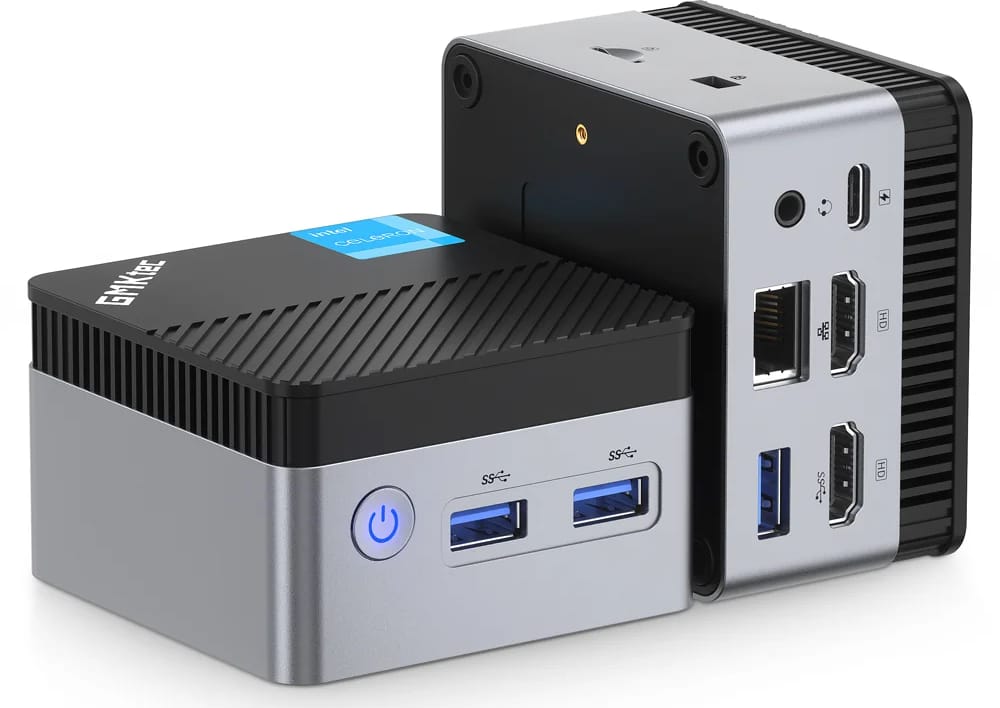
The GMKtec NucBox 5 is a tiny Intel Celeron N5105 mini PC, barely larger than a deck of cards, aimed at low-power everyday computing: media streaming, web and document work, and retro gaming. It ships with 8GB of soldered LPDDR4 and a 128GB M.2 SSD that you can swap for a larger drive. It drives two 4K displays at 60Hz over its dual HDMI 2.0 ports and has Wi-Fi 6 and Bluetooth 5.2. GMKtec now sells the same 72mm chassis as the NucBox G5S, with the closely related Celeron N5095 in place of the N5105.
Pros and cons
| Pros | Cons |
|---|---|
| Palm-sized and very low power (~18W max) | Entry-level N5105; not for demanding 3D games |
| Dual HDMI 2.0 for two 4K-at-60Hz displays | 8GB RAM is soldered (no upgrade) |
| User-replaceable M.2 SSD | Single small drive slot; tight on storage |
| Three USB 3.2, microSD, gigabit LAN, dual HDMI 2.0 | Has a fan (quiet, but not fanless) |
| Wi-Fi 6 and Bluetooth 5.2 | Stock Windows 11 feels heavy on this hardware |
| VESA mount support for tucking it behind a screen | Gigabit (not 2.5GbE) Ethernet |
Related Videos
GMKtec NucBox 5 Comparison Chart
 GMKtec NucBox 5 | GMKtec NucBox 5 | |
| Price | List Price: $129.99 Amazon Prices: | List Price: $229.99 Amazon Prices: Loading prices... |
| Version | 8GB/128GB/Intel N5105 | 8GB/128GB/Intel N5095 (G5S) |
| Performance Rating | 2.6 | 2.6 |
| Operating System | Windows 11 Pro | Windows 11 Pro |
| Processor | Quad-core 2.00 Ghz (max 2.90 Ghz) Intel Celeron N5105 | Quad-core 2.00 Ghz (max 2.90 Ghz) Intel Celeron Processor N5095 |
| GPU | Integrated Intel UHD Graphics | Integrated Intel UHD Graphics |
| RAM | 8 GB | 8 GB |
| Internal Storage | 128 GB | 128 GB |
| Dimensions width x length x thickness | 2.83 x 2.83 x 1.75 inches (71.88 x 71.88 x 44.45 mm) | 2.83 x 2.83 x 1.75 inches (71.88 x 71.88 x 44.45 mm) |
| Weight | 0.45 lbs (0.2 kg) | 0.45 lbs (0.2 kg) |
| WiFi | Wi-Fi 6 (802.11ax) | Wi-Fi 6 (802.11ax) |
| Bluetooth | Bluetooth 5.2 | Bluetooth 5.2 |
| Ethernet | 1 Ethernet port at 1 Gbps | 1 Ethernet port at 1 Gbps |
| HDMI | 2 Full-Size HDMI Ports | 2 Full-Size HDMI Ports |
| DisplayPort | No DisplayPort | No DisplayPort |
| VGA | No VGA Ports | No VGA Ports |
| USB Ports | 3 USB 3, 1 USB-C | 3 USB 3, 1 USB-C |
| Thunderbolt Ports | No | No |
| OCuLink | No | No |
| Internal SATA Ports | No SATA ports | No SATA ports |
| Card Reader | microSD Card Reader | microSD Card Reader |
| Headphone Jack | combo | combo |
| Fanless | No | No |
| VESA Mount | Yes | Yes |
| In the Box | GMKtec NucBox 5, power cable and adapter, user manual | GMKtec NucBox 5, power cable and adapter, user manual |
| Expandability | RAM not user-upgradable, storage expandable via M.2 slot | RAM not user-upgradable, storage expandable via M.2 slot |
Related Mini PCs
-
 GMKtec NucBox G3 ProThe GMKtec NucBox G3 Pro pairs a 2019-era Intel Core i3-10110U with two DDR4 slots that take up to…
-
 GMKtec NucBox G3The GMKtec NucBox G3 is a compact, low-power Intel N100 mini PC with DDR4 (a single SO-DIMM slot,…
-
 AWOW AK10The AWOW AK10 is an Intel N100 mini PC with 8GB of soldered DDR5, a 256GB SSD in an M.2 slot that…
-
 Beelink Mini SA compact Celeron N5095 mini PC with dual 4K HDMI outputs, a swappable M.2 SSD plus a 2.5-inch…
-
 Bmax B1 PlusThe Bmax B1 Plus is an ultra-budget mini PC on Intel's 2016 Celeron J3355, with 6GB of soldered…
-
 CHUWI HeroBox (2023)The CHUWI HeroBox (2023) is an Intel N100 mini PC with 8GB of LPDDR5, a 256GB M.2 drive, a 2.5-inch…
A soldered 8GB, one M.2 slot, and a full port set
The Celeron N5105 (Jasper Lake, up to 2.9 GHz) with Intel UHD graphics and 8GB of LPDDR4 is enough for web browsing, documents, and media, not heavy work. Storage is a single M.2 slot (a 2242 SATA drive ships, and the slot also takes NVMe), user-replaceable for a larger SSD, plus a microSD reader. Despite the size, the port set is full: three USB 3.2, a USB-C power port, two HDMI 2.0, gigabit Ethernet, and a 3.5mm jack, with Wi-Fi 6 and Bluetooth 5.2 for wireless. It ships with Windows 11.
It draws about 18 watts at most and plays back 4K video smoothly, which makes it a tidy home-theater PC, digital-signage box, or retro-emulation machine. Modern 3D gaming is beyond the Intel UHD graphics on this chip.
Reviewer Insights
Retro Game Corps: smooth 4K playback, PSP fully playable
Russ at Retro Game Corps liked the price-to-performance and walked the ports: “I love the fact that it has two USB ports here in the front, and then on the back we have dual HDMI ports, the USB-C charging port, headphone jack, gigabit ethernet, and then another USB 3.2 port.” He ran 4K playback and said it could likely serve as a Plex server, found it handled 2D games, indie titles, and emulation (PSP fully playable, about three quarters of GameCube at 60 frames per second, about half of PS2) but struggled with demanding 3D games, and was surprised by the cooling: “Surprisingly, the fan is super quiet.” His verdict was that the price-to-performance suited retro gaming and streaming.
Team Pandory found the G5S quiet but slow in Windows
Team Pandory tested the current G5S version (Celeron N5095) in Windows, games, and Batocera emulation, and took it apart. They measured about 7 watts at idle, just under 13 watts under load, and around 17 watts in a CPU and GPU stress test at about 77°C, with the fan still quiet. Windows felt slow at 4K but usable at 1080p, and a full malware scan took 12 hours and 57 minutes, which they put down to the SATA SSD. Emulation ran PSP at full speed, while demanding PS2 titles such as Gran Turismo 4 needed frame skip. Their verdict: “Most, if not all, components feel like they’ve been taken from 5 years ago, giving us ultimately a slow mini PC with poor value, especially in 2026.”
ETA Prime measured about 18 watts under full load
ETA Prime liked the tiny size and the snappy feel for browsing and video, and ran older games like Minecraft and Skyrim at adjusted settings plus emulation. He measured a maximum draw of about 18 watts under full load, and rated it a decent step up over earlier NucBox models for light gaming and emulation.
A lighter Linux gave RetroBreeze a noticeable boost
RetroBreeze focused on retro gaming and daily use, praising the size, low power, and quiet operation. He found stock Windows 11 heavy on the N5105 and got a noticeable boost from a lighter Linux OS (Zorin OS), and used it for Batocera retro gaming and a live video call without trouble.
The G5S is the current version of this box
GMKtec now sells this design as the NucBox G5S. It keeps the 72 x 72 x 44.5mm case, 8GB of soldered LPDDR4, the 128GB M.2 2242 SSD, dual HDMI 2.0, Wi-Fi 6, and Bluetooth 5.2, and swaps the Celeron N5105 for the Celeron N5095. Both are four-core Jasper Lake chips with Intel UHD graphics and a 2.9 GHz boost.
Best as a near-silent media and emulation box
The N5105 and 8GB of RAM cover media streaming, a home-theater or signage role, and retro emulation. The dual HDMI 2.0 outputs, gigabit Ethernet, and VESA mount make it easy to park behind a TV and leave alone.
The RAM is soldered at 8GB, and the single M.2 slot keeps storage tight until you fit a larger drive. Modern 3D gaming and heavy multitasking are out of reach; if you need either, look at a Ryzen or N150-class box instead. To compare it with other models, use Starry Hope’s Mini PC Comparison Chart.
Frequently Asked Questions
Can I upgrade the RAM in the GMKtec NucBox 5?
No. The 8GB of LPDDR4 is soldered to the motherboard, so it cannot be swapped or added to. That much memory covers everyday tasks and light gaming on the N5105.
Does the NucBox 5 support Wi-Fi 6 and Bluetooth 5.2?
Yes to both. Wi-Fi 6 handles the wireless networking, and Bluetooth 5.2 covers keyboards, mice, and headphones.
Can I connect multiple displays to the NucBox 5?
Two HDMI 2.0 ports each drive 4K at 60Hz, so a dual-4K-monitor setup works.
Is the storage expandable on the NucBox 5?
Yes. The single M.2 slot takes a 2242 drive, so swapping the shipped SSD for a larger one is the upgrade path when you run out of room for applications, games, or media.
What operating system does the NucBox 5 come with?
Windows 11 comes pre-installed. It sits heavy on the N5105, and a lighter Linux OS such as Zorin gave one reviewer a noticeable boost.
Is the NucBox 5 fanless?
No. A small fan does the cooling. RetroBreeze said it stays quiet and cool, and Retro Game Corps called it “super quiet.”
Can I use the NucBox 5 for gaming?
Light gaming and emulation work. Older titles and indie games run well, and emulation runs through PSP and most GameCube, with PS2 hit or miss. Demanding 3D games are beyond it.
Does the NucBox 5 have a VESA mount?
Yes. VESA mount support lets you attach it to the back of a monitor or TV and keep it off the desk.
What comes in the box with the NucBox 5?
The box holds the mini PC itself, a power cable and adapter, and a user manual.
What kind of tasks is the NucBox 5 suitable for?
Web browsing, document editing, media playback, and video calls all run comfortably. Streaming and retro emulation are its best uses; modern 3D gaming and heavy multitasking are not.