Listen to this article:
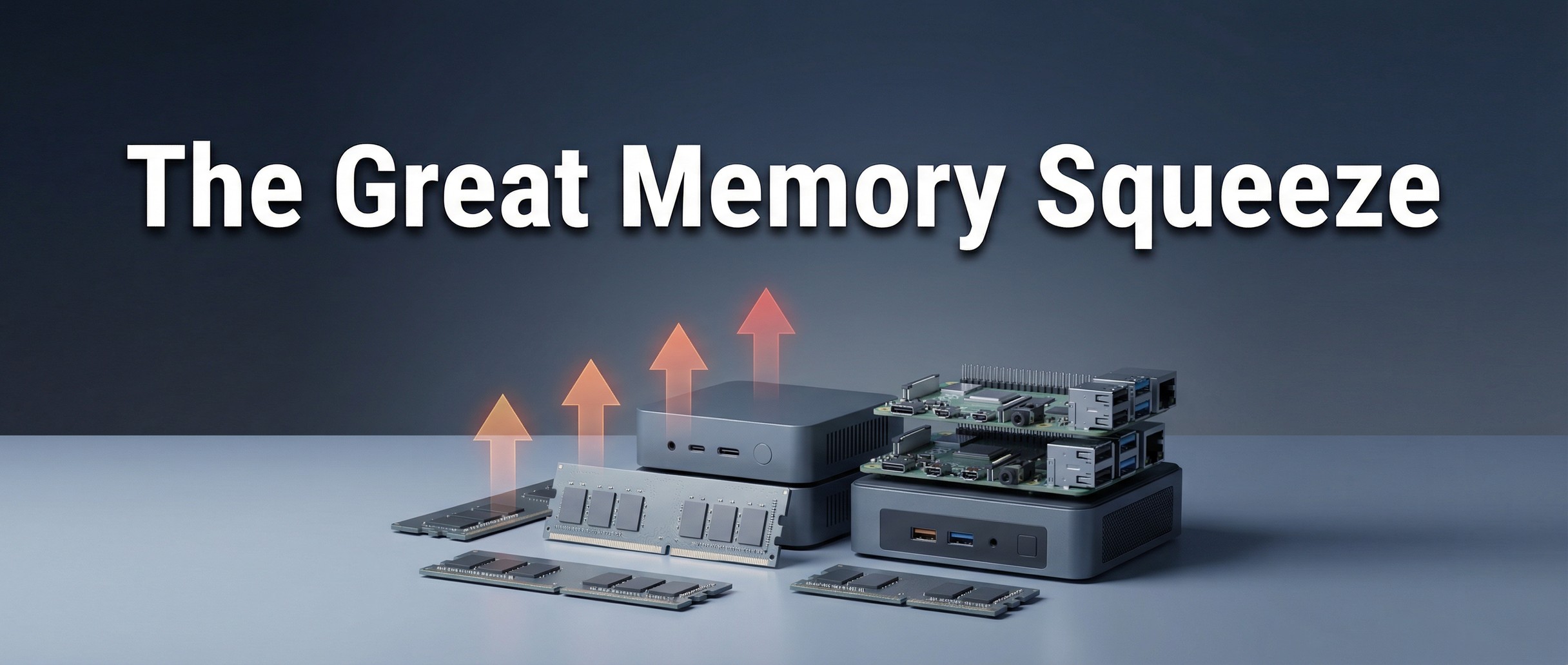
Something strange happened to the economics of home computing over the past year, and then it happened again. The Beelink S13, a modest Intel N100 mini PC that sold for $169 in August 2025, now commands $269 on Amazon. But that’s only half the story. As of January 2026, a fully-equipped GMKtec N100 mini PC and a comparable Raspberry Pi 5 setup both cost around $247. The culprit isn’t supply chain disruption or manufacturer greed. It’s memory, specifically the DRAM chips that every computer needs but nobody thinks about until prices jump 171% in twelve months.
This price convergence has created an unexpected situation in the home lab community: neither platform offers a clear budget advantage anymore. The math that once made single-board computers the obvious affordable choice, and later made N100 mini PCs the value kings, has been upended entirely. Both options now represent a significant investment, forcing hobbyists to make decisions based purely on use case rather than price. For many, the answer increasingly lies elsewhere: in the used hardware market.
The Memory Market Went Haywire
To understand how we got here, you need to follow the money flowing into AI infrastructure. Modern AI data centers consume staggering quantities of memory, both conventional DRAM for CPUs and the specialized high-bandwidth memory that lives on cutting-edge GPUs. When NVIDIA and its competitors started building out the infrastructure to power every company’s AI ambitions, they triggered a demand surge that the memory industry simply wasn’t prepared to meet.
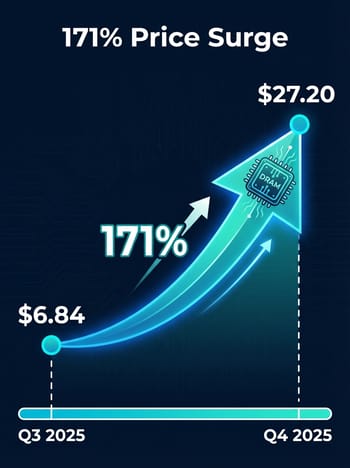
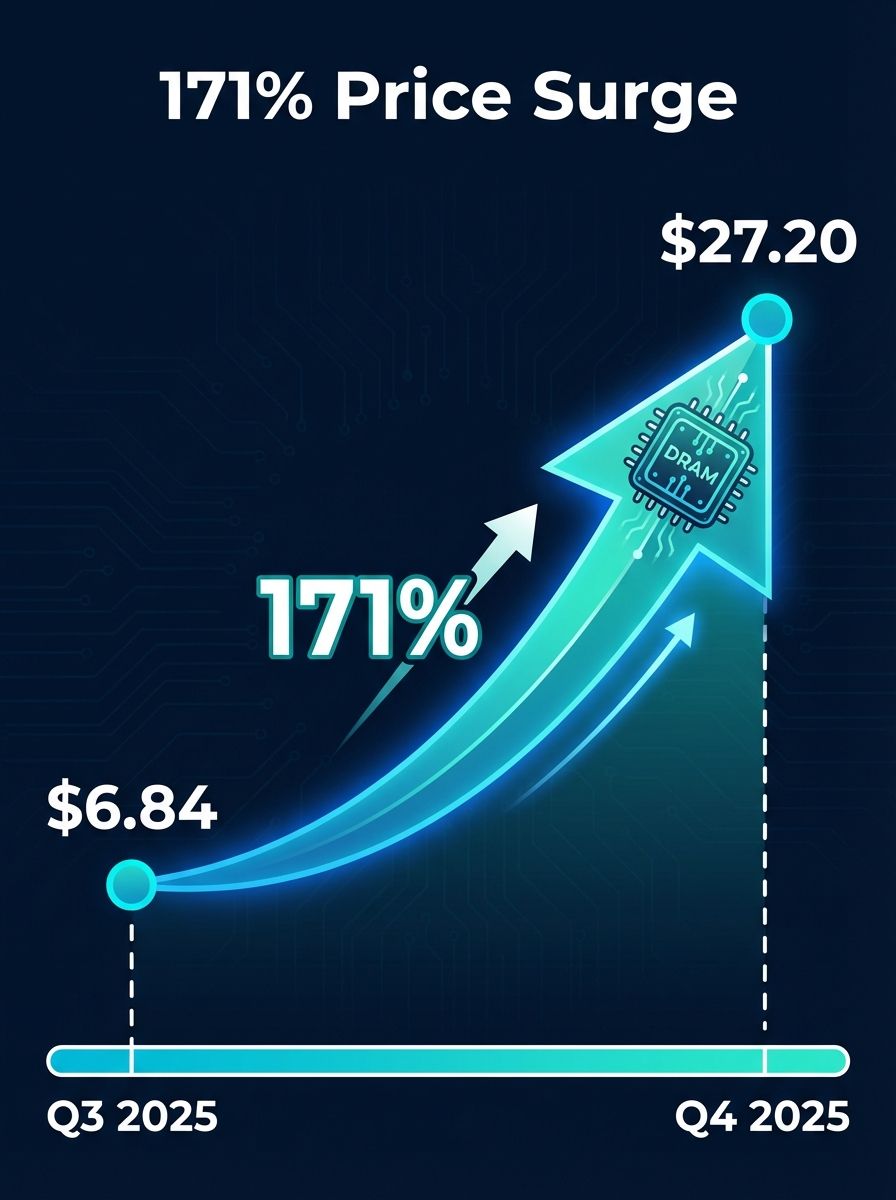
The numbers tell the story with brutal clarity. DRAM contract prices increased 171.8% year-over-year by the third quarter of 2025, a price increase that actually outpaced gold during the same period. In September 2025, a 16GB DDR5 chip traded at roughly $6.84. By late December, that same chip cost $27.20, representing a nearly 300% increase in just three months. Team Group’s general manager Gerry Chen warned that this crisis has “only just started,” predicting that DRAM and NAND prices could double within a single month during 2026.
The dynamics are straightforward, if painful. Memory manufacturers are shifting production toward datacenter-focused products because that’s where the profit margins are. Every chip destined for an AI server is a chip not going into your home lab mini PC. Goldman Sachs research suggests conventional DRAM prices could rise by double-digit percentages quarter-over-quarter throughout 2026, with normalization unlikely before 2027 or 2028 when new production capacity finally comes online. New semiconductor fabs require 2-3 years to bring online, meaning relief isn’t coming soon. And it’s not just data centers driving demand—consumer trends like developers running AI agents on dedicated mini PCs are adding pressure from the other end of the market.
For the home lab community, this translates into immediate sticker shock on both platforms. That 16GB of DDR5 in your mini PC, or the LPDDR4X in your Pi 5, represents a significantly larger portion of the total cost than it did a year ago.
The Price Convergence
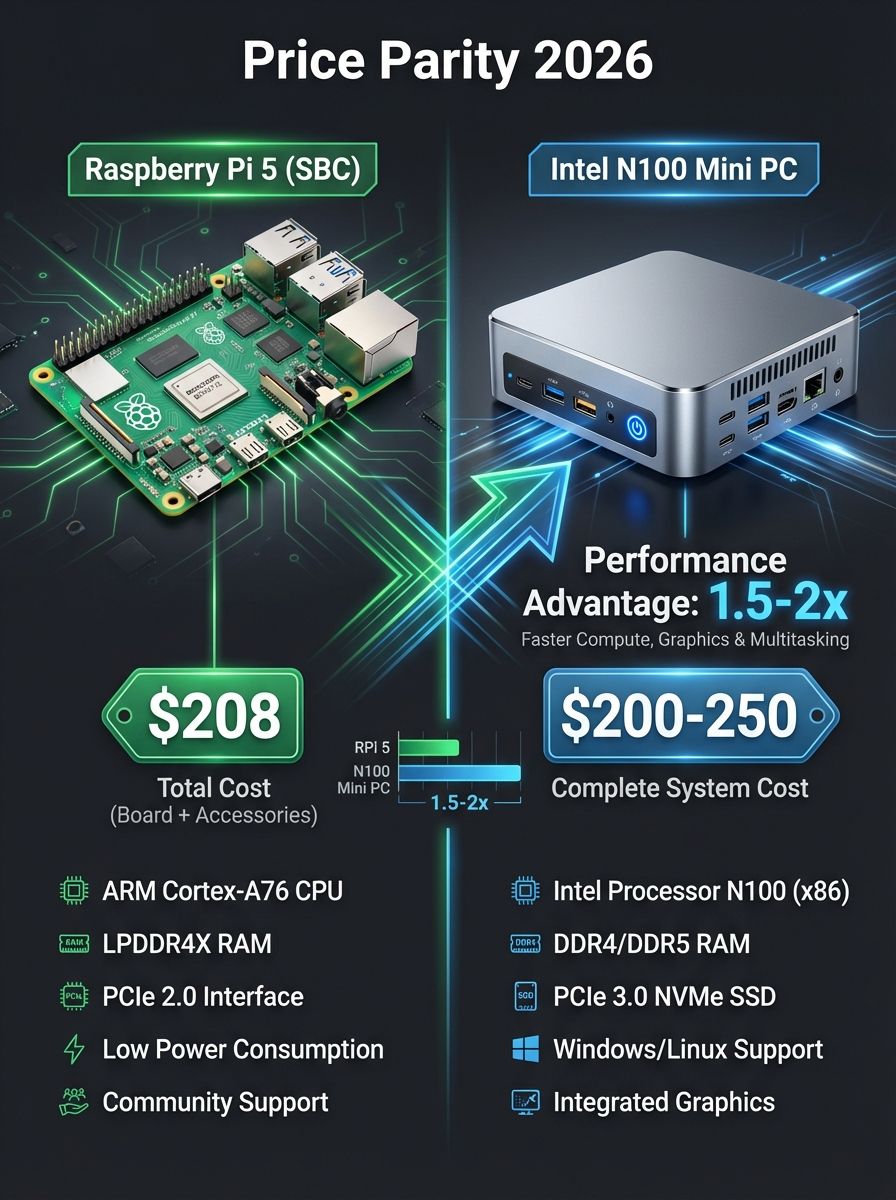
The journey to price parity has been remarkable to watch. In March 2025, Jeff Geerling published an analysis showing that a GMKtec N100 mini PC at $159 offered better value than a fully-equipped Raspberry Pi 5 at $208. His testing showed that an N150-equipped mini PC delivered 1.5 to 2x the performance of a Pi 5 across various benchmarks, with High Performance Linpack results nearly doubling. At the time, the N100 was the clear winner for anyone who could use x86 architecture.
Fast forward to January 2026, and the landscape has shifted dramatically. That same GMKtec N100 now costs $246.99. A comparable Raspberry Pi 5 setup with 16GB RAM and 512GB storage runs $246.95. The price difference that once made N100 mini PCs the obvious choice has evaporated entirely. Neither platform offers a budget advantage anymore.
The discussion on Hacker News following these revelations captured the community’s conflicted feelings. User wpm articulated why Intel mini PCs have advantages: genuine upgradeable storage and RAM, far superior video hardware with native M.2 support, standard x86 operating system compatibility—especially for running Linux—with real boot processes, and superior encoding capabilities. Another user, connorbrinton, described practical frustrations with the Pi 5’s removal of dedicated H.264 video encoding, which yielded only 2-3 frames per second in OBS, making it unsuitable for streaming applications that Pi 4 handled adequately.
The counterarguments focus on what mini PCs sacrifice. Tracker1 noted that some newer Beelink models now feature soldered RAM, eliminating the upgradeability that once distinguished them from single-board computers. Others raised security concerns about devices from lesser-known manufacturers, though as tonymet pointed out, even established brands have faced vulnerabilities. The RK3588 processors that some saw as alternatives have their own challenges, with bullen noting price escalation from $70 to $110 across batches while dahrkael observed that Rockchip’s software compatibility remains “very low” compared to Intel alternatives.
The Power Question Remains
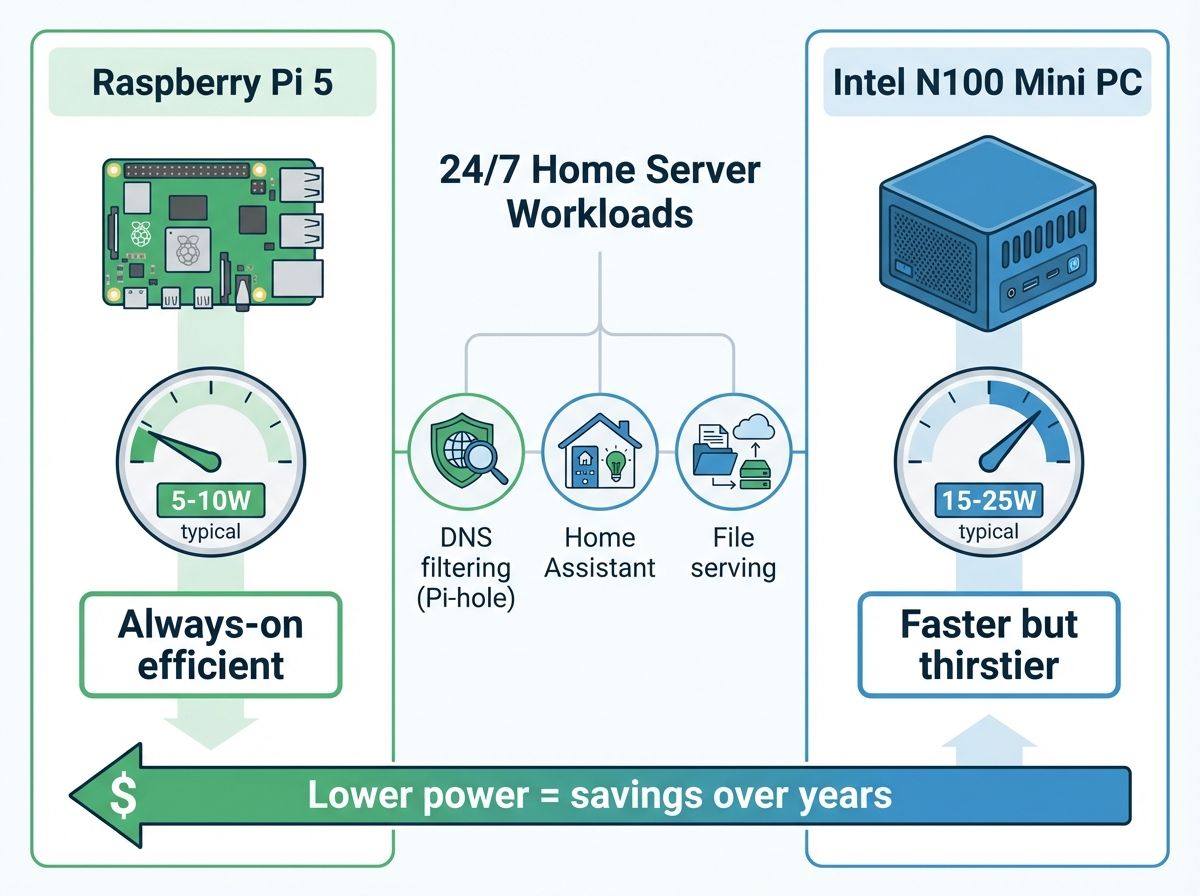
With prices now equal, the traditional argument for Raspberry Pi centered on power efficiency becomes more relevant, not less. A Pi draws a fraction of the wattage of even the most efficient Intel mini PC, which matters when the machine runs continuously as a home server. Over years of operation, that efficiency translates into real electricity savings.
Geerling’s earlier analysis calculated this difference at roughly $10 to $20 per year in power consumption. When the N100 cost $50 less upfront, that efficiency advantage didn’t matter much. But now that both platforms cost the same, that annual savings starts to add up over a multi-year deployment. For a five-year home server lifespan, power efficiency could represent $50 to $100 in total savings.
The efficiency calculation depends heavily on your use case. A Pi running Pi-hole for DNS filtering draws minimal power whether idle or under its light load. A mini PC serving as a media transcoding system or running multiple virtual machines spends more time under load, where power consumption differences grow. But if you’re running demanding workloads anyway, the mini PC completes them faster, potentially using less total energy to accomplish the same work despite higher peak consumption.
The honest assessment is that at equivalent price points, power efficiency now clearly favors the Pi 5 for always-on, light-duty workloads. If raw performance matters more than electricity costs, the N100 still wins on performance per dollar of hardware, but not by enough to ignore the running costs.
The Year of Used Hardware
If you’re planning a home lab build in 2026, the decision framework has fundamentally changed, but perhaps not in the way you’d expect. Geerling’s latest analysis concludes that “the theme of 2026 is going to be repurposing used hardware.”
When both new platforms cost nearly $250, the used market suddenly looks far more attractive. A used Lenovo ThinkCentre Tiny or Dell OptiPlex Micro from a few generations back might offer the best value of all. These machines often sell for $50 to $100 depending on configuration and condition, with proven reliability, standard x86 compatibility, and all the benefits of enterprise-grade build quality.
For those committed to new hardware, Geerling suggests exploring lower-spec alternatives. The Mac Mini M4 sidesteps commodity DRAM pricing since its unified memory cost is locked in at manufacture rather than tied to upgradeable SO-DIMM modules, though at a higher starting price. The Raspberry Pi Zero 2W at $15 offers limited but real capability for specific use cases. Various Pi clones provide alternatives at different price points, though with varying levels of software support and community resources.
For dedicated, always-on services that benefit from ARM efficiency and compact form factors, the Raspberry Pi 5 makes sense if you can justify the cost. Pi-hole, Home Assistant, small file servers, and similar workloads play to the Pi’s strengths. The ecosystem of cases, HATs, and accessories designed specifically for the Pi platform adds value that mini PCs don’t match.
For home labs that need to run virtual machines, Docker containers at scale, Windows compatibility, Linux development workflows, or any workload that benefits from x86 architecture and raw performance, the N100-class mini PCs remain capable choices. The Beelink Mini S13 and similar models deliver performance that’s excellent for the architecture, even if the price no longer reflects a budget option. You can compare current specs and pricing across models in our mini PC comparison chart.
The Uncomfortable Reality
Memory analysts expect prices to continue climbing through mid-2026, with a significant downward correction unlikely before late 2027. TrendForce’s investigations reveal that smartphone and notebook brands are already raising product prices and reducing specifications in response to memory costs, a pattern that will inevitably continue affecting both the mini PC and single-board computer markets.
This means any decision you make today about home lab hardware will be made at historically high memory prices. Waiting for prices to drop isn’t practical when normalization is potentially two years away. The pragmatic approach is to accept current pricing as the new baseline and choose hardware based on your actual needs, or look to the used market where the memory was purchased before prices spiked.
The Raspberry Pi Foundation has responded by introducing a 1GB Pi 5 variant to maintain a sub-$50 entry point, though as Geerling notes, this offers “limited” usefulness for most home lab applications. It’s a recognition that the traditional Pi value proposition has been severely compromised by forces outside anyone’s control.
For the home lab community, this moment represents a forced evolution. The assumptions that guided builds for the past decade need updating yet again. Price sensitivity no longer clearly favors either new platform. The community is adapting by looking backward to used enterprise hardware, sideways to specialized lower-cost boards, and forward to whenever memory prices finally normalize.
The old question was simple: which platform gives you more for less? The new question is more honest: is new hardware worth it at all right now, or should you be haunting eBay for last-generation ThinkCentres? For many builders in 2026, the answer to that question won’t involve either a Pi 5 or an N100.