
UGREEN NASync DXP4800 GT
Published on

The UGREEN NASync DXP4800 GT is a four-bay NAS for video editors, homelab owners, and small offices that need fast network storage. It has two 10GbE ports, so two workstations can each get a full 10GbE link, or a managed switch can aggregate both. Its AMD Ryzen Embedded R2514 takes ECC memory modules; UGREEN’s Intel-based models have only the on-die error correction built into DDR5. The 8GB module in the box is standard non-ECC memory, so ECC protection means buying new modules. UGREEN launched it in June 2026 at $659.99.
Pros and Cons
| Pros | Cons |
|---|---|
| Two 10GbE ports on the board | The M.2 slots run at PCIe 3.0 x2, which caps SSD speed |
| ECC SO-DIMM support, up to 64GB across two slots | The included 8GB module is not ECC, and one module runs single-channel |
| Bays 1 and 2 also take U.2 NVMe SSDs | UGOS Pro cannot encrypt whole volumes, only individual shared folders |
| Radeon Vega graphics transcode H.264 and H.265 in hardware | The OS lives on a 64GB eMMC, which makes TrueNAS or Unraid installs harder |
| Metal case with a magnetic dust filter and a quiet fan | UGOS Pro trails Synology DSM in apps and backup features |
| SD card reader and 10Gbps USB-C and USB-A on the front | The Ryzen R2514 is a 2022 embedded chip with a PassMark score near 6,700 |
UGREEN NASync DXP4800 GT Comparison Chart
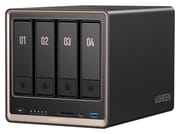 UGREEN NASync DXP4800 GT | |
| Price | List Price: $559.99 Amazon Prices: Loading prices... |
| Version | 8GB, diskless |
| Drive Bays | 4 x 3.5-inch SATA (2.5-inch compatible) 2 x U.2 NVMe (Bays 1-2 take U.2 in place of SATA (PCIe 3.0 x4)) Hot-swap, tool-less trays |
| M.2 Slots | 2 x M.2 NVMe, cache or storage pool PCIe 3.0 x2 each, M.2 2280 |
| Max Raw Capacity | 128 TB |
| Included Drives | None (diskless) |
| System Drive | 64GB eMMC |
| Processor | Quad-core 2.10 Ghz (max 3.70 Ghz) AMD Ryzen Embedded R2514 |
| Hardware Transcoding | Yes (Radeon Vega graphics: H.264 and H.265) |
| RAM | 8 GB DDR4 SO-DIMM Max 64 GB, 2 slots Ships with one non-ECC DDR4-3200 module |
| ECC Memory | Yes (ECC SO-DIMM) |
| Network Ports | 2 x 10GbE RJ45 |
| PCIe Slot | No |
| Expansion Unit | None |
| Operating System | UGOS Pro |
| Third-Party OS | Yes (The 64GB eMMC system drive makes other OS installs less straightforward) |
| File Systems | Btrfs, ext4 |
| USB Ports | 2 USB 3, 1 USB-C Front: USB-C and USB-A 10Gbps. Rear: USB-A 10Gbps, 2x USB 2.0 |
| Thunderbolt Ports | No |
| HDMI | 1 |
| WiFi | No |
| Idle Power | 25 W (Drives in sleep mode; 40-42W in normal operation) |
| Load Power | 60 W (Full load, measured) |
| Power Supply | 150W external |
| Noise | 38 dB (In operation, measured) |
| Dimensions width x length x thickness | 7 x 10.1 x 7 inches (177.8 x 256.54 x 177.8 mm) |
| Weight | 8.36 lbs (3.8 kg) |
| Released | June 2026 at $659.99 |
| In the Box | Main unit, 150W power adapter, 2x Cat7 cables, HDMI cable, U.2 heatsinks, thermal pads, screws, screwdriver, keys. |
| Expandability | RAM to 64GB (2x SO-DIMM, ECC supported). 2x M.2 2280 PCIe 3.0 x2. U.2 in bays 1-2. No PCIe slot. |
Drive bays, memory, and ports

The DXP4800 GT measures about 10.1 x 7 x 7 inches in a dark gray metal case with bronze trim around the front. The four SATA bays take 3.5-inch drives up to 32TB each, or 128TB raw, and UGREEN’s 144TB figure adds two 8TB M.2 SSDs. Bays 1 and 2 also accept U.2 NVMe SSDs at PCIe 3.0 x4. A U.2 drive replaces the SATA drive in that bay rather than adding a fifth drive, and UGREEN includes U.2 heatsinks in the box.
The two M.2 2280 slots work as an SSD cache for the hard drive pool or as their own storage pool for Docker containers and virtual machines. They connect at PCIe 3.0 x2, which limits each SSD to about 2GB/s, against about 8GB/s for a PCIe 4.0 x4 slot. The operating system lives on a separate 64GB eMMC chip, which keeps the bays free for data but is not a drive you can swap out.
Memory is 8GB of DDR4-3200 in one of two SO-DIMM slots, expandable to 64GB. The platform supports ECC memory, but the included module is a standard non-ECC stick, so error correction means buying and installing ECC modules yourself. With only one module installed, memory runs in single-channel mode; a second module fixes that.
The front panel has a 10Gbps USB-C port, a 10Gbps USB-A port, and an SD 3.0 card reader. The back has the two 10GbE RJ45 ports, a second 10Gbps USB-A port, two USB 2.0 ports, and an HDMI port with 4K output. There is no PCIe slot, no Thunderbolt, and no Wi-Fi. Reaching 10GbE speeds also takes a 10GbE adapter in the client computer and a 10GbE switch or a direct cable.
Ryzen R2514 performance, power, and noise

The Ryzen Embedded R2514 is a four-core, eight-thread embedded chip from AMD’s 2022 R2000 series with a 3.7GHz boost clock. Its PassMark CPU Mark is about 6,700, below the Core i3-1315U in UGREEN’s DXP4800 Pro at about 11,200. That is enough for file serving, Docker containers, and a small virtual machine, and the integrated Radeon Vega graphics transcode H.264 and H.265 video for Plex and Jellyfin. Heavy virtual machine hosts need a faster chip. Plex needs a Plex Pass subscription for hardware transcoding; Jellyfin does it for free.
PCWorld measured 25 watts at idle with the drives in sleep mode, 40 to 42 watts in normal operation, and 60 watts under full load. It measured 38dB(A) of noise during operation. NASCompares recorded about 25 watts with empty bays, about 45 watts with drives installed, and peaks of about 70 to 77 watts. The unit runs on a 150W external power adapter.
In PCWorld’s file-copy test, the NAS wrote large files at an average of 340MB/s and read them at 430MB/s, and it copied 20,000 small files at 65MB/s.
Reviewer Insights
PCWorld
Christoph Hoffmann and Michael Rupp at PCWorld gave it an Editors’ Choice award in September 2026. On the processor: “The Ryzen Embedded R2514 offers plenty of headroom for containers and a virtual machine without exceeding reasonable power consumption limits.” They praised the metal chassis, the magnetic dust filter, and the quiet fan, and wrote, “The build quality and choice of materials are on a par with significantly more expensive devices.” The review calls the missing full-volume encryption the most notable shortcoming; UGOS Pro can encrypt individual shares only.
NASCompares
“The DXP4800GT feels less like a minor variation of the DXP4800 range and more like a separate performance-focused branch of it,” wrote NASCompares, which gave it 8.4 out of 10. The review could not test U.2 drives. It marked the unit down for the eMMC system storage, which makes third-party OS installs harder, for power use above lighter NAS units, and for software that still lacks features such as WORM support. The verdict: “If you want dual 10GbE, AMD hardware, U.2 potential, and a modern 4-bay NAS that feels genuinely different from the usual options, this is a very strong release.”
TechRadar
Alastair Jennings at TechRadar edited video straight off the NAS over 10GbE: “The 10GbE upgrade made a huge difference to the speed and smoothness of the edit; it was, in effect, like running the files from a direct-attached storage device.” He rated it 5 out of 5, gave it an Editor’s Choice award, and called it “the best-value 4-bay NAS with 10GbE networking that I have seen yet.” He also warned that dual 10GbE may mean buying a new switch, and that UGREEN’s AI features only cover Photos.
AppleInsider
The streaming test at AppleInsider pushed six 4K60 HDR streams to Apple TV units over a wired 10GbE network, and Mike Wuerthele added, “I managed five when transcoding, which is still incredible.” He rated it 4.5 out of 5 in June 2026 and pointed out that “It also brings dual 10GbE networking and U.2 SSD support to the DXP family for the first time, at a low price, compared to some other models that support the technologies.”
Dong Knows Tech
Dong Ngo at Dong Knows Tech gave it 8.1 out of 10: “There’s little to complain about the NASync DXP4800 GT. It’s a good-looking, robust server that has everything to justify its sensible $659.99 price tag (before discount), and then some.” His cons include no flexible RAID and no easy way to migrate storage from one server to another.
NotebookCheck, TweakTown, and How-To Geek
NotebookCheck reviewer Abhinav Fating wrote, “Ultimately, the Ugreen NASync DXP4800 GT is a fantastic 4-bay NAS that delivers in both performance and cost,” and listed single-channel RAM, no Thunderbolt 4, and the PCIe Gen 3 x2 M.2 slots as cons. TweakTown scored it 88 percent: “With excellent network performance even on hardware below its 10GbE limits and easy installation, there’s a lot to like about the UGREEN NASync DXP4800 GT.” It also found UGREEN’s app discovery temperamental. Patrick Campanale at How-To Geek scored it 9 out of 10 and wrote, “This NAS also has way better I/O than I expected at this price,” while noting that remote access and file sharing apps are not as mature as Synology Drive.
Customer Reviews
On Amazon, the DXP4800 GT holds 4.6 out of 5 stars from 63 ratings, with 85 percent five-star and 4 percent one-star. John yuh keeps it on 24/7 as a home lab server with Plex, a VPN download setup, and a Windows VM: “UGOS Pro is easy to start with, and its Docker support is where this NAS really shines.” Jason Coon still runs a Synology DS1621+ but is done buying Synology: “Rock solid, and I love that I can use any brand of HDD.”
After moving from another brand’s NAS, shutterspeed1000 found the DXP4800 GT stable and fast. The backup app was the problem: “The only weakness I’ve found is the backup application, which needs work to match competing solutions.”
Who the DXP4800 GT suits
The DXP4800 GT fits a creator or small office that edits video over the network, a homelab that runs Docker containers and a virtual machine, and anyone who wants ECC memory or U.2 drives in a four-bay box. It needs 10GbE gear on the other end to show its main advantage. Buyers who depend on full-volume encryption or first-party backup tools will find Synology’s DSM more complete; the UGREEN vs Synology comparison covers those tradeoffs.
Frequently Asked Questions
Does the UGREEN DXP4800 GT come with ECC memory?
No. The Ryzen Embedded R2514 supports ECC SO-DIMMs, but UGREEN ships the DXP4800 GT with a standard non-ECC 8GB DDR4 module. To get ECC protection, buy compatible ECC modules and install them yourself.
Can the DXP4800 GT transcode video for Plex or Jellyfin?
Yes. Its integrated Radeon Vega graphics transcode H.264 and H.265 video in hardware. Plex needs a Plex Pass for hardware transcoding; Jellyfin does not.
What do the U.2 bays on the DXP4800 GT do?
Bays 1 and 2 accept U.2 NVMe SSDs at PCIe 3.0 x4 as well as SATA drives. A U.2 drive takes the place of the SATA drive in that bay, so the unit still holds four drives in total, plus the two internal M.2 SSDs.
How much RAM does the DXP4800 GT support?
Up to 64GB of DDR4 across two SO-DIMM slots. It ships with one 8GB module and one free slot, and adding a second module also moves memory from single-channel to dual-channel.
How much power does the DXP4800 GT use?
PCWorld measured 25 watts at idle with the drives asleep, 40 to 42 watts in normal operation, and 60 watts under full load.