

A year ago, a K-12 IT administrator could order a Dell Chromebook 3120 with 8GB of RAM and 64GB of storage for around $250. Today, that same configuration costs $400. In another thread on r/k12sysadmin, an administrator warned colleagues that manufacturers had communicated price increases of roughly 50% within 60 days, adding that the impact on their district’s planned summer refresh would exceed half a million dollars. These aren’t isolated complaints. They’re the ground-level reality of a global memory price surge that has hit Chromebooks harder than any other computing category.
The forces behind these price increases are structural, not seasonal. DRAM prices have surged 171% year-over-year, driven by insatiable AI data center demand for high-bandwidth memory. Tariffs on electronics imports have compounded the squeeze. And the entire hardware industry is racing to transition from DDR4 to DDR5 memory, leaving the budget devices that schools depend on caught in a painful gap between two generations. For the 93% of U.S. school districts that plan to purchase Chromebooks this year, according to IDC research, these overlapping pressures are forcing a fundamental rethink of how fleets are planned, purchased, and maintained.
But this isn’t just a school problem. If you’re a parent shopping for a student Chromebook, a budget-conscious buyer who relied on sub-$200 options, or anyone watching the Chromebook market, the same forces are pushing up prices across the board. Understanding why it’s happening is the first step toward making smarter purchasing decisions in a market that looks very different from twelve months ago.
The Memory Squeeze: Why Chromebooks Are Hit Hardest

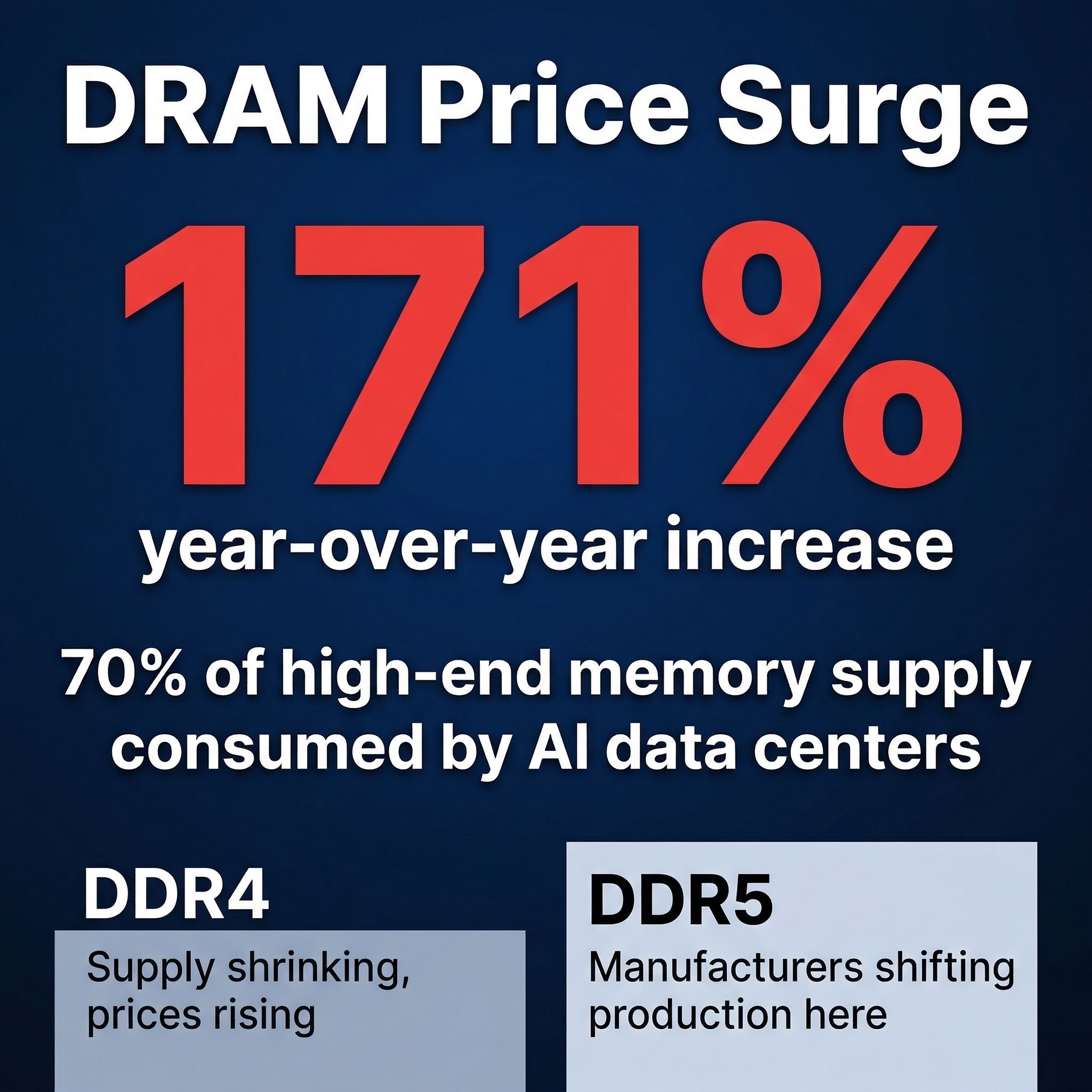
The root cause is straightforward even if the consequences are complex. AI companies are consuming enormous quantities of memory chips. Modern large language models and the GPU clusters that run them require vast amounts of both conventional DRAM and specialized high-bandwidth memory. When NVIDIA, AMD, and their cloud computing customers began scaling AI infrastructure in earnest, they triggered a demand spike that memory manufacturers weren’t prepared to absorb. Industry analysts estimate that AI data centers could consume roughly 70% of high-end memory supply in 2026, leaving the remaining 30% for every other device category.
That scarcity rolls downhill. Samsung, SK Hynix, and Micron, the three companies that produce nearly all of the world’s DRAM, have shifted factory capacity toward the more profitable DDR5 and HBM products that AI customers pay premium prices for. DDR4 production, the memory standard that powers virtually every education Chromebook on the market today, is being actively wound down. The result is a cruel irony for schools: the memory their devices need is becoming scarce not because demand for DDR4 is high, but because manufacturers have moved on to more lucrative products.
The math at the component level tells the story. The cost of mainstream memory and storage configurations has jumped between $90 and $165 per device since the start of 2025, according to Omdia research. For a $1,200 business laptop, that’s a manageable percentage increase. For a $250 education Chromebook operating on razor-thin margins, an extra $90 in component costs represents a 36% price hike that manufacturers have no choice but to pass along. Omdia researcher Kieren Jessop noted that Chrome devices face the steepest projected shipment decline at 28%, precisely because the education-heavy platform is “particularly exposed to tighter component allocation, lower margins, and the discontinuation of some memory and storage products.”
Tariffs Make a Bad Situation Worse
Memory costs alone would have been enough to reshape Chromebook pricing. Tariffs have turned a difficult situation into a crisis for budget-constrained buyers. Dell began hiking prices on commercial PCs by 15-20% as of late 2025, with Lenovo, HP, Acer, and Samsung issuing similar warnings through the first quarter of 2026. These vendor increases reflect both the memory cost pressures and the tariff uncertainty. As EdWeek reported, schools are bracing for the compounding effect of these twin cost drivers.
For districts operating on fixed budgets from grants or bond measures, the arithmetic is unforgiving. A 15% price increase on a planned order of 5,000 Chromebooks doesn’t just mean spending more money. If the budget is fixed, it means purchasing 750 fewer devices. When you’re trying to maintain a 1:1 student-to-device ratio, that gap can mean entire classrooms going without updated hardware. The timing couldn’t be worse: many districts that launched 1:1 programs during the pandemic are now watching those devices approach the end of their useful lives, creating a replacement wave at precisely the moment when replacement costs have spiked.
What K-12 Districts Are Actually Doing About It
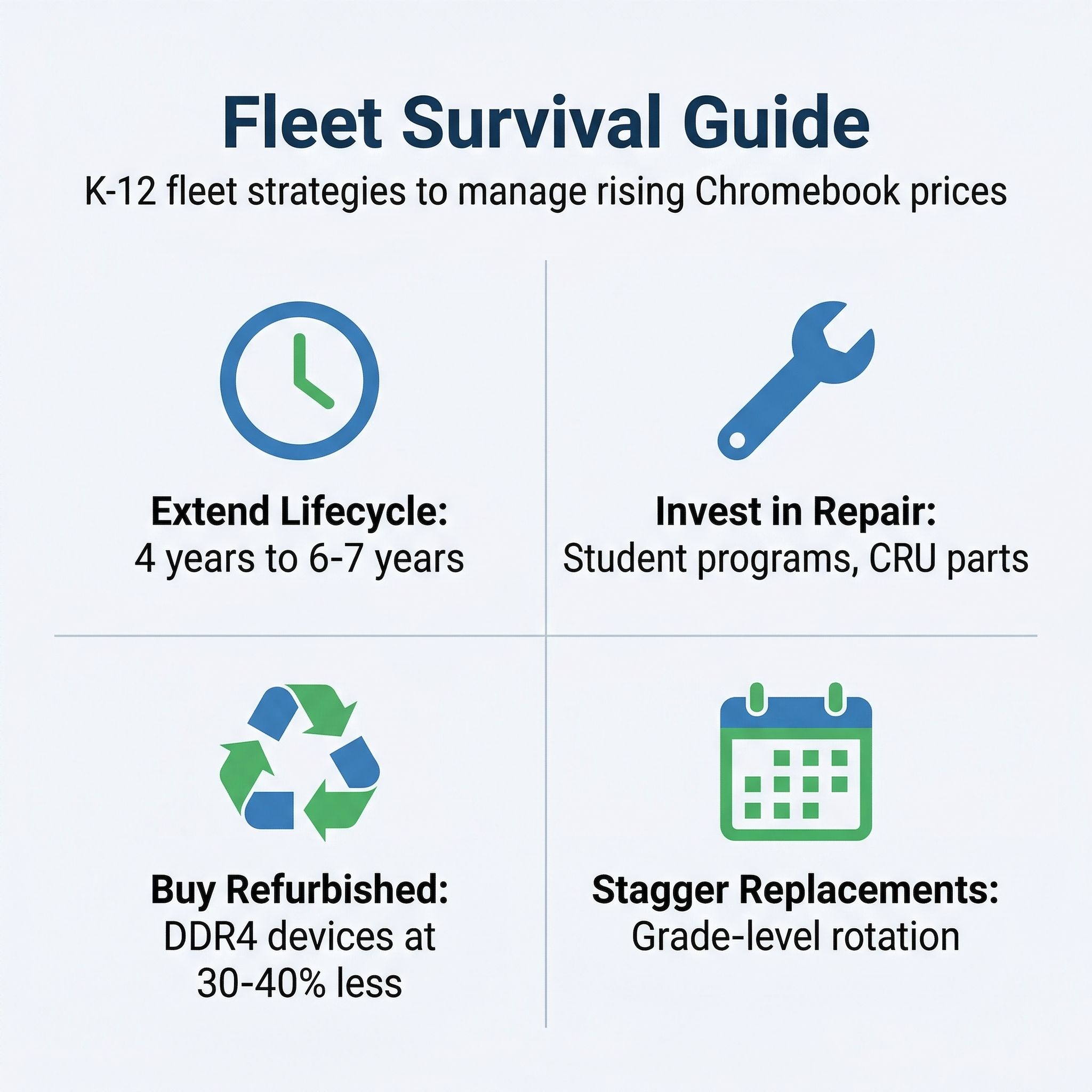
The conversations happening in school IT communities right now are remarkably pragmatic. Rather than waiting for prices to drop, something industry analysts don’t expect to happen before 2027 or 2028, districts are adapting their fleet strategies in several concrete ways.
The most common adjustment is extending replacement cycles. The traditional model of replacing Chromebooks every three to four years is giving way to five, six, or even seven-year lifecycles. Google’s decision in 2024 to extend its Auto Update Expiration policy to 10 years of support for newer platforms has made this viable from a software perspective. The question is whether the hardware holds up that long. IT administrators in r/k12sysadmin threads report mixed results: well-maintained devices can survive six or seven years of student use, but battery degradation, broken ports, and worn-out keyboards become increasingly common after year four.
That’s where repair programs enter the picture. Schools that have invested in in-house repair capabilities, whether through staff training or student-run programs, are finding that extending device lifecycles is far more practical than it used to be. Manufacturers like Lenovo have responded with repair-friendly hardware designs featuring customer-replaceable batteries, USB-C ports, and keyboards. Google’s own Chromebook Self-Repair Program provides guides and positions repair as both a cost-saving measure and an educational opportunity. For districts already running these programs, the price crisis is uncomfortable but manageable. For districts that haven’t invested in repair infrastructure, the current pricing environment is a compelling reason to start.
The refurbished market has also become strategically important. High-quality refurbished Chromebooks, particularly models like the Lenovo 300e or Dell 3100 series that run on DDR4 memory, are available at 30-40% less than equivalent new 2026 models. Because the performance gap between DDR4 and DDR5 is negligible for the web-based workloads that define K-12 computing, these refurbished devices are functionally identical to new ones for classroom purposes. Some districts are using refurbished devices strategically, deploying them for lower-intensity use cases like standardized testing, substitute teacher stations, and summer school programs, while reserving new purchases for primary student devices.
What This Means If You’re Buying for Yourself or Your Family
The same forces squeezing school budgets affect retail Chromebook pricing. The sub-$200 Chromebook that was a reliable recommendation for students, casual browsing, and home use has become genuinely scarce. Models that previously occupied that price tier have either disappeared from shelves, had their specs downgraded to maintain the price point, or simply moved up to the $250-$350 range.
For individual buyers, the practical advice mirrors what districts are doing at scale. First, recognize that most of the Chromebook inventory currently on store shelves was built with components purchased before the late-2025 price spike. Buying sooner rather than later avoids the full impact of the memory cost increases. Second, don’t dismiss education-model Chromebooks as consumer options. These devices are built to survive years of student handling, which translates to genuine durability advantages for home use. They lack the thin bezels and premium finishes of consumer models, but the tradeoff is a machine that can handle being tossed in a backpack for years without falling apart.
Third, if Apple’s MacBook Neo — $599 retail, or $499 with education pricing — has made you reconsider the entire platform, it’s worth understanding what the fleet cost math actually looks like before making a decision. The per-device gap between a $350 Chromebook and a $499 education-priced MacBook Neo is meaningful for institutions buying thousands, but for a family purchasing one or two devices, the total cost of ownership comparison is closer than the sticker price suggests. ChromeOS still wins on management simplicity and the absence of malware headaches, but the Mac option is no longer in a completely different price universe.
The Timing Question: When Will Prices Stabilize?
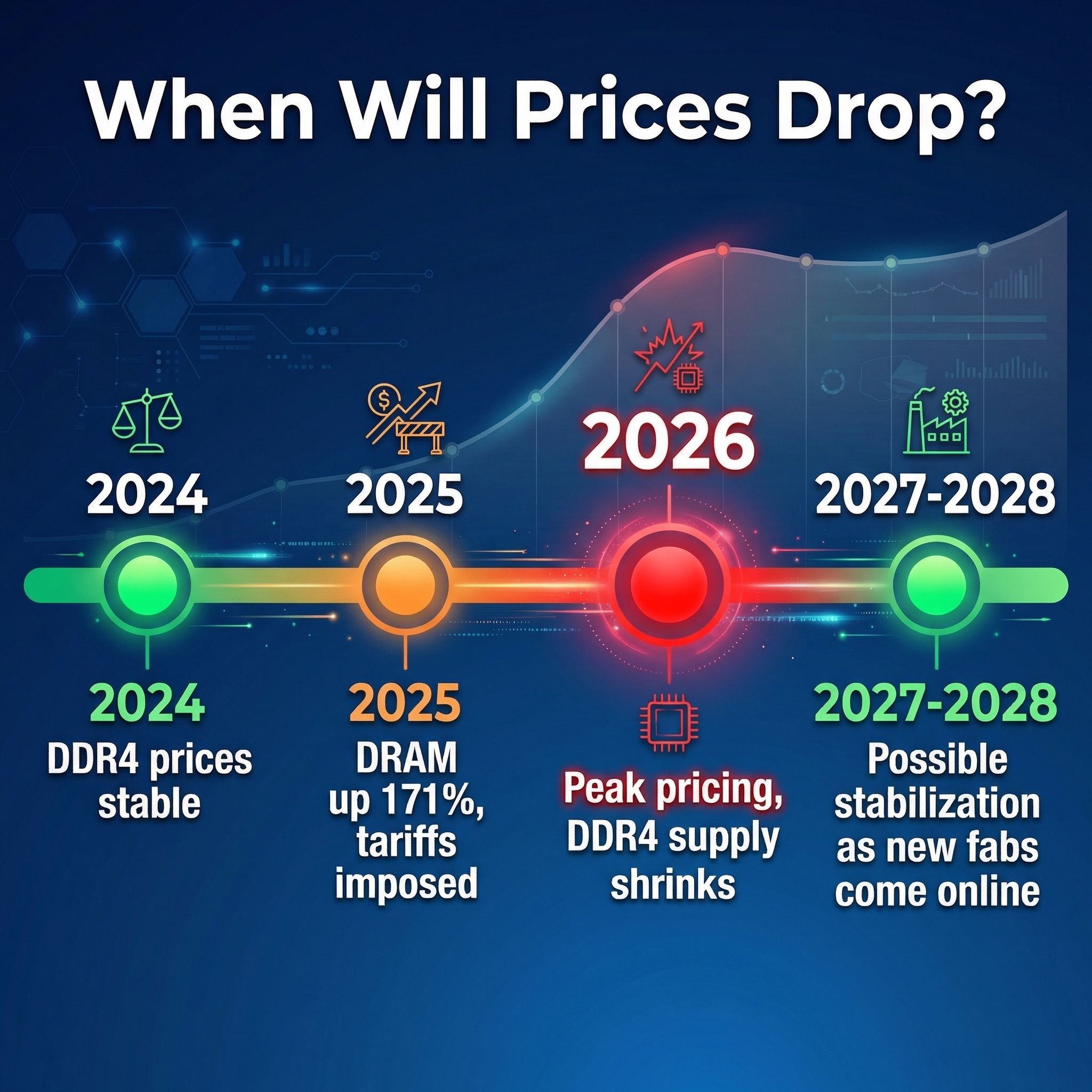
The honest answer is that nobody knows with precision, but the signals aren’t encouraging for anyone hoping for a quick return to pre-2025 prices. Building new semiconductor fabrication facilities takes years. The memory manufacturers currently investing in expanded capacity are building plants designed to produce DDR5 and HBM for AI workloads, not the DDR4 chips that budget Chromebooks rely on. Industry analysts suggest meaningful relief on DRAM pricing is unlikely before 2027 or 2028, and even then, DDR4 pricing may not return to previous levels because production capacity for that standard will have permanently contracted.
The tariff situation adds another layer of uncertainty. Current levies on electronics imports from China affect every major Chromebook manufacturer’s supply chain. Whether these tariffs remain, escalate, or are negotiated down is a political question that no analyst can reliably predict. What’s clear is that districts and buyers who plan based on current prices rather than hoped-for future reductions will be better positioned regardless of how the trade landscape evolves.
For K-12 IT administrators, the lesson from this pricing cycle may be that the era of abundant, ultra-cheap Chromebooks was an anomaly rather than a permanent state. The confluence of pandemic-era federal funding, low memory prices, and intense manufacturer competition for education contracts created a buyer’s market that lasted several years. Those conditions have reversed. Adapting to a world where Chromebooks cost $350-$400 instead of $200-$250 isn’t just a budget exercise. It’s a fundamental rethinking of how device fleets are planned, maintained, and eventually replaced. The districts that had already invested in repair infrastructure, extended lifecycle planning, and refurbished device pipelines are weathering this transition with relative ease. For everyone else, the scramble is on.
The memory story also serves as a reminder of how interconnected the technology supply chain has become. The same AI revolution that is generating headlines about chatbots and code-writing assistants is, through a chain of supply and demand that few outside the semiconductor industry follow closely, making it more expensive for a fourth-grader to have a laptop. Understanding that connection doesn’t make the budget math any easier, but it does clarify that the price increases aren’t arbitrary or temporary. They’re the downstream consequence of the largest reallocation of computing resources in a generation.


