
Acemagic's Retro X5 Puts a Ryzen AI 9 Inside an NES: Nostalgia Meets Serious Hardware
Published on by Jim Mendenhall

There’s something delightfully absurd about stuffing a 12-core processor with an AI accelerator into a box designed to look like it belongs in your parents’ living room circa 1987. But that’s exactly what Acemagic has done with the Retro X5, and after spending weeks tracking this product since its CES 2026 debut, I’m genuinely torn between calling it brilliant and calling it bonkers. It might be both.
The Retro X5 doesn’t just take “design cues” from the Nintendo Entertainment System. It goes much further than competitors like AYANEO’s AM02, which borrowed the NES aesthetic while keeping things tastefully abstract. Acemagic’s approach is more brazen: the beige-and-gray case, the boxy proportions, the lines where the cartridge slot would be, even a big red power button on the front. As Liliputing noted, it looks “almost exactly like an NES,” and that’s clearly the point. Whether Nintendo’s lawyers agree remains to be seen, but in the meantime, Acemagic is leaning into the nostalgia hard.
What’s Actually Inside This Thing
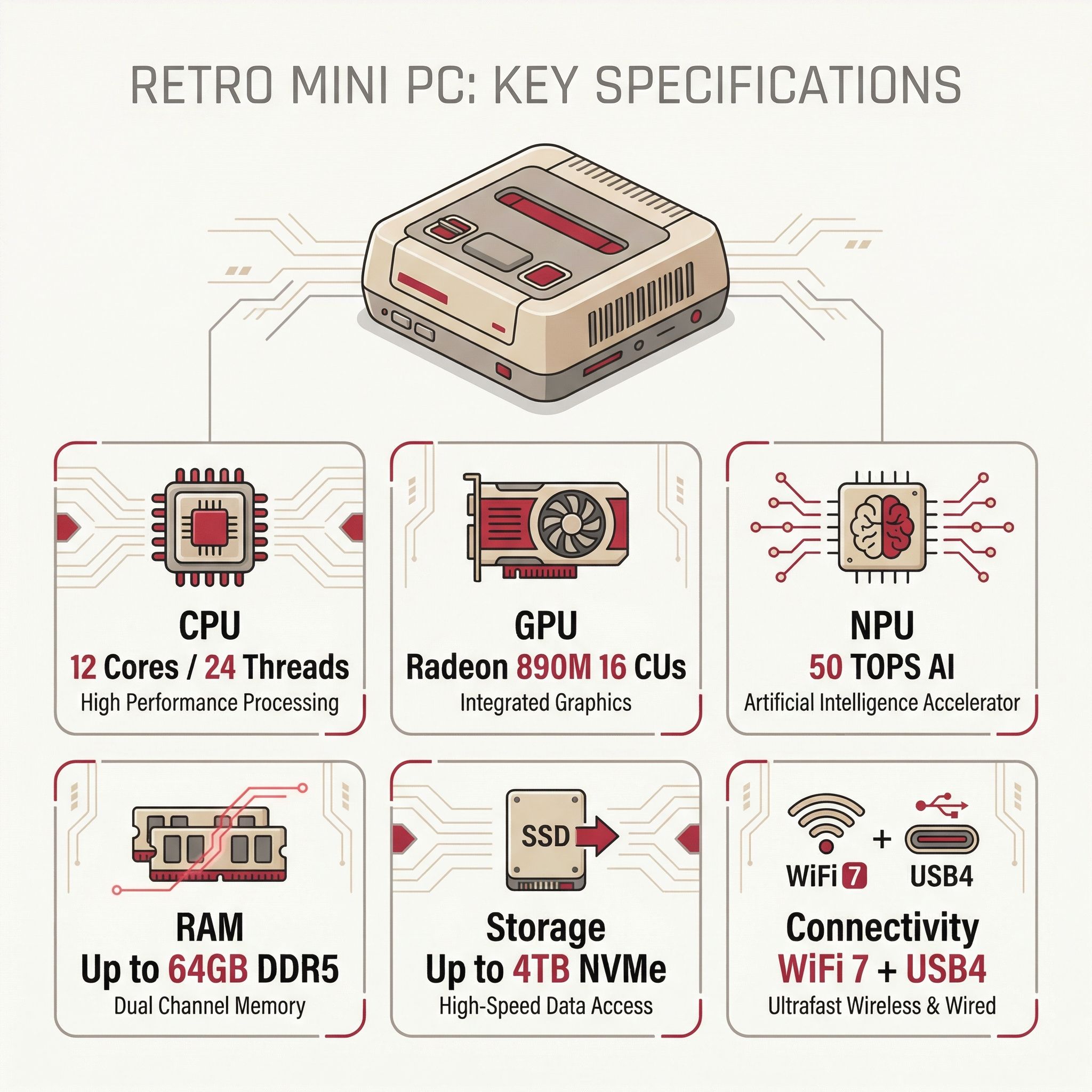
Here’s where the Retro X5 stops being a novelty and starts being interesting. The flagship configuration runs AMD’s Ryzen AI 9 HX 470 processor, part of the Gorgon Point family built on Zen 5 architecture. That’s 12 cores and 24 threads, with four high-performance Zen 5 cores handling heavy lifting and eight Zen 5c efficiency cores managing background tasks. The boost clock reaches 5.1 GHz, which puts it in the same performance bracket as processors found in high-end ultrabooks and workstation-class mini PCs.
The integrated Radeon 890M graphics deserve particular attention for anyone interested in emulation. With 16 RDNA 3.5 compute units clocking up to 2900 MHz, this is one of the most capable integrated GPUs available in a mini PC today. TweakTown’s CES coverage confirmed that the GPU is “powerful enough to run most games at 60 FPS at 1080p as well as emulate classic console and gaming hardware.” For retro emulation specifically, the Radeon 890M should handle everything from NES and SNES through PlayStation 2 and GameCube with room to spare, and even push into more demanding systems like Wii U and Switch emulation territory.
Memory and storage options are thoroughly modern. The Retro X5 supports up to 64GB of DDR5 SO-DIMM RAM across two slots and up to 4TB of M.2 2280 NVMe storage across two slots. Connectivity includes USB4, WiFi 7, Bluetooth 5.4, and dual 2.5 Gigabit Ethernet ports. The front panel features two USB Type-A ports, a USB Type-C connector, and a headphone jack, while the rear adds HDMI, DisplayPort, and additional USB ports. It’s a genuinely comprehensive port selection that rivals or exceeds what you’d find on any similarly-priced mini PC in our mini PC comparison chart.
RetroPlay Box: Emulation Made Simple (In Theory)
The Retro X5 ships with Acemagic’s RetroPlay Box software, which is described as an all-in-one emulation frontend that removes much of the setup friction that typically comes with retro gaming on a PC. According to Acemagic’s official page, RetroPlay Box provides a dedicated interface with organized emulators so users can load their own ROMs and start playing with minimal configuration. If you’ve ever spent an afternoon wrestling with RetroArch configurations or tracking down BIOS files, the appeal of a pre-configured solution is obvious.
What makes RetroPlay Box potentially interesting beyond existing emulation frontends is its planned integration with the Ryzen AI 9’s neural processing unit, which delivers up to 50 TOPS of AI compute performance. Acemagic has outlined plans for AI-powered game recommendations, automatic translation for games that were never officially localized for Western markets, and even in-game assistance features. Ubergizmo reported that these AI functions would run entirely locally on the NPU, avoiding the latency and privacy concerns that come with cloud-based processing.
I should be honest here, though: these AI features are future promises, not shipping functionality. NotebookCheck’s coverage confirmed that the AI capabilities will be “continuously developed further” and rolled out in progressive updates. The base RetroPlay Box experience at launch will likely be a straightforward emulation frontend, which is perfectly fine on its own. Just don’t buy this expecting an AI-powered retro gaming butler on day one.
Beyond Emulation: A Genuine All-Purpose PC
It’s tempting to treat the Retro X5 as a dedicated retro gaming machine, but the hardware inside makes that reductive. A Ryzen AI 9 HX 470 with 64GB of DDR5 and NVMe storage is a legitimate productivity workstation. You could run this as your daily driver for web development, photo editing, video production, or even local AI model inference. The dual 2.5G Ethernet ports make it a surprisingly capable home server candidate, and the WiFi 7 support means wireless performance shouldn’t be a bottleneck for most use cases.
Acemagic and TweakTown both noted that the Retro X5 supports both Windows 11 and Linux, opening the door to a SteamOS installation that would transform it into a Steam Machine-like device. Imagine a NES-shaped box on your entertainment center that boots directly into your Steam library. For a certain type of person (and I am absolutely that type of person), this is deeply appealing. The Radeon 890M can handle a surprising number of modern games at 1080p, and between native gaming, Steam Remote Play, and cloud gaming services, you’d have a versatile entertainment machine that doubles as a conversation piece.
The compact dimensions help here too. At roughly 140 x 128 x 41 mm (about 5.5 x 5 x 1.6 inches), the Retro X5 is small enough to sit on a shelf next to actual vintage consoles without looking out of place. Acemagic has also highlighted a tool-free upgrade approach using side release buttons, which means swapping RAM or storage doesn’t require disassembling the whole machine.
The Broader Retro PC Trend
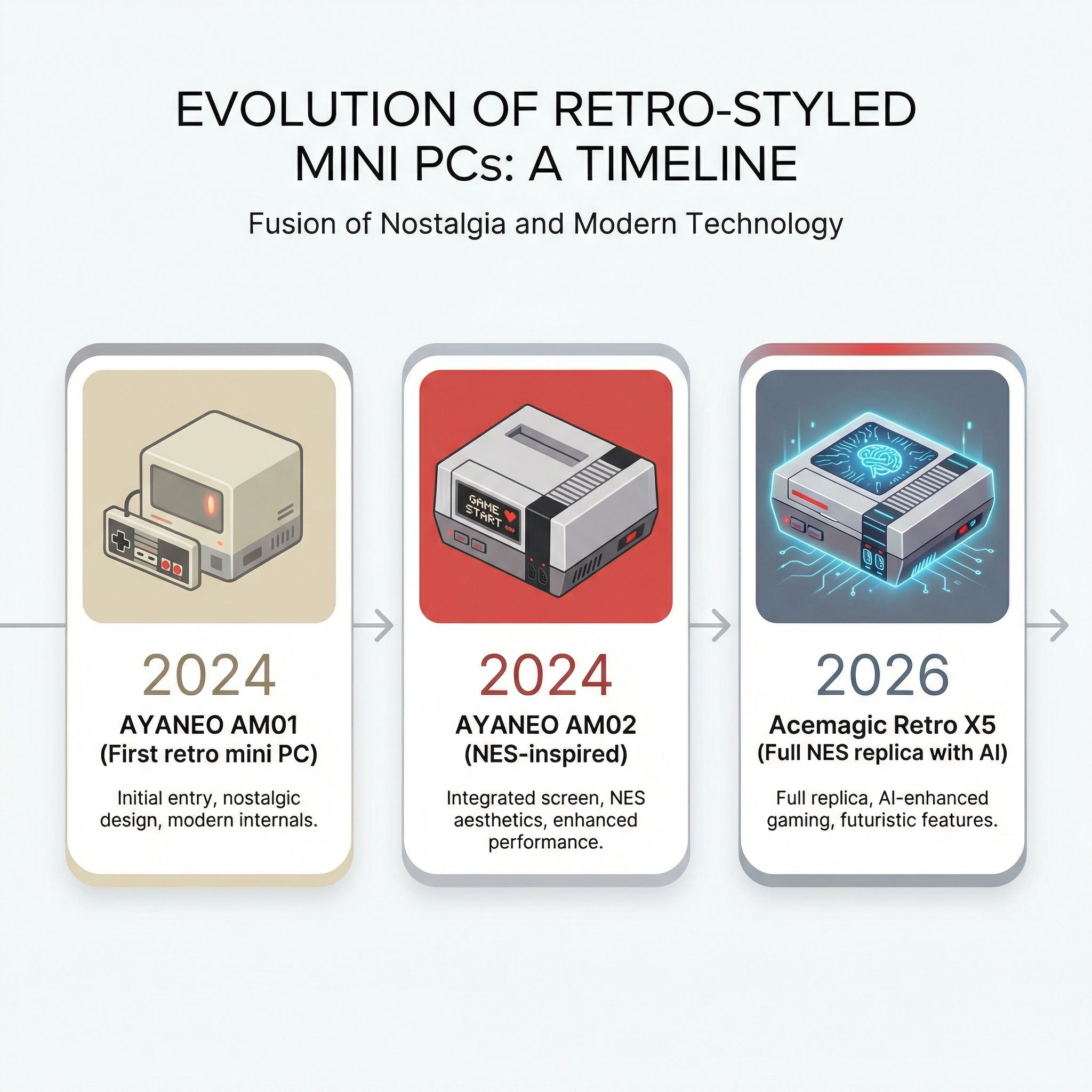
Acemagic isn’t operating in a vacuum here. AYANEO has been building retro-inspired mini PCs for a couple of years now, starting with the AM01 and the more NES-flavored AM02 that launched in 2024. Those machines earned genuine praise for their build quality and performance, proving there’s real demand for mini PCs that look like they belong in a gaming museum. The key difference is that AYANEO kept its designs more suggestive than literal, while Acemagic has gone for unmistakable console replication.
What’s new with Acemagic’s approach at CES 2026 is the variety. Beyond the NES-inspired Retro X5, the company showed off designs inspired by the original PlayStation 1 and Sega Dreamcast. The PlayStation variant even features two buttons on top: one for power and another dedicated to Microsoft’s Copilot service, which is a delightfully incongruous detail on a machine designed to look like a 1994 Sony console. These alternate designs share the same internal hardware and port selection as the Retro X5, differing primarily in their external shell.
There’s also a budget option in the pipeline. The Retro X3 uses an AMD Ryzen 7 H 255 processor with 8 cores, Radeon 780M integrated graphics, WiFi 6, and a similar NES-inspired design. It’s already available for pre-order in China at approximately $273 for a barebones configuration (no RAM or storage), though international availability hasn’t been confirmed. For buyers who want the aesthetic without the flagship price, the Retro X3 could be an interesting alternative, though the step down in GPU performance from Radeon 890M to 780M will matter for more demanding emulation targets.
Should You Wait for This?
Here’s where I need to be straightforward. As of February 2026, you cannot buy an Acemagic Retro X5. The company hasn’t announced pricing, and the release date remains vague. The Retro X3 is China-only for now. If you want a retro-styled mini PC that you can actually purchase today, AYANEO’s existing lineup remains the more practical choice.
That said, the Retro X5 represents something worth watching. The combination of a Zen 5-based processor with serious integrated graphics, an NPU capable of running local AI workloads, and a form factor that doubles as shelf art hits a sweet spot that didn’t exist a year ago. When it does launch, expect pricing in the $600 to $900 range based on Acemagic’s existing high-end mini PC pricing, though that’s speculation on my part.
For now, the Retro X5 is the most interesting “coming soon” product in the mini PC space. Whether you’re a retro gaming enthusiast who wants a modern emulation powerhouse, a mini PC fan looking for something with personality, or someone who just wants to see the look on guests’ faces when your NES boots into Windows 11, this is one to keep on your radar. Just don’t hold your breath on the AI-powered game translation features. Those will arrive when they arrive, and the Retro X5 will need to stand on its hardware merits in the meantime. Fortunately, those hardware merits are substantial.

