Every few months, a mini PC manufacturer refreshes a popular model and bumps the price. Sometimes the upgrades justify the increase. Sometimes they don’t. The GEEKOM A5 Pro 2026 Edition sits right on that line, shipping with an AMD Ryzen 5 7530U, 16GB of DDR4 RAM, and a 1TB NVMe SSD for $549 on Amazon. That’s roughly $150 more than the 2025 Edition sold for on a typical day, and only marginally faster on paper. But there’s one thing this refresh has going for it that most mini PC reviews ignore entirely: someone actually tested it with Linux.
CNX Software’s Jean-Luc Aufranc published a three-part review covering teardown and specs, Windows benchmarks, and Ubuntu 25.10 testing with hardware compatibility checks and real-world power measurements. That kind of detailed Linux coverage is rare for budget mini PCs, and it reveals a machine that’s genuinely compelling for a specific kind of user, even if it’s hard to recommend as an outright bargain. All benchmarks and test data in this article come from CNX Software’s review unless otherwise noted.
What’s Actually New in the 2026 Edition
Let’s be clear about what the Ryzen 5 7530U actually is: a Zen 3 refresh, not a generational leap. It’s the same Barcelo-R (Barcelo Refresh) architecture as the 7430U in the 2025 Edition, with slightly higher boost clocks (4.5 GHz vs 4.3 GHz) and the same 16MB L3 cache. In practical terms, the performance difference between the two processors is modest. CNX Software measured Geekbench 6 scores of 1,980 single-core and 7,024 multi-core under Ubuntu, which is solid for a 15-watt chip but not dramatically ahead of its predecessor.
The more meaningful changes are elsewhere. GEEKOM doubled the default SSD to 1TB with a PCIe Gen 4 drive that delivers 3,520 MB/s reads under Linux, and upgraded the cooling system to what they call “IceBlast 3.0” with dual copper heat pipes. CNX Software’s teardown found the industrial-grade metal chassis more substantial than the rose-gold 2025 model. But there’s a trade-off that matters for Linux home server users: the 2.5-inch SATA bay is gone. Where the previous A5 models offered triple storage expansion (NVMe + M.2 SATA + 2.5” SATA), the 2026 Edition drops to two slots. If you were planning to add a cheap bulk storage drive for media or backups, that option has disappeared.
The other elephant in the room is DDR4. In March 2026, shipping a $549 mini PC with DDR4-3200 memory feels like a generation behind. Competitors at this price point increasingly offer DDR5, which provides meaningfully better memory bandwidth for workloads like compilation, container management, and video editing. For basic desktop use and web browsing, you won’t notice the difference. But if you’re buying a Linux workstation for development work, the memory subsystem is a legitimate concern.
Linux Compatibility: The Good News
Here’s where the A5 Pro 2026 Edition genuinely shines. Ubuntu 25.10 with kernel 6.17 detected every piece of hardware automatically. No BIOS modifications, no driver hunting, no firmware workarounds. CNX Software installed it as a dual-boot alongside Windows 11 by simply booting from a USB drive and shrinking the Windows partition, the kind of straightforward experience that Linux users dream about but don’t always get.
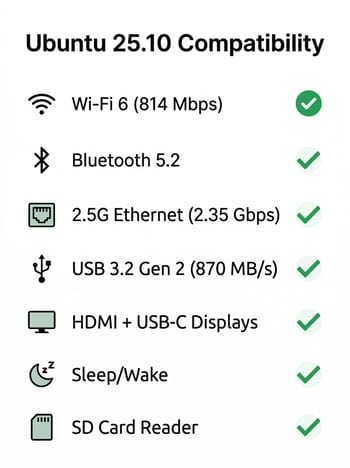
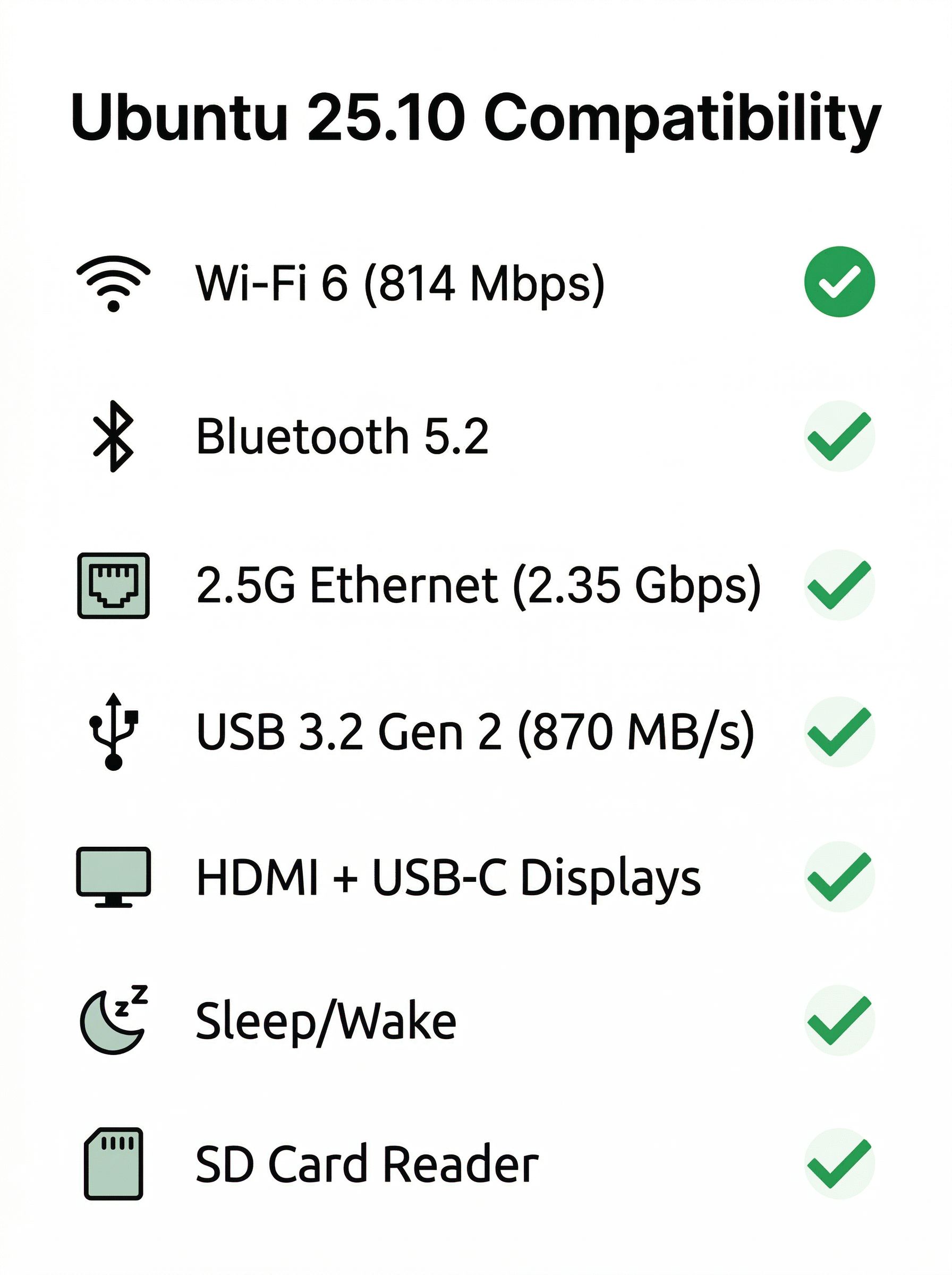
In CNX Software’s testing, all six USB ports work at their rated speeds, with USB 3.2 Gen 2 delivering 870-910 MB/s. The 2.5 Gigabit Ethernet hits near line-rate at 2.35 Gbps. Wi-Fi 6 through the Realtek RTL8852BE module pulls 814 Mbps down and 474 Mbps up on 5 GHz. Bluetooth 5.2 handles file transfers without issues. The SD card reader works. Sleep and wake work. Multi-monitor output across HDMI and USB-C DisplayPort works for up to four displays. It’s the kind of comprehensive compatibility report that makes you wonder why more manufacturers don’t just ship Ubuntu as an option.
The benchmarks tell an equally positive story. Performance under Linux matches Windows almost exactly, with no throttling observed during sustained workloads. CPU temperatures peaked at 75.9 degrees Celsius under stress testing, and the fan noise settled to a quiet 39-40 dBA after an initial ramp. At idle, the fan shuts off entirely, leaving the machine drawing just 3.8 watts from the wall.
That power figure deserves emphasis. A machine that idles at under 4 watts and sustains around 24 watts under full load is genuinely attractive for always-on Linux use cases: a home server running Docker containers, a Pi-hole DNS filter, a media server, or a development machine you leave running overnight compiling code. Over a year of 24/7 operation at idle, you’re looking at roughly 33 kWh of electricity, which costs less than $5 in most US markets.
The Value Question
The honest assessment is that the A5 Pro 2026 Edition faces a value problem. CNX Software’s own conclusion noted that “the earlier GEEKOM A5 looks like a better deal if you can live with a smaller capacity 512GB NVMe SSD.” The original GEEKOM A5 with its eight-core Ryzen 7 5800H delivered better multi-threaded performance and included the 2.5-inch SATA bay, often available for under $400. The 2025 Edition with the Ryzen 5 7430U frequently sold for around $279 during promotions, offering nearly identical performance to the 2026 refresh at half the price.
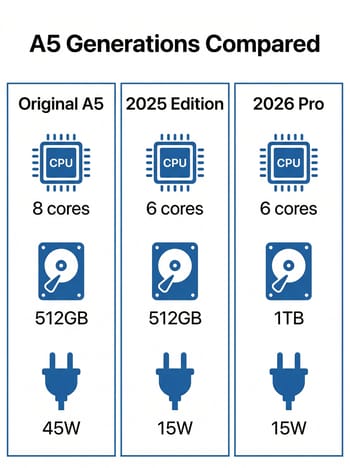
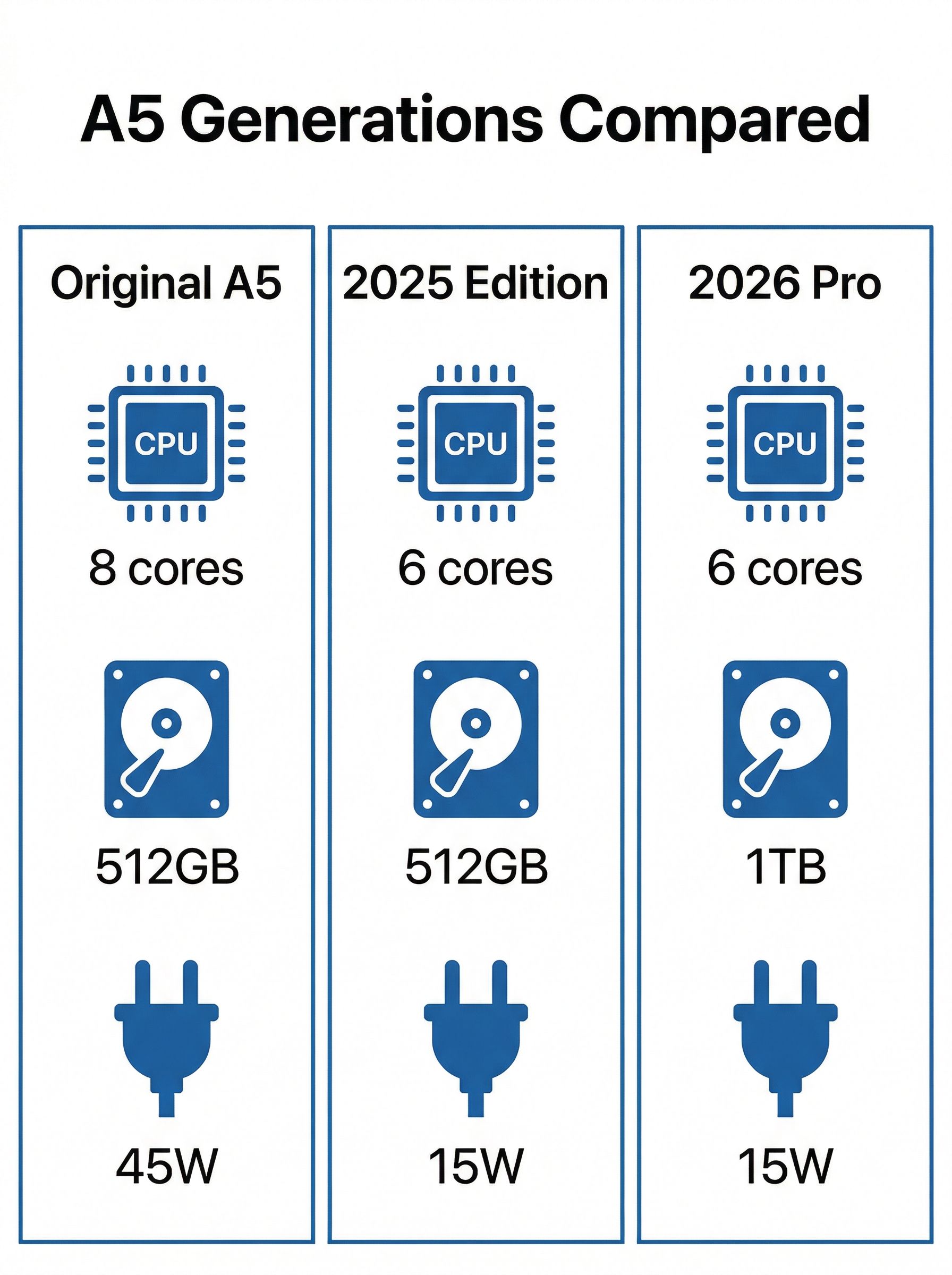
At $549, the A5 Pro sits in an awkward middle ground. It’s too expensive to be a casual recommendation over older A5 models, but not powerful enough to compete with eight-core machines from Minisforum and Beelink at the same price. The six-core, 15-watt Ryzen 5 7530U is efficient and quiet, but it can’t match the raw throughput of H-series processors that competing mini PCs offer for similar money.
That said, the value calculation changes if your priorities align with what this machine does best. If you specifically want a Linux-compatible mini PC that runs cool, quiet, and power-efficient, with verified Ubuntu compatibility and no hardware surprises, the field narrows considerably. Most competing mini PCs at this price have never been tested with Linux by a reputable reviewer. You’re essentially paying a premium for certainty, and for some users, that certainty is worth the extra cost.
Who Should Buy This
The A5 Pro 2026 Edition makes the most sense as an always-on Linux machine where power consumption and noise matter more than raw performance. A home server sitting in a living room or bedroom, a quiet office desktop for web development and writing, or a media center connected to a TV. The 3.8-watt idle draw and silent fan-off operation at idle are genuine advantages that most competitors can’t match.
It’s a harder sell as a developer workstation for heavy compilation or container-heavy workflows. The six Zen 3 cores and DDR4 memory will feel limiting compared to what $549 buys in an eight-core, DDR5-equipped alternative. And if gaming is any part of your use case, the Vega 7 integrated graphics won’t cut it for anything released in the last few years.
GEEKOM A5 Pro
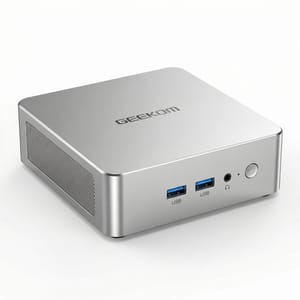
- +Verified Linux compatibility
- +3.8W idle power
- +silent fan-off at idle
- +1TB PCIe Gen 4 SSD
- +IceBlast 3.0 cooling
- -DDR4 memory in 2026
- -no 2.5-inch SATA bay
- -$549 is steep for 6-core Zen 3
For buyers on a tighter budget, the GEEKOM A5 2025 Edition remains the more compelling option. It delivers 90% of the performance at 50-60% of the price, includes the 2.5-inch SATA bay the 2026 Edition dropped, and has extensive review coverage from multiple sources. The 2026 Edition’s advantages, a faster SSD, improved cooling, and marginally better CPU, are real but modest. Unless you specifically need the larger default storage and don’t want to upgrade it yourself, the older model is the better value.
The GEEKOM A5 Pro 2026 Edition is a well-built, Linux-friendly mini PC that does exactly what it promises. The problem isn’t what it is. The problem is what it costs. At $400, it would be an easy recommendation. At $549, you need to care specifically about its strengths, quiet operation, low power draw, and verified Linux compatibility, to justify choosing it over alternatives that offer more performance per dollar. For the right user, those strengths matter enough. For everyone else, the 2025 Edition sitting at half the price is the smarter buy.