When most people hear “mini PC,” they think of a palm-sized box running an Intel N100 that costs less than a nice dinner for two. The NZXT H2 is not that kind of mini PC. At $3,499, it packs a desktop GeForce RTX 5080 and your choice of AMD’s Ryzen 7 9800X3D or Intel’s Core Ultra 9 285K into a 20.7-liter Mini-ITX chassis — a machine that can run Cyberpunk 2077 at 4K with ray tracing while occupying less than half the volume of a standard mid-tower. It’s the clearest signal yet that the small form factor PC market has grown up, splitting into two completely different product categories that happen to share a name.
NZXT launched the H2 Mini PC in February 2026 alongside the H2 Flow case and C850 SFX power supply, giving buyers the choice between a turnkey prebuilt and a DIY foundation. The prebuilt is US-only and has already sold through its initial stock, which tells you something about demand for high-end SFF gaming. The case ships globally at $149.99, and the early reviews have been overwhelmingly positive about what NZXT managed to fit into such a compact footprint.
What’s Inside the $3,499 Box
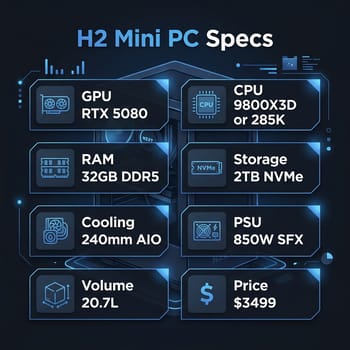
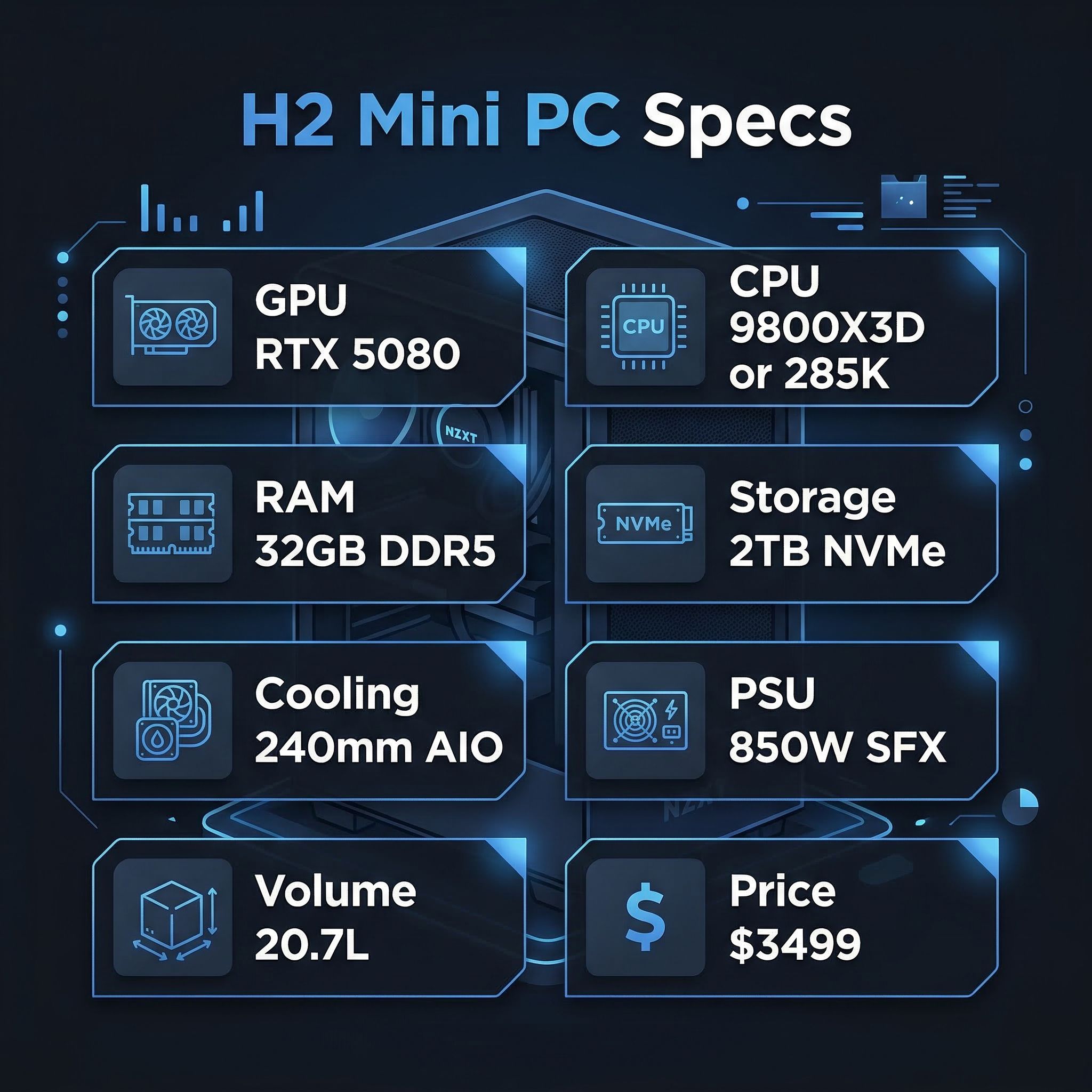
Both editions of the H2 Mini PC share the same GPU, cooling, storage, and power delivery. The Gigabyte GeForce RTX 5080 Windforce OC handles graphics duties, paired with 32GB of Team T-Force Delta RGB DDR5 memory and a 2TB Western Digital Blue SN5000 NVMe SSD. Cooling comes from NZXT’s own Kraken Elite 240 AIO liquid cooler with dual 120mm F120P static pressure fans, and a Lian Li SP850G 850W SFX 80 Plus Gold PSU keeps everything fed. Windows 11 Home is included.
The AMD edition seats a Ryzen 7 9800X3D — widely regarded as the best gaming CPU available — on a Gigabyte B850I AORUS Pro Mini-ITX motherboard with DDR5-4800 memory. The Intel edition uses the Core Ultra 9 285K on a Gigabyte Z890I AORUS Ultra with DDR5-5200. Both configurations target the same audience, though gamers will generally prefer the 9800X3D for its 96MB of 3D V-Cache, while content creators might lean toward the 285K’s 24 cores for multi-threaded rendering workloads.
According to NotebookCheck’s coverage, both configurations can “smoothly handle AAA games at 1440p” and exceed 60 FPS at 4K “with some tweaks” — which in practice means enabling DLSS 4 and dialing back a ray tracing setting or two. That’s desktop-class gaming performance in a box you could carry with one hand, though you probably wouldn’t want to since it weighs about 10 kg fully loaded.
The Case That Makes It Possible
The H2 Flow chassis is the real engineering story here. At 435mm tall, 181mm wide, and 263mm deep, it occupies 20.7 liters of volume — less than half the 46.7 liters of NZXT’s own H5 Flow mid-tower. Despite that compression, it accommodates GPUs up to 331mm long and 65mm thick, AIO radiators up to 280mm, and SFX or SFX-L power supplies up to 130mm in length. That’s enough room for genuine high-end hardware, not the compromised mobile components you find in most compact builds.
Reviewers have been broadly positive about the thermal design, though with some caveats. Club386 measured the Ryzen 7 9800X3D peaking at 83 degrees C under multi-thread load, well short of the processor’s 95-degree thermal limit. Noise levels landed between 37 and 45 dBA across reviews — audible under load, but manageable with a gaming headset and quieter than many competing SFF builds pushing similar hardware. OC3D’s review captured a common refrain among case reviewers: the H2 Flow is “10mm short of perfect,” with just a bit more internal width needed to make liquid cooling hose routing truly comfortable. Igor’sLAB echoed this sentiment but noted that airflow performance exceeded expectations for the volume.
The front I/O includes two USB 3.2 Gen 1 Type-A ports, one USB 3.2 Gen 2 Type-C port at 20 Gbps, and a 3.5mm headset jack. A PCIe Gen 5.0 x16 riser cable routes the GPU vertically, which is what allows such a tall, narrow chassis to house a full desktop graphics card. Two pre-installed 120mm F120Q fans handle exhaust duties. None of the panels include traditional dust filters — NZXT claims the ultra-fine mesh perforations keep debris out, though long-term durability of that approach remains to be seen.
The DIY Math That Surprised Everyone
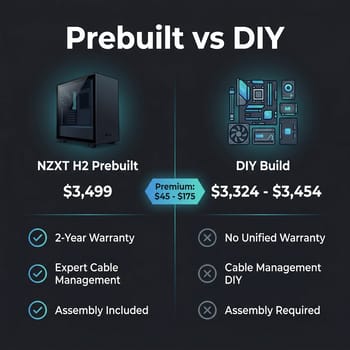
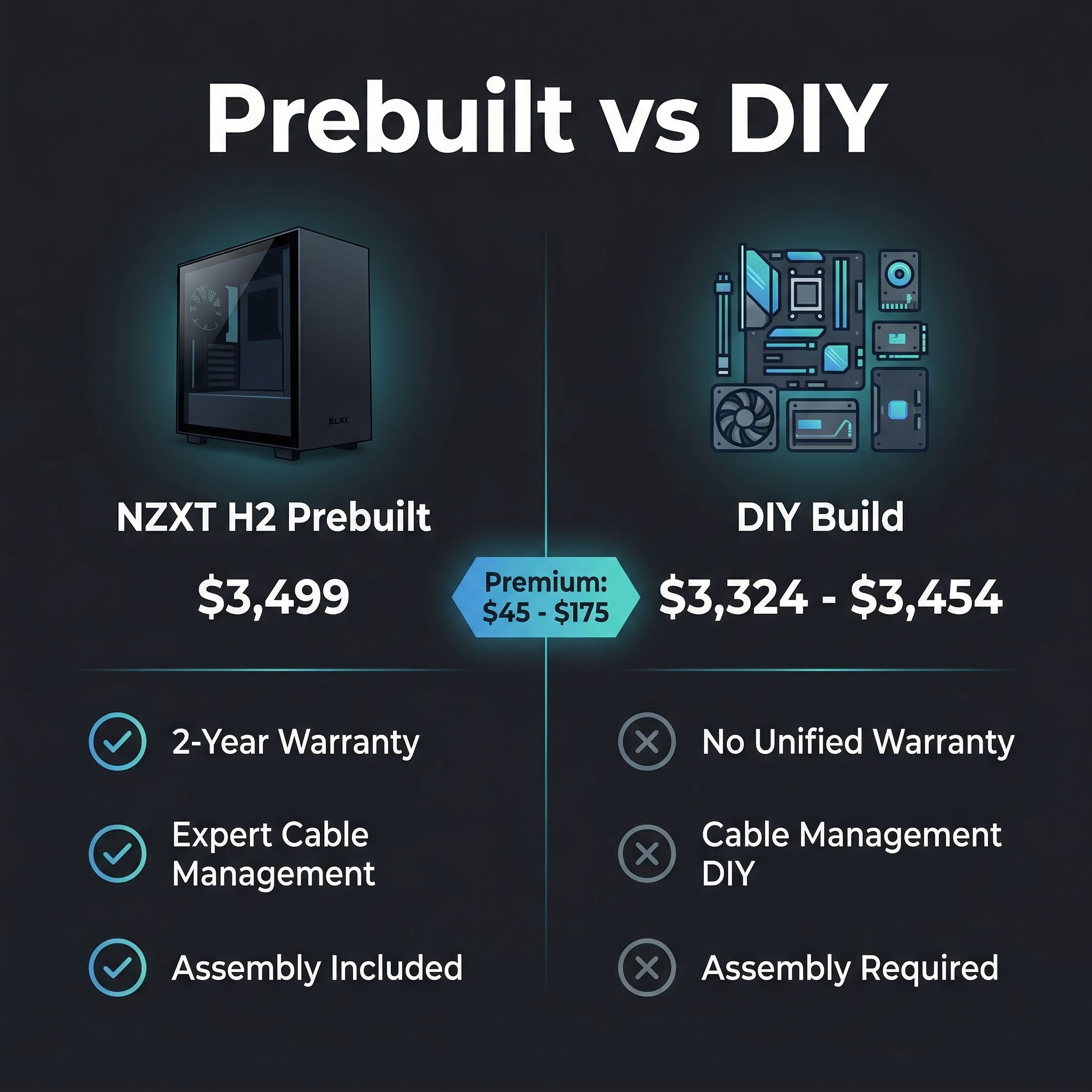
Prebuilt gaming PCs usually carry a significant markup over building the same system yourself. The NZXT H2 breaks that pattern. Adding up the individual component costs, the Intel configuration runs about $3,454 and the AMD build about $3,324 when sourcing parts at retail prices. That puts the prebuilt premium at roughly $45 for the Intel edition and $175 for the AMD edition — a gap that largely evaporates once you factor in the cost of a Windows 11 Home license, professional cable management in a cramped Mini-ITX chassis, and NZXT’s two-year unified warranty.
For experienced builders, the value proposition still tips toward DIY thanks to the ability to cherry-pick components. You could swap in a different SSD brand, find the RTX 5080 on sale, or skip the RGB memory for a meaningful savings. But for anyone who has never built a small form factor PC — and building in Mini-ITX is genuinely more difficult than a standard ATX build — the H2 prebuilt offers a rare case where the convenience tax is almost negligible. NZXT seems to have priced this as a loss leader to establish the H2 Flow ecosystem rather than as a profit center, and buyers are the ones who benefit.
The H2 Flow case alone at $149.99 and the C850 SFX PSU at $199 are available globally for builders who want to chart their own path. Given the positive thermal reviews and the 331mm GPU clearance, the case is competitive with established SFF options like the Meshlicious and NR200P at a lower price point. If NZXT’s goal was to make Mini-ITX building more approachable, the $150 entry price for the case is arguably more significant than the $3,499 prebuilt.
A Different Universe From Budget Mini PCs
Here’s where context matters for Starryhope readers. The NZXT H2 occupies a completely different market segment from the compact mini PCs that dominate our coverage and comparison charts. A Beelink Mini S12 runs about $150 and handles web browsing, office work, and media streaming in a package the size of a paperback novel. The Beelink SER8 steps up to a Ryzen 7 8845HS for around $400 and can handle light gaming and content creation. The Mac Mini M4 starts at $499 with performance that embarrasses many $1,000 PCs.
The NZXT H2 costs more than all three of those combined and exists to solve a problem none of them attempt: running AAA games at 4K with a desktop-class GPU. It’s the machine you buy when you’ve read 5 Things Mini PCs Can’t Do in 2026 and decided that the GPU limitation is the one you refuse to accept. Where a traditional mini PC trades performance for size, the H2 trades size for… well, slightly less size compared to a mid-tower. Twenty liters is compact for a gaming desktop but enormous compared to a sub-liter NUC or a 0.43-liter Khadas Mind Pro.
That’s not a criticism — it’s a category distinction. The word “mini” does heavy lifting when it describes both a $150 fanless box and a $3,500 liquid-cooled gaming rig with an RTX 5080. As Panther Lake NUCs bring genuine gaming capability to sub-liter form factors through integrated graphics, and AMD’s Strix Halo chips push local AI inference into compact desktops, the spectrum of what qualifies as a “mini PC” keeps widening. The NZXT H2 is the high end of that spectrum — the proof point that a full desktop replacement can fit in a carry-on-sized footprint.
Should You Buy One?
The practical barriers are significant right now. Both configurations were out of stock at launch, the prebuilt is US-only, and $3,499 is a lot of money regardless of how you rationalize the component math. If you’re willing to build your own, the H2 Flow case at $150 with your choice of components is the more flexible path — especially since you can scale the GPU and CPU to match your actual budget and needs rather than committing to top-tier everything.
One advantage the H2 has over laptops and most traditional mini PCs is upgradeability. The Mini-ITX motherboard accepts standard desktop CPUs, the DDR5 DIMM slots allow memory swaps, and the 331mm GPU clearance means you can drop in a next-generation graphics card when the time comes — assuming NVIDIA and AMD stay within similar card dimensions. The M.2 NVMe slot is accessible for storage upgrades, too. This is a machine you could reasonably run for four or five years with a mid-cycle GPU swap, which changes the value calculus compared to a soldered-everything mini PC that becomes e-waste when its specs fall behind.
For the specific buyer who wants a compact, high-performance gaming PC without the hassle of sourcing Mini-ITX-compatible components and wrestling with cable routing in a tight chassis, the H2 prebuilt is priced fairly and built well. The Kraken Elite 240 keeps temperatures in check, the RTX 5080 delivers desktop-class gaming performance, and the two-year warranty provides a single point of contact if anything goes wrong. Just understand that you’re buying a gaming desktop that happens to be small, not a mini PC that happens to game well. The distinction matters when your expectations — and your budget — need to match reality.
The broader significance of the H2 isn’t the machine itself but what it signals about the SFF market. NZXT is a mainstream PC brand, not a boutique SFF specialist, and the fact that they’ve committed to a Mini-ITX ecosystem — case, PSU, and prebuilt — suggests that compact gaming PCs have moved beyond niche enthusiasm into genuine market demand. Whether you buy the H2 or simply benefit from the competition it creates, the era of compromise-free small form factor gaming is arriving faster than most people expected.