Intel’s Core Ultra Series 3 “Panther Lake” processors have started arriving in mini PCs, and the headline feature isn’t the 18A manufacturing process or the 180 TOPS AI performance: it’s the integrated GPU. The Arc B390, packed into Intel’s X-series Panther Lake chips, delivers 12 Xe3 graphics cores that push 99 FPS in Cyberpunk 2077 at 1080p Medium with XeSS upscaling. NotebookCheck’s benchmark testing concluded that this performance level “practically disqualifies RTX 4050 from mini PCs.” That’s a bold claim, but the data backs it up in ways that matter for compact desktop buyers.
Six manufacturers (ASUS, GMKtec, MSI, ASRock, Khadas, and Minisforum) have launched or announced Panther Lake NUCs, each targeting different segments of the market. The ASUS NUC 16 Pro and GMKtec EVO-T2 are already shipping, with configured models available on Amazon and through direct sales respectively. Before reaching for a credit card, though, you need to understand a critical distinction that determines whether your new mini PC gets genuine GPU performance or entry-level graphics wearing a Panther Lake badge.
The X-Series Distinction That Changes Everything
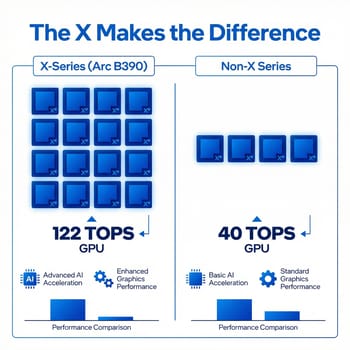
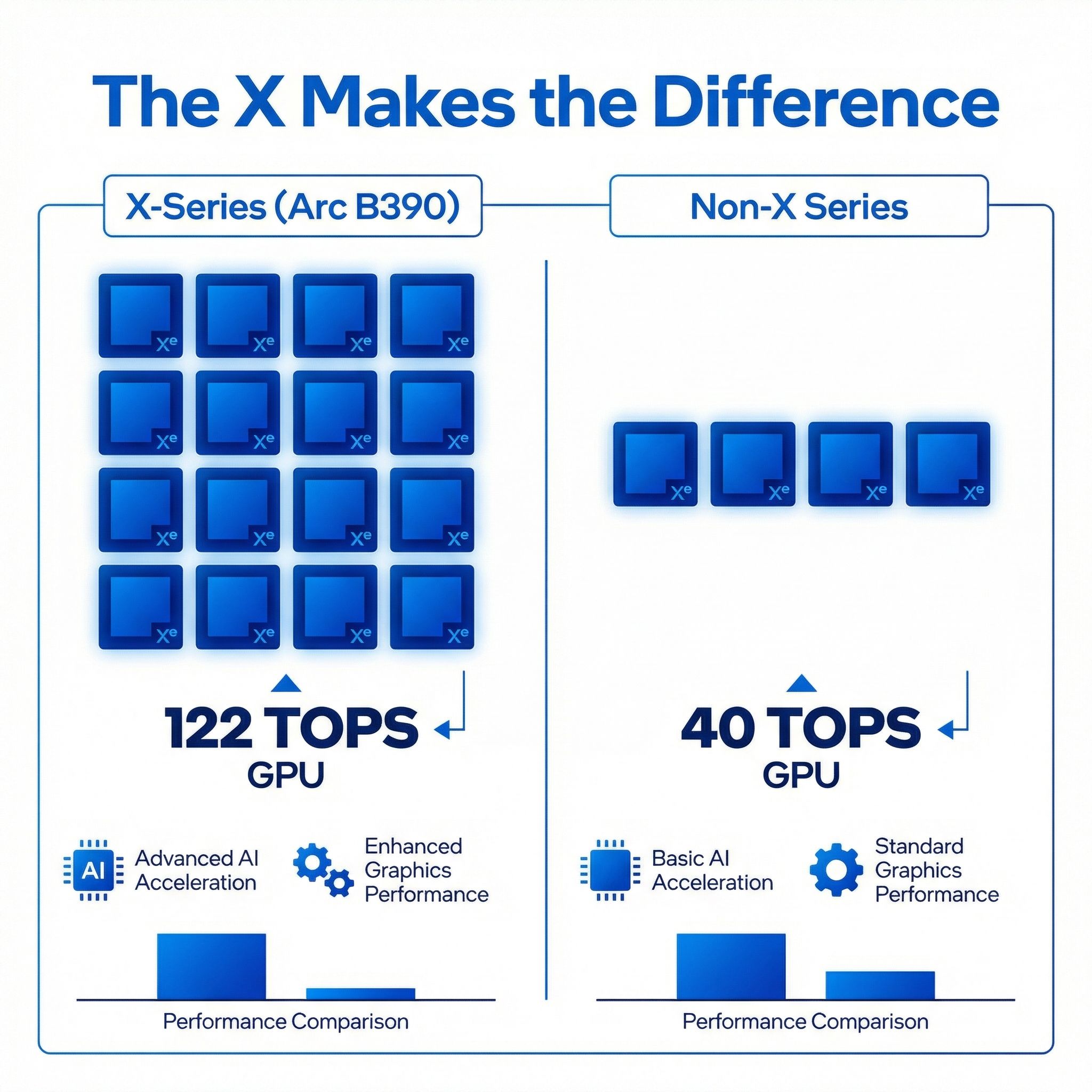
Not every Panther Lake chip includes the Arc B390. Intel’s naming scheme hides this behind a single letter, and getting it wrong means the difference between gaming-capable integrated graphics and a basic display adapter. The X-series processors (the Core Ultra X9 388H and Core Ultra X7 358H) pack all 12 Xe3 cores that make up the Arc B390, delivering 122 TOPS of GPU compute and Time Spy scores around 7,192 points. Drop down to the non-X chips (the Core Ultra 9 386H, Core Ultra 7 355, or Core Ultra 5 322) and you get just 4 Xe3 cores with roughly a third of the graphics power.
The letter matters when shopping for a mini PC. The MSI Cubi NUC AI+ 3MG, for example, uses the Core Ultra 9 386H, a chip with strong CPU performance and a 50 TOPS NPU, but only 4 Xe3 graphics cores. Someone buying it for gaming based on Panther Lake marketing would be deeply disappointed. Meanwhile, the Khadas Mind Pro ships with the Core Ultra X7 358H and its full Arc B390, delivering the benchmark numbers that have reviewers excited. The “X” in the processor name isn’t a marketing flourish. It’s the dividing line between useful integrated graphics and a basic iGPU that’s fine for desktop work but nothing more.
The tradeoff goes beyond just GPU cores. Most X-series Panther Lake systems use LPDDR5X memory soldered to the board, which means faster memory bandwidth for GPU workloads but zero upgrade path. However, the memory type depends on the system design, not just the chip: ASRock’s NUC Ultra 300 pairs the Core Ultra X7 358H with socketed DDR5 SO-DIMMs up to 128GB, proving that X-series chips can work with user-replaceable memory. The tradeoff there is less memory bandwidth for GPU workloads compared to LPDDR5X systems. For homelabbers running virtual machines, that 128GB with socketed DIMMs might matter more than squeezing every last frame from the Arc B390.
The Arc B390 Trades Blows With the RTX 4050
The benchmark numbers tell a nuanced story once you look past the headlines. In 3DMark synthetics, the Arc B390 trades blows with the RTX 4050 Laptop GPU, winning some tests and losing others by single-digit margins depending on the benchmark and the RTX 4050’s power configuration. In real-world gaming, the picture requires more context.
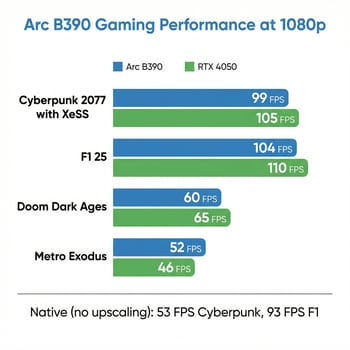
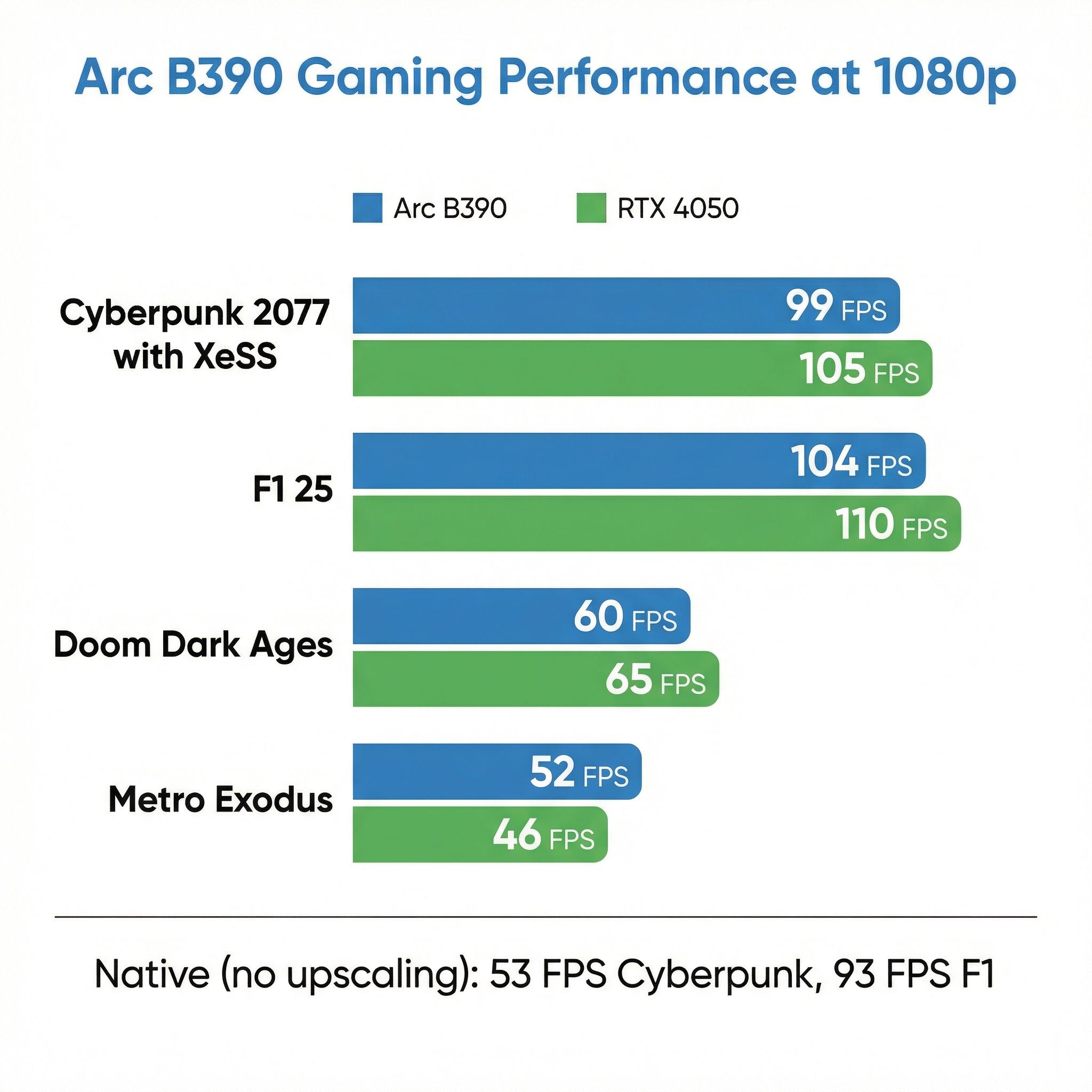
At native 1080p without upscaling, the Arc B390 delivers playable frame rates: 53 FPS in Cyberpunk 2077 at High settings, 74 FPS in Shadow of the Tomb Raider, and 93 FPS in F1 25. Turn on XeSS Balanced upscaling and those numbers jump dramatically: Cyberpunk hits 99 FPS, F1 pushes past 100 FPS, and even demanding titles like Doom: The Dark Ages reach a smooth 50-70 FPS range. The Arc B390 is also the first integrated GPU to support multi-frame generation at up to 4x, which can push Cyberpunk past 160 FPS with XeSS and 2x frame gen enabled, though input lag increases make this more useful for visual smoothness than competitive gaming.
Where the Arc B390 changes the game for mini PCs is power efficiency. The whole system draws roughly 56W from the wall during heavy GPU workloads, about half what AMD’s faster Radeon 8060S requires. In a 0.5-liter chassis like the MSI Cubi or a compact NUC form factor, that efficiency advantage translates directly into quieter fans, lower surface temperatures, and smaller power supplies. For a desktop that sits on your desk rather than under it, thermal behavior matters as much as raw performance.
The Arc B390 sits in a tier that didn’t exist before: integrated graphics capable of real 1080p gaming without the heat, noise, and cost of a discrete GPU. It doesn’t eliminate the need for dedicated graphics in every scenario. AMD’s Strix Halo mini PCs with the Radeon 8050S and 8060S pull 20-60% ahead in raw GPU performance, and NVIDIA’s mobile RTX 4050 still wins in ray tracing workloads. But for the typical mini PC buyer who wants occasional gaming, video editing, and creative work alongside daily productivity, the Arc B390 eliminates the awkward gap between “useless for games” and “needs a dedicated GPU.”
The Panther Lake NUC Lineup
Six manufacturers have launched or announced Panther Lake mini PCs, each making different tradeoffs. The key variables across these NUCs are GPU tier (full Arc B390 or entry-level 4-core), memory type (soldered LPDDR5X or socketed DDR5), and networking (2.5GbE versus 10GbE). Pricing ranges from the ASUS NUC 16 Pro’s $999 barebone to the Khadas Mind Pro’s $2,299 fully loaded configuration, and availability ranges from shipping now to “sometime in 2026.”
ASUS NUC 16 Pro
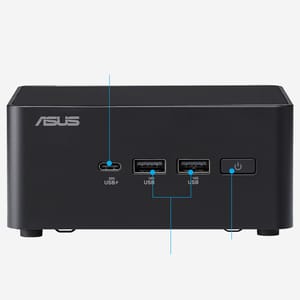
The ASUS NUC 16 Pro is now available, with configured models on Amazon ranging from the $999 barebone (Core Ultra 7 356H) up to $1,999 for a 32GB/2TB configuration. Pre-configured models with 16GB/512GB ($1,559), 16GB/1TB ($1,659), 32GB/1TB ($1,879), and 32GB/2TB ($1,999) are all shipping with the Core Ultra 7 356H processor and DDR5 CSO-DIMM memory upgradeable to 128GB. The familiar NUC form factor returns with 2x Thunderbolt 4 ports, 4x USB 3.2 Gen 2, dual 2.5GbE Ethernet, WiFi 7, Bluetooth 6.0, and PCIe Gen 5 storage in a tool-less 0.7-liter chassis. TechRadar reports that the Arc B390 in the flagship X9 388H delivers enough for 1080p gaming on high settings. The currently shipping 356H models have only 4 Xe3 GPU cores, not the full Arc B390. The X-series models with the complete 12-core Arc B390 haven’t reached US retail yet. For a detailed breakdown of specs, pricing, and reviewer insights, see our ASUS NUC 16 Pro product page.
ASUS NUC 16 Pro
- +$999 barebone entry point
- +DDR5 upgradeable to 128GB
- +dual 2.5GbE
- +Thunderbolt 4
- +0.7L chassis
- -Shipping 356H models have only 4 Xe3 GPU cores
- -X-series not yet available in US
Khadas Mind Pro
The Khadas Mind Pro packs the Core Ultra X7 358H with the full Arc B390 in a 0.43-liter chassis measuring just 146 x 105 x 28mm. Now priced at $2,299 (up from the original $1,799 early-bird price), the 64GB LPDDR5X and 2TB NVMe configuration includes WiFi 7, Bluetooth 6, dual Thunderbolt 4, and a built-in 7.98 Wh battery for portability. Khadas also offers a Mind Graphics 2 dock with a desktop RTX 5060 Ti for users who want to scale beyond integrated graphics. A 32GB/1TB configuration and a higher-end model with the Core Ultra X9 388H and 96GB RAM are planned for later.
ASRock NUC Ultra 300 BOX
ASRock targets the enterprise and industrial market with two SKUs: the Core Ultra 5 325 (8-core, 40 TOPS GPU) and Core Ultra X7 358H (16-core, Arc B390 with 122 TOPS GPU). The standout feature is socketed DDR5 supporting up to 128GB across two SO-DIMM slots, the only Panther Lake NUC in this lineup offering user-replaceable memory despite using an X-series chip. Dual HDMI 2.1 and dual DisplayPort 2.1 support four 8K displays, and dual 2.5GbE with Intel VMD RAID support across two M.2 NVMe slots (including PCIe Gen5) makes this a genuine workstation contender. Available in standard (49mm) and slim (38mm) chassis variants, both around 1 kg. Pricing requires distributor quotes, positioning this as business hardware rather than consumer.
Minisforum EliteMini M2 Pro
Minisforum brings the highest-end silicon with up to the Core Ultra X9 388H and 96GB LPDDR5X-9600 in either Arc B390 or Arc 370 (entry-level) GPU configurations. The networking stands out: 10GbE plus 2.5GbE gives it the best wired connectivity in this lineup, complemented by USB4 ports with eGPU capability. An integrated power supply eliminates the external brick. Pricing and availability haven’t been announced, but Minisforum typically undercuts ASUS pricing by 10-20% based on patterns from their existing mini PC lineup.
MSI Cubi NUC AI+ 3MG
The outlier in this group, MSI’s 0.51-liter Cubi uses non-X Panther Lake chips (the Core Ultra 9 386H, Ultra 7 355, or Ultra 5 322), meaning it gets only 4 Xe3 graphics cores instead of the full Arc B390. What it trades in GPU power it gains in expandability: two DDR5 SO-DIMM slots support user-replaceable RAM up to 32GB, and the tool-free design enables easy upgrades. Dual Thunderbolt 4, dual 2.5GbE, WiFi 7, and a fingerprint reader round out the I/O. At 120 x 115 x 38mm, it’s compact enough for VESA mounting behind a monitor. This is an enterprise desktop replacement, not a gaming machine; it’s also the smallest Panther Lake NUC in the lineup and the one most likely to hit accessible price points. Pricing and availability remain TBA.
GMKtec EVO-T2
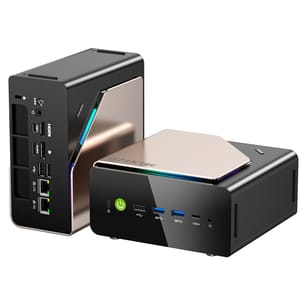
GMKtec entered the Panther Lake market with the EVO-T2, initially offered at $1,450 early-bird pricing with global retail at $1,899 starting March 30. It ships with the Core Ultra X7 358H or X9 388H and the full Arc B390, paired with up to 128GB LPDDR5X and Phison aiDAPTIV+ AI-optimized NVMe SSDs across two M.2 slots (one PCIe 5.0, one PCIe 4.0). The networking is particularly aggressive for this price range: OCuLink for external GPU support, 10GbE plus 2.5GbE dual LAN, USB4, and WiFi 7. Igor’sLab highlighted the EVO-T2’s 180 TOPS as a foundation for AI workloads, noting the combination of high-bandwidth memory and PCIe 5.0 storage as key differentiators. The EVO-T2 is available through both GMKtec’s direct sales channel and Amazon, offering more connectivity than the ASUS NUC 16 Pro: particularly the OCuLink and 10GbE that no other Panther Lake NUC in this lineup provides.
GMKtec EVO-T2
- +Full Arc B390
- +OCuLink for eGPU
- +10GbE + 2.5GbE
- +PCIe 5.0 storage
- -$1
- -899 launch price
- -64GB soldered RAM
- -limited first-batch availability
How Panther Lake Stacks Up Against the Competition
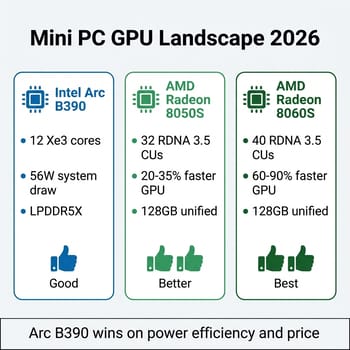
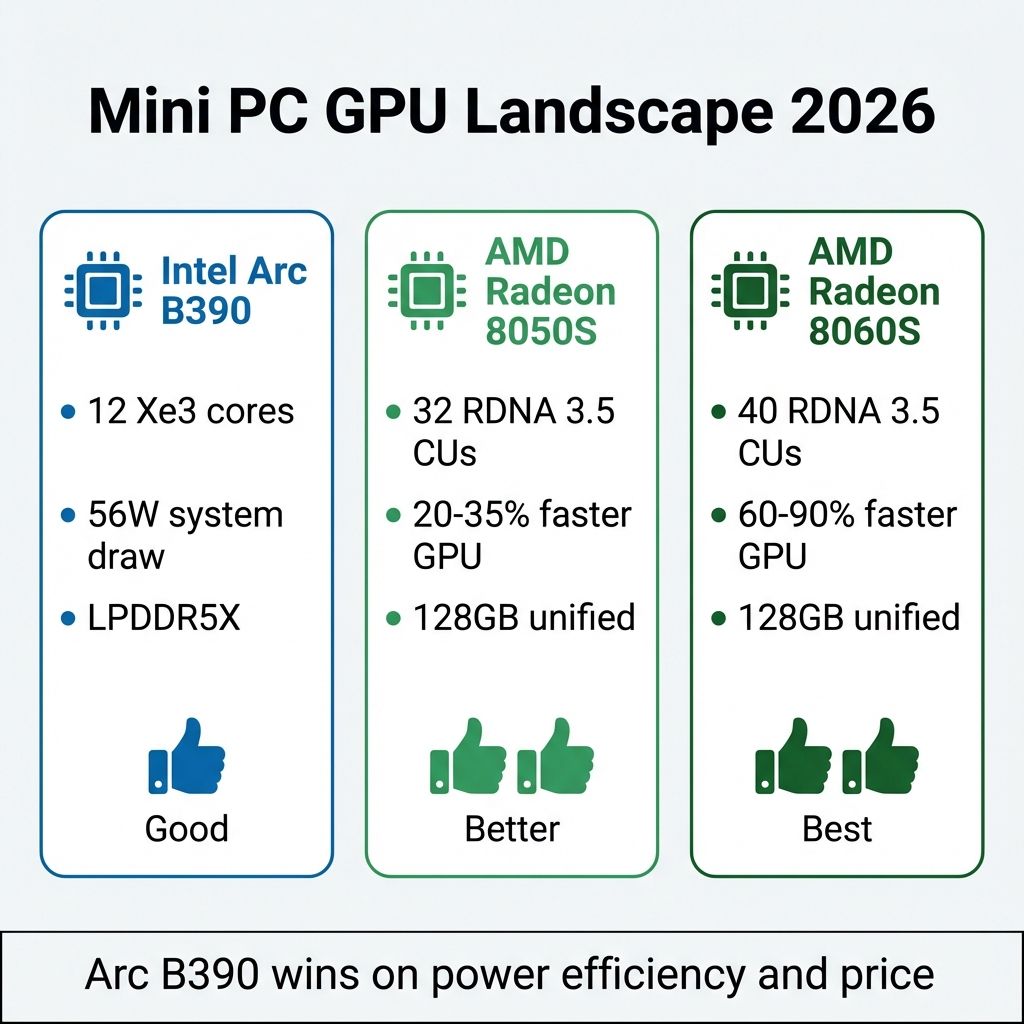
AMD’s Strix Halo platform occupies a different tier entirely. The Radeon 8050S in systems like the Framework Desktop pulls 20-35% ahead of the Arc B390 in GPU benchmarks, while the Radeon 8060S in higher-end machines leads by 60-90% in synthetics. AMD also offers up to 128GB of unified memory with bandwidth designed for AI inference workloads, a compelling proposition for anyone running local LLMs. Intel has been direct about this: they’re not positioning Panther Lake against Strix Halo, as the platforms serve different markets and price points.
Where the comparison gets interesting is against the outgoing Arrow Lake and Lunar Lake generations that Panther Lake directly replaces. The Arc B390 delivers roughly 77% more GPU performance than Lunar Lake’s Arc 140V and over 40% better performance-per-watt than Arrow Lake’s Arc 140T. For anyone upgrading from a current Intel mini PC, the jump is substantial. The ASUS NUC 14 Pro with its Arrow Lake chip offered fine productivity performance but struggled with anything beyond basic gaming. Panther Lake X-series chips change that equation dramatically.
Linux support is also worth noting for Starry Hope’s audience. The Xe3 architecture has working support in Linux 6.18 with Mesa 26.1 drivers, and Phoronix testing on Ubuntu 26.04 shows strong gains over the previous generation. If you’re planning a Linux workstation or home server, the driver situation is in decent shape, a notable improvement over the early Xe days when Intel iGPU support lagged behind for months after hardware launches.
Should You Wait or Buy Now?
The Panther Lake mini PC market has moved from announcements to real products you can buy. The ASUS NUC 16 Pro offers the most accessible entry point at $999 for the barebone Core Ultra 7 356H, with pre-configured models available on Amazon up to $1,999 for a 32GB/2TB system. The GMKtec EVO-T2 targets power users with its OCuLink, 10GbE networking, and full Arc B390 at $1,899 through both GMKtec and Amazon. And the Khadas Mind Pro remains the most compact option at $2,299 for a 0.43-liter chassis with the full Arc B390. The Minisforum EliteMini M2 Pro and ASRock NUC Ultra 300 still lack confirmed retail dates.
For budget-conscious buyers, the NUC 16 Pro barebone at $999 is the most practical starting point: add your own RAM and NVMe storage and you’ll have a capable Panther Lake system for under $1,200. Just keep in mind that the 356H models currently shipping have only 4 Xe3 GPU cores, not the full Arc B390. If gaming performance is your priority, you’ll need to wait for the X-series models or look at the GMKtec EVO-T2 or Khadas Mind Pro, both of which ship with the complete 12-core Arc B390.
If raw GPU performance matters most, AMD Strix Halo systems still pull 20-60% ahead with the Radeon 8050S and 8060S. The emerging Snapdragon X2 mini PCs offer an ARM alternative with high power efficiency. And if you want a capable Intel system right now at a lower price, the ASUS NUC 14 Pro handles daily productivity tasks well and may see price cuts as Panther Lake inventory grows.
The 180 TOPS AI performance figure that manufacturers are advertising deserves a reality check, too. That number combines CPU, GPU, and NPU compute: it’s a composite marketing metric, not a measure of what any single workload can actually access. The NPU alone delivers 50 TOPS, which meets Windows Copilot+ requirements and handles on-device AI features capably. But if you’re comparing that 180 TOPS headline against Apple’s M-series or NVIDIA’s dedicated AI hardware, you’re comparing apples to oranges.
This article is about what the hardware can do. For the money side of the same decision, including what the entry Panther Lake graphics tier measures against a two-generation-old Meteor Lake box, see our companion piece on Meteor Lake vs Panther Lake mini PC pricing.
What’s not in question is the trajectory. Integrated graphics have reached a point where a sub-liter mini PC can run Cyberpunk 2077 at playable frame rates, handle 4K video editing, and drive four displays simultaneously. With the NUC 16 Pro starting at $999 and the EVO-T2 offering enthusiast-grade connectivity at $1,899, the Panther Lake lineup now spans multiple budgets and use cases. The Arc B390 has moved the floor of what Intel’s compact hardware can deliver, and that benefits everyone shopping for a mini PC in 2026.