Tom’s Hardware published two mini PC reviews a day apart in August 2026, both by the same reviewer, on the same bench, running the same benchmark suite. On August 12 it covered the GMKtec EVO-T2, a Panther Lake box listed at $1,959 with 64GB of memory and a 1TB SSD. On August 13 it covered the Geekom IT13 Max 2026, a Meteor Lake box listed at $799 with 24GB and a 500GB SSD. Sitting between them in the same comparison charts was a third machine, the MSI Cubi NUC AI+ 3MG, running Panther Lake silicon of a lower tier. Read the three together and the generational story stops being a straight line.
Starry Hope has already covered what the top Panther Lake parts can do. Our piece on Intel’s Arc B390 iGPU in Panther Lake NUCs walks through the twelve-core Arc B390, the X-series naming, and the gaming numbers, and this article deliberately does not re-litigate any of that. The question here is the money one: at current prices, what does a buyer who is not gaming and not running local models get for the extra spend, and where does the newer generation come out behind?
The August 2026 price spread
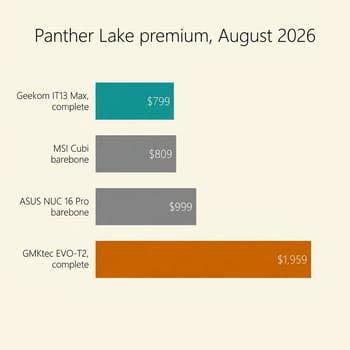
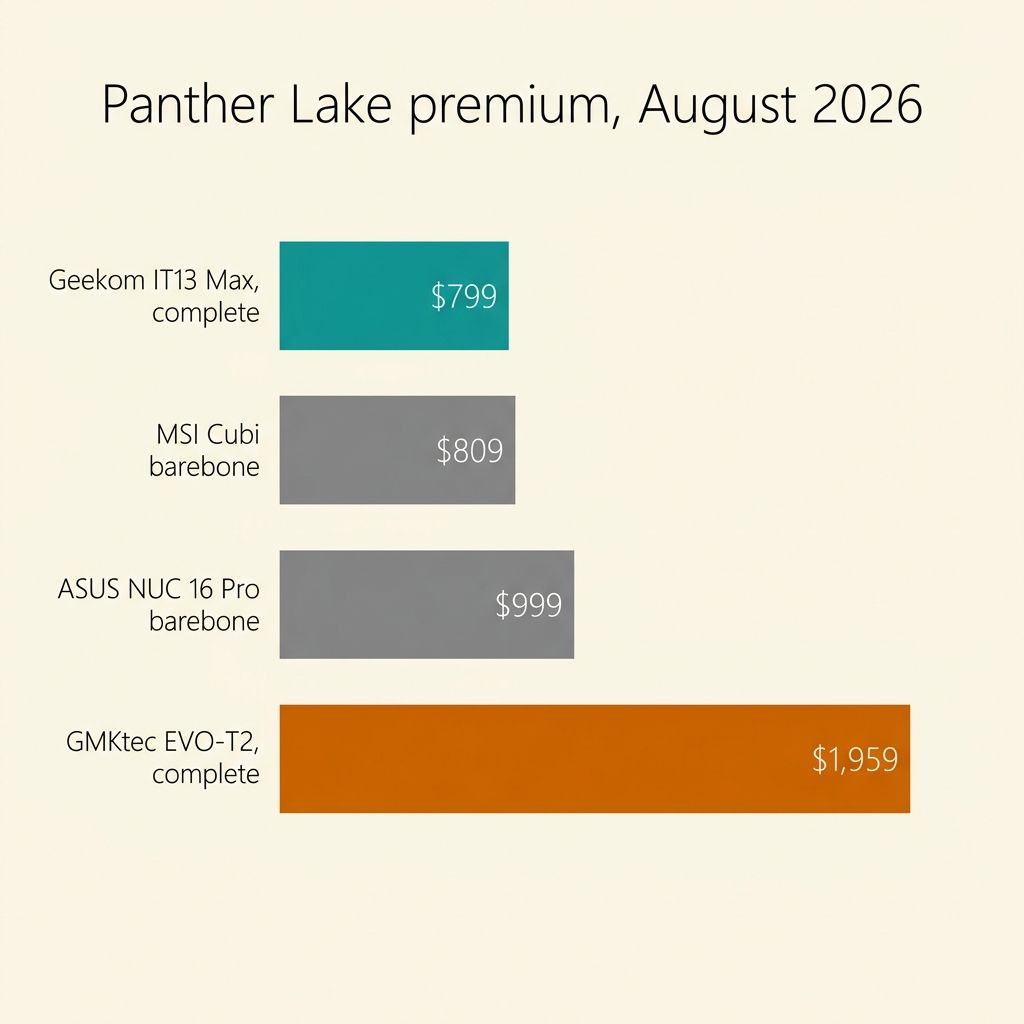
Quoting a single multiple would flatter one side or the other, because the Panther Lake range is wide. Tom’s reviewed the EVO-T2 at a $1,959 MSRP for the Core Ultra X7 358H with 64GB and a 1TB drive, and PCWorld’s review of the same silicon on August 7 landed on the same $1,959; GMKtec’s own store was showing $1,899 for it when Tom’s checked, which is a reminder that even one SKU carries more than one number. At the other end of the same generation, Tom’s found MSI selling the Cubi with a Core Ultra 5 322 in a 16GB/1TB configuration for $1,079 on Amazon, and a Core Ultra 7 355 version at $1,549. The ASUS NUC 16 Pro lists at $999 barebone and climbs to $1,999 for 32GB and 2TB.
So the useful figure is not a ratio, it is a spread. As of August 2026, shipping Panther Lake mini PCs list from roughly $809 for a Core Ultra 9 386H barebone up to $1,959 fully configured, while a complete Meteor Lake box with memory, storage, and Windows 11 Pro included sits at $799. Every figure here is a list price on a specific date; the Geekom IT13 Max and NUC 16 Pro product pages carry current prices.
Read the processor, not the model name
GMKtec’s naming is the clearest trap in this comparison. Tom’s Hardware reviewed a machine it calls the Evo-T2 running the Core Ultra X7 358H. PCWorld reviewed a machine it calls the EVO-T2S running the same Core Ultra X7 358H at the same price, and noted that GMKtec lists the Core Ultra X9 388H version as the EVO-T2, which was out of stock when it tested. Our own GMKtec EVO-T2 page carries both chips under the one product name, because that is how the listings arrive.
The practical rule follows from that mess: the model name on the box is not a reliable guide to the silicon inside it. Read the processor string on the listing before you order, compare it against the specification you meant to buy, and if a listing does not print a processor model at all, treat the omission as a reason to skip it. This is not a GMKtec-only habit, and it matters more in 2026 than it used to, because the graphics tier inside Panther Lake moves with the individual chip rather than with the generation. Our Arc B390 piece covers which parts carry the full GPU and which do not.
The entry Panther Lake graphics test slower than Meteor Lake
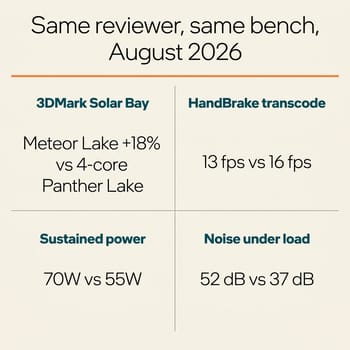
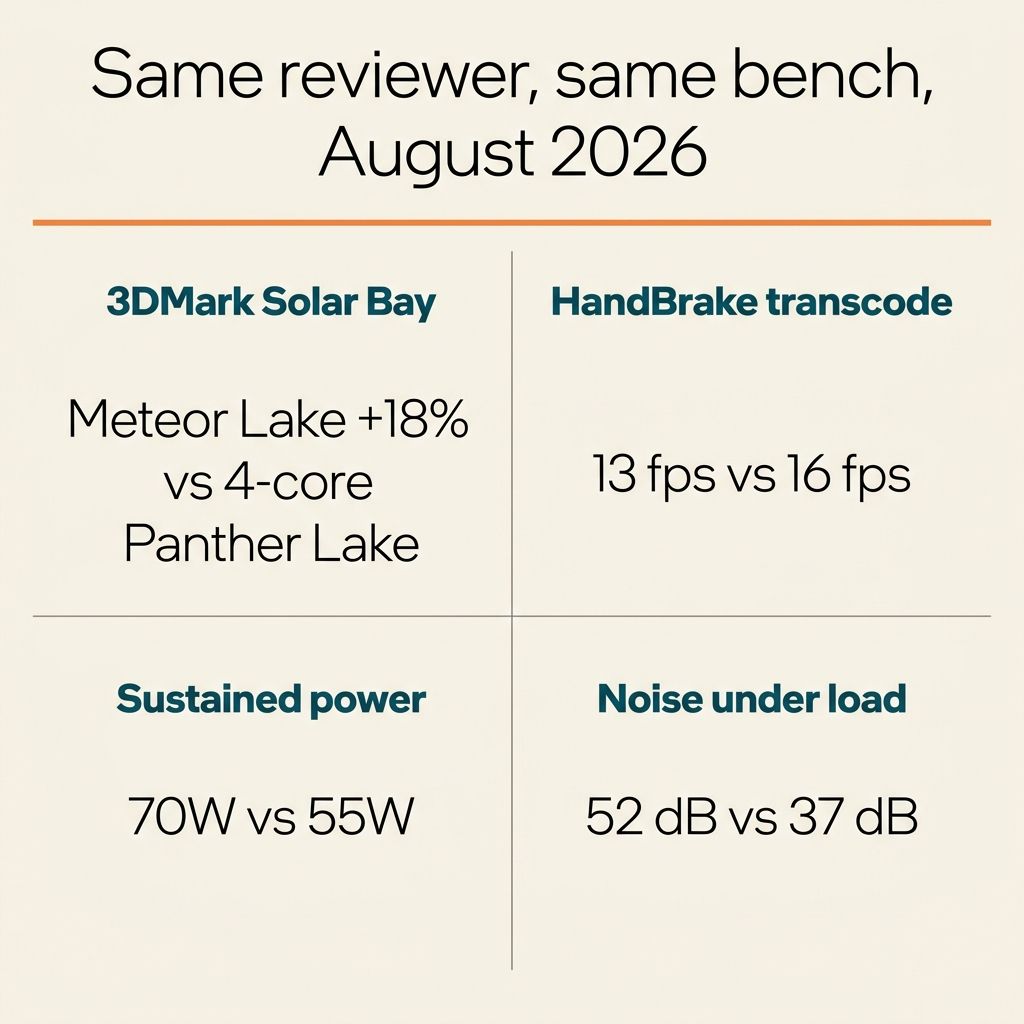
Here is the result that reframes the buying question. In 3DMark Solar Bay, a cross-platform test Tom’s Hardware uses specifically because it scales sensibly on integrated graphics, the Geekom IT13 Max scored 13,430. Tom’s then wrote that the Meteor Lake machine’s score, with its eight Xe-LPG cores, “is about 18% faster than the newer Panther Lake rival (with four Xe3-LPG cores).”
Both halves of that sentence carry weight. The comparison is against the MSI Cubi and its Core Ultra 9 386H, a Panther Lake chip that ships with four Xe3 graphics cores. It is emphatically not a comparison against the twelve-core Arc B390, which Tom’s says in the same paragraph that both machines “crumble in comparison with.” Repeating the 18% figure without that qualifier turns a narrow, specific result into a false claim about an entire generation, and you will see it repeated that way.
What the number does establish is narrower and more useful: buying a newer Intel generation does not by itself buy better graphics. A Core Ultra 9 185H from two generations back, with eight Xe-LPG cores, measured ahead of a current Core Ultra 9 386H with four Xe3 cores, on one bench, from one reviewer. If your reason for paying more is that the chip is newer, the entry Panther Lake tier does not reward that instinct.
The CPU results are closer than the price spread
On the processor side the gap narrows further, though it depends which Panther Lake you line the Geekom up against. Tom’s reports that in Cinebench 2026, the Geekom’s older Meteor Lake chip “basically matches” the Panther Lake Core Ultra 9 386H on the multicore result, crediting the Geekom’s 16 cores and 22 threads and its higher power limits against the MSI’s 16 cores and 16 threads. That multicore comparison was published as a chart rather than as numbers in the text, so the parity is the reviewer’s reading rather than a figure worth quoting. The single-thread result runs the other way: the Geekom landed around 450 points and trails the field.
Where the same outlet did print numbers for both boxes is HandBrake. The Geekom transcoded at 13 frames per second and the EVO-T2 at 16, and Tom’s described the Geekom as “neck and neck” with the MSI on the same test. That is a 23% transcoding advantage for a machine listed at $1,959 over one listed at $799.
The numbers above all come from one outlet, one reviewer, and one bench, which is exactly why they are worth putting side by side. Cross-outlet benchmark arithmetic is where mini PC comparisons usually break down, because memory configuration, power limits, and fan profiles differ more between two review samples than the silicon does.
Power and noise depend on the box, not the generation
Panther Lake’s reputation for efficiency shows up in this group, but it belongs to specific machines rather than to the architecture. Tom’s measured the MSI Cubi drawing roughly 55W sustained at the wall against the Geekom’s roughly 70W. Reviewing the MSI separately, Tom’s put that lower ceiling down to configuration rather than architecture, writing that MSI’s default profile maxes out around 55W while the GMKtec machine it compared against was seen pulling over 70W. The EVO-T2, also Panther Lake, peaked around 72W, so the efficiency story belongs to specific power profiles rather than to the generation. Reviewing the Geekom, Tom’s put the point plainly, noting that efficiency is “far more important in a laptop than a mini PC like this.”
Noise tracks power, and it is the difference you are most likely to notice. The Geekom measured 29.8 dB idle and 52.3 dB under sustained load, which is clearly audible across a room. The MSI ran 30.8 dB to 37.3 dB, and the EVO-T2 32 dBA to 38 dBA. For a machine that sits on your desk rather than in a cupboard, that is a genuine argument for the newer boxes, and it has nothing to do with benchmark scores.
Most of the gap is memory and storage
Line the barebone prices up and the shape of the premium changes. A Panther Lake MSI Cubi with the Core Ultra 9 386H and no memory, storage, or operating system was $809 on Amazon when Tom’s checked. An ASUS NUC 16 Pro barebone with the Core Ultra 7 356H lists at $999 on the same terms. A complete Geekom IT13 Max, memory and SSD and Windows 11 Pro included, is $799. Priced as bare hardware, the step from one Intel generation to the next is a couple of hundred dollars at most.
The rest arrives with the memory and the drive. Adding 16GB in a single SO-DIMM, a 1TB SSD, and a Windows 11 Home license took that same $809 Cubi to $1,661, and the Windows 11 Pro version to $1,767. ASUS charges $560 to go from its $999 barebone to a 16GB/512GB configuration. GMKtec does not sell the EVO-T2 barebone at all, so its 64GB of soldered LPDDR5X and its 1TB drive are compulsory parts of the $1,959.
That is less about vendor greed than about the memory market. Tom’s Hardware, reporting TrendForce’s Q3 2026 survey, has conventional DRAM contract prices rising a further 13% to 18% quarter over quarter after roughly 60% jumps the quarter before, with those costs feeding through into retail pricing. Testing the NUC 16 Pro, Level1Techs called 32GB “the sweet spot” and said it was “tough to recommend the 64 gig configuration” at current prices. The old escape hatch of buying barebone and bringing your own memory still works, but it saves less than it did a year ago.
Which one to buy
For a single person’s everyday desktop, the deciding variable is the memory you can never change later. The IT13 Max 2026 that Tom’s tested ships 24GB of soldered LPDDR5 and that number is final, which is exactly the soldered-RAM tradeoff worth thinking through before you order. Geekom also still sells an older IT13 Max with two SO-DIMM slots and a 96GB ceiling, which Tom’s noted was discounted to the same $799 at review time. With DRAM priced where it is, the soldered 24GB is the better value today and the SO-DIMM version is the better bet if you expect to keep the machine past the current squeeze. Either way, this is the tier where $1,959 buys very little you will feel.
For a small office buying several machines, what comes with the box usually matters more than what is in it. The MSI Cubi adds a fingerprint reader in the power button that Tom’s found inconsistent, a remote power button on a cable, and three years of advanced warranty coverage when ordered with Windows 11 Pro, and it was the quietest machine in the group under load. Against that, Tom’s was blunt about the value, writing that less established brands “definitely offer better value with more potent processors, and more generous memory/storage configurations, at better or similar pricing.” Geekom’s three-year warranty requires you to pay return shipping. Price the Windows licenses and the warranty terms before you read the benchmarks, because at this tier those line items move the total more than the chip does.
For a homelab or an always-on host, the deciding variables are the memory ceiling and how mature the graphics stack is on Linux. Meteor Lake’s Xe-LPG graphics have been supported in mainline kernels since early 2024, so any current distribution picks them up. Xe3 is newer, and Level1Techs’ Linux testing on the NUC 16 Pro found sleep and resume misbehaving on kernel 6.19 and working consistently on kernel 7.0 across both Arch and Ubuntu 24.04 LTS, calling it “a first class Linux experience” once you are on the newer kernel. If your distribution ships an older kernel, that is a scheduling problem rather than a footnote. The NUC 16 Pro barebone is the strongest Panther Lake option for this use, because its two DDR5 slots take up to 128GB, which no soldered box here can approach.
GEEKOM IT13 MAX
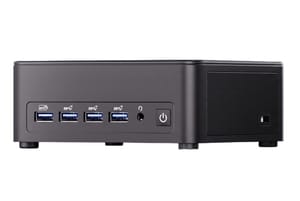
- +$799 complete with memory
- +SSD and Windows 11 Pro
- +16 cores and 22 threads
- +dual 2.5GbE
- +two USB4 ports
- +SO-DIMM version still sold
- -52.3 dB under sustained load
- -24GB soldered on the 2026 model
- -no front USB-C
- -no biometrics
GMKtec EVO-T2
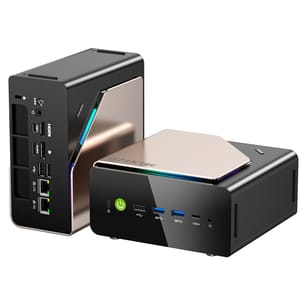
- +Twelve-core Arc B390 graphics
- +64GB LPDDR5X
- +OCuLink for an external GPU
- +10GbE plus 2.5GbE
- +quiet at 38 dBA loaded
- -$1
- -959 with no barebone option
- -soldered memory
- -one-year warranty
- -model naming does not tell you the chip
ASUS NUC 16 Pro
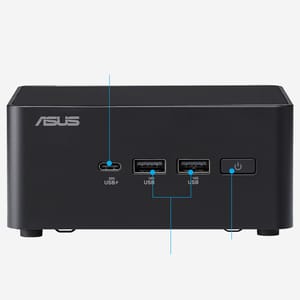
- +$999 barebone entry
- +two DDR5 slots to 128GB
- +dual Thunderbolt 4
- +dual 2.5GbE
- +PCIe Gen 5 storage
- +tool-less chassis
- -$560 to add 16GB and 512GB
- -Xe3 needs kernel 7.0 for reliable sleep and resume
- -X-series parts not yet at US retail
None of this makes Panther Lake a bad generation. It makes it a generation whose gains sit in places most mini PC buyers do not spend their day: the top X-series graphics tier, and a power envelope that counts for more inside a laptop. In the middle of the range, where most people shop, an August 2026 buyer choosing between a $799 Meteor Lake box and a Panther Lake box at $1,079 or $1,959 is mostly deciding how much memory and storage to prepay for at a bad moment to be buying either. That arithmetic should look different once memory supply loosens and the X-series parts reach US retail in volume, and this comparison is worth revisiting when it does. If you want the wider field first, our roundup of mid-tier mini PCs worth buying in 2026 covers the AMD side of the same budget.