For about a decade, the pitch for a mini PC was easy to make against a laptop, because the laptop you were comparing it to cost noticeably more. That gap nearly closed in March, when Apple announced the MacBook Neo at $599 with the fanless A18 Pro chip, a 13-inch Liquid Retina display, and a 16-hour battery. Then on June 25, Apple raised the Neo to $699, with the education price going from $499 to $599, and it blamed the memory chip shortage. So the cheapest competent Apple laptop now costs about $100 more than a Ryzen mini PC before you add a screen.
The Neo is a good purchase for the buyer who wants one finished thing in a bag, and a mini PC remains the better value for the buyer who needs a machine that stays on, drives two screens, runs Linux, or holds more than 8GB. The $100 increase widened the gap on the budget end, since a cheap box and a basic monitor now come in at less than half the Neo’s price.
The Neo targets the biggest slice of the 2026 laptop market
Analyst Ming-Chi Kuo reported that Apple doubled its 2026 production forecast from 5 million to 10 million units after a strong launch quarter, and IDC framed the launch, as reported by MacRumors, as “putting real pressure on the entire PC ecosystem.” The same IDC figures, as MacRumors relays them, put the sub-$700 notebook tier at roughly 75 million units a year, about 40 percent of all notebook volume, and forecast an 11.3 percent decline in PC shipments for 2026. At $699 the Neo still sits inside that price-sensitive tier, though now at its very top rather than in the middle of it.
That pressure shows up in mini PC coverage too. Kotaku ran a piece pitching the GMKtec G3 line as a cheaper alternative to the Mac mini, and r/MiniPCs threads weigh whether a sub-$300 box still makes more sense than Apple’s cheapest laptop.
A mini PC costs less if you reuse peripherals or accept a basic display
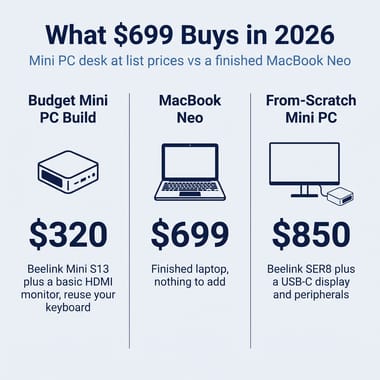
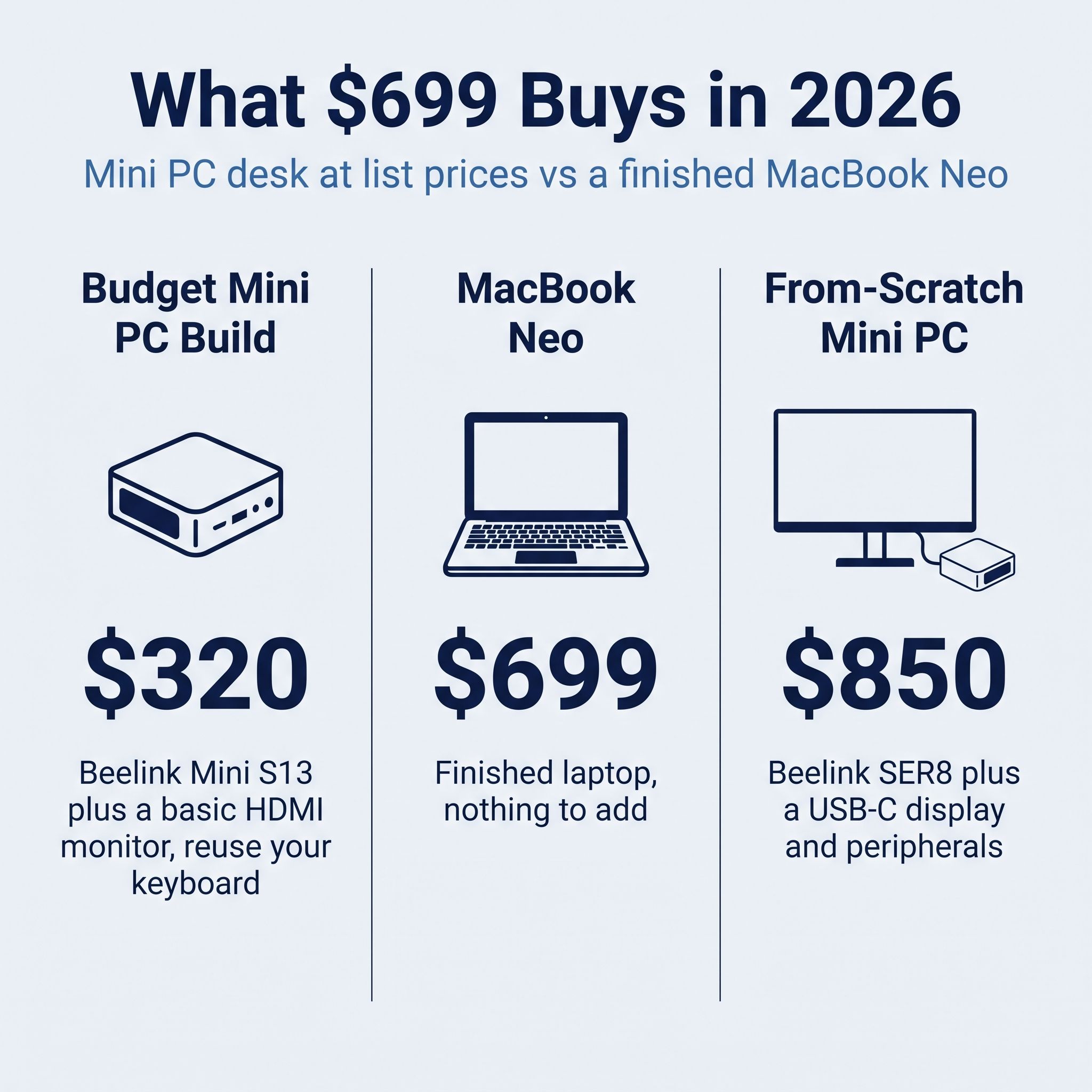
Start with the budget path. A Beelink Mini S13 lists at $219 for an Intel N150 with 16GB of memory and a 512GB SSD. Pair it with a plain 24-inch 1080p monitor over HDMI, which sells for around $100, and reuse a keyboard and mouse you already have. On those two figures the whole desk comes in near $320, less than half the Neo’s price, and you get double the memory and double the storage of the base Apple machine. The same memory shortage behind Apple’s increase has pushed street prices for 16GB boxes well above their list prices this year, so check the live price before you count on $219. Even with a sizable markup, this desk stays far below $699.
Now build it the way a first-time buyer would, from scratch and cabled with one wire. A Beelink SER8 with a Ryzen 7 8745HS, 24GB of memory, and a 1TB SSD lists at $599, about $100 under the Neo on its own. Add a single-cable USB-C display that also charges and acts as a dock, like the BenQ GW2786TC at about $210 per PCWorld, plus a keyboard and mouse, and you land around $850. At that point the Neo is still the cheaper finished product by roughly $150, and it fits in a bag.
Power belongs on the spreadsheet too. A mini PC that you leave on all the time draws watts every hour of every day, where a laptop you close sleeps for free. For an N150 box idling at a few watts the yearly cost is trivial, a few dollars, but for a Ryzen machine pushing background workloads it is a number worth knowing before you assume the box is the cheaper long-term choice; our 24/7 running-cost breakdown does that math. Prices throughout this piece are list figures as of September 2026. Treat them as a snapshot, because this market is moving.
The memory shortage raised the Neo’s price and the mini PC’s
As MacRumors relays IDC’s figures, much of that forecast PC decline traces to a memory shortage that is pushing average selling prices up around 17 percent in 2026, with no meaningful relief expected before the end of 2027. That cuts against the mini PC value story, because the entire pitch of a bargain box is generous RAM and SSD for the money, and those are exactly the components getting more expensive. Apple fixed the base Neo at 8GB and 256GB, but that did not insulate it: Apple’s $100 increase in June came with a statement, quoted by MacRumors, that “we have never seen a component price increase this much, this quickly.” A 16GB mini PC is still the better hardware-per-dollar deal today, and the Neo’s increase helped that case.
Where the $699 Neo wins
If you want one object that you open and use, with nothing to assemble and no driver to chase, the Neo is the clear pick. It weighs 2.7 pounds, runs fanless and silent, and lasts a day on battery, none of which a desktop mini PC can offer. It runs full macOS, so the creative-curious buyer who wants GarageBand, iMovie, or the Mac versions of photo and video tools has an on-ramp that no mini PC running Windows or Linux quite matches on polish.
The 8GB ceiling is the Neo’s hard limit. For browsing, documents, light photo edits, and everyday app-switching, 8GB on Apple Silicon holds up better than the number suggests. Push into a large Lightroom catalog or a serious Final Cut timeline and you will feel it, and you cannot add more later because the memory is soldered. The $100 increase did not add memory either: the $699 model is the same 8GB and 256GB machine that launched at $599, and the 512GB model with Touch ID is now $799. So the Neo wins decisively for casual and lightly creative use; it is a weaker pick for anyone whose work will grow past what 8GB can hold. If you mostly want a cool, light laptop that comes in citrus, it is the answer, and our MacBook Neo versus Chromebooks piece covers that budget-laptop angle in depth.
Where a mini PC plus a display still wins cleanly
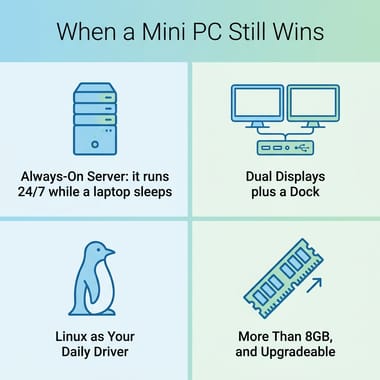
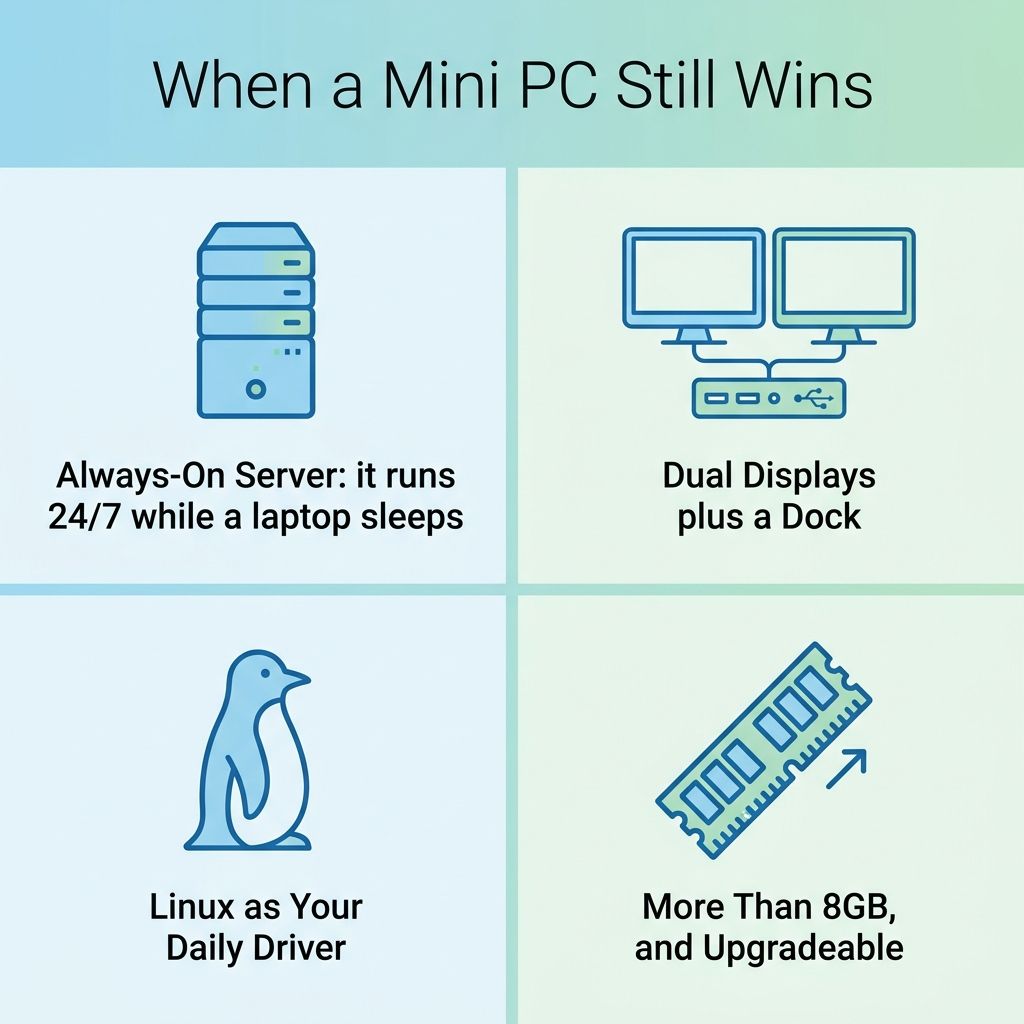
The cleanest mini PC win is the always-on machine. A laptop is designed to sleep; close the lid and the work stops. A mini PC is designed to sit there and run, which is why if you want a Plex or Jellyfin server, a Home Assistant hub, Pi-hole, or a small network drive humming in a closet, the box is the only one of the two that does the job at all.
A mini PC also wins on the multi-monitor desk. One with HDMI plus USB-C, or a proper dock, drives two external displays and a pile of peripherals through cabling that stays plugged in when you walk away. The Neo’s two USB-C ports (one of them USB 2.0 speed) and support for one external display make it the wrong tool for a heavy docked workstation. If you want Ubuntu, Proxmox, or a tinker-friendly OS as your daily driver, a mini PC is built for it, while the Neo is macOS and nothing else. Several mini PCs ship with 24GB or 32GB and have SO-DIMM and M.2 slots you can upgrade later, where the Neo’s 8GB and 256GB are fixed for the life of the machine.
If you specifically want macOS and an always-on machine, the fair comparison is the Mac mini, and that option got more expensive this year. Apple dropped the $599 Mac mini in May, and the current Mac mini with the M6 chip starts at $899 at Apple’s store with 16GB of memory and 256GB of storage. That is $200 more than the Neo before you add a screen, but it doubles the Neo’s memory, sits on a desk, and is happy to run all day. If local AI models are part of the plan, our M6 versus M5 Pro Mac mini comparison covers which configuration to buy.
The picks, by budget
The Beelink Mini S13 is the budget pick if you already own a screen and need a quiet, competent box.
Beelink Mini S13
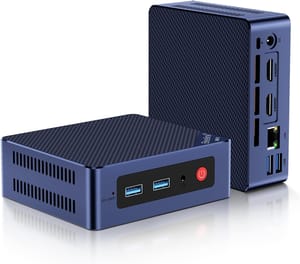
- +16GB RAM and 512GB SSD at a $219 list price
- +Intel N150
- +dual HDMI
- +two M.2 slots
- +idles around 7W
- -Not fanless
- -no USB-C
- -1Gb Ethernet only
- -memory capped at 16GB
Step up about $100 below the Neo’s price, before a screen, and you get Ryzen 7 performance with room to grow.
Beelink SER8
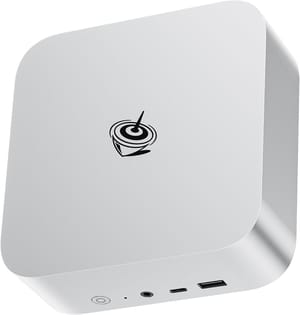
- +Ryzen 7 8745HS
- +memory upgradeable to 64GB
- +fast NVMe
- +dual-display output
- -Needs your own monitor and peripherals
- -draws more power if left on
- -not portable
The UM880 Plus adds memory and connectivity for anyone willing to spend more than the Neo.
MINISFORUM UM880 Plus
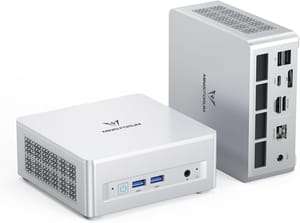
- +32GB RAM and 1TB SSD
- +Ryzen 7 8845HS
- +strong I/O
- +comfortable multitasking
- -Lists around $869
- -about $170 above the Neo before a display
- -no battery or portability
When the requirement is macOS that stays on, the Mac mini is the closest Apple equivalent.
Mac mini (2026)

- +Full macOS
- +M6 chip
- +16GB base memory
- +Wi-Fi 7 and 2.5Gb Ethernet
- +small and quiet
- -Starts at $899 with no display or peripherals
- -memory and storage fixed at purchase
- -not portable
The Neo outsold the M5 Air in its first quarter
According to IDC data shared with TechCrunch and relayed by 9to5Mac, the Neo moved about 1.1 million units in its debut quarter, ahead of the M5 MacBook Air at roughly 900,000 and the M5 Pro models near 550,000. IDC analyst Singh forecast a “very big spike” the following quarter as supply opened up. Read those as launch-quarter figures at the old $599 price and a forecast made before the increase, not a settled scoreboard. They still show a lot of people choosing the simple finished laptop, which is the buyer the Neo is built for.
Which one to buy at $699
Buy the Neo if the machine goes in a bag and you want it working the day it arrives. Buy a mini PC if it will sit on a desk or in a closet, especially if you already own a screen and keyboard. For the broader laptop-versus-box decision beyond Apple, our mini PC versus laptop for remote work guide and our Strix Halo local LLM analysis cover the workloads where a box pulls furthest ahead.
Product prices and availability are accurate as of the date and time indicated and are subject to change. Any price and availability information displayed at the time of purchase will apply.