Listen to this article:
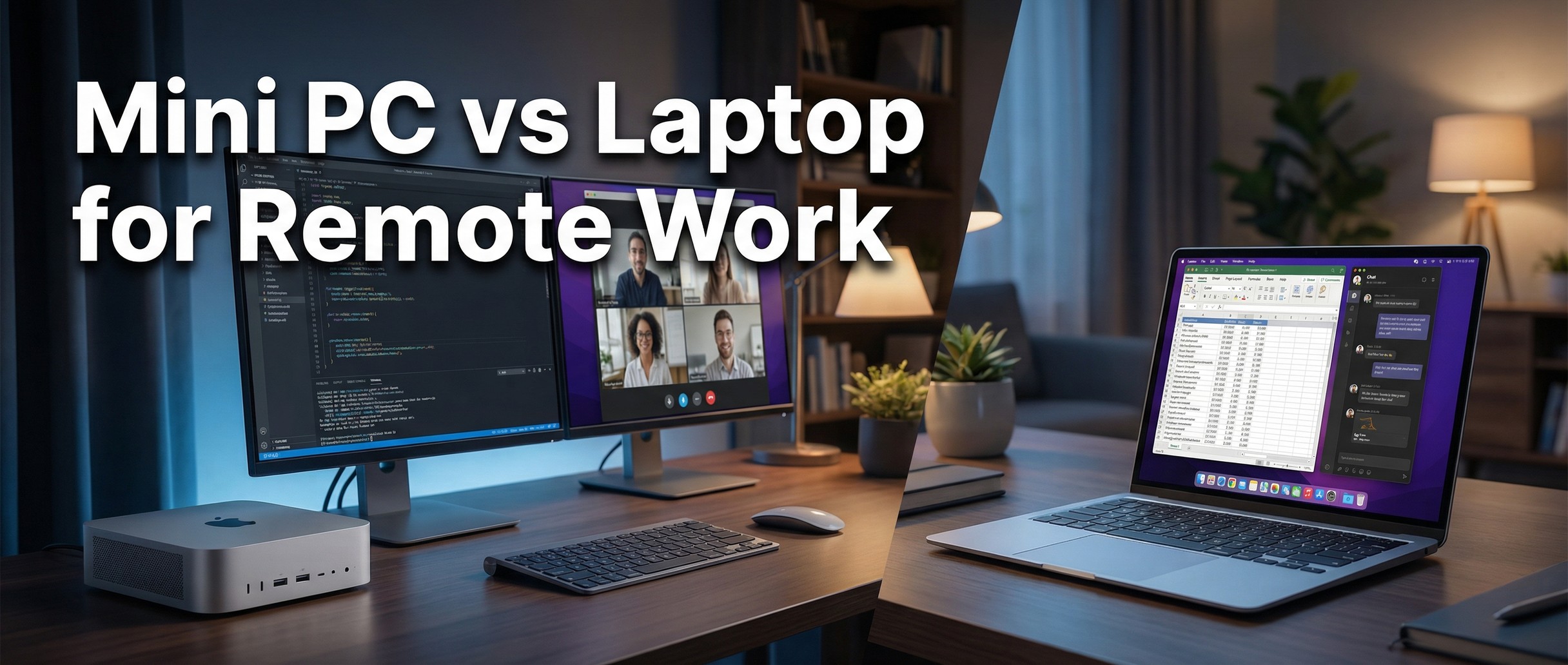
Some remote workers swear by the flexibility of a laptop, while others have gone all-in on desktop-style workstations. I’ve used both extensively, and I’ve come to believe that the “right” choice depends entirely on how you work.
The mini PC vs laptop question comes down to whether you stick with the laptop you already own or switch to a small desktop. The answer depends on how often you actually leave your home office, whether you’ve been suffering through a cramped single screen, and how long you plan to keep your setup before upgrading again.
Mini PCs Cost Less and Do More at a Desk

When I first switched from a laptop to a mini PC for my primary work machine, the performance difference surprised me less than the quality of life improvements. Yes, the mini PC was faster, but what changed my daily experience was everything around that speed: the silence during video calls, the multiple monitors that stayed exactly where I positioned them, and the simple reliability of a setup that didn’t require plugging and unplugging anything.
Mini PCs mostly run the same mobile chips laptops do, but in a chassis with room for real cooling and no battery budget, which means you’re getting more sustained performance per dollar compared to laptops. A $400 mini PC typically matches or exceeds a $700 to $800 laptop in raw performance because manufacturers don’t have to squeeze everything into a thin, portable chassis with battery life constraints. Those chips also don’t throttle as aggressively in a mini PC, since better cooling means the processor can sustain its performance during extended workloads. When you’re compiling code, rendering video, or running virtual machines, a mini PC maintains its speed while a laptop’s fans spin up and performance drops.
If you’re the kind of person who has Slack open alongside a browser with dozens of tabs, your IDE, maybe a video call, and some reference documentation, the mini PC keeps all of it responsive. That same workload might make your laptop uncomfortably warm and noticeably slower. The difference between a machine that’s working hard and one that’s coasting affects your perception of speed even when the benchmark numbers look similar.
The Multi-Monitor Advantage

Most mini PCs support two to four monitors directly through their HDMI and DisplayPort connections, no dongles required, no docking stations to troubleshoot. You plug in your cables, and they work. The typical setup offers two HDMI outputs plus one or two DisplayPort or USB-C connections with DisplayPort Alt Mode, giving you three or four displays without any adapters.
Compare that to the laptop experience: you have your built-in screen, maybe one HDMI output if you’re lucky, and then you need a $150 to $400 docking station to drive additional monitors. Even then, you might find yourself rebooting or replugging when a monitor randomly decides not to wake up from sleep.
Multi-monitor research puts the average self-reported productivity gain from multiple monitors at 42 percent, and the benefit scales further with three screens for certain workflows. For remote work specifically, having your video call on one screen, your documents on another, and your reference material on a third eliminates the constant Alt-Tab cycling that fragments your attention. Once you’ve worked this way, going back to a single laptop screen feels constraining.
An AMD Ryzen 5 Build Costs Less Than a Laptop and Dock
For a $1,000 budget with a mini PC, you could put together something like this: a capable mini PC with an AMD Ryzen 5 processor for $300 to $400, two 24-inch 1080p monitors for $250 to $300 total, a good mechanical keyboard for $50 to $80, a quality mouse for $30 to $50, and a decent webcam for $50 to $80. That brings your total to somewhere between $680 and $910, with change left over. Models like the Beelink SER5 or the GEEKOM A5 balance price and performance.
The laptop route for the same $1,000 budget looks quite different. A decent work laptop runs $800 to $1,000, and if you want multiple external monitors, you need a USB-C dock for another $200 to $350. Even with the dock, you’re still tied to the laptop’s built-in screen when you’re mobile, and connecting everything when you sit down at your desk becomes a daily ritual. For comparable productivity to the mini PC setup, you’re looking at $1,200 to $1,600 or more.
Mini PC RAM and SSD Slots Stay Open; Laptop Memory Does Not
Most modern laptops solder RAM and storage directly to the motherboard. When your 8GB laptop starts struggling with browser tabs three years from now, your options are limited to dealing with it or buying a new laptop entirely. That thin design came at the cost of any meaningful upgrade path.
Mini PCs take the opposite approach. Most of them still use SO-DIMM slots, typically upgradeable to 32GB or even 64GB, though a growing number of newer models solder LPDDR5 memory, so check the spec before you buy. Most use standard M.2 SSDs that you can swap or expand, and some support adding a second drive for extra storage. When your mini PC feels slow in a few years, a $60 RAM upgrade and an $80 SSD upgrade can give it new life. This upgradeability advantage becomes even more valuable as DRAM prices continue to climb, making it cheaper to add RAM to an existing mini PC than to buy a new laptop with more memory.
This upgradeability also means you can buy a more modest system initially and upgrade components as your needs change or as prices drop.
Better Ergonomics by Default
When you use a laptop as your primary work machine, you’re forced into one of three compromises: you look down at the screen, which is terrible for your neck over eight hours; you use an external keyboard and monitor anyway, at which point you’re just using the laptop as a desktop; or you buy a laptop stand and external keyboard, adding cost and complexity while still dealing with the laptop’s smaller screen.
A mini PC setup forces you into proper ergonomics from day one. Your monitors sit at eye level on stands or arms, and your keyboard rests at the correct height. I’ve talked to remote workers who dealt with persistent neck and shoulder pain until they switched to a proper desktop setup.
Laptops Are the Better Buy If You Work Away From Your Desk

If your job requires you to work from coffee shops, co-working spaces, client offices, or airports with any regularity, a mini PC isn’t practical. You can technically travel with a mini PC and a portable monitor, but that’s a lot of gear to haul around compared to slipping a laptop into your bag. For digital nomads or anyone who splits time between multiple locations, a laptop is essential. The mini PC offers a better desk experience, but it can’t help you finish that project while waiting for a delayed flight.
A laptop includes a display, keyboard, trackpad, webcam, microphone, speakers, battery backup, and WiFi, all in a single device ready to go. Mini PCs require you to buy and set up each component separately. If you value simplicity and hate managing cables and peripherals, the integrated approach has appeal.
When the power goes out, your laptop keeps working on battery while your mini PC, external monitors, and peripherals all go dark immediately. If you live somewhere with unreliable power or work on time-sensitive tasks where losing even five minutes would be catastrophic, the built-in UPS of a laptop battery keeps you working. You could add a dedicated UPS to your mini PC setup for $50 to $100, but that’s another device to manage and another point of potential failure.
Hybrid Office Work
If you go into a physical office two or three days per week, the trade-off shifts toward the laptop. Most offices provide monitors, keyboards, and mice, so you just plug in your laptop and start working. Your files, applications, and environment come with you.
With a mini PC at home, you’d need a second computer at the office, which means syncing files between machines, managing multiple software environments, and doubling your hardware costs. Cloud storage and sync services help, but the experience is never quite the same as carrying your actual work machine with you.
Resale and Flexibility
When it’s time to upgrade, selling a laptop is straightforward. Post it on eBay or Facebook Marketplace, ship it in a box, and you’re done.
Selling a mini PC setup means listing multiple items separately or finding a local buyer willing to pick up monitors, stands, keyboards, and everything else. It’s not impossible, but it’s more hassle.
The Mini PC Ties at $500 and Pulls Ahead Above It

At $500, the mini PC route gets you something like a mini PC with an Intel N100 processor for around $200 (the Beelink EQ12), a single 24-inch 1080p monitor for $130, a basic keyboard and mouse combo for $40, and a USB webcam for $50. That’s $420 total with $80 left over. A budget laptop runs $400 to $500, but you’re limited to its single screen. At this price point, the mini PC gives you a better display experience while the laptop gives you portability. Neither is clearly superior; it depends on what you need.
At $1,000, the mini PC starts pulling ahead for productivity. You could build a setup with a mini PC featuring an AMD Ryzen 5 processor like the Beelink SER5 MAX for $350, two 27-inch 1440p monitors for $400 total (about $200 each), a quality mechanical keyboard for $80, a good mouse for $50, and an HD webcam for $80. That’s $960 for a dual 1440p setup. The laptop route gets you a mid-range ThinkPad or HP ProBook for $800 to $900 plus a USB-C dock for $150 to $200, totaling $950 to $1,100, but you’re still just using the laptop screen when mobile. For someone who primarily works at a desk, the mini PC delivers meaningfully better daily productivity for the same money.
The gap widens further at $1,500. A high-end mini PC with Ryzen 7 or Intel i7 like the GEEKOM A7 runs $500 to $600, two 27-inch 4K monitors add $500 to $600 total, a premium keyboard $150, a quality mouse $80, and a premium webcam with good microphone $130. That’s roughly $1,360 to $1,560 for a dual 4K productivity setup. On the laptop side, a business ultrabook costs $1,200 to $1,400 plus a dock for $200 to $300 and maybe one external monitor for $200 to $300, totaling $1,600 to $2,000 for a less capable desk setup.
Your Work Style Decides It
Get a mini PC if:
- You work from home 80 percent or more of the time
- You value multi-monitor productivity
- Your budget is tight but you want a great desk setup
- You plan to keep your setup for four or more years
- You prioritize performance over portability
Get a laptop if you work from multiple locations regularly, or if you’re in a hybrid office role with two or more days in the office.
Consider getting both if your budget allows for a home mini PC and a travel laptop, if you work from home most days but travel occasionally, or if your company provides a laptop but lets you use your own equipment at home. Use a capable mini PC for your daily work at home, and keep a lightweight laptop for travel. Your main machine handles the heavy lifting while your laptop covers meetings and basic work on the road. A dedicated mini PC can also run AI agents that keep working while you’re away from your desk.
My Recommendation
For most remote workers who primarily work from home, a mini PC setup offers better value and productivity.
However, I also know people who regretted being tied to one location with a desktop setup when an opportunity arose to work from somewhere else. Only you know how often you need to work away from home. If you’re on the fence, count the days in the last three months when you worked somewhere other than your home office. If the answer is “rarely” or “never,” a mini PC is probably the right call. If it’s “every week,” stick with the laptop. If it’s “a few times,” the hybrid approach with both devices might be worth the investment.
Whatever you choose, invest in a good keyboard, a quality mouse, and at least one good monitor.
Frequently Asked Questions
Are mini PCs as good as laptops?
For desk work, usually better. Cooling is the reason: the same mobile chip throttles in a thin laptop and holds its clocks in a mini PC, so long compiles and renders finish faster even when the benchmark numbers look similar.
What are the downsides of a mini PC?
It doesn’t leave the desk, and it goes dark the second the power does, while a laptop keeps running on its battery. You also buy the display, keyboard, mouse, and webcam separately, which is more to set up at the start and more to sell off at the end. If you’re in an office two or three days a week, you’d need a second machine there too.
Can a mini PC be used as a laptop?
Not in any practical sense: it needs mains power and a separate screen wherever it lands, so taking one on a trip means packing a portable monitor and finding an outlet.
Is a mini PC worth buying?
At $400 a mini PC typically matches or exceeds a $700 to $800 laptop in raw performance, drives three or four displays without a docking station, and keeps its RAM and SSD replaceable years later. That’s worth it if you’re at your desk most days. If you’re working somewhere else every week, buy the laptop.