The mini PC budget tier gained a new entrant in late May, and it is the first one built on Intel’s 18A process. Beelink unveiled three Wildcat Lake systems on May 27, and ECS announced a LIVA Z15 Plus with the same chip family on the same calendar week ahead of Computex. The spec sheets are covered elsewhere (see NotebookCheck, VideoCardz, and Beelink’s own press release).
For most budget buyers it is not worth waiting for. Wildcat Lake earns its higher price only if you need 10GbE, USB4, or an NPU in a low-power box.
Wildcat Lake is a low-power five-core x86 platform
Intel announced Wildcat Lake earlier in 2026 for value laptops, edge devices, and now mini PCs. The Beelink lineup uses the entry-tier part in that family, the Intel Core 3 Processor 304. It is a five-core chip built on the 18A node in a 1P plus 4LP layout (one Cougar Cove performance core, four Darkmont low-power efficiency cores), with one Xe GPU core, a 15 W base power rating, and a 35 W max turbo envelope. The AI compute breaks down as 15 TOPS on the NPU and 9 TOPS on the iGPU, for 24 TOPS combined.
Wildcat Lake sits below Panther Lake, which is the higher-tier 2026 Intel platform we covered in the Panther Lake NUC + Arc B390 piece. It sits above the Alder Lake-N chips (N100 and N305) and their Twin Lake refresh (N150 and N250) that fill today’s budget boxes. Liliputing’s coverage of the parallel ECS announcement makes the placement explicit: ECS is launching a Wildcat Lake box (the LIVA Z15 Plus) and a Twin Lake box (the LIVA Q4, with N150 or N250) the same week, because Intel wants the two to coexist for a while.
The Beelink press release leans hard on Intel’s process-node story: RibbonFET gate-all-around transistors, PowerVia backside power delivery, Cougar Cove and Darkmont cores. Treat all of that as Intel’s slide deck, repeated by a vendor.
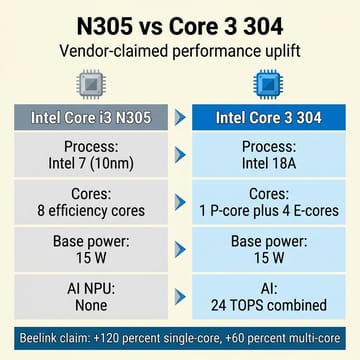
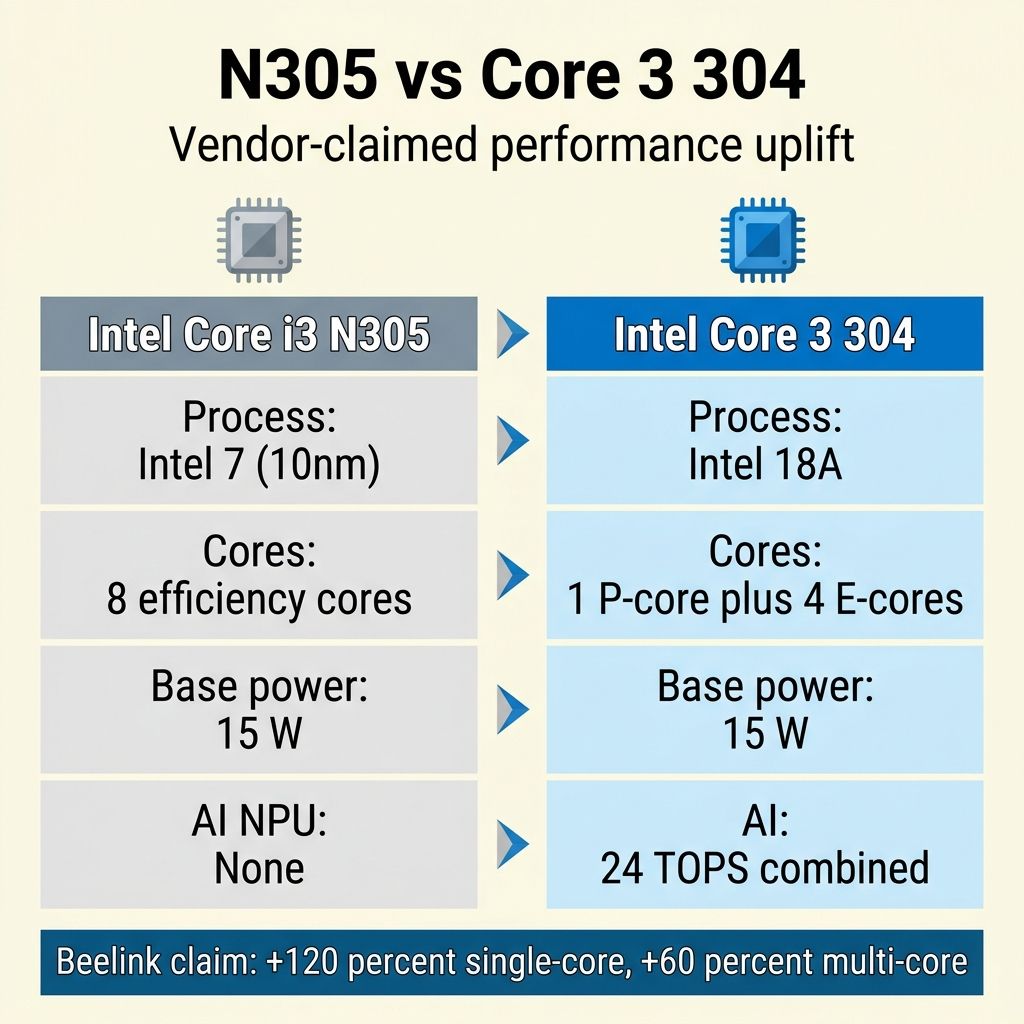
The headline number Beelink is shopping around is 120 percent higher single-core performance and roughly 60 percent higher multi-core performance compared to the Core i3-N305. Independent testing puts the gap lower. In CNX Software’s Windows 11 review, the EQi 304 scored 1,732 in Cinebench R23 single-core against 1,030 for a Core i3-N305 machine, about 68 percent higher. Multi-core came in at 4,863 against 4,505, about 8 percent higher, and CNX notes that its N305 comparison system does not have optimal cooling, so a well-cooled N305 would likely close some of that gap. Against the slower Intel N100 under Linux, LinuxLinks timed a Smallpt render at 19.4 seconds on the EQi 304 against 43.3 seconds on the N100 machine.
The N305 was eight Gracemont efficiency cores at 15W; the Core 3 304 is one Cougar Cove plus four Darkmont at the same 15W. Fewer cores, but one of them is a performance core, which usually means snappier single-threaded responsiveness (the kind that makes browser tabs and Electron apps feel less laggy) at the cost of some peak multi-threaded throughput, which fits CNX’s small multi-core margin over the N305. The NPU is the larger change. The N305 had no on-die NPU; the Core 3 304 adds one and claims a combined 24 TOPS of AI compute when the NPU and iGPU run in parallel.
That 24 TOPS number is below Microsoft’s Copilot+ PC threshold, which is 40 TOPS on the NPU alone. Wildcat Lake misses that bar on purpose: it is the budget tier, and the Copilot+ badge sits in the Panther Lake and Lunar Lake tiers above it. For Windows 11 users hoping a budget mini PC would unlock the same on-device AI features as a Copilot+ laptop, the answer is no, not this generation.
The three Beelink SKUs and who each one is for
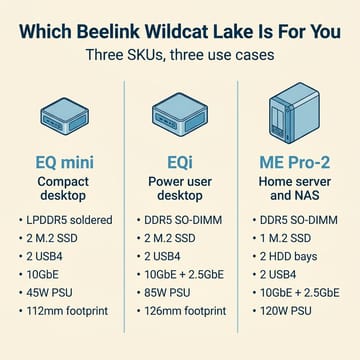
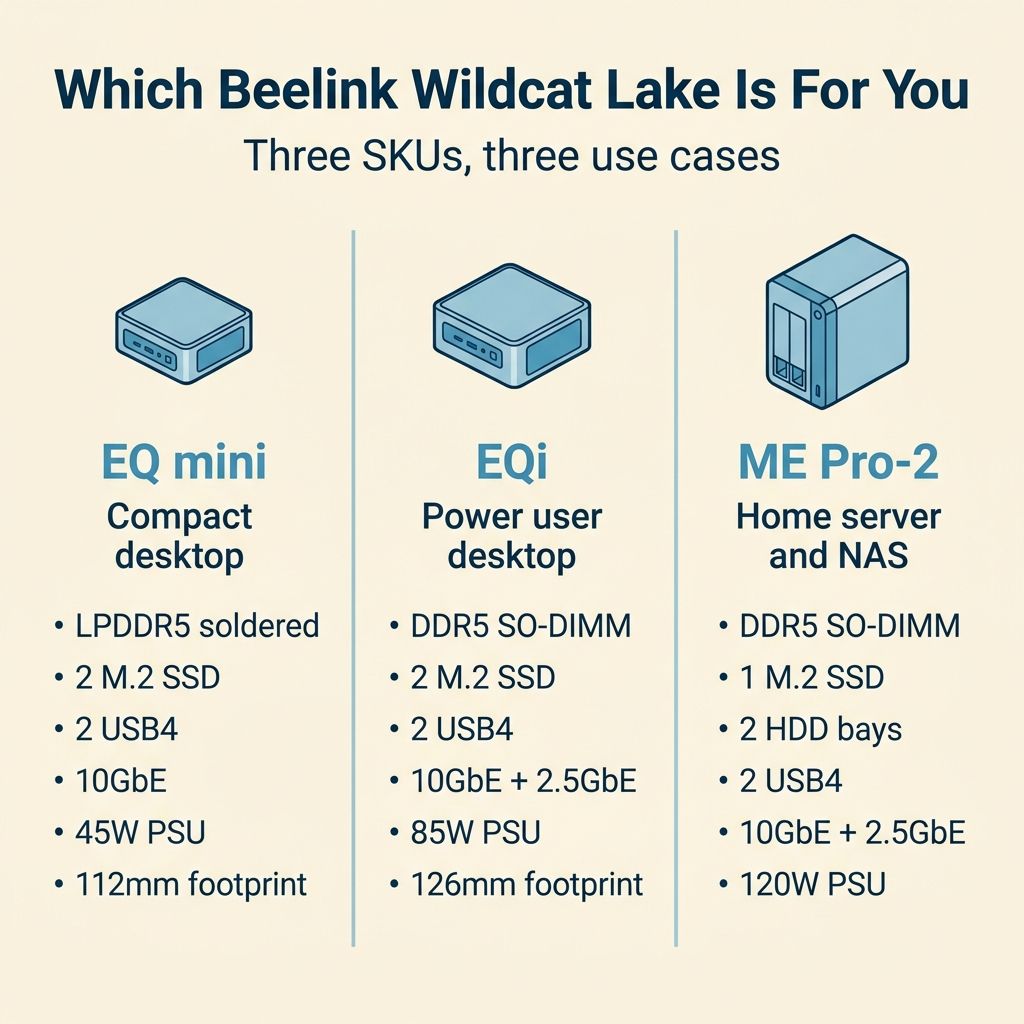
Beelink’s three Wildcat Lake models all use the same Core 3 304, so the choice between them comes down to chassis, networking, and storage. The smallest is the EQ mini, a 4.4 by 4.4 by 1.5 inch box with LPDDR5 memory soldered on, two M.2 PCIe 4.0 SSD slots, dual USB4 ports, a single 10GbE NIC, and a 45 W internal power supply. In the prior generation, a 10GbE port meant stepping up to a MINISFORUM MS-01 or another pricier workstation-class mini PC.
The EQi suits anyone who runs a pfSense or OPNsense box, hosts a small Proxmox lab, or wants the option to add 64GB of DDR5 later. Its slightly larger 5.0 by 5.0 by 1.7 inch chassis adds a DDR5 SO-DIMM slot on its 24GB and 32GB models (the 16GB model has soldered LPDDR5, like the EQ mini), adds a second 2.5GbE NIC alongside the 10GbE port, and uses a larger 85 W internal PSU.
The third model is the ME Pro-2, which is the NAS-flavored sibling: a 6.5 by 4.8 by 4.4 inch box with room for two 3.5-inch or 2.5-inch HDDs alongside one M.2 SSD, DDR5 memory, the same 10GbE plus 2.5GbE networking, and an external 120 W PSU. Beelink sells it as the ME Pro 2-Bay NAS, the Wildcat Lake update of its ME Pro and a larger, hard-drive-capable sibling of the all-SSD Beelink ME Mini: a low-power x86 alternative to a Synology DS224+ or a UGREEN DXP4800, with the home-server crowd in mind. Beelink’s store lists the 16GB/512GB model at $749, with pre-orders at $609.
All three get dual USB4 ports rated at 40 Gbps, 10GbE on at least one NIC, and UFS 3.1 onboard storage alongside the M.2 slots. UFS 3.1 is faster than the eMMC storage that many budget N100 and N305 boxes boot from, which matters for anyone running a Linux distro that hammers the root partition.
A $229 N100 box is still the budget baseline
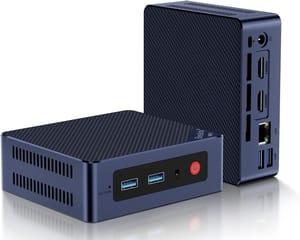
The Beelink Mini S12 Pro is an N100 box with a $229 list price on a mature platform.
Beelink MINI S12 Pro
- +$229 list price
- +mature N100 platform
- +2.5-inch bay for a second drive
- +VESA mount in the box
- -No USB4
- -no 10GbE
- -no NPU
- -16 GB single-channel memory cap (N100 controller limit
- -not a soldering issue)
Wildcat Lake is worth the extra money for three buyers: anyone who needs a 10GbE NIC in a small, low-power box (the Beelink EQi 304 has one and is available now); anyone running local LLM inference on small models where the combined 24 TOPS (15 from the NPU plus 9 from the iGPU) shows up as a speedup (see local LLM mini PC guide for what 24 TOPS does and does not buy you); and anyone whose workload is bottlenecked on single-threaded performance, where the roughly 68 percent single-core gain over the N305 in CNX Software’s testing would be felt every day.
For everyone else, the decision comes down to price. The EQi 304 lists at $469 with 16GB of soldered memory, and at $629 and $699 for the 24GB and 32GB models with a DDR5 SO-DIMM slot. At those prices it competes with the Beelink SER-series AMD boxes, which have more cores, more graphics, and a Ryzen-shaped power envelope. The smaller EQ mini lands in the same range: Beelink’s store lists the 12GB/512GB model at $499, with pre-orders at $429. That still puts it well above a $229 N100 box like the Mini S12 Pro, so it makes sense only for the three buyers above.
Linux runs on Wildcat Lake without driver trouble
Michael Larabel at Phoronix put it succinctly when CHUWI announced their $449 Wildcat Lake laptop the same week: “Wildcat Lake’s Linux support should be in good shape at this stage.” Hands-on Linux testing has since backed it up. CNX Software’s Ubuntu 26.04 review of the EQi 304 reported no installation issues, and the 10GbE, 2.5GbE, Wi-Fi, and Bluetooth hardware all worked. That is enough that the self-hosting and home-server segment of our readership (the same crowd we wrote the self-hosting renaissance piece for) should not be afraid that this generation is going to be a driver nightmare.
CHUWI has a Wildcat Lake laptop with the same Core 3 304, ECS has announced a desktop-form Wildcat Lake LIVA, and Beelink has three mini PCs. They are presumably all using the same reference kernel and the same Intel firmware blobs, which means a Linux distro that boots cleanly on the CHUWI UniBook should boot cleanly on the Beelink EQ mini too. CNX’s results on the EQi 304 point the same way.
The ARM alternative for low-power mini PCs in 2026 comes from Qualcomm, which we covered in the Snapdragon X2 ARM piece. For a Linux home server, x86 with mature kernel support is still the path of least resistance; ARM is improving but the binary ecosystem is not yet at parity for the kind of workloads (Proxmox, ZFS, Docker images compiled for x86_64, random vendor binaries) that a home-lab reader actually runs.
Wildcat Lake boxes cost more than current mini PCs at launch
The N100 and N305 platforms have years of discounting behind them; the Wildcat Lake boxes are still at launch pricing, and the EQ mini and ME Pro-2 are still pre-orders on Beelink’s store. If your job is a browser, an Electron app, and maybe a small Plex server, buy a current-generation Beelink, MINISFORUM, or GMKtec box that is on sale.
If your specific reason to upgrade is a 10GbE port in a small box (pulling RAW video files or backups off a 10GbE NAS), the Beelink EQi 304 is available now, or you can wait for the smaller Beelink EQ mini. The 10GbE NIC is what the EQi 304’s higher list price pays for. Bear in mind that any 10GbE-capable mini PC also needs a 10GbE-capable switch and 10GbE NICs on the other end of the wire; plugged into a 2.5GbE switch, the 10GbE port runs at 2.5GbE.
If you do not need 10GbE, the Beelink EQi13 uses the same five-inch-square shape as the EQi 304 with a built-in 85W power supply, with a 13th-gen Core i5-13420H or i5-13500H.
If you were eyeing a home-server NAS box like the Beelink ME Mini, and you want hard drive bays, the ME Pro-2 adds what the ME Mini lacks: two HDD bays, two USB4 ports, dual LAN with 10GbE, and socketed DDR5 instead of soldered LPDDR5. For the always-on workload, the process-node story matters more than for a desktop: Intel says 18A’s RibbonFET transistors and PowerVia backside power delivery improve power efficiency over the previous FinFET node, and an always-on box is where any idle-power difference shows up on the electricity bill. Beelink does not publish an idle-power figure, but CNX Software measured the EQi 304 at 5.7 to 6.2 W idle on Wi-Fi and 6.8 to 7.2 W with the 10GbE link active, under Windows 11. CNX’s own earlier Windows 11 measurements, taken with a display, keyboard, mouse, and network connected, put two N100 mini PCs at 8 to 10 W idle and a Core i3-N305 machine at 12.5 W. On those numbers the Core 3 304 idles about 2 to 4 W below an N100 box on Wi-Fi (1 to 3 W with 10GbE active) and 5 to 7 W below the N305 machine. The two test setups differ, so treat these as rough gaps. The ME Pro-2 will add whatever its drives draw.
Beelink ME Mini
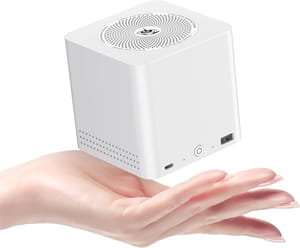
- +Quiet
- +low idle power
- +six M.2 SSD slots
- +much lower list price than the ME Pro-2
- -N150 chip
- -no hard drive bays
- -no 10GbE or USB4 (the ME Pro-2 has all three)
We will revisit this once the ECS LIVA Z15 Plus has a US price and the EQ mini and ME Pro-2 ship.