Qualcomm walked into CES 2026 with something that looked more like a drink coaster than a computer. The disc-shaped reference design, barely thicker than a stack of CDs, packed a Snapdragon X2 Elite Extreme chip with 18 CPU cores and no fans whatsoever. Instead of traditional blowers, it used Frore Systems’ AirJet solid-state cooling, a technology that moves air through tiny vents using vibrating piezoelectric membranes. No spinning parts, no noise, no dust intake. A second reference design fit inside a monitor stand, turning any display into a stealth all-in-one. Both were prototypes, not products you can buy today.
Microsoft released Windows 11 26H1 exclusively for ARM devices in February 2026, built on an entirely new codebase. The first ARM mini PC you can actually buy, Lenovo’s ThinkCentre neo 50q, has been shipping since late 2025 and earned strong reviews. And Qualcomm’s Snapdragon X2 Elite, built on TSMC’s 3nm process, is posting benchmark numbers that compete with Apple’s M5 in multi-threaded workloads.
The Only ARM Mini PC on Sale Today Is Lenovo’s
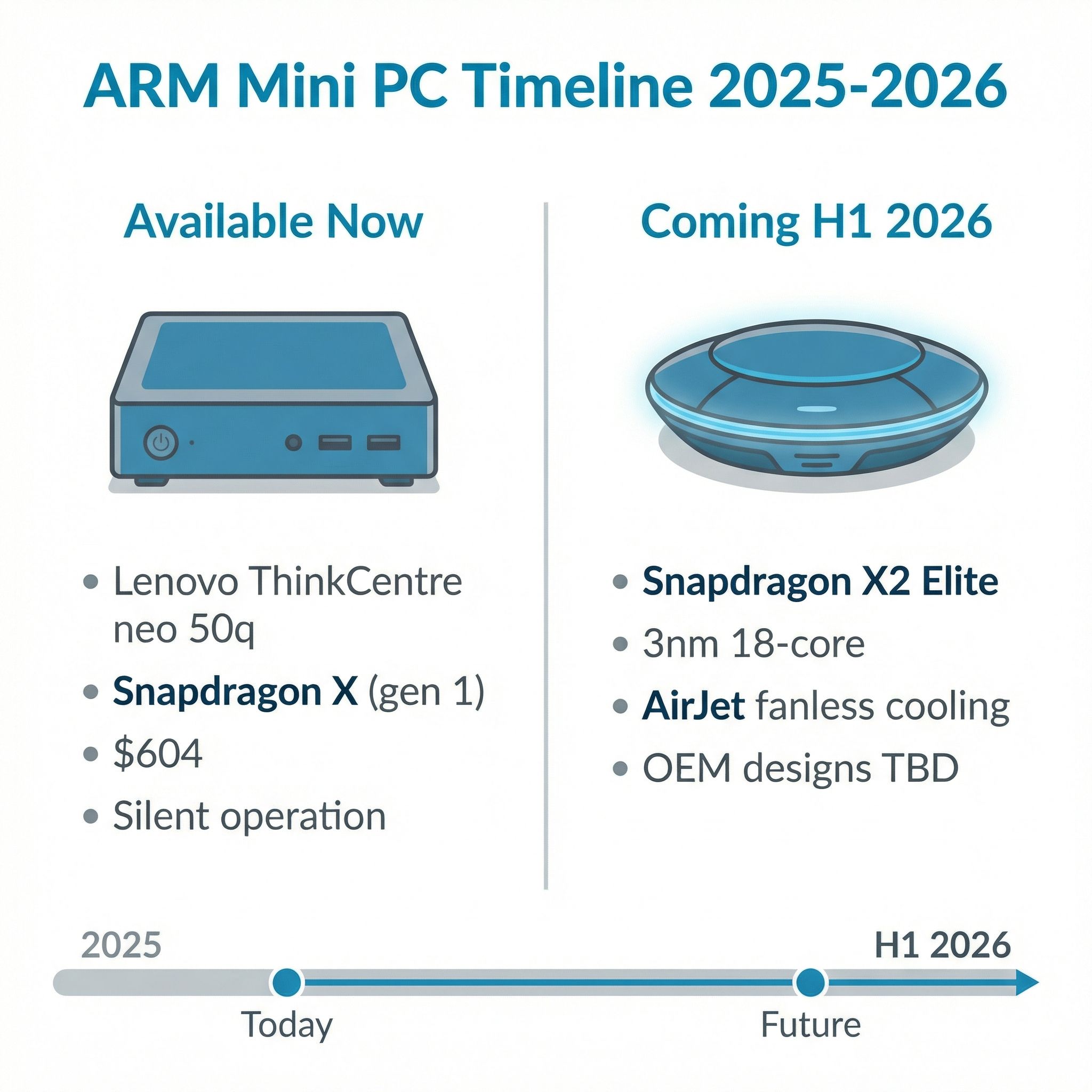
The Lenovo ThinkCentre neo 50q runs the original Snapdragon X, not the newer X2. At $604, it ships with 16GB of LPDDR5X RAM, a 1TB NVMe SSD, and a form factor small enough to VESA-mount behind a monitor. XDA’s review praised its silent operation and said the base Snapdragon X chip handles productivity tasks competently. The reviewer used it for weeks as a primary machine and didn’t miss their desktop tower much.
The Cheaper Alternative Is a Fanless N100 Box
A capable fanless N100 mini PC runs $150-250, roughly a third of the Lenovo’s cost. The N100 sips 6 watts at idle and handles general productivity just fine. If all you need is a quiet desktop for browsing, documents, and light media consumption, the Intel option remains dramatically cheaper. The Snapdragon X earns its premium through stronger multi-threaded performance, a more capable NPU for on-device AI tasks, and an efficiency curve that scales better under sustained load.
The ThinkCentre neo 50q is a business-class machine from Lenovo, not the kind of affordable hardware you’ll find from the mini PC brands that dominate this space, like Beelink, GMKtec, or MINISFORUM. None of those manufacturers have announced ARM-based models yet, though that may change once Snapdragon X2 silicon starts shipping to OEMs in volume. Lenovo’s broader interest in unusual desktop shapes shows up in their own catalog too: the 0.65L cylindrical Yoga Mini i is x86 for now, but it points at the same fanless direction Qualcomm’s disc concepts are exploring. The neo 50q is also a first-generation product on a platform that’s still maturing.
Prism Emulation Covers Most x86 Apps
Microsoft’s Prism emulation layer translates x86 instructions to ARM64 code on the fly, and a major update in December 2025 added AVX and AVX2 support. Programs that previously refused to install, like Ableton Live 12, now run without issue.
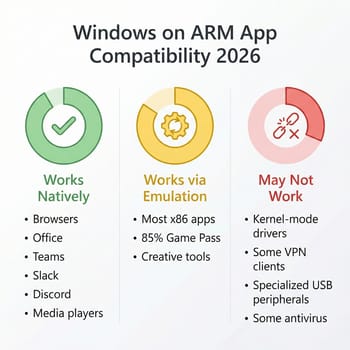
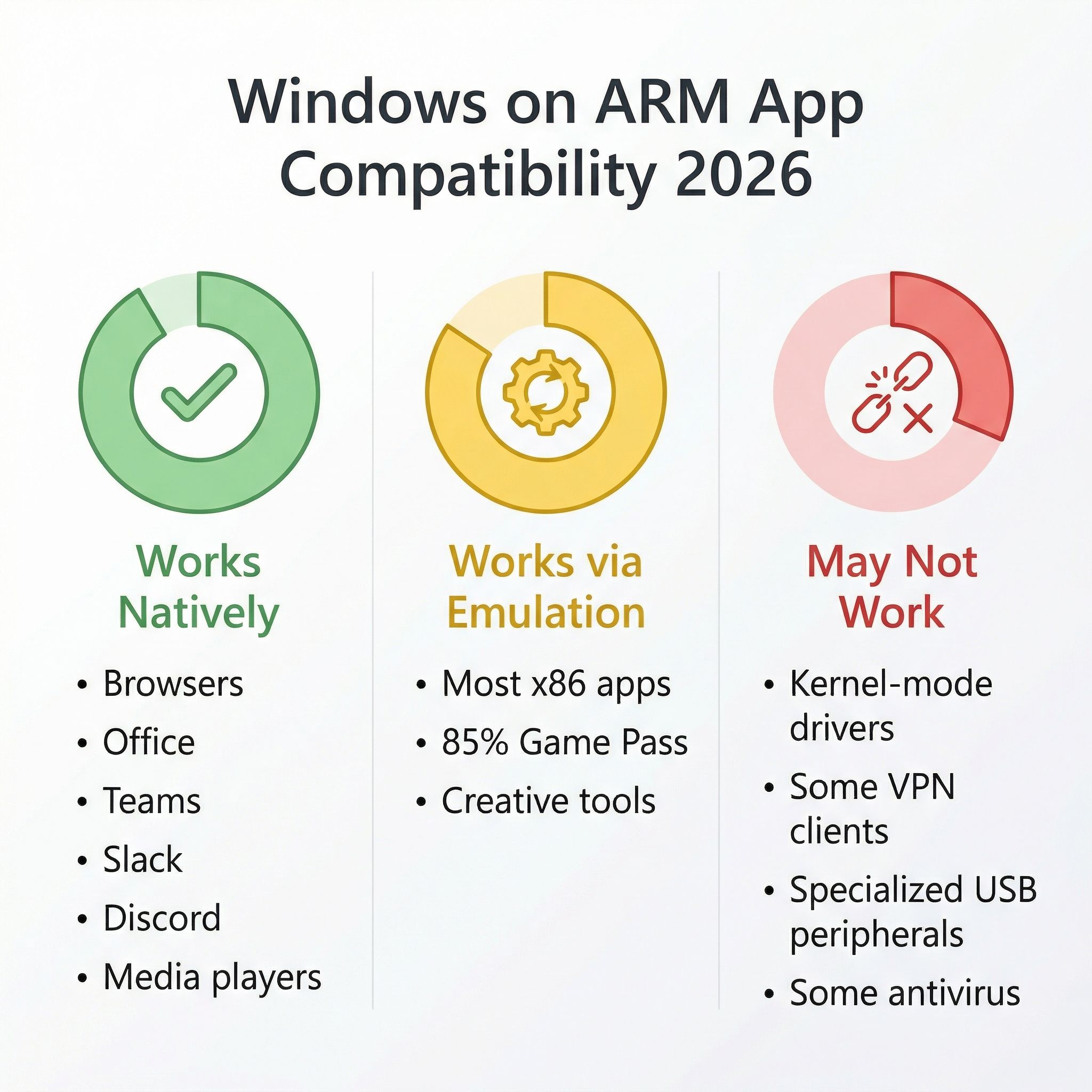
For day-to-day productivity, the experience is nearly indistinguishable from an Intel machine. Browsers, Office apps, communication tools, media players, and most creative software work natively or through emulation that’s transparent enough that you won’t notice. One reviewer spent a full year using a Snapdragon device as a daily driver and concluded that most users won’t notice a meaningful difference between an Intel PC and a Snapdragon one.
Kernel Drivers Are the Exception
Adobe’s suite remains sluggish on ARM, a perennial complaint that’s improved but not resolved. Software that requires kernel-mode drivers, including certain antivirus programs, VPN clients, and specialized USB peripherals, may not work at all because Prism can’t translate kernel-level code. If you rely on a specific piece of hardware that needs custom Windows drivers, check ARM compatibility before buying. This is the most likely dealbreaker for enterprise users and anyone with a niche workflow involving proprietary peripherals.
Most of the Game Pass Catalog Now Runs on ARM
Microsoft announced that the Xbox PC app now works on ARM devices and claims over 85% of the Game Pass catalog is compatible. Anti-cheat middleware from vendors like Easy Anti-Cheat has been ported to ARM, unblocking many multiplayer titles.
Qualcomm’s Snapdragon X2 Elite Extreme Brings 18 Cores on a 3nm Process
Qualcomm’s top configuration, the X2 Elite Extreme, pairs 12 Prime cores clocking up to 5.0GHz for burst performance with 6 Performance cores at 3.6GHz for efficiency, a big-medium-little arrangement. Those are third-generation Oryon cores on TSMC’s 3nm process, backed by 53MB of cache and an 80 TOPS neural processing unit that dwarfs anything Intel or AMD currently offers for on-device AI.
Early Geekbench 6 multi-core scores landed around 23,000, comfortably beating Apple’s M5 (~17,800) and Intel’s Core Ultra 9 in multi-threaded workloads. Qualcomm claims the X2 architecture delivers up to 25% more multi-threaded performance while consuming significantly less power than the first-generation X Elite. These numbers come from Qualcomm reference hardware under controlled conditions with pre-production software. Real-world OEM products will likely perform differently, as they always do.
The X2 Still Trails Apple’s M5 on Single-Core Speed and GPU
Launching apps and scrolling web pages, the snappy single-threaded work that makes a computer feel responsive, is where Apple’s M5 stays ahead. The Adreno GPU in the X2 trails Apple’s M4 Pro by roughly 45% in synthetic graphics benchmarks. For a productivity-focused mini PC, that GPU gap matters less than it would for a gaming laptop.
AirJet Replaces Spinning Fans With Vibrating Membranes
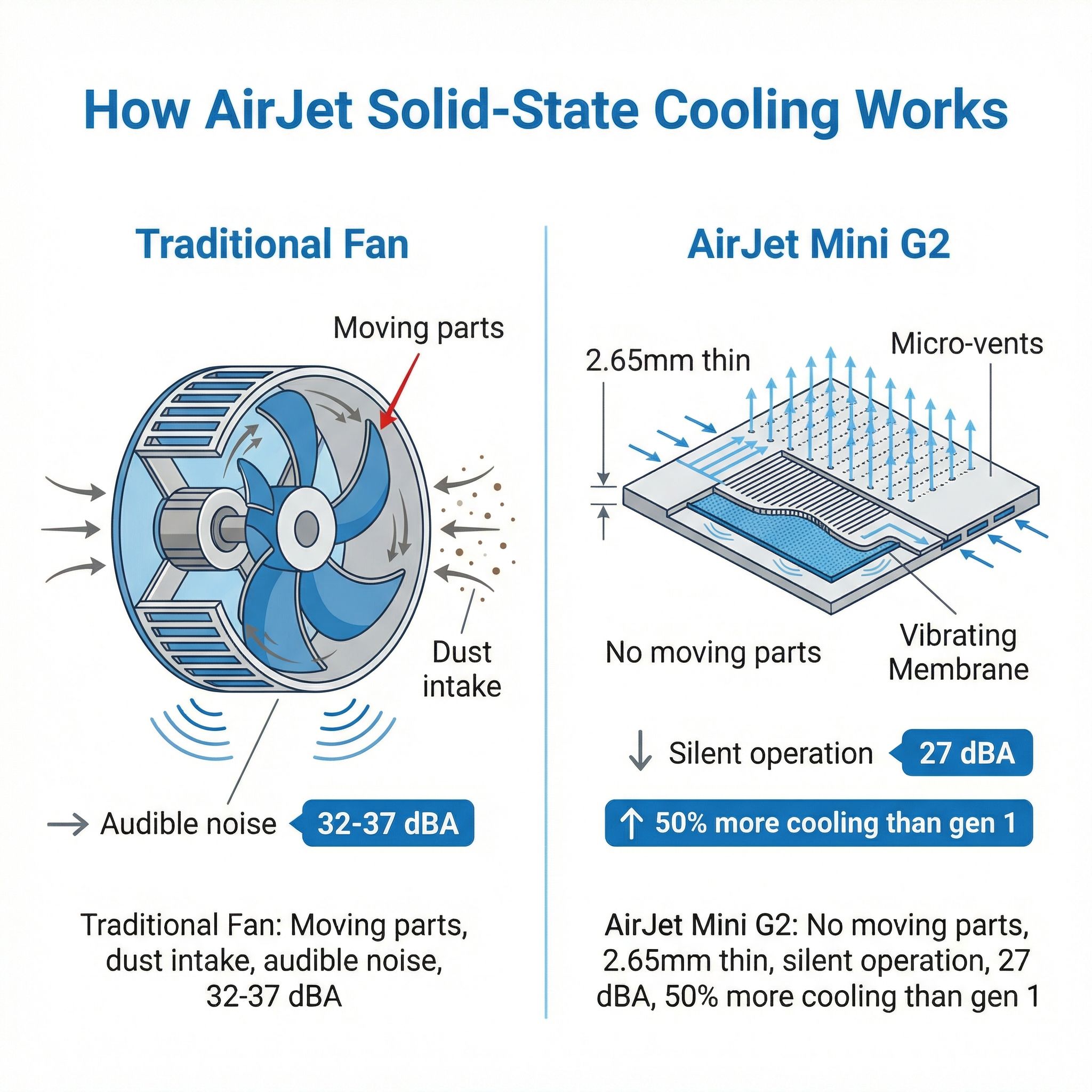
Qualcomm’s CES reference designs use Frore Systems’ AirJet Mini G2, a solid-state active cooling chip measuring just 2.65mm thin. Instead of a fan blade spinning on a bearing, it uses piezoelectric membranes that vibrate at ultrasonic frequencies, pulling air across a heat exchanger and pushing it out through micro-vents. The result is active cooling with no moving parts.
The second-generation AirJet Mini G2 removes 50% more heat than the original while maintaining the same ultra-compact footprint. In a Samsung Galaxy Book proof-of-concept at CES 2025, four AirJet Mini units replaced a dual-fan cooling system entirely. Cinebench tests showed the AirJet-cooled laptop ran faster than the fan-cooled version because the processor could sustain higher clocks without thermal throttling, all while running near-silently.
A single AirJet Mini G2 handles modest thermal loads, appropriate for ultrabooks and thin mini PCs, but high-performance desktop chips generate more heat than solid-state cooling can currently manage. Frore’s AirJet Pak, which bundles multiple Mini G2 units together, can cool up to around 45 watts in a compact form factor. That’s enough for a Snapdragon X2 running within its efficient operating range, but not enough for a desktop-class AMD or Intel chip under sustained all-core load. The X2 delivers strong performance at power levels solid-state cooling can handle.
The first commercially available AirJet mini PC, Zotac’s ZBOX PI430AJ, shipped with an Intel Core i3 and two AirJet Mini chips. It’s the size of a deck of cards and runs completely silent. It proved the concept works in a real product, though with a modest processor. Qualcomm’s reference designs suggest the next generation will pair AirJet with much more capable silicon.
Windows 11 26H1 Puts ARM PCs on a Separate Branch, Possibly Until 2027
Microsoft released Windows 11 26H1 exclusively for ARM devices. It is a separate Windows build on a new codebase, internally called “Bromine,” designed from the ground up for ARM silicon. Snapdragon X2 devices shipping in the first half of 2026 will run 26H1, while existing AMD and Intel machines continue on the separate 25H2/26H2 track.
Devices running 26H1 are on an isolated servicing lane with no upgrade path to 26H2 when it arrives later this year. Microsoft has indicated these builds won’t converge until a future release, potentially not until the second half of 2027. For a mini PC buyer spending $600 or more, that means living on a separate Windows branch for over a year, potentially missing features and optimizations that ship in 26H2. Microsoft’s track record with the famously buggy 24H2 launch is the stated reason for this separation, and the caution is understandable, but it creates uncertainty for early adopters.
A separate ARM-first codebase means Microsoft’s engineers are building for ARM as a primary target rather than retrofitting x86 features. Qualcomm’s performance improvements and the growing list of native ARM64 applications are moving the platform along, but first-half 2026 still feels like early-adopter territory.
Linux on ARM Desktops Is Not Ready Yet
The Lenovo ThinkCentre neo 50q’s Snapdragon X chip has limited Linux support, and running a standard Linux distribution on it ranges from difficult to impossible depending on the distro. Qualcomm’s Linux driver support has historically lagged behind their Windows efforts, and while progress is being made upstream in the Linux kernel, the experience is nowhere near the “install and go” simplicity of running Linux on an x86 mini PC.
If you run Linux for self-hosting, home automation, or as your everyday desktop, x86 mini PCs remain the practical choice for the foreseeable future. CNX Software’s testing of the GEEKOM A5 Pro 2026 Edition on Ubuntu 25.10 found full hardware compatibility and a 3.8W idle draw. ARM Linux on desktop hardware will get there eventually, but right now the driver and compatibility work isn’t done. This is one area where ARM Chromebooks, which ship with Google-managed Linux support for their MediaTek and Qualcomm silicon, have a meaningful head start over the Windows ARM ecosystem.
Who Should Buy Now and Who Should Wait
ARM mini PC buyers in early 2026 fall into three groups. If you’re a productivity-focused user who works primarily in a browser, Microsoft Office, and standard communication tools, and you value absolute silence, the Lenovo ThinkCentre neo 50q is a legitimate option today. It’s overpriced compared to N100 alternatives for basic tasks, but the combination of ARM efficiency, complete silence, and capable performance makes it appealing for desk-bound office work.
Anyone drawn to the fanless disc-shaped designs and the X2’s performance should wait, because a Snapdragon X2 mini PC you can order does not exist yet. Those designs are reference hardware, not shipping products, and OEMs may or may not produce anything resembling them. Qualcomm expects X2-based systems to ship in the first half of 2026, but initial products will likely be laptops, not mini PCs. Give the OEM ecosystem six to twelve months to produce desktop-oriented X2 hardware, and give the software ecosystem time to build out native ARM64 support.
Linux users, anyone tied to specialized peripherals with x86-only drivers, and anyone shopping under $300 are better served by the mini PC world they already know, powered by Intel’s N100/N150 or AMD’s budget Ryzen chips. Check out the mini PC comparison chart to find the right x86 option. ARM’s efficiency advantage holds, but at the low end x86 costs far less and its software and driver support are more mature.
The disc-shaped puck Qualcomm showed at CES is unlikely to arrive before late 2026 at the earliest, and the software branch question will still be open when it does.
Frequently Asked Questions
Is the Snapdragon X2 good?
Geekbench 6 puts the X2 Elite Extreme around 23,000 multi-core, ahead of Apple’s M5 at roughly 17,800 and ahead of Intel’s Core Ultra 9, though single-core speed is slower and the Adreno GPU trails Apple’s M4 Pro by about 45%. Those scores come from Qualcomm’s own reference systems on pre-production software.
Can a Snapdragon processor run Windows?
Yes. Windows 11 26H1 shipped in February 2026 exclusively for ARM devices, and Microsoft’s Prism layer translates x86 software to ARM64 as it runs. Programs that load kernel-mode drivers, such as some antivirus tools and VPN clients, still break.
Is there a Snapdragon mini PC?
Lenovo’s ThinkCentre neo 50q is the only one you can buy, at $604, and it runs the first-generation Snapdragon X. Qualcomm’s fanless disc and monitor-stand designs run the X2 Elite Extreme, but neither has gone on sale.