Valve’s Steam Machine quietly cleared its last engineering milestone on May 23, 2026. The cube appeared in the Khronos Group’s Vulkan 1.4 conformant products database under the name “AMD Steam Machine,” listing an AMD Navi 33 GPU, a custom “AMD Custom CPU 1772,” and a Linux 6.16.12-valve6-1-neptune-616 kernel matching SteamOS Beta 3.85. That is the final step a piece of graphics hardware normally takes before a launch announcement. That does not mean Valve is shipping next week, but the box is no longer a render in a press release.
For a buyer currently shopping a $500 to $1,000 mid-tier mini PC, this changes the math. The Steam Machine lands on the same shelf as a Beelink SER8, a Geekom A8, or an ASUS NUC 14 Pro, not on the PlayStation shelf. Valve hardware engineer Yazan Aldehayyat told IGN, in an interview GameSpot also relayed, that “if you’re trying to make a PC that has similar features and similar performance,” the Steam Machine will be “a really competitive price to that”; the framing is against PCs, not against consoles. Waiting for Valve is now a live option at this budget.
The Steam Machine is built to play your Steam library on a TV. A mid-tier mini PC is built to be a full desktop that also games.
Anti-cheat games decide it if one is in your rotation
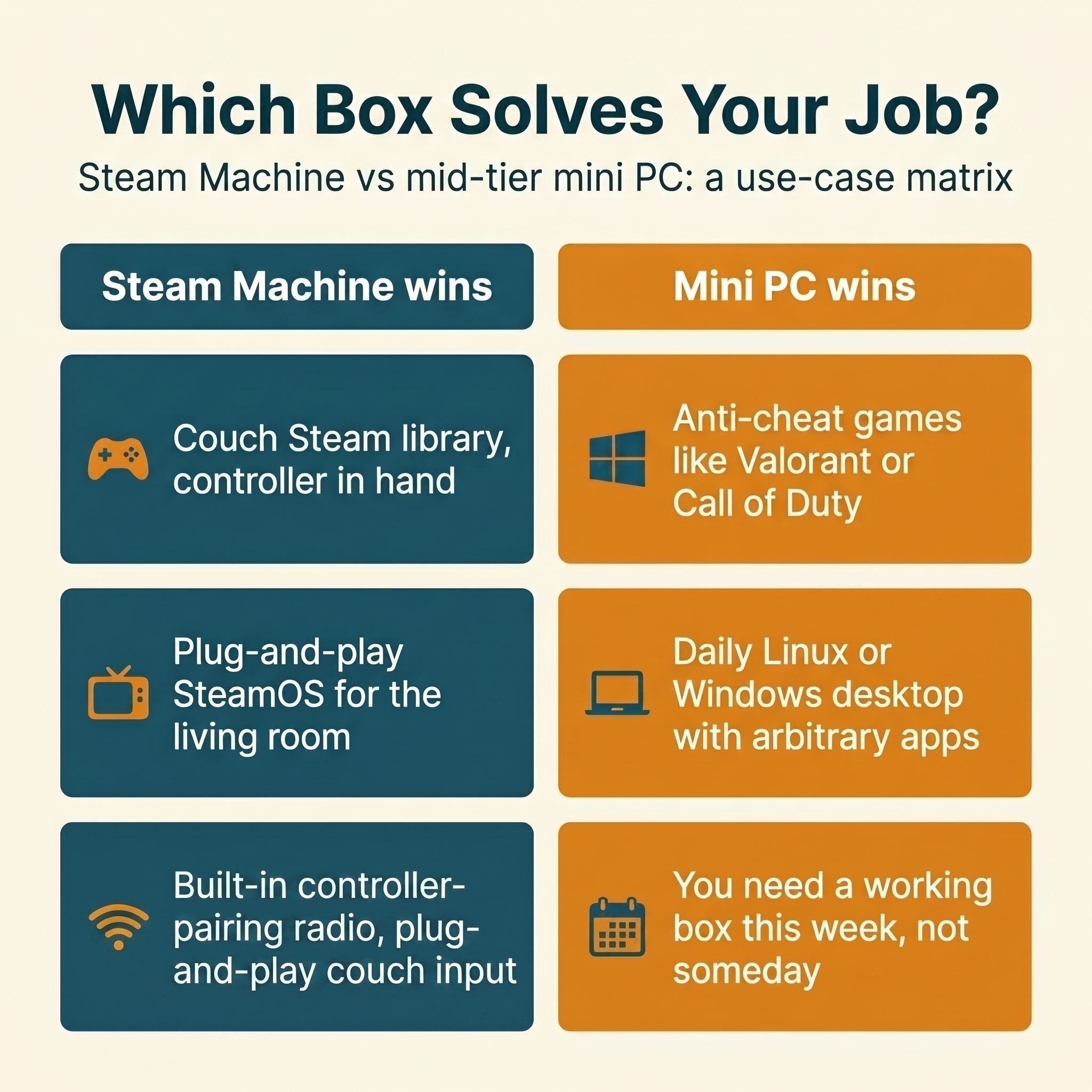
Open Are We Anti-Cheat Yet and look up the games you actually play. According to data cited by TechTimes, more than 680 of the 1,136 Steam titles that ship with anti-cheat are unplayable on SteamOS today. The unplayable list includes Valorant, every current Call of Duty release, Battlefield 6, the EA Sports lineup, Rainbow Six Siege, and GTA V Online. Kernel-level anti-cheat software (Riot’s Vanguard, Activision’s RICOCHET, EA’s Javelin) is built against the Windows kernel and structurally cannot run on Linux without publisher opt-in. Counter-Strike 2 and Dota 2 are the obvious working examples because Valve runs them and uses VAC, which is not a kernel-level system. The publisher-opt-in titles that do run today, such as Apex Legends and Halo Infinite via Easy Anti-Cheat, work only because the publishers explicitly flipped the Proton-compatibility switch.
If any of those unplayable titles is on your weekly rotation, the rest of this comparison is moot for you. The Steam Machine cannot run them and probably will not for years, because the threshold publishers care about (SteamOS sits at roughly 1 to 1.5% of Steam users in the April 2026 Hardware Survey) has not moved them so far. A mid-tier mini PC running Windows runs all of them today. Stop reading and go buy one.
The unplayable list can change overnight if a publisher chooses to enable Proton. Some BattlEye-protected and Easy Anti-Cheat-protected titles cross the line at the publisher’s discretion, which is why the Are We Anti-Cheat Yet database is the right place to look up specific titles rather than trusting any single article (this one included) to be current. The Vulkan certification narrows the technical risk on SteamOS; it does not narrow the publisher-decision risk at all.
What Valve confirmed for Steam Machine hardware
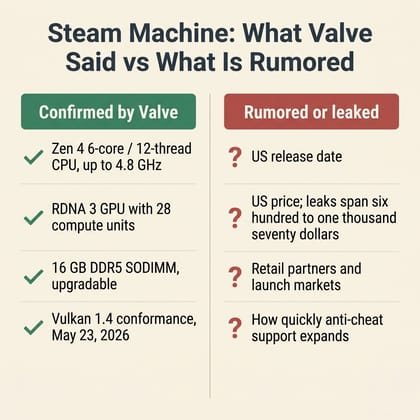
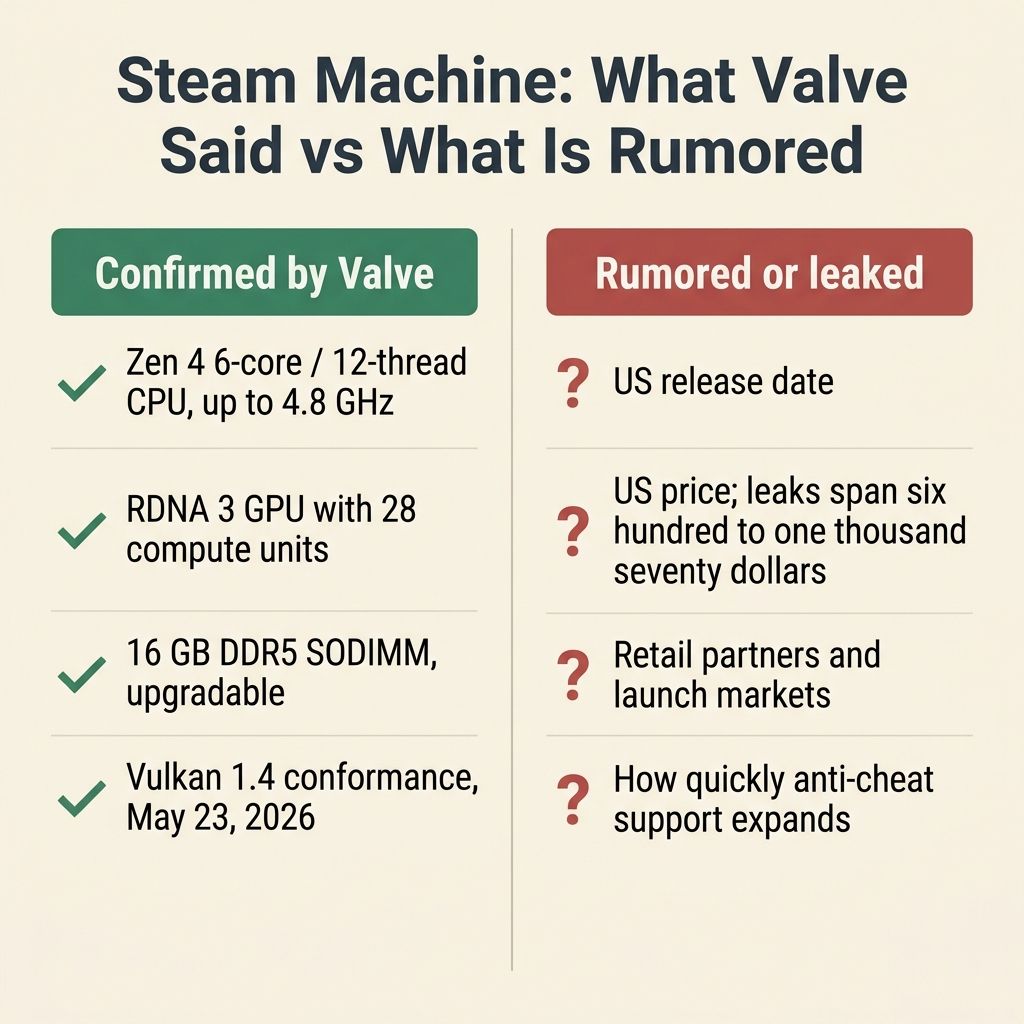
The Steam Machine that cleared Vulkan certification is a 156 by 162.4 by 152 mm cube weighing 2.6 kg. According to Valve’s official hardware page, the CPU is a semi-custom AMD Zen 4 design with six cores and twelve threads, boosting to 4.8 GHz inside a 30 W TDP. The GPU is a semi-custom AMD RDNA 3 unit with 28 compute units, a 2.45 GHz sustained clock, and a 110 W power envelope; it is dedicated silicon soldered to the same board as the CPU, not a fused APU like the Steam Deck. RAM is 16 GB of DDR5 SODIMM that Valve has confirmed will be user-upgradable, and the GPU has its own 8 GB of GDDR6 VRAM. Two storage tiers ship at launch, 512 GB and 2 TB NVMe, with a microSD slot for expansion. The front panel pops off and is intended to be swappable for skins. Seventeen individually addressable RGB LEDs run the system-status strip on the front edge.
The new Steam Controller launched separately on May 4, 2026 at $99, and the Steam Machine cube includes a built-in 2.4 GHz Steam Controller Puck radio so no extra USB dongle is required to pair one. Whether a Steam Controller is included in the Steam Machine box itself, or sold separately, is not something Valve has confirmed on its product page; treat any “bundled controller” claim you see in launch coverage as unconfirmed until Valve says so directly. The operating system is SteamOS 3, the same Arch-based distribution that runs the Steam Deck, with a KDE Plasma desktop available behind the Big Picture front end.
What Valve has explicitly not committed to: a US price, a firm release date, retail partners, or which markets ship first. The company’s own FAQ on the delay puts the blame on the global RAM and storage shortage, noting that “the memory and storage shortages you’ve likely heard about across the industry have rapidly increased” since the November 2025 announcement, forcing Valve to “revisit our exact shipping schedule and pricing.”
The price rumor problem
You will read a lot of dollar figures in the next two months. Treat all of them as evidence that nobody outside Valve knows the answer.
The source code of Czech retailer Smarty briefly listed the Steam Machine at $950 for the 512 GB model and $1,070 for a larger storage tier in January 2026 (the leak predates Valve’s later confirmation that the actual tiers are 512 GB and 2 TB); that is the headline number most outlets are running with. Hardware insider Moore’s Law Is Dead estimated a $600 to $650 range in early May. PCGamesN’s launch tracker projects $799 for the 512 GB SKU and $999 for the 2 TB. Brad Lynch reported in late April that Valve’s internal pricing targets had risen sharply after the RAM shortage, calling the Steam Machine “the most affected” of Valve’s three new products.
These figures span a sixty-percent range and cannot all be correct. The most useful directional signal is Lynch’s “targets rose,” because it lines up with Valve’s own FAQ and with DDR5 spot prices tripling (and in some cases quadrupling) between November 2025 and May 2026. A reader budgeting against the leaked range should plan on the high end and hope to be pleasantly surprised. Anyone presenting a single dollar number as the Steam Machine price (this article included) is guessing.
The Steam Machine solves couch gaming on a TV
Valve built the Steam Machine to do what the Steam Deck does on a handheld, on a TV: launch directly into Big Picture, accept a controller as the default input, and run a curated subset of the Steam catalog smoothly enough that the buyer never thinks about Linux. That is one job, and the Steam Machine does it better than a general-purpose mini PC ever will out of the box.
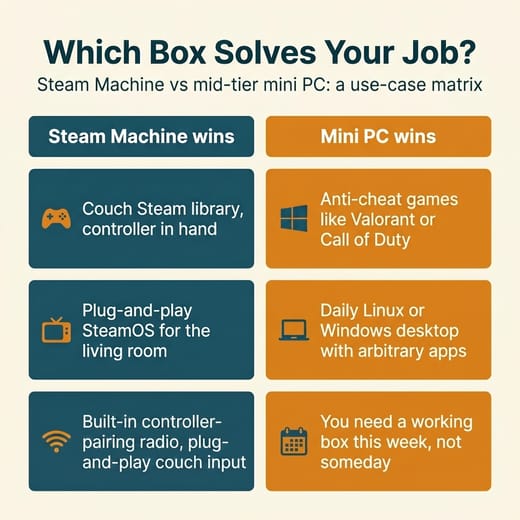
First, the integrated 2.4 GHz Steam Controller Puck radio means the Steam Machine pairs a Steam Controller without a separate USB dongle and ships with the SteamOS controller stack pre-configured; even if Valve charges separately for the Steam Controller itself, the cube does the rest of the couch-input setup for you. A mid-tier mini PC needs an Xbox or DualSense controller, a Bluetooth dongle, probably an HTPC remote or wireless keyboard touchpad combo, and ten to fifteen minutes of pairing setup before it works the same way. Budget roughly $50 to $150 in accessories on top of any mini PC price you are comparing, depending on what you already own. Second, SteamOS 3 ships Big Picture as the default front end, not an afterthought you launch manually; Bazzite or ChimeraOS approximate this on a mini PC but they are not the same thing as a vendor-tuned image. Third, the Steam Machine has a dedicated AMD RDNA 3 GPU with its own 8 GB of GDDR6 memory, which most mid-tier mini PCs in this band do not. The Beelink SER8’s Ryzen 7 8845HS shares system RAM with its Radeon 780M iGPU; the Steam Machine does not have to make that compromise.
For 4K-on-a-TV gaming with FSR upscaling and a controller, that combination is competitive at this price band. Valve’s own positioning is that “the majority of Steam titles play great at 4K 60FPS with FSR on Steam Machine,” with the caveat that some demanding titles still want internal 1080p plus variable refresh rate to feel right. Digital Foundry’s Richard Leadbetter, in his hands-on preview, placed the system between an Xbox Series S and a PlayStation 5 in raw graphical horsepower. Neither figure is independently measured against shipped retail hardware yet, because retail hardware does not yet exist.
A mid-tier mini PC solves everything else
A mid-tier mini PC is a full Windows or Linux desktop in a 500 mL box, capable of running any application you would run on a tower. Each of the four products here is strongest at a different thing.
The Beelink SER8 is the best raw gaming value in the band, pairing a Ryzen 7 8845HS with a Radeon 780M iGPU that handles 1080p esports titles competently and 1080p AAA at low to medium without complaint. The Geekom A8 leans on the Ryzen 9 8945HS for the best CPU-per-dollar in the band, which matters for compiles, virtualization, and the kind of homelab work the SER8 also does but with less headroom. The Minisforum MS-01 reframes the category as a workstation; it ships with a PCIe slot, dual 10 GbE, and 12th or 13th Gen Intel Core i5 or i9 mobile chips topping out at the Core i9-13900H. The ASUS NUC 14 Pro is the Intel platform answer for businesses that need vPro, an ASUS service contract, and the boring reliability of an enterprise NUC successor.
All four of them ship today, at known prices, with full Windows compatibility (anti-cheat games included), arbitrary Linux distribution choice, and a known port count, all of which the Steam Machine either does not offer (anti-cheat games), constrains (SteamOS first, generic Linux second), or has not committed to (price). The four also let you keep or wipe Windows depending on your goal, a tradeoff worth its own piece if you have not read Mini PC With Windows: Keep It or Wipe It for Linux?.
The Steam Machine does not replace any of those use cases. It is a Steam couch box, not a workstation, a Windows productivity machine, or the right substrate for a Proxmox homelab.
The cost of waiting
Valve has not committed to a shipping window. The “first half of 2026” line in the original announcement is gone. The Steam Controller launched on May 4, the Steam Frame headset and the Steam Machine did not, and Valve told Polygon the Controller went first precisely because it did not need scarce memory and storage components. The Vulkan 1.4 certification narrows the technical risk but does not narrow the supply-chain risk; DDR5 spot prices have moved against Valve, not for it, since the announcement.
A buyer who decides to wait is not waiting six weeks. They might be waiting six months, or twelve, or eighteen. During that window, the Beelink SER8 they did not buy is a small living-room PC they are not using. This calculus tips harder if the buyer’s Steam library is mostly singleplayer titles they could play on any of the four mini PCs above with a controller in Big Picture mode. The Steam Machine will be better at that specific job when it ships. It will not be the only thing that does that job today.
Valve has a documented history of late hardware. The original Steam Deck slipped from its announced November 2021 window to late February 2022, the Steam Deck OLED arrived more than a year after the LCD model with a refresh that some buyers wished they had waited for, and the Steam Frame headset announced alongside the Steam Machine has lost its first-half-2026 window and is now marked only as coming in 2026. None of those slips were existential, but each one cost buyers months of waiting. A buyer choosing to wait for the Steam Machine should price in some probability that the announcement window keeps moving even after the Vulkan certification clears.
The “I already have a desktop” inversion
If you already own a full desktop or a work laptop, the Steam Machine’s narrowness is a feature. You need a specialized second computer for the living room. The Steam Machine is exactly that, and a mid-tier mini PC at the same price is overkill because most of what makes the mini PC valuable (Windows, arbitrary Linux, productivity software, work overlap) is already covered by the machine on your desk.
Buyers in this bucket should treat the Steam Machine as the better choice the moment Valve announces a US price they can live with, and treat any mid-tier mini PC purchased today as a backstop in case the Steam Machine slips again or ships above their budget. The comparison chart helps with that backstop decision.
The opposite is also true. A buyer whose only computer is a five-year-old laptop, who wants the small living-room box to be their main machine, should not buy the Steam Machine even at a hypothetical $799. SteamOS is not a daily-driver operating system for someone whose work lives in Microsoft 365, Adobe, or Windows-only line-of-business apps. A mini PC running Windows or Linux serves that buyer’s primary need; gaming is the secondary feature.
The Linux-on-the-desktop framing
The Steam Machine is the most consumer-facing test of whether Linux can hold a mainstream gaming audience that “the year of Linux on the desktop” has ever produced. The Steam Deck proved the technical case in handheld form. The Steam Machine extends that case to the living room, where the user does not know or care what OS is running and just wants the controller to work.
That thesis is not what a buyer making a decision this month should optimize for. But if you do buy a Steam Machine, you are participating in it whether you intend to or not, and so is every Beelink, Geekom, and Minisforum buyer who decides to wipe Windows for a Linux distribution. The next-generation ARM mini PC class and the current mid-tier sweet spot are part of the same story.
The practical version of that thesis matters for a buyer’s risk calculus. If the Steam Machine sells well, anti-cheat publishers feel commercial pressure to enable Linux paths; Valve has told Eurogamer it expects exactly that dynamic. If it does not sell well, the unplayable list stays roughly the size it is now and the platform’s gravity does not move. A buyer choosing the Steam Machine is making a bet that the first scenario happens; a buyer choosing a mid-tier mini PC running Windows is hedging against the second. Neither bet is risk-free.
Two products that bracket the question
Beelink SER8
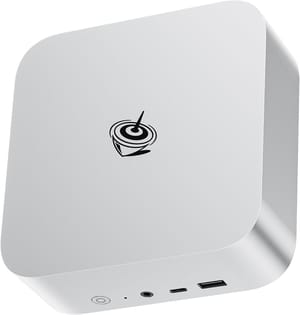
- +Ships today at a known price
- +Ryzen 7 8845HS handles 1080p gaming and any Linux distribution
- +full Windows compatibility for anti-cheat titles
- -Shared system RAM and iGPU caps 4K gaming
- -no bundled controller
- -no Big Picture by default
MINISFORUM MS-01
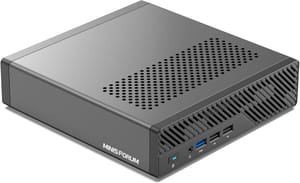
- +PCIe slot
- +dual 10 GbE
- +workstation-class CPUs
- +real upgrade headroom
- -Higher-end Core i9 configurations sit at the top of the Steam Machine's rumored range
- -heavier and louder than a SER8 or NUC
- -overkill for couch Steam
Wait only for a couch-only Steam library
The Vulkan 1.4 certification and the spec sheet are public, and the Steam Machine has moved from “Valve press release” to “hardware Khronos signed off on.” The pricing range is not real yet; treat anything below the leaked $950 Czech-retailer figure as wishful, and anything below the Moore’s Law Is Dead $600 figure as marketing. The defensible plan, given what the named leaks span, is to budget for the upper part of that band, somewhere around $950 to $1,070, possibly plus the price of a Steam Controller if Valve does not include one in the Steam Machine box. Plan to wait an unspecified number of months for the US price and date.
If your job is a couch Steam library and nothing else, wait. The Steam Machine is the answer Valve designed for that exact buyer.
For anything else (a daily Linux or Windows desktop, an anti-cheat-game gaming rig, a small workstation, a homelab head node, or a “second machine” with overlap into productivity), buy the mid-tier mini PC now. The Steam Machine is not built to serve any of those jobs, no matter what the rumored price ends up being, and you would wait an unknown number of months for a box that does not fit the job.
If your job is the couch Steam library plus a little of everything, the right play is a mid-tier mini PC today with a controller and Big Picture set as the default boot target, with the option to revisit when Valve announces a US price. It is the same product Valve is selling, assembled by you, available now, running every game in your library instead of half of them.