
ASUS NUC 14 Pro
Updated on

ASUS built the NUC 14 Pro after Intel transferred the NUC brand in 2023, making it the first NUC to carry the ASUS name. Inside a chassis measuring 4.6 inches across sit Intel’s Core Ultra 7 155H with its integrated NPU, dual Thunderbolt 4 ports, and a 2.5-gigabit Ethernet connection. The chassis opens without a screwdriver, so a RAM or storage swap takes a latch and a lift instead of a toolkit. Home lab builders and anyone shopping for a Mac Mini alternative that runs Windows 11 Pro get the ports and the upgrade path in the same box. The same always-on, low-power profile suits the dedicated mini PC AI agent setups covered elsewhere on the site.
Pros and Cons
| Pros | Cons |
|---|---|
| Toolless chassis design for easy RAM and storage upgrades | No 3.5mm audio jack for headphones or speakers |
| Dual Thunderbolt 4 ports for eGPU or high-speed peripherals | WiFi card is soldered and not user-replaceable |
| Near-silent at idle and through everyday productivity work | Costs around $880 even in the 16GB/512GB build |
| Professional BIOS with vPro and iSCSI boot support | Second M.2 slot limited to shorter 2242 form factor |
| Intel Core Ultra 7 with NPU for AI acceleration | Only one 2.5GbE port for networking |
| USB ports labeled with their speed ratings | Integrated graphics insufficient for AAA gaming |
Related Videos
ASUS NUC 14 Pro Comparison Chart
 ASUS NUC 14 Pro | ASUS NUC 14 Pro | |
| Price | List Price: $882.49 Amazon Prices: Loading prices... | List Price: $1049.00 Amazon Prices: Loading prices... |
| Version | 16GB/512GB | 32GB/1TB |
| Performance Rating | 5.2 | 5.6 |
| Operating System | Windows 11 Pro | Windows 11 Pro |
| Processor | Sixteen-core 2.50 Ghz (max 4.80 Ghz) Intel Core Ultra 7 Processor 155H | Sixteen-core 2.50 Ghz (max 4.80 Ghz) Intel Core Ultra 7 Processor 155H |
| GPU | Integrated Intel Arc graphics | Integrated Intel Arc graphics |
| RAM | 16 GB DDR5 SO-DIMM | 32 GB DDR5 SO-DIMM |
| Internal Storage | 512 GB | 1 TB |
| Dimensions width x length x thickness | 4.61 x 4.41 x 2.13 inches (117.09 x 112.01 x 54.1 mm) | 4.61 x 4.41 x 2.13 inches (117.09 x 112.01 x 54.1 mm) |
| Weight | 1.37 lbs (0.62 kg) | 1.37 lbs (0.62 kg) |
| WiFi | Wi-Fi 6E (802.11ax) | Wi-Fi 6E (802.11ax) |
| Bluetooth | Bluetooth 5.3 | Bluetooth 5.3 |
| Ethernet | 1 Ethernet port at 2.5 Gbps | 1 Ethernet port at 2.5 Gbps |
| HDMI | 2 Full-Size HDMI Ports | 2 Full-Size HDMI Ports |
| DisplayPort | 2x DisplayPort 1.4 via Thunderbolt 4 | 2x DisplayPort 1.4 via Thunderbolt 4 |
| VGA | No VGA Ports | No VGA Ports |
| USB Ports | 1 USB 2.0, 3 USB 3, 3 USB-C Rear: 3x USB 3.2 Gen2 Type-A (10Gbps), 1x USB 2.0. Front: 1x USB 3.2 Gen2x2 Type-C (20Gbps). 2x Thunderbolt 4 (40Gbps) with DisplayPort 1.4 alt mode | 1 USB 2.0, 3 USB 3, 3 USB-C Rear: 3x USB 3.2 Gen2 Type-A (10Gbps), 1x USB 2.0. Front: 1x USB 3.2 Gen2x2 Type-C (20Gbps). 2x Thunderbolt 4 (40Gbps) with DisplayPort 1.4 alt mode |
| Thunderbolt Ports | 2 | 2 |
| OCuLink | No | No |
| Internal SATA Ports | No SATA ports | No SATA ports |
| Card Reader | No Card Reader | No Card Reader |
| Headphone Jack | --- | --- |
| Fanless | No | No |
| VESA Mount | Yes | Yes |
| In the Box | AC adapter with power cord, VESA bracket and screws, M3 screws for 2.5-inch drive (tall chassis only), cable clip, safety/regulatory inserts, warranty card | AC adapter with power cord, VESA bracket and screws, M3 screws for 2.5-inch drive (tall chassis only), cable clip, safety/regulatory inserts, warranty card |
| Expandability | 2x DDR5-5600 SO-DIMM slots (max 96GB). 2x M.2 slots: 1x 2280 PCIe 4.0 x4, 1x 2242 PCIe 4.0 x4. Tall chassis adds 2.5-inch SATA bay. Toolless chassis access: no screwdriver needed for upgrades. WiFi card is soldered (not upgradeable) | 2x DDR5-5600 SO-DIMM slots (max 96GB). 2x M.2 slots: 1x 2280 PCIe 4.0 x4, 1x 2242 PCIe 4.0 x4. Tall chassis adds 2.5-inch SATA bay. Toolless chassis access: no screwdriver needed for upgrades. WiFi card is soldered (not upgradeable) |
Related Mini PCs
-
 ASUS NUC 13 ProThe ASUS NUC 13 Pro is a 4x4 mini PC sold in Core i5-1340P and Core i7-1360P builds with two DDR4…
 -
 ASUS NUC 15 ProThe ASUS NUC 15 Pro is the mainstream Cyber Canyon NUC, sold as slim or tall barebones kits across…
 -
 ACEMAGIC K1 (Intel Core i5-12600H)The Intel version of ACEMAGIC's K1 pairs the 12-core Core i5-12600H with triple 4K output, seven…
 -
 ACEMAGIC M5 Mini PCThe ACEMAGIC M5 packs the 14-core Intel Core i5-14500HX into a 5-inch square chassis. Triple 4K…
 -
 GEEKOM A6The GEEKOM A6 pairs an AMD Ryzen 7 6800H with Radeon 680M graphics, USB4, 2.5GbE, and two M.2 slots…
 -
 HP Elite Mini 805 G8HP's 1-liter Elite Mini 805 G8 pairs a 6-core AMD Ryzen 5 PRO 5650G with DDR4 memory, dual M.2…
Toolless Access to the Memory and Storage Slots

The 4x4-inch footprint that made Intel’s NUC famous carries over here, and the aluminum chassis weighs 1.37 pounds, light enough to hang off the back of a monitor with the included VESA bracket. ASUS kept the square box, unlike the cylindrical Lenovo Yoga Mini i. A latch on the bottom panel pops the cover off without any screws, giving immediate access to the two DDR5 SO-DIMM slots and both M.2 storage slots. ServeTheHome highlighted that ASUS labels every USB port with its actual speed rating, useful when you need to know which port delivers 10Gbps versus 20Gbps.
The Intel Core Ultra 7 155H brings 16 cores and 22 threads with a boost clock up to 4.8GHz. Its integrated Intel Arc graphics handle video editing and hardware-accelerated encoding, though multiple reviewers noted it’s not suited for AAA gaming without connecting an external GPU via Thunderbolt. The NPU runs on-device AI work such as video conferencing enhancements and local large language models, while the ecosystem of NPU-optimized software is still maturing. VirtualizationHowto measured power consumption at around 10 watts at idle and 80.5 watts under full load.
Dual HDMI 2.1 outputs drive a single 8K display, or four 4K monitors once the Thunderbolt ports join in. The 2.5-gigabit Ethernet port runs on Intel’s I226-V controller, and wireless comes from WiFi 6E with Bluetooth 5.3. A 20Gbps USB-C port sits on the front panel alongside USB-A, while the rear carries the two Thunderbolt 4 ports that open the machine up to external GPU enclosures, fast storage arrays, or docking stations.
Reviewer Insights

Enterprise BIOS Options and Near-Silent Fans
Wendell at Level1Techs approached the NUC 14 Pro from a professional and enterprise perspective and emphasized that ASUS has preserved everything that made the Intel NUC valuable to business users. He noted “the Intel experience that you know and crave, now from ASUS” and walked through the professional BIOS options, including iSCSI boot and display persistence settings. The fan noise impressed him particularly, describing it as “whisper quiet” and “basically inaudible even when it’s running under full load.” For anyone needing vPro for enterprise manageability or the reliability of a properly supported professional platform, Level1Techs considers this the obvious choice.
Gaming Stays Out of Reach Despite the Better Cooler
ETA PRIME recorded a Geekbench 6 single-core score of 2,141 with the chip pushed to 65W. His gaming tests revealed the limitations of integrated graphics, with 3DMark Time Spy hitting 3,480, leading him to conclude “if you’re looking for a mini PC for gaming, this is definitely not the one for you.” He praised the improved cooling system, noting “the new cooling system that ASUS has implemented works much better than the older version” and that the system is viable for 24/7 operation. He specifically called out that the soldered WiFi card might frustrate users who want to upgrade their wireless capabilities down the road.
Stable Under ESXi and Proxmox After One Boot Parameter
The hybrid CPU architecture requires a specific boot parameter to work around initial ESXi compatibility issues, but Brandon Lee at VirtualizationHowto found the hardware stable under both VMware ESXi and Proxmox once configured. He reported the 14 Pro idling at around 10 watts and creeping up to roughly 12 watts in his testing. The support for up to 96GB of DDR5 RAM makes this capable of running multiple virtual machines, and he concluded it’s “a fantastic mini PC for home lab environments.”
Intel Arc Graphics Hold Up in DaVinci Resolve
SomeGadgetGuy ran DaVinci Resolve on the Intel Arc graphics and compared the NUC 14 Pro directly to the Mac Mini, finding that “the ASUS is nicely built, easier to work on, sources name brand components, and is better supported than the other systems I’ve used and reviewed.” His testing showed the Intel Arc graphics performing admirably for video editing tasks. He identified fan noise under sustained creative workloads as the only notable downside, though he acknowledged this is a trade-off for the compact form factor.
ServeTheHome praised the NUC 14 Pro’s refinement and its attention to small details, particularly the power cable retention bracket “to help minimize unwanted power disruptions” and the chassis labels carrying barcodes for the MAC addresses. For IT professionals deploying multiple units, these details simplify setup and maintenance.
Tom’s Guide awarded the NUC 14 Pro 4 out of 5 stars, praising its ability to drive up to four displays and its smaller footprint compared to the Mac Mini M4. They noted the availability of barebones configurations appeals to users who prefer to choose their own RAM and storage. The missing 3.5mm audio jack stood out as their primary criticism, requiring users to rely on USB or Bluetooth audio solutions.
A Quiet, Serviceable Box for Enterprise and Home Lab Work
The Core Ultra 7 155H covers productivity, creative work, and virtualization, and the integrated NPU handles on-device AI features in software that uses it. The toolless chassis and the professional BIOS options are where the extra money goes. If you would rather wait for the next NUC generation, our look at the Panther Lake NUCs and their Arc B390 graphics covers what ASUS and others are shipping next.
Professionals who need vPro and enterprise manageability get the most out of it, as do home lab builders running virtual machines on 96GB of RAM. Buyers chasing frame rates or the lowest price per point of performance should look elsewhere, and console-curious buyers can read about waiting for Valve’s Steam Machine or buying a mini PC now. Street prices start around $880 for the 16GB/512GB configuration, with a three-year warranty behind it.
Starry Hope’s Mini PC Comparison Chart lines this machine up against others in its class.
Upgrades
Accessories that fit the ASUS NUC 14 Pro's USB4 or Thunderbolt ports.
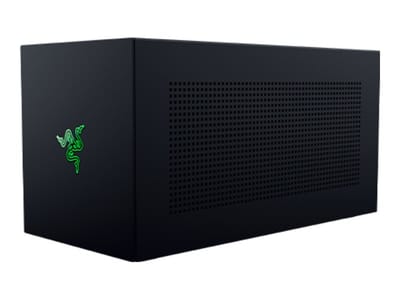
Core X V2
A Thunderbolt 5 enclosure that Razer lists as working with Thunderbolt 4 and USB4 hosts; it fits a four-slot card and needs an ATX power supply.
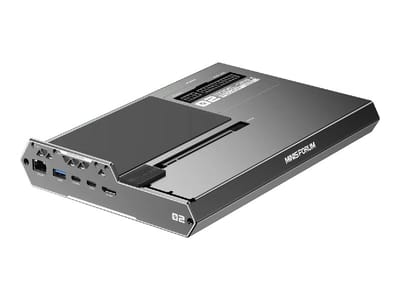
DEG2 eGPU Dock
Connects over USB4 or Thunderbolt 5, with an OCuLink input behind a switch, and adds an M.2 slot; it needs an ATX or SFX power supply.
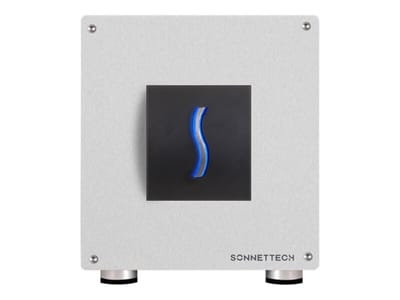
Breakaway Box 850 T5
Has an 850W power supply built in, so only the graphics card is extra, and works with Thunderbolt 4 and USB4 Windows PCs.
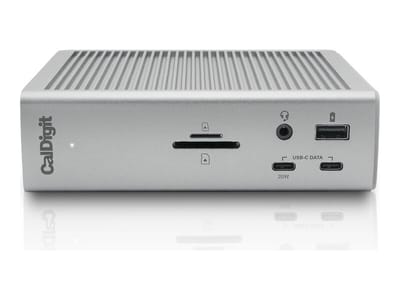
TS4 Thunderbolt 4 Dock
An 18-port dock that CalDigit lists for Thunderbolt 4 and USB4 hosts, with 2.5GbE and a DisplayPort 1.4 output.
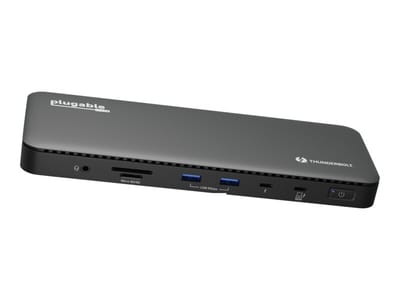
TBT4-UD5 Thunderbolt 4 Dock
Two HDMI ports drive two 4K60 monitors from one Thunderbolt 4 or USB4 port on a Windows PC.
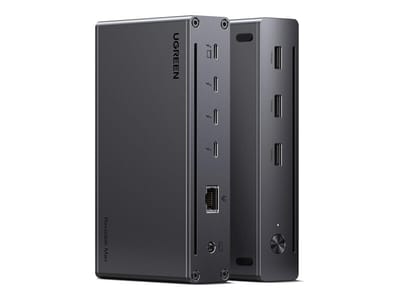
Revodok Max 208 Thunderbolt 4 Dock
Adds three Thunderbolt 4 ports for dual 4K60 displays plus gigabit Ethernet; it has no HDMI port, so monitors connect over USB-C or an adapter.
Frequently Asked Questions
Can I upgrade the RAM and storage in the ASUS NUC 14 Pro?
Yes. Two DDR5 SO-DIMM slots take up to 96GB of RAM, and two M.2 slots take NVMe storage. The tall chassis version adds a 2.5-inch SATA bay. The toolless design means none of it needs a screwdriver.
Is the ASUS NUC 14 Pro good for gaming?
The Intel Arc integrated graphics can handle casual games and older titles at lower settings, but multiple reviewers confirmed it’s not suitable for AAA gaming. ETA PRIME specifically noted it’s “definitely not the one for you” if gaming is your priority. The dual Thunderbolt 4 ports do let you connect an external GPU for serious gaming performance.
How many monitors can the ASUS NUC 14 Pro support?
Four displays at once. Two HDMI 2.1 ports and two Thunderbolt 4 ports with DisplayPort 1.4 alt mode carry the signal, so you can drive a single 8K display or up to four 4K monitors.
Does the ASUS NUC 14 Pro work with VMware ESXi and Proxmox?
Yes, VirtualizationHowto tested both platforms successfully. ESXi requires a boot parameter workaround due to the hybrid CPU architecture, but runs stably once configured. Proxmox works without issues. The support for up to 96GB RAM allows running multiple virtual machines in home lab environments.
Is the ASUS NUC 14 Pro noisy?
Level1Techs described it as “whisper quiet” and “basically inaudible even under full load.” SomeGadgetGuy found the fan noticeable during sustained heavy workloads like video rendering. Idle operation and normal productivity use stay quiet.
What’s the difference between the short and tall chassis versions?
The tall chassis version (54mm height) includes a 2.5-inch SATA drive bay for additional storage, while the short version (37mm height) is more compact but lacks this bay. Both versions have identical processor options, RAM capacity, M.2 slots, and port selection. The tall version weighs slightly more at around 600 grams versus 500 grams for the short version.
Does the ASUS NUC 14 Pro have Intel vPro support?
Yes, select configurations of the NUC 14 Pro support Intel vPro for enterprise manageability. Level1Techs highlighted the professional BIOS features including vPro, iSCSI boot, and display persistence settings. Check the specific processor variant to confirm vPro support.