
GMKtec EVO-T2
Updated on

The GMKtec EVO-T2 is one of the first mini PCs built on Intel’s Panther Lake platform and its 18A (1.8nm) process. The Core Ultra X9 388H pairs its CPU cores with an Arc B390 integrated GPU and an NPU 5 for a combined 180 TOPS of AI compute, aimed at people who want to run large models on hardware they own instead of renting cloud time. The Arc B390 carries 12 Xe3 cores, and two M.2 slots with PCIe 5.0 support plus Phison’s aiDAPTIV+ technology handle AI model storage and loading. All of it fits in the same compact chassis as the EVO-T1 predecessor.
Pros and cons
| Pros | Cons |
|---|---|
| 180 TOPS AI performance for local LLM inference | Soldered RAM cannot be upgraded after purchase |
| Intel 18A (1.8nm) process | Power draw peaks near 116W under full load |
| Arc B390 iGPU with 12 Xe3 cores | Premium pricing reflects flagship positioning |
| PCIe 5.0 M.2 with Phison aiDAPTIV+ AI SSD support | Only 2 M.2 slots vs. EVO-T1’s 3 slots |
| 10GbE + 2.5GbE dual Ethernet networking | No SD card reader |
| OCuLink for external GPU expansion | First-generation platform with unproven driver maturity |
Related Videos
GMKtec EVO-T2 Comparison Chart
 GMKtec EVO-T2 | |
| Price | List Price: $1,899.00 Amazon Prices: Loading prices... |
| Version | 64GB/1TB/Core Ultra X7 358H |
| Performance Rating | 10.3 |
| Operating System | Windows 11 Pro |
| Processor | Sixteen-core 1.90 Ghz (max 4.80 Ghz) Intel Core Ultra X7 358H |
| GPU | Integrated Intel Arc B390 |
| RAM | 64 GB LPDDR5X, 2-channel (LPDDR5X-8533 soldered) |
| Internal Storage | 1 TB NVMe PCIe 5.0 SSD |
| Dimensions width x length x thickness | 6.06 x 5.94 x 2.9 inches (153.92 x 150.88 x 73.66 mm) |
| Weight | 2.05 lbs (0.93 kg) |
| WiFi | Wi-Fi 7 (802.11be) |
| Bluetooth | Bluetooth 5.4 |
| Ethernet | 2 Ethernet ports at 10 Gbps |
| HDMI | 2 Full-Size HDMI Ports |
| DisplayPort | DP Alt Mode via 2x USB4 ports (up to 8K@60Hz) |
| VGA | No VGA Ports |
| USB Ports | 1 USB 2.0, 2 USB 3, 2 USB-C (2 USB4) Front: 1x USB4 (100W PD + DP Alt Mode), 2x USB-A 3.2, 1x USB-A 2.0. Rear: 1x USB4 |
| Thunderbolt Ports | No |
| OCuLink | OCuLink Gen4x4 for external GPU |
| Internal SATA Ports | No SATA ports |
| Card Reader | No Card Reader |
| Headphone Jack | combo |
| Fanless | No |
| VESA Mount | Yes |
| In the Box | Power adapter, VESA mounting bracket, HDMI cable, user manual |
| Expandability | 64GB LPDDR5X-8533 soldered (not upgradable). Dual M.2 NVMe slots (PCIe 5.0 + PCIe 4.0, up to 16TB total). OCuLink Gen4x4 for eGPU. |
Related Mini PCs
-
 GMKtec EVO-X1The GMKtec EVO-X1 is a Ryzen AI 9 HX-370 mini PC with Radeon 890M graphics, 32GB of soldered…
 -
 GMKtec EVO-X2The GMKtec EVO-X2 is a 3.6-pound upright mini PC built on the AMD Ryzen AI Max+ 395 with Radeon…
 -
 PELADN HO5The PELADN HO5 puts AMD's 12-core Ryzen AI 9 HX 370 and Radeon 890M graphics in a plastic five-inch…
 -
 Beelink GTR9 ProA high-performance AI Mini PC featuring the AMD Ryzen AI Max+ 395 processor with 126 AI TOPS, 128GB…
 -
 HP Z2 Mini G1aProfessional-grade compact workstation with AMD Ryzen AI Max+ PRO processors and unified memory…
 -
 MINISFORUM MS-S1 MAXA high-performance AI workstation powered by the AMD Ryzen AI Max+ 395 with 128GB unified memory,…
Four 4K displays, OCuLink, and 64GB you cannot change

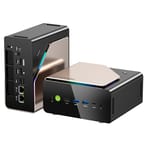
The case measures 6.06 x 5.94 x 2.90 inches and weighs just over 2 pounds, the same footprint as its predecessor, and it keeps VESA mount compatibility for behind-the-monitor placement. Cooling comes from a dual-fan and vapor chamber design rated for up to 60W sustained power output, with configurable TDP modes up to 80W for peak performance. The front panel carries a USB4 port with 100W Power Delivery and DisplayPort Alt Mode alongside two USB-A 3.2 ports and one USB-A 2.0. The rear adds a second USB4 port, dual HDMI 2.1, both Ethernet jacks, OCuLink, and a combo audio jack, and the HDMI and USB4 outputs together drive up to four displays at 4K.
GMKtec sells the box with Intel’s Core Ultra X9 388H or Core Ultra X7 358H, both 16-core processors arranged with 4 performance cores, 8 efficiency cores, and 4 low-power efficiency cores. The flagship X9 boosts to 5.1 GHz while the X7 reaches 4.8 GHz. Panther Lake spreads 180 TOPS of heterogeneous AI compute across the NPU 5, the Arc B390’s 12 Xe3 GPU cores, and the CPU cores themselves. According to WCCFTech, the system can run models with 70 billion parameters locally, using the 64GB of LPDDR5X-8533 memory and Phison’s aiDAPTIV+ SSD technology that intelligently pages model weights between memory and storage. GMKtec bundles its own “GMKtec Claw” AI utility based on OpenClaw for a ready-to-use local AI assistant out of the box.
WiFi 7 and Bluetooth 5.4 cover the wireless side, and the two Ethernet jacks run at 10GbE and 2.5GbE for demanding network workloads. Storage goes into two M.2 slots, one supporting PCIe 5.0 and the other PCIe 4.0, with a theoretical maximum of 16TB combined capacity. The OCuLink Gen4x4 port adds an external GPU for users who need dedicated graphics beyond the integrated Arc B390. Buyers who want raw GPU power over AI TOPS can look at the GMKtec EVO-X2 with AMD’s Ryzen AI Max+ 395, which pairs Radeon 8060S integrated graphics with up to 128GB of unified memory.
Launch coverage centered on the 180 TOPS figure

An Intel CEO visit and a 50% AI claim against AMD
At CES 2026, Intel CEO Lip-Bu Tan tested the EVO-T2 at the GMKtec booth. TechRadar reported that the EVO-T2 delivers 50% more AI computing power than its AMD Ryzen AI Max+ 395 rival, calling it “a critical step in making high performance AI computing accessible at the desktop level.”
WCCFTech on the two chips and the price
WCCFTech’s coverage laid out detailed specifications and pricing and singled out the Phison aiDAPTIV+ AI SSD integration as a key differentiator. The publication noted that GMKtec has “precisely optimized the system around the OpenClaw AI Agent,” providing users with a fully local AI assistant. Their analysis positioned the EVO-T2 as the successor to the Arrow Lake-powered EVO-T1 series, with a generational leap in AI capabilities and the same focus on local AI workloads that defined its predecessor.
Where 180 TOPS sits against Arrow Lake and Strix Halo
Intel’s Panther Lake architecture is the company’s first consumer silicon on the 18A process node, and GMKtec is among the first vendors shipping it. The 180 TOPS figure surpasses both Intel’s own Arrow Lake offerings (99 TOPS in the EVO-T1) and AMD’s Strix Halo platform (up to 126 TOPS), which sets a new ceiling for mini PC AI acceleration.
A local AI workstation for buyers who can live with 64GB
The EVO-T2 puts a Panther Lake chip in a box that sits on a desk. The 180 TOPS rating on the X9 388H, PCIe 5.0 storage with aiDAPTIV+ model paging, and 10GbE networking fit people running local language models and other AI workloads. The OCuLink port and the two USB4 connections leave room to add hardware as workloads grow.
The soldered 64GB of RAM is the limitation to weigh, since the EVO-T1’s SO-DIMM slots allowed later memory upgrades. Buyers who need more memory for larger models should consider the GMKtec EVO-X2 with up to 128GB of LPDDR5X, or wait for potential higher-memory EVO-T2 variants. As a first-generation Panther Lake device, its drivers are also still maturing. Our overview of the Panther Lake NUCs and their Arc B390 graphics covers the broader wave of boxes built on this same silicon.
The Mini PC Comparison Chart lines this machine up against the rest of the catalog.
Reviewer Insights
TechTablets
TechTablets tested the Core Ultra X7 358H build and measured the Arc B390 as the fastest integrated GPU the channel had run to that point, reporting “A graphics score over 7,000 for integrated graphics. This is phenomenal. In fact, it is the highest I have seen.” He also singled out the OCuLink port. “So this is becoming a bit of a rarity and that is a mini PC with OcuLink on it. If you run eGPUs, this is the port to get.” Thermals and fan noise held up in testing, with the review saying “GMK Tech has done a good job with the thermals and the fan profile… other mini PCs are typically louder.” His main complaint was the price. “The downside is… it’s almost $2,000 US at the time of this video, and that is really expensive from what these used to cost.” The review also flagged the soldered memory, HDMI 2.0 rather than 2.1 on the video outputs, and Adobe Premiere Pro export problems during the test.
Frequently Asked Questions
What processor does the GMKtec EVO-T2 use?
Two Intel Panther Lake chips are offered. The flagship Core Ultra X9 388H has 16 cores and boost speeds up to 5.1 GHz, and the Core Ultra X7 358H has 16 cores boosting to 4.8 GHz. Both are built on Intel’s 18A (1.8nm) process; the 180 TOPS figure GMKtec quotes is for the X9 388H, through its integrated NPU 5, Arc B390 GPU, and CPU cores.
Can I upgrade the RAM in the GMKtec EVO-T2?
No. The 64GB of LPDDR5X-8533 memory is soldered, which allows higher speeds than SO-DIMM configurations but fixes the capacity for the life of the machine. If you need more memory, the GMKtec EVO-X2 offers up to 128GB of LPDDR5X.
What ports does the GMKtec EVO-T2 have?
Two USB4 ports, one of them with 100W Power Delivery, plus 2x USB-A 3.2, 1x USB-A 2.0, dual HDMI 2.1, a combo audio jack, and an OCuLink Gen4x4 port for external GPU expansion. Networking runs over 1x 10GbE and 1x 2.5GbE Ethernet alongside WiFi 7 and Bluetooth 5.4.
Can the GMKtec EVO-T2 run local AI models?
Yes. With 180 TOPS of combined AI acceleration and 64GB of high-speed LPDDR5X memory, it can run language models with up to 70 billion parameters locally. Phison’s aiDAPTIV+ AI SSD technology pages model data between memory and storage, and GMKtec’s Claw utility ships as a ready-to-use local AI assistant.
How does the EVO-T2 compare to the EVO-T1?
The EVO-T2 moves from Arrow Lake to Panther Lake (18A process), raises AI performance from 99 TOPS to 180 TOPS, swaps the Arc 140T iGPU for the Arc B390 with 12 Xe3 cores, adds WiFi 7 (vs WiFi 6) and faster 10GbE networking (vs 2.5GbE), and supports PCIe 5.0 SSDs. The EVO-T1 keeps two advantages, upgradable SO-DIMM RAM and a third M.2 slot.
Does the GMKtec EVO-T2 support external GPUs?
An OCuLink Gen4x4 port provides the high-bandwidth connection for external GPU enclosures. A discrete card can then take on gaming, rendering, or AI training tasks that exceed what the integrated Arc B390 GPU handles.
How many displays can the GMKtec EVO-T2 support?
Four at once at 4K resolution, across the dual HDMI 2.1 ports and the two USB4 ports with DisplayPort Alt Mode. A single high-resolution display over USB4 can run up to 8K at 60Hz.