
TerraMaster F2-425 Plus
Published on

The TerraMaster F2-425 Plus is a compact 2-bay NAS for home backups, photo libraries, and a Plex or Jellyfin server, sold without drives. Three M.2 NVMe slots and two 5GbE ports are its main advantages over a basic 2-bay unit; the two-drive limit is the main reason to look elsewhere. It launched in October 2025 at $399.99 with an Intel N150, and TerraMaster later added a second model with an Intel N95.
Pros and cons
| Pros | Cons |
|---|---|
| Two 5GbE ports, double the speed of 2.5GbE | Only two hard drive bays, so hard drive capacity stops at 60TB |
| Three M.2 NVMe slots for SSD cache or a separate SSD pool | Each M.2 slot runs at PCIe 3.0 x1, under 1,000 MB/s |
| Intel N150 with hardware transcoding for Plex and Jellyfin | One SO-DIMM slot and non-ECC memory |
| 8GB of DDR5 on the N150 model, upgradable to 32GB | No PCIe slot, so no internal route to 10GbE |
| Thick aluminum shell and tool-less drive trays | Rear fan has no dust filter |
| Very quiet in ITPro’s and Fstoppers’ testing | HDMI video output is unconfirmed; CNX Software and ITPro disagree |
TerraMaster F2-425 Plus Comparison Chart
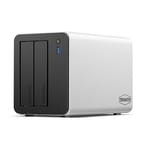 TerraMaster F2-425 Plus | TerraMaster F2-425 Plus | |
| Price | List Price: $499.99 Amazon Prices: Loading prices... | List Price: $399.49 Amazon Prices: Loading prices... |
| Version | Intel N150, 8GB DDR5, diskless | Intel N95, 8GB, diskless |
| Drive Bays | 2 x 3.5-inch SATA (2.5-inch compatible) Hot-swap, tool-less trays | 2 x 3.5-inch SATA (2.5-inch compatible) Hot-swap, tool-less trays |
| M.2 Slots | 3 x M.2 NVMe, cache or storage pool PCIe 3.0 x1 each | 3 x M.2 NVMe, cache or storage pool PCIe 3.0 x1 each |
| Max Raw Capacity | 60 TB | 60 TB |
| Included Drives | None (diskless) | None (diskless) |
| System Drive | none (TOS installs on the drives) | none (TOS installs on the drives) |
| Processor | Quad-core 3.60 Ghz Intel Processor N150 | Quad-core 3.40 Ghz (max 3.40 Ghz) Intel Processor N95 |
| Hardware Transcoding | Yes (Intel Quick Sync (UHD Graphics); 4K) | Yes (Intel Quick Sync (UHD Graphics); 4K) |
| RAM | 8 GB DDR5 SO-DIMM Max 32 GB, 1 slot Non-ECC SO-DIMM; DDR5 on-die ECC only | 8 GB Max 16 GB, 1 slot Non-ECC SO-DIMM; 16GB is Intel's chip rating, no TerraMaster max |
| ECC Memory | No (DDR5's built-in on-die ECC only) | No |
| Network Ports | 2 x 5GbE RJ45 | 2 x 5GbE RJ45 |
| PCIe Slot | No | No |
| Expansion Unit | None; USB DAS units mount as external drives | None; USB DAS units mount as external drives |
| Operating System | TOS 7 | TOS 7 |
| Third-Party OS | Yes (Unraid guide covers older models; warranty unconfirmed) | Yes (Unraid guide covers older models; warranty unconfirmed) |
| File Systems | Btrfs, ext4 (external drives also EXT3, NTFS, FAT32, HFS+) | Btrfs, ext4 (external drives also EXT3, NTFS, FAT32, HFS+) |
| USB Ports | 3 USB 3, 1 USB-C Front: USB-A. Rear: 2x USB-A, USB-C. All 10Gbps | 3 USB 3, 1 USB-C Front: USB-A. Rear: 2x USB-A, USB-C. All 10Gbps |
| Thunderbolt Ports | No | No |
| HDMI | 1 | 1 |
| WiFi | No | No |
| Idle Power | 12 W (N150 model, two Seagate 4TB drives in hibernation, maker spec) | 12 W (N150 model, two Seagate 4TB drives in hibernation, maker spec) |
| Load Power | 31 W (N150 model, two Seagate 4TB drives in read and write, maker spec) | 31 W (N150 model, two Seagate 4TB drives in read and write, maker spec) |
| Power Supply | 48W external | 48W external |
| Noise | 20 dB (two drives in standby, 1 m, 17.3 dB(A) room, maker spec) | 20 dB (two drives in standby, 1 m, 17.3 dB(A) room, maker spec) |
| Dimensions width x length x thickness | 4.8 x 8.6 x 5.9 inches (121.92 x 218.44 x 149.86 mm) | 4.8 x 8.6 x 5.9 inches (121.92 x 218.44 x 149.86 mm) |
| Weight | 4.9 lbs (2.23 kg) | 4.9 lbs (2.23 kg) |
| Released | October 2025 at $399.99 | October 2025 at $399.99 |
| In the Box | Main unit, power adapter and cord, Ethernet cable, screws, quick start guide, warranty note. | Main unit, power adapter and cord, Ethernet cable, screws, quick start guide, warranty note. |
| Expandability | RAM to 32GB on the N150 model (one SO-DIMM). 3x M.2 NVMe, PCIe 3.0 x1. No PCIe slot. | One SO-DIMM. 3x M.2 NVMe, PCIe 3.0 x1. No PCIe slot. |
Two drive bays, three M.2 slots, and one memory slot
The F2-425 Plus measures about 4.8 x 8.6 x 5.9 inches and weighs 4.9 pounds without drives. ITPro describes the aluminum alloy shell as 3mm thick. Each hot-swappable bay takes a 3.5-inch or 2.5-inch SATA drive. A 3.5-inch drive clips into its push-lock tray without screws; a 2.5-inch drive uses the tray’s mounting holes. TerraMaster rates the bays for 30TB drives, or 60TB raw across both. TerraMaster’s 84TB maximum counts three 8TB M.2 SSDs as well. The bays support RAID 0, RAID 1, JBOD, single disks, and TerraMaster’s TRAID. TOS installs onto an SSD or hard drive you fit, since the unit has no separate system drive.
The three M.2 2280 NVMe slots and the SO-DIMM slot sit under the shell, which slides off after you remove two screws on the bottom. TOS can use the M.2 drives as a cache for the hard drives or as their own storage pool, and TerraMaster supports RAID 5 across all three. Each slot gets one PCIe 3.0 lane, so a single drive tops out under 1,000 MB/s, and ITPro advises against paying for PCIe Gen 4 SSDs. The N150 model ships with 8GB of DDR5 on one non-ECC SO-DIMM and takes up to 32GB, which means replacing the module rather than adding one. Its only error correction is the on-die kind built into DDR5 chips.
The N95 model keeps the same case, bays, M.2 slots, and network ports. TerraMaster’s product page says DDR5 for this model and seller listings on the price-comparison site Geizhals say DDR4, so check the installed module before buying an upgrade. TerraMaster publishes no memory limit for the N95 model. Geizhals lists 32GB, and Intel rates the chip for 16GB. Intel gives the N150 the same 16GB rating and TerraMaster lists that model at 32GB, so the N95 may also take more than 16GB.
Network, USB, power, and noise

TerraMaster rates the two RJ45 network ports at up to 1,020 MB/s combined, using link aggregation or SMB Multichannel, which needs multi-gig ports on the other end. A single link measured about 4.6 Gb/s in ITPro’s read tests. There is no PCIe slot or network upgrade slot, so the unit cannot gain an internal 10GbE port. The front has a 10Gbps USB-A port; the rear has two more 10Gbps USB-A ports, a 10Gbps USB-C port, and an HDMI port. CNX Software describes that port as terminal output only, while ITPro lists it as HDMI 2.0 with 4K 60Hz video. The USB ports also take DAS enclosures, which mount as external drives.
TerraMaster’s spec sheet rates the N150 model at 12 W with two Seagate 4TB drives in hibernation and 31 W with those drives reading and writing. It also lists 20 dB(A) at 1 meter with two drives in standby, in a room measured at 17.3 dB(A). Cooling is one 80mm fan at the rear, with smart, high, middle, and low modes. Power comes from a 48 W external adapter, according to TerraMaster and ITPro; CNX Software’s unit shipped with a 12V/3.33A adapter.
Four-core chips for file sharing and light Docker, with TOS or Unraid

The Intel N150 dates from early 2025 and has four threads, a 3.6GHz boost, and a PassMark score of about 5,300. That covers file sharing, backups, photo indexing, and several light Docker containers, and TerraMaster rates its integrated graphics for 4K hardware transcoding of H.264 and H.265. The N95 in the second model is the older 2023 chip with a 3.4GHz boost and a PassMark score of about 5,300, so the two perform about the same. Neither chip suits several VMs at once.
TOS is TerraMaster’s own system; ITPro, CNX Software, and Fstoppers tested TOS 6, and TerraMaster now lists TOS 7 for this unit. For backups and photo libraries, it has Btrfs snapshots, CloudSync and TerraSync, and a photo app with face, pet, and scene recognition. Containers run in Docker with Portainer, and VirtualBox is included for VMs. Fstoppers credits TRAID, TerraMaster’s own RAID type, with easier expansion than standard RAID. HyperLock-WORM is write-once protection, so a locked file cannot be changed. Plex and Emby install from the app center.
NASCompares’ Unraid guide says running Unraid on an Intel TerraMaster unit does not invalidate the hardware warranty, though TerraMaster will not support it at the software level. That guide covers older models, so warranty treatment on the F2-425 Plus is unconfirmed. CNX Software’s teardown found an internal USB port that may work as an alternative boot device, though space is tight enough that it needs an ultra-compact flash drive.
Reviewer Insights
All four reviews tested the N150 model with 8GB of RAM. ITPro, CNX Software, and Fstoppers praise the build, and each of the four values the M.2 slots. GameRevolution and Fstoppers name the two-bay limit as a drawback, CNX Software’s complaints are about software, and ITPro’s is the single memory slot.
ITPro
Dave Mitchell of ITPro ran Iometer over 5GbE against a mirrored pool of two Kingston NVMe SSDs. An SMB share reached 4.6 Gb/s reads and 3.9 Gb/s writes, with random writes at 2.4 Gb/s. An iSCSI target over a dual 5GbE MPIO link reached 7 Gb/s reads and 5.1 Gb/s writes. He wrote that “all cooling is handled by a single 8 cm diameter fan at the rear, which we found to be extremely quiet during testing.” His only listed drawback was the single memory slot, and his verdict: “The F2-425 Plus is very well built, and its triple M.2 NVMe SSD slots plus dual 5GbE ports add extra levels of versatility.”
CNX Software
CNX Software, testing a unit TerraMaster supplied, measured 4.71 Gb/s both ways in iperf3 over 5GbE. Over 2.5GbE, a TRAID pool of two 4TB SATA drives and a 256GB NVMe SSD got 279 MB/s sequential reads and 111 MB/s writes. Rebuilt as two hard drives with that SSD as Hyper Cache, writes rose to 206 MB/s, with little benefit elsewhere. It flagged a TRAID sync of about 15 hours and a TNAS PC program for Linux that failed with TerraSync, and wrote of the media search: “It works, but it’s case-sensitive, and it does not handle synonyms at all.” The conclusion: “The TerraMaster F2-425 Plus has a solid hardware design, and the software works well enough that I’ll probably keep using it at home for my storage needs.”
Fstoppers
Zhen Siang Yang of Fstoppers, a first-time NAS user, tested with two Seagate Barracuda hard drives and no NVMe cache. Copying 35.5GB to the NAS took about 9 minutes over a wired connection and about 27 minutes over Wi-Fi. Yang concluded: “These results prove that a wired network connection is strongly recommended if you want to get the most out of this NAS.” On fan noise, Yang wrote: “In practice, noise levels are impressively low, as I could barely hear the NAS even when it was placed right beside me.” Yang’s complaints were unclear setup guides, no 10GbE, the two-bay limit, no front USB-C port, no dust filter on the rear fan, and having to unscrew the chassis to upgrade RAM or add M.2 drives.
GameRevolution
Mack Ashworth of GameRevolution scored a TerraMaster review sample 9 out of 10 in February 2026 and found multitasking smooth with reliable transfers. “The biggest downside to the F2-425 Plus is the two-bay limitation,” he wrote. On setup he added: “That is not to say TerraMaster has done a bad job, it’s just that some competitors make a huge effort in walking users through NAS setup.”
Our verdict
The F2-425 Plus fits a household or small office that wants two mirrored hard drives, an SSD pool or cache for containers and photo libraries, and a network link faster than 2.5GbE without paying for 10GbE. A photographer moving large folders should connect it by wire rather than Wi-Fi, and it can sit on a desk: Fstoppers’ reviewer could barely hear it placed right beside them. The N150 model is the safer choice for a memory upgrade, because TerraMaster publishes a 32GB limit only for that model. The N95 model scores about the same on PassMark, so it gives up little if the stock 8GB is enough.
Buyers who expect to outgrow two hard drives are better served by the TerraMaster F4-425 Plus, which adds two bays and RAID 5 or RAID 6 for hard drives in the same family. Our best 2-bay NAS guide compares this unit with the UGREEN DXP2800 and Synology’s 2-bay models.
Frequently Asked Questions
What is the difference between the N150 and N95 versions of the F2-425 Plus?
The chip, and a published 32GB maximum for the N150 model only. TerraMaster lists that model with 8GB of DDR5 and gives no maximum for the N95 model, which uses the older chip. Both have 8GB installed, two drive bays, three M.2 NVMe slots, and two 5GbE ports in the same aluminum case.
Does the TerraMaster F2-425 Plus support ECC memory?
No. TerraMaster ships and lists a non-ECC SO-DIMM. DDR5 has on-die ECC inside each chip, which does not correct errors between the memory and the CPU.
Can the F2-425 Plus transcode video for Plex or Jellyfin?
Yes. TerraMaster’s spec sheet lists hardware transcoding of H.264, H.265, MPEG-4, and VC-1 up to 4K at 60 frames per second, and its product page names Plex, Emby, and Jellyfin as supported media servers.
Can the F2-425 Plus be upgraded to 10GbE?
Not internally, because it has no PCIe slot. Bonding the two 5GbE ports or using SMB Multichannel gives TerraMaster’s rated 1,020 MB/s, which needs a switch or a computer with multi-gig ports.
How much power does the TerraMaster F2-425 Plus use?
About 12 W with the drives asleep and 31 W under load, by TerraMaster’s figures for two 4TB drives. TerraMaster lists a 48 W external adapter.