
Acer Chromebook Spin 13
Updated on

The Acer Chromebook Spin 13 (CP713-1WN) is a premium 2-in-1 Chromebook that Acer launched in September 2018 to compete directly with Google’s Pixelbook in the enterprise and prosumer market. As of June 2026, the device is still supported by Chrome OS: Google’s official Chrome Enterprise Auto Update Expiration list shows “Chromebook Spin 13 (CP713-1WN): Jun 2028” (with extended support flagged), so Chrome OS updates and security patches continue through that date.
The defining hardware is the 13.5-inch 2256x1504 (3:2) IPS touchscreen, the anodized aluminum chassis, and the bundled Wacom EMR stylus that lives in a garage slot at the front of the device. The keyboard is backlit, the pen is battery-free, and the chassis hinges through 360 degrees for tablet, tent, and presentation modes. Three CPU tiers shipped: Intel Core i3-8130U on the entry SKUs, Intel Core i5-8250U on the mid SKUs, and Intel Core i5-8350U (vPro-eligible) on the top SKU (CP713-1WN-57LT) paired with 16 GB of RAM.
Related Videos
Acer Chromebook Spin 13 Comparison Chart
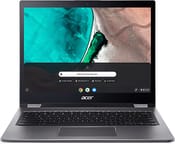 Acer Chromebook Spin 13 | Acer Chromebook Spin 13 | Acer Chromebook Spin 13 | Acer Chromebook Spin 13 | |
| Price | List Price: $899.99 Amazon Prices: | List Price: $799.99 Amazon Prices: | List Price: $1049.99 Amazon Prices: | List Price: $899.99 Amazon Prices: |
| Model number | CP713-1WN-53NF / NX.EFJAA.005 | CP713-1WN-385L | CP713-1WN-57LT / NX.EFJAA.02B | CP713-1WN-55HT |
| Performance Rating | 6.0 | 4.9 | 4.4 | 6.0 |
| Chromebook Plus | No | No | No | No |
| Processor | Quad-core 1.60 Ghz (max 3.40 Ghz) Intel Core i5-8250U | Dual-core 2.20 Ghz (max 3.40 Ghz) Intel Core i3-8130U | Quad-core 1.70 Ghz (max 3.60 Ghz) Intel Core i5-8350U | Quad-core 1.60 Ghz (max 3.40 Ghz) Intel Core i5-8250U |
| RAM | 8 GB | 8 GB | 16 GB | 8 GB |
| Internal Storage | 128 GB eMMC | 64 GB eMMC | 128 GB eMMC | 64 GB eMMC |
| Screen Size | 13.5" | 13.5" | 13.5" | 13.5" |
| Screen Resolution | 2256x1504 | 2256x1504 | 2256x1504 | 2256x1504 |
| Screen Type | IPS | IPS | IPS | IPS |
| Touch Screen | Yes | Yes | Yes | Yes |
| Stylus / Pen | Supported | Supported | Supported | Supported |
| Dimensions width x length x thickness | 12.2 x 9.7 x 0.7 inches (309.88 x 246.38 x 17.78 mm) | 12.2 x 9.7 x 0.7 inches (309.88 x 246.38 x 17.78 mm) | 12.2 x 9.7 x 0.7 inches (309.88 x 246.38 x 17.78 mm) | 12.2 x 9.7 x 0.7 inches (309.88 x 246.38 x 17.78 mm) |
| Weight | 3.5 lbs (1.59 kg) | 3.5 lbs (1.59 kg) | 3.5 lbs (1.59 kg) | 3.5 lbs (1.59 kg) |
| Backlit Keyboard | Yes | Yes | Yes | Yes |
| Webcam | 720p | 720p | 720p | 720p |
| WiFi | IEEE 802.11a/b/g/n/ac | IEEE 802.11a/b/g/n/ac | IEEE 802.11a/b/g/n/ac | IEEE 802.11a/b/g/n/ac |
| Bluetooth | Bluetooth 4.2 | Bluetooth 4.2 | Bluetooth 4.2 | Bluetooth 4.2 |
| Ethernet | No | No | No | No |
| Cellular Modem | No | No | No | No |
| HDMI | No HDMI | No HDMI | No HDMI | No HDMI |
| USB Ports | 1 USB 3, 2 USB-C (supports external display) | 1 USB 3, 2 USB-C (supports external display) | 1 USB 3, 2 USB-C (supports external display) | 1 USB 3, 2 USB-C (supports external display) |
| Thunderbolt Ports | No | No | No | No |
| Card Reader | microSD Card Reader | microSD Card Reader | microSD Card Reader | microSD Card Reader |
| Battery | 3 cell, 4670 mAh, Lithium-ion | 3 cell, 4670 mAh, Lithium-ion | 3 cell, 4670 mAh, Lithium-ion | 3 cell, 4670 mAh, Lithium-ion |
| Battery Life | 10.0 hours | 10.0 hours | 10.0 hours | 10.0 hours |
| Fanless | No | No | No | No |
| Auto Update Expiration Date | June, 2028 | June, 2028 | June, 2028 | June, 2028 |
Related Chromebooks
-
 Acer Chromebook Spin 713The Acer Chromebook Spin 713 boasts a vivid 13.5-inch 2256x1504 IPS touch display, versatile 2-in-1…
 -
 Acer Chromebook Spin 513The Acer Chromebook Spin 513 is a fanless 13.3-inch convertible Chromebook with a Qualcomm…
 -
 HP Chromebook x360 14b (2024)The HP Chromebook x360 14b (2024) is a 14-inch convertible sold as a standard Intel N100 build and…
 -
 Samsung Galaxy Chromebook 2The Samsung Galaxy Chromebook 2 is a 13.3-inch 2-in-1 with a vivid 1080p QLED touchscreen, an…
 -
 ASUS Chromebook Flip CX1 (Touchscreen)The ASUS Chromebook Flip CX1 is a 14-inch Full HD convertible with a 360-degree touchscreen, an…
 -
 ASUS Chromebook Flip C434The 2019 ASUS Chromebook Flip C434 is a 14-inch convertible with a slim-bezel FHD touchscreen, an…
Browser benchmarks put it ahead of the Pixelbook
The 8th-gen Intel U-series chips were aimed at thin-and-light Windows ultrabooks, and this Chromebook inherits that performance profile. UltrabookReview’s Andrei Girbea (November 1, 2018) measured Jetstream 1.1 at 161.12 against the Pixelbook’s 144.78 and Octane 2.0 at 33,487 against the Pixelbook’s 32,334. Android Authority’s Williams Pelegrin (November 12, 2018) tested the Core i5-8250U variant and recorded an Octane 2.0 score of 36,464, noting that “the Chromebook Spin 13 is squarely in the front of the pack here, particularly when compared to the 27,000 score that the Google Pixelbook attained.”
Deep-tab browsing, Android apps, and lightweight Linux container workloads all run without strain. Williams Pelegrin’s verdict was that “the performance is absolute overkill for most people and the $899 price means a select few will actually take advantage of what is being offered.” The chassis has a fan, and Android Authority listed “Fan randomly ramps up and down” as a con.
Memory and storage depend on the SKU. The CP713-1WN-385L ships 8 GB / 64 GB at the entry $799.99 price with the Core i3-8130U. The CP713-1WN-53NF and CP713-1WN-55HT ship 8 GB / 128 GB and 8 GB / 64 GB respectively with the Core i5-8250U. The top CP713-1WN-57LT ships 16 GB of LPDDR3 with the Core i5-8350U and 128 GB of eMMC at $1,049.99 list. RAM and eMMC are soldered on every SKU; no upgrade path exists.
A sharp 3:2 panel above a chassis that is heavy in tablet mode
The 13.5-inch 2256x1504 IPS panel uses the same 3:2 aspect ratio Google chose for the Pixelbook, which leaves more vertical pixels for reading, scrolling, and side-by-side documents than a 16:9 layout permits. Chrome Unboxed’s video review (Robby Payne) said “this display is an absolute knockout.” UltrabookReview measured peak brightness at “316 cd/m2 on power” with a contrast ratio of 1170:1 in the middle of the screen. The touchscreen and the trackpad both use Gorilla Glass.
TechRadar’s Desire Athow (December 5, 2018) listed “Premium finish” as one of three pros. Android Authority’s Williams Pelegrin wrote that “the Chromebook Spin 13 features the aluminum build I always wanted from a Chromebook.” On Acer’s own YouTube channel, Ian Dixon’s hands-on described the chassis as “a proper laptop rather than some of the very plasticky earlier Chromebooks I’ve played with” (the same observation TechRadar made about the diamond-cut edges and anodized aluminum).
UltrabookReview pointed out that the chassis has “a few crude-aluminum beveled edges around the interior and touchpad,” that the lid has “a little bit of flex,” and that the overall tablet experience is awkward at 3.5 pounds. Robby Payne at Chrome Unboxed framed the size the same way: “the 3:2 aspect ratio really makes this feel like a 14 or 15-inch device,” which makes it a less natural tablet than a smaller convertible.
Software support limits what the bundled pen can do
Acer included a full-size battery-free Wacom EMR pen that stores in a garage slot at the front of the device. The pen draws power inductively from the display and offers 4,096 levels of pressure sensitivity at the hardware level. Because it lives in the chassis, it travels with the machine instead of alongside it.
Paul Thurrott’s review (November 24, 2018) found the Chrome OS and Android app integration uneven. “What you don’t get, sadly, are any advanced smartpen features like tilt support or pressure sensitivity. There aren’t any buttons either, or an eraser.” That puts the pen in the note-taking and basic-drawing bucket. Thurrott’s bottom line is “the Spin 13 is adequate for note-taking but less so for drawing.”
The trackpad is the weak point of the input hardware
The keyboard is full-size, backlit, and laid out as a standard Chromebook chiclet, with short travel. Robby Payne at Chrome Unboxed called the keyboard “mushy” and noted that the action “can get a little bit mushy from time to time and so it wasn’t terrible it just isn’t great either, but the keys are backlit so that is a nice plus especially when you’re paying top dollar for a Chromebook.” TechRadar’s only published keyboard complaint was that the backlight cannot be turned off (“Can’t switch off keyboard backlight” was listed as a con).
The trackpad surface is short from top to bottom. Chrome Unboxed’s Robby Payne wrote that “the surface feels great and the click mechanism is fantastic, but Chrome OS’ palm rejection keeps inputs from the edges from being picked up. With such a small area from top to bottom, this results in lots of missed inputs on the Spin 13 on a regular basis.” The Chrome Unboxed video review separately noted that “Chrome OS does a good job of palm rejection but sometimes on this device it feels like it’s doing too bit of a job.”
Two USB-C ports, no HDMI or Ethernet
Both USB-C 3.1 ports sit one to a side, and either can charge the device or drive an external display. The rest of the complement is one USB 3.0 Type-A, a microSD slot, and a combo 3.5 mm jack. TechRadar listed “No HDMI port” as a con, and there is no Ethernet either, so a USB Ethernet adapter covers wired networking. Wireless is dual-band 802.11ac with Bluetooth 4.2. A volume rocker and a Kensington lock slot sit on the chassis edges, and the backlit power button sits inline with the keyboard.
The chassis also carries a status LED, rubber strips that keep it stationary on a desk, and a small lip rather than a notch for opening the lid. TechRadar’s Desire Athow flagged that lip and “three (yes, three) stickers” on the chassis as the only design irritations.
Battery results depend on the workload
Acer rates the device at 10 hours. Paul Thurrott measured “a bit over 8 hours of battery life” in his Movies-and-TV streaming test, and Williams Pelegrin at Android Authority noted that battery life “falls short” of Acer’s 10-hour claim. Chrome Unboxed’s Robby Payne reported “getting 10 hours easily without too much thought” in mixed real-world Chrome OS use. Plan for a full work or school day on a single charge, and expect to plug in before the second day.
UltrabookReview described the machine as “completely quiet with daily use,” while Android Authority and TechRadar separately noted that the fan ramps up unpredictably during light tasks.
Reviewer Insights
TechRadar (Desire Athow, December 5 2018) rated the Spin 13 4.5 / 5 with the verdict that “if you’re after a Chromebook for business use, the Spin 13 is probably the best out there, pushing Google’s Pixelbook aside thanks to better hardware and a bundled stylus that’s more than just a gimmick.” Published pros: “Gorgeous display, Premium finish, Integrated stylus.” Published cons: “Expensive, No HDMI port, Can’t switch off keyboard backlight.”
Chrome Unboxed (Robby Payne, December 4 2018) made the value call directly in the conclusion: “I can confidently say that if the price comes down $100-150, this becomes a simple and easy recommendation. For now, though, the choice comes down to whether or not you want or need all that Acer is offering with the Spin 13 and, if you do, whether or not you are willing to part with the dollars to get it all in one package.” The keyboard (“mushy from time to time”) and trackpad (“inexplicably small”) were the two specific input criticisms.
Paul Thurrott (November 24 2018) gave the strongest endorsement of the group: “This is the Chromebook on which I would spend my own money.” His pros were “Stunning 3:2 display, Premium design, Versatile convertible design, Excellent performance, Great battery life, Android app compatibility.” His cons were “A bit thick and heavy in tablet mode, Chrome OS/Android integration is still a bit awkward, A bit expensive for a Chromebook.”
Android Authority (Williams Pelegrin, November 12 2018) framed the device as “The best Chromebook, but at what cost?” The headline finding was that the performance is “absolute overkill for most people and the $899 price means a select few will actually take advantage of what is being offered.”
UltrabookReview (Andrei Girbea, November 1 2018) rated the device 4.25 / 5 and landed on a careful positioning verdict: the Spin 13 “is stuck somewhere in no-mans-land: too expensive for the average user, and not yet capable-enough for power-users, despite packing hardware and characteristics like few other Chromebooks.” His benchmark numbers (Octane 33,487; Jetstream 161.12; Geekbench 4 multi 8,642; brightness 316 cd/m^2; contrast 1170:1) supplied most of the measured figures on this page.
Best kept in service by owners who value the screen and the pen
Chrome OS support runs to June 2028, so a school or business fleet bought in 2019 still has a supported platform, and a secondhand buyer in 2026 gets a fast, well-built convertible running the current Chrome OS image. The draw is the 3:2 display, the aluminum chassis, and stylus input that stores inside the device rather than next to it.
At 3.5 pounds it is heavy for travel-first use, and the EMR pen’s hardware pressure sensitivity is not matched by software support, so digital art is outside its range. A buyer who wants a long Chrome OS runway from a fresh purchase should look at a newer model, since the June 2028 date is close.
Frequently Asked Questions
When does the Acer Chromebook Spin 13 reach its Chrome OS Auto Update Expiration date?
Google’s official Chrome Enterprise Auto Update Expiration list shows “Chromebook Spin 13 (CP713-1WN): Jun 2028” with extended support enabled, so Chrome OS updates and security patches continue until June 2028.
What is the difference between the four CP713-1WN variants on this page?
All four share the 13.5-inch 2256x1504 IPS touchscreen, the anodized aluminum chassis, the garaged Wacom EMR stylus, the backlit keyboard, the 2x USB-C / 1x USB 3.0 / microSD port set, and the 802.11ac + BT 4.2 wireless radios. They differ on CPU and RAM and storage: v1 (CP713-1WN-53NF) ships Core i5-8250U with 8 GB and 128 GB at $899.99; v2 (CP713-1WN-385L) ships the entry Core i3-8130U with 8 GB and 64 GB at $799.99; v3 (CP713-1WN-57LT) ships the vPro Core i5-8350U with 16 GB and 128 GB at $1,049.99; v4 (CP713-1WN-55HT) ships Core i5-8250U with 8 GB and 64 GB at $899.99.
Is the Wacom stylus rechargeable?
No, the stylus is a Wacom EMR pen that draws power inductively from the display. It has no battery to charge or replace. It stores in a garage slot at the front of the chassis and is always present when the device is.
Does the Acer Chromebook Spin 13 have an SD card slot?
The slot is microSD rather than full-size SD, and it supports the standard microSD, microSDHC, and microSDXC formats.
Can the RAM or storage be upgraded?
Neither can be upgraded. Both the LPDDR3 RAM (8 or 16 GB depending on SKU) and the eMMC storage (64 or 128 GB depending on SKU) are soldered to the motherboard. A microSD card is the practical way to add storage.
Is the Spin 13 still available to buy new?
Amazon’s CP713-1WN listings are either unavailable, marketplace-only (third-party sellers without Amazon-direct stock), or “Renewed” / refurbished. As of June 2026, the practical sources are enterprise refresh channels and the secondhand market. With the Auto Update Expiration in June 2028, used pricing should reflect the remaining Chrome OS support window.