

We already compared the MacBook Neo to Chromebooks on hardware, and the verdict was nuanced: Apple’s $599 laptop is genuinely impressive for creative work, but most students and cloud-first users are better served by a Chromebook Plus at half the price. What we didn’t account for in that analysis was Google’s counterpunch. Starting in mid-2025, every new Chromebook Plus from every major manufacturer ships with 12 months of Google AI Pro at no additional cost. That’s a subscription Google normally charges $19.99 per month for, and it includes Gemini Advanced, 2TB of cloud storage, and AI capabilities baked into Gmail, Docs, Sheets, and the rest of Google Workspace.
The marketing math is simple: $240 in free services stacked on top of a $400 to $650 laptop. The real math is more complicated, and more interesting. Does this bundle genuinely change who should buy what, or is it a promotional sugar rush that evaporates after twelve months? We broke down the numbers to find out.
What You Actually Get in the Box
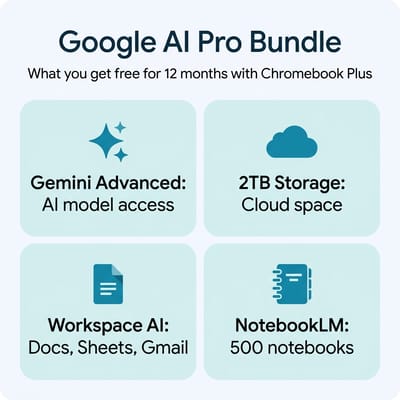
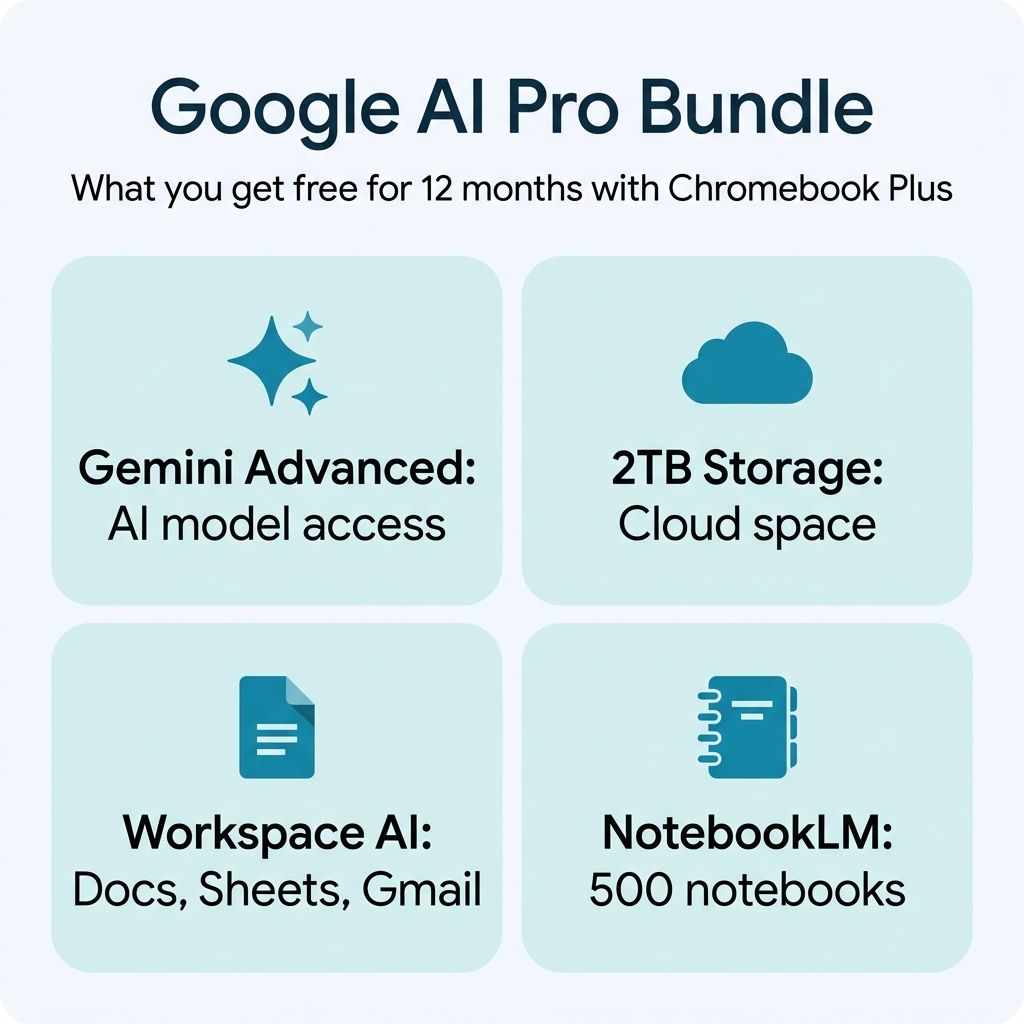
The Google AI Pro bundle isn’t a stripped-down trial or a limited preview. It’s the full subscription that paying customers get, and as of March 2026, that includes access to Gemini 3.1 Pro, Google’s most capable AI model available to consumers. You get the Gemini side panel in Chrome for summarizing web pages, drafting emails, and researching across multiple tabs. You get AI-powered features inside Google Docs, Sheets, Slides, and Gmail, including writing assistance, data analysis, and presentation generation. You get 2TB of Google One cloud storage, up from the 15GB free tier. And you get access to NotebookLM with dramatically higher limits, up to 500 notebooks and 300 sources per notebook, which is genuinely useful for students and researchers organizing large amounts of material.
This isn’t an Acer-only promotion or a limited-time offer from a single retailer. Acer confirmed the bundle with its Chromebook Plus 514, 516, and Spin 714 lines. HP’s new Chromebook Plus x360 14 qualifies as well. Lenovo’s Chromebook Plus 14 with its MediaTek Kompanio Ultra processor and OLED display ships with it. Samsung’s Galaxy Chromebook Plus comes with Gemini built into the Quick Insert key. This is a Google-level initiative pushed across the entire Chromebook Plus ecosystem, and it signals something more significant than a seasonal deal: Google is using AI services as a competitive weapon against Apple’s hardware advantages.
Even if you bought a Chromebook Plus before the current promotion, Chrome Unboxed discovered that performing a Powerwash and visiting the Google Perks page often unlocks the offer on older Chromebook Plus devices. Google hasn’t officially confirmed this works for all models, but multiple users have reported success regardless of purchase date.
The Value Equation: Year One
Here’s where the comparison gets interesting. A well-equipped Chromebook Plus costs between $400 and $650 depending on the model and configuration. The Acer Chromebook Plus 514 sits at the lower end with Intel processors and solid all-around specs. The Lenovo Chromebook Plus 14 with its OLED display and MediaTek Kompanio Ultra pushes toward the higher end at $649. In the first year, both come bundled with Google AI Pro at no additional cost.
The MacBook Neo starts at $599 with 8GB of unified memory and 256GB of storage. Apple Intelligence is free and included with macOS, with no subscription required now or ever. That’s a meaningful philosophical difference: Apple’s AI features, while more limited in scope, are part of the operating system with no expiration date. Apple Intelligence offers writing tools, system-wide summarization, Genmoji, Image Playground, and on-device processing that prioritizes privacy. What it doesn’t offer is the deep Google Workspace integration that defines most students’ and office workers’ daily computing.
In year one, the math favors the Chromebook Plus at every price point. A $449 Chromebook Plus with the AI Pro bundle delivers a combined package worth roughly $689 in hardware and services, compared to the MacBook Neo’s $599 with Apple Intelligence baked in. But the services included are dramatically different in character. Google AI Pro gives you the most capable consumer version of Gemini, cloud storage that replaces the need for a larger SSD, and AI tools specifically designed around the Google Workspace apps that dominate education and office work. Apple Intelligence gives you polished on-device AI that works across the Apple ecosystem but doesn’t extend into Google’s productivity suite, which is where most Chromebook buyers spend their time anyway.
The comparison gets murkier when you ask which AI features actually matter for daily use. For a student writing papers in Google Docs, Gemini’s inline writing assistance and research summarization tools are immediately practical. For someone who primarily uses their laptop for creative work in native macOS apps, Apple Intelligence’s integration with Final Cut Pro, Logic Pro, and the broader Apple ecosystem is more relevant. The bundle doesn’t change who should buy what based on workflow. It changes the financial calculus for people whose workflows already favor Google’s ecosystem.
The Subscription Trap: Years Two and Three
Here’s the part that the promotional marketing glosses over. When those twelve free months expire, Google AI Pro auto-renews at $19.99 per month. TechRadar specifically warned readers to set a calendar reminder to cancel. If you don’t, your year-two costs jump by $240. If you cancel, you lose access to Gemini Advanced, your 2TB of cloud storage drops back to 15GB (and you’ll need to figure out what to do with any data exceeding that limit), and the AI features in Workspace revert to the free tier.
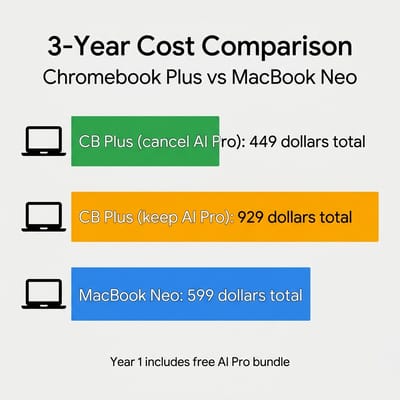
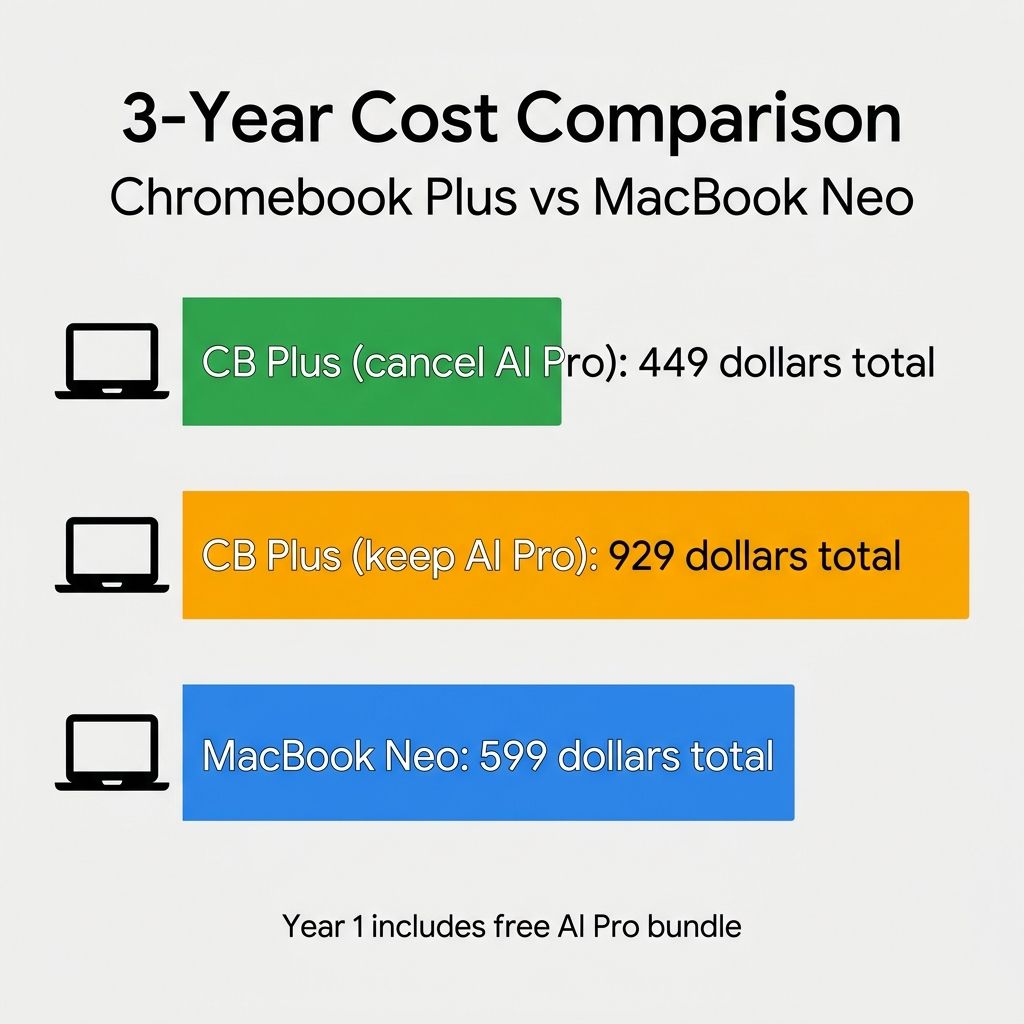
This creates three realistic scenarios for a buyer evaluating the total cost over three years. In the first scenario, you keep paying for AI Pro. A $449 Chromebook Plus costs $449 in year one, $240 in year two, and $240 in year three, for a total of $929. In the second scenario, you cancel after the free year. Total cost is $449, period, but you lose the cloud storage and AI features that may have become part of your workflow. In the third scenario, a MacBook Neo buyer pays $599 with Apple Intelligence permanently free. No subscription decisions, no storage downgrades, no calendar reminders.
The honest assessment is that the AI Pro bundle is most valuable as a long trial that lets you discover whether these AI features genuinely improve your workflow before committing to a subscription. For a significant number of users, the answer will be that Gemini’s summarization and writing tools are nice to have but not worth $240 per year once the novelty wears off. For others, particularly students, researchers, and anyone who lives in Google Workspace, the integration might prove indispensable enough to justify the ongoing cost. The bundle gives you twelve months to figure out which camp you’re in.
It’s also worth noting that Google’s own pricing behavior suggests the $240 figure is inflated. In January 2026, Google ran a promotion cutting the annual AI Pro plan to $99.99, half the quoted list price. If Google itself values the service at $100 during promotions, the “free $240 value” framing feels more like marketing than math. A more honest characterization would be that you’re getting $100 to $200 in AI services depending on which price you consider real.
What Apple Intelligence Does Differently
Apple’s approach to AI is philosophically the opposite of Google’s, and it’s worth understanding why before making a purchase decision. Apple Intelligence processes most tasks on the device itself using the A18 Pro’s 16-core Neural Engine. Your writing suggestions, email summaries, and photo edits happen locally. Data doesn’t leave the laptop unless you explicitly ask Siri to tap into Apple’s Private Cloud Compute infrastructure, which uses custom Apple Silicon servers and an architecture designed so that even Apple cannot access your data.
That privacy-first design comes with real trade-offs in capability. Apple Intelligence can summarize emails and suggest writing improvements, but it can’t analyze ten open browser tabs and synthesize research across them the way Gemini can. It can generate custom emoji and playground images, but it can’t draft a Google Docs outline from a collection of research sources. It can’t help you build formulas in Google Sheets because it has no integration with Google’s products at all.
For anyone embedded in Apple’s ecosystem, with an iPhone, iPad, Apple Watch, and iCloud storage, the MacBook Neo slots in beautifully. Apple Intelligence features improve when they can reference your other Apple devices, your photo library, and your communication history. For someone whose computing life revolves around Google Workspace, which encompasses the vast majority of Chromebook buyers, those ecosystem advantages are irrelevant. This is the fundamental tension the AI Pro bundle exploits: Google is giving away precisely the features that matter most to the audience most likely to be cross-shopping these two platforms.
Who Should Care About This Bundle
If you’re already planning to buy a Chromebook Plus, the AI Pro bundle is pure upside. There’s no price premium for the bundled models, and you get twelve months to explore features you might never have tried otherwise. Set a calendar reminder for month eleven, evaluate honestly whether you’ve used the AI tools enough to justify the subscription, and cancel or keep accordingly. The 2TB of storage alone is worth the reminder, since many users end up depending on that space without realizing the free tier is a fraction of it.
If you’re deciding between a Chromebook Plus and a MacBook Neo, the bundle tips the math in the Chromebook’s favor for year one but doesn’t fundamentally change who each platform serves. A $449 Acer Chromebook Plus 516 with the AI Pro bundle is an outstanding value for a student who does everything in a browser and Google Workspace. A $599 MacBook Neo is a better buy for someone who wants to learn GarageBand, edit video in iMovie, or eventually run professional creative software. The AI bundle sharpens the value proposition for cloud-first users without eliminating the MacBook Neo’s genuine advantages for creative work.
If you’re an existing Chromebook Plus owner who hasn’t claimed the perk yet, it’s worth checking the Google Perks page to see if you qualify. The worst that happens is it doesn’t work. The best case is twelve months of premium AI features and 2TB of storage that you weren’t paying for before.
The Bigger Picture
What’s happening here is more interesting than a promotional bundle. Google is pioneering a strategy that mirrors what Apple has done with its ecosystem for years, but with a twist. Apple locks you in with hardware integration: your iPhone talks to your Mac talks to your Watch, and switching away means losing those connections. Google is building a parallel lock-in through AI services: your Gemini talks to your Docs talks to your Sheets talks to your Photos, and once you’ve built workflows around that integration, canceling the subscription feels like losing a productivity tool rather than saving $20 a month.
Whether that strategy benefits you depends on where you spend your computing time. For Chromebook Plus buyers who already live in Google’s world, the AI Pro bundle is a genuinely good deal in year one and a reasonable subscription in the years that follow if you use the features. For MacBook Neo buyers who want full macOS and Apple’s creative tools, no amount of bundled cloud services changes the fundamental platform choice. The AI Pro bundle doesn’t make the MacBook Neo obsolete. It makes the Chromebook Plus a harder offer to ignore for the millions of people whose laptops are, functionally, Google Workspace machines with keyboards.


