

A disclosure before we begin: Starryhope covers Chromebooks extensively and has a natural interest in ChromeOS being seen favorably. What follows is our honest reading of Japan’s GIGA School Program and what it tells us about Chromebooks in education worldwide, including the parts where the story is more complicated than the headlines suggest.
In March 2026, Google Japan published a graduation-season post celebrating Chromebook as the most adopted PC in Japan’s GIGA School Program. The post itself was modest, the kind of thing a brand shares when the school year ends, but the underlying data point it highlighted is anything but.
Japan, a country that ranked dead last among OECD nations for classroom technology use in 2018, had just completed the largest government-funded device deployment in its history. And when the dust settled on which platform won, ChromeOS came out on top.Google Japan @googlejapan2026年3月に卒業を迎える皆さん!卒業おめでとうございます。Chromebook は GIGA スクール採用率 No.1 パソコンとして、たくさんの学生さんと、学校生活を共にできたことを感謝しています。これからも共に、よろしくお願いします。View on X
The numbers behind that social media moment tell a story about how governments around the world are betting on Chromebooks for education, and what happens when billions of dollars in public money flow toward a single platform.
What the GIGA School Program Actually Is
Japan’s Global Innovation Gateway for All, universally known as GIGA, launched in December 2019 when the Japanese cabinet approved a supplementary budget of roughly 460 billion yen through the Ministry of Education, Culture, Sports, Science and Technology. The goal was straightforward and staggeringly ambitious: put one device in the hands of every student in every public school in Japan. That budget covered devices, networking infrastructure, and training for 13 million students across 35,000 schools. When COVID-19 hit months later, the ministry accelerated the timeline dramatically, completing 97.6 percent of hardware delivery to 1,769 local governments by March 2021, a quarter of the originally planned timeframe.
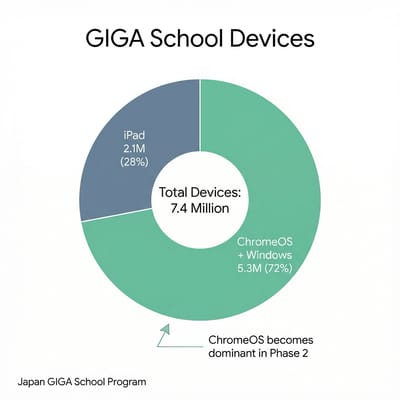
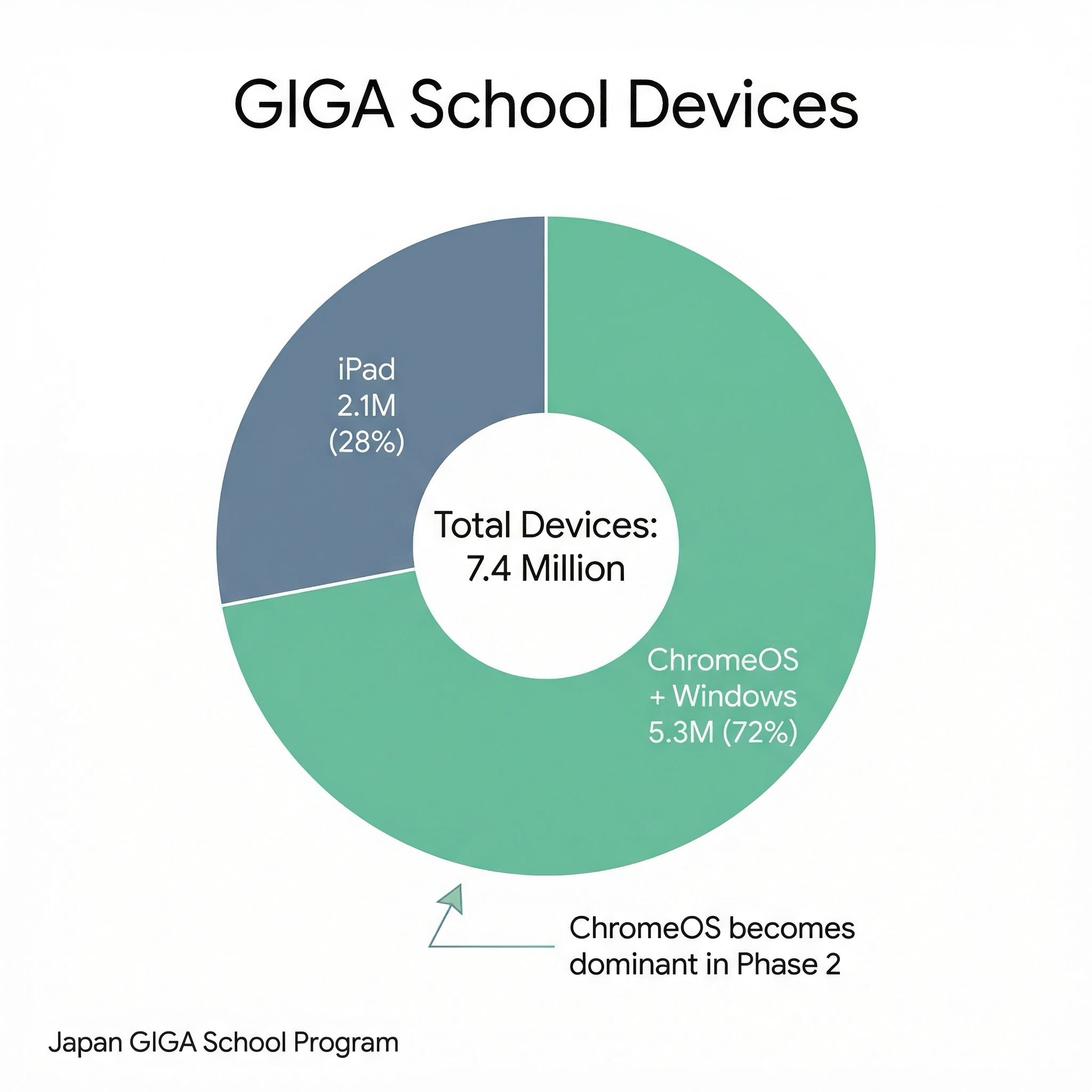
The initial phase distributed approximately 7.4 million devices. According to MM Research Institute data cited by the US International Trade Administration, Apple’s iPad claimed 2.1 million units, about 28 percent of the total, while Windows and ChromeOS devices split the remaining 5.3 million. The breakdown between Windows and ChromeOS in that first wave was not as clear-cut as Google’s recent celebration might suggest, but by the time Phase 2 renewals began in 2025, the picture had shifted decisively. Google for Education’s Head of Government Relations, Seiko Nakano, stated that “about half of Japan’s local governments and boards of education have decided to adopt Google for Education, because it best fits the ideal learning environment outlined in the GIGA School Plan.”
That adoption rate translated into extraordinary hardware numbers. According to Canalys data reported by The Register, Chromebook shipments to Japan grew more than twentyfold year-over-year in the first half of 2025 as Phase 2 procurement ramped up. Eleven million Chromebooks shipped globally in that period, with Japan’s GIGA renewals serving as the single largest driver. Lenovo captured 31 percent of the worldwide Chromebook market on the strength of its Japanese education contracts alone.
Why Japan Chose Chromebooks
Understanding why ChromeOS won GIGA requires understanding what Japanese schools actually need from a device program at this scale. The answer, it turns out, is not terribly different from what American and European schools need, but the GIGA program’s sheer size makes the reasoning more visible.
The first factor is fleet management. When you are deploying devices to 35,000 schools across a country with significant rural-urban divides in IT staffing, the management console matters as much as the hardware. ChromeOS was designed from the ground up for centralized administration. Through the Google Admin Console, a single IT administrator can push policies, restrict access, deploy apps, and monitor thousands of devices without physically touching any of them. Japan’s second-phase emphasis on “cloud by default” infrastructure aligned naturally with ChromeOS’s architecture, which assumes a cloud-first environment rather than bolting cloud capabilities onto a local-first operating system.
The second factor is cost, but not in the way most people think about it. The upfront price of a Chromebook is competitive with Windows laptops at the education tier, typically 250 to 350 dollars for a capable student device. But the total cost of ownership diverges sharply over a deployment cycle. Google’s extension of automatic ChromeOS updates to ten years from the platform release date means a device purchased in 2025 receives security updates through 2035. For a government program spending billions on infrastructure, that longevity calculation changes the math fundamentally. Our coverage of repair-friendly education Chromebooks from FETC 2026 showed that manufacturers like Lenovo are now building devices with customer-replaceable USB-C ports, keyboards, and batteries, further extending useful life.
The third factor is the ecosystem schools already inhabit. Google Workspace for Education had already established a significant foothold in Japanese schools before GIGA launched. When local governments evaluated which platform would integrate most seamlessly with the tools their teachers and students were already using, ChromeOS had a built-in advantage. As Figma noted in a partnership announcement with Google for Education in Japan, Chromebook had become “the country’s most popular personal computing device for students” even before Phase 2 renewals amplified that lead.
The Global Picture
Japan’s GIGA program did not create Chromebook’s education dominance. It confirmed it. ChromeOS now commands 60.1 percent of the global education device market, with more than 38 million Chromebooks deployed in K-12 schools worldwide. That number has been building for over a decade, but the geographic breadth of adoption has accelerated in ways that even close observers of the market may not fully appreciate.
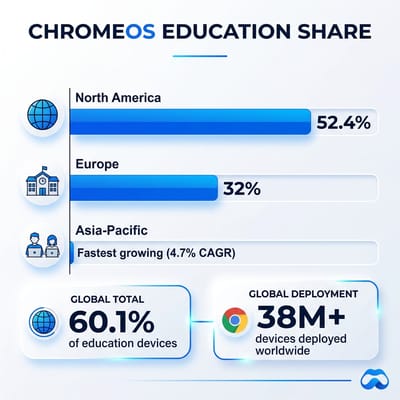
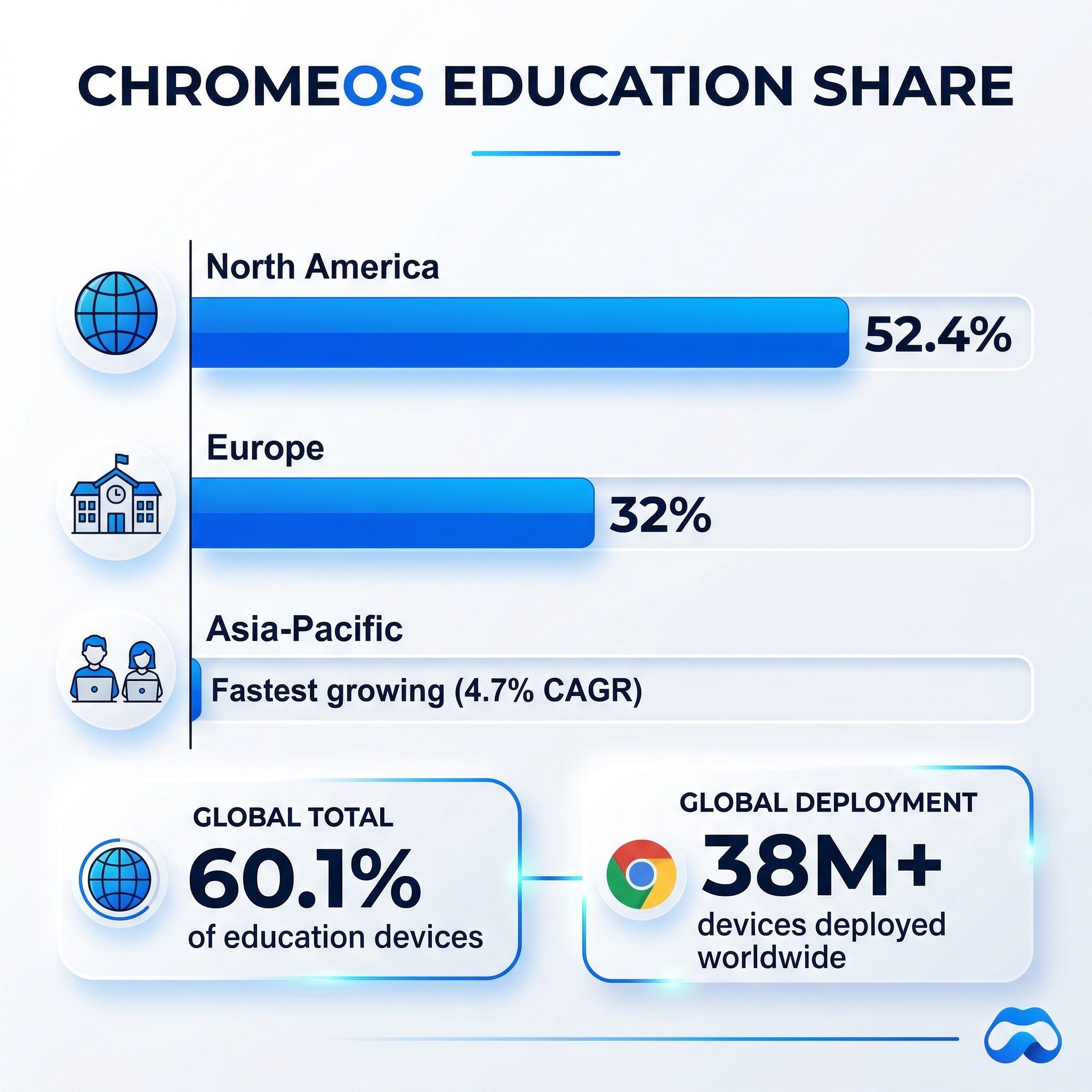
North America remains the largest market, accounting for 52.4 percent of global Chromebook sales, driven primarily by US K-12 demand. The statistic that 93 percent of US school districts intended to purchase Chromebooks in 2025, up from 84 percent in 2023, tells a story of near-universal institutional adoption. Perhaps more telling is that 68 percent of those purchases are now funded through local and state budgets rather than federal pandemic-era allocations, suggesting the buying is sustainable rather than a temporary spending spree. We explored what drove that US dominance in detail when Microsoft quietly killed Windows 11 SE earlier this year.
Europe holds roughly 32 percent of the global Chromebook market, valued at 1.89 billion dollars in 2025. The United Kingdom leads European adoption with 20.2 percent of the regional market, supported by widespread school-level deployment. Nordic countries contribute significant institutional procurement, while France, Germany, Spain, and Italy each show distinct adoption patterns shaped by their national education policies. The European Union’s digital education goals have provided a policy tailwind that continues to push adoption upward.
The Asia-Pacific region, however, is where the growth story gets most interesting. Beyond Japan, countries including India, South Korea, Indonesia, and China are driving the fastest-growing Chromebook market segment at 4.7 percent compound annual growth. India’s National Education Policy and Indonesia’s public education programs are creating demand patterns that echo GIGA’s structure: large-scale government procurement aimed at getting affordable, manageable devices into classrooms where they did not previously exist.
What the Competition Is Doing
Chromebook’s education dominance has not gone unchallenged. Apple’s iPad captured 28 percent of Japan’s initial GIGA deployment and maintains a significant share of school-issued tablets in the US. Some districts, like Niigata City with its 167 schools, chose iPad exclusively and report higher-than-average daily device usage. The iPad’s strength lies in creative applications, accessibility features, and the intuitive touch interface that works well for younger students. Our Chromebook versus iPad comparison for schools found that the total cost of an iPad setup runs 530 to 730 dollars with necessary accessories, roughly double the Chromebook equivalent, which remains the decisive factor for budget-constrained districts.
Apple launched the MacBook Neo in early March 2026 at a 499-dollar education price point, the most aggressive pricing Apple has ever offered for a laptop in the education market. IDC analyst Francisco Jeronimo noted that the move signals Apple’s intent to “compete more directly with Windows laptops and Chromebooks in education and price-sensitive segments.” Whether a 499-dollar MacBook can dent Chromebook’s installed base in schools that have already built their infrastructure around Google Workspace remains an open question, but it represents the most serious competitive threat the platform has faced in years.
Microsoft’s approach, meanwhile, has gone in the opposite direction. The company announced it will end support for Windows 11 SE in October 2026, abandoning its purpose-built education operating system after just five years. Some Japanese municipalities like Shibuya had chosen Microsoft Surface devices for their GIGA deployments, but those represent a shrinking share of the market rather than a growing one.
The Uncomfortable Questions
It would be easy to end this article with a victory lap. Chromebooks dominate education globally, Japan just confirmed it with a 460-billion-yen bet, and the competition is either retreating or playing catch-up. But honest analysis requires asking whether that dominance is entirely healthy, and whether the current trajectory is as stable as the numbers suggest.
The GIGA program’s Phase 2 surge is real, but it is also finite. Canalys analyst Kieren Jessop noted that renewed demand is expected to continue through mid-2026, but after that, “the state of the Chromebook market is far less clear.” The US market, meanwhile, offers “no clear visibility on when, or if, substantial demand will return” following the termination of the Emergency Connectivity Fund. Chromebook’s growth has been powered by waves of institutional procurement, first pandemic response, then refresh cycles, and the question of what sustains demand between those waves does not have a comfortable answer.
There is also the question of what a 60 percent market share means for educational diversity. When a single platform dominates this thoroughly, schools become dependent on one company’s decisions about pricing, features, privacy, and data practices. The screen time debate that erupted after psychologist Jean Twenge declared school-issued devices a failure in late 2025 raised legitimate concerns about whether the rush to digitize classrooms has outpaced the evidence for doing so. ChromeOS is not uniquely responsible for those concerns, they apply equally to any device program, but its dominance means those concerns disproportionately involve Chromebooks simply because there are more of them in schools than anything else.
Japan’s GIGA program offers a useful lesson in this regard. The initiative did not just distribute devices. Its second phase emphasized building cloud-based infrastructure, training teachers, and developing digital curricula alongside the hardware deployment. Over 75 percent of schools have adopted cloud-based attendance tracking, and the program explicitly addresses challenges like insufficient time for implementation discussions and uncertainty about integration. The countries that will get the most value from Chromebooks in education are the ones that treat the device as one piece of a larger pedagogical strategy, not as the strategy itself.
The numbers tell a clear story: Chromebooks have won the education market worldwide, and Japan’s GIGA program is the latest and largest confirmation of that reality. What remains to be written is whether that dominance produces better educational outcomes, or simply more devices in more classrooms. The evidence so far suggests the answer depends entirely on what schools do with them after they arrive.


