
Acer Chromebook 15 CB315
Updated on

Released in mid-2018, the Acer Chromebook 15 CB315 represented Acer’s push into larger budget Chromebook displays at a time when most manufacturers focused on 11 and 14-inch portables. The 15.6-inch Full HD IPS touchscreen made it an attractive option for users who prioritized screen real estate over portability. With an Auto Update Expiration date of June 2027, this Chromebook continues receiving Chrome OS updates—a remarkable support window for a device from this era.
Related Videos
Acer Chromebook 15 CB315 Comparison Chart
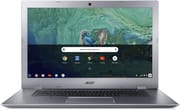 Acer Chromebook 15 CB315 | |
| Price | List Price: $279.99 Amazon Prices: |
| Model number | CB315-1HT-C4RY / NX.H09AA.002 |
| Performance Rating | 2.8 |
| Chromebook Plus | No |
| Processor | Dual-core 1.10 Ghz (max 2.40 Ghz) Intel Celeron N3350 |
| RAM | 4 GB |
| Internal Storage | 64 GB eMMC |
| Screen Size | 15.6" |
| Screen Resolution | 1920x1080 |
| Screen Type | IPS |
| Touch Screen | Yes |
| Stylus / Pen | No Stylus Support |
| Dimensions width x length x thickness | 15 x 10.1 x 0.79 inches (381 x 256.54 x 20.07 mm) |
| Weight | 3.97 lbs (1.8 kg) |
| Backlit Keyboard | No |
| Webcam | 1280x720 |
| WiFi | 802.11 a/b/g/n/ac |
| Bluetooth | Bluetooth 4.0 |
| Ethernet | No |
| Cellular Modem | No |
| HDMI | No HDMI |
| USB Ports | 2 USB 3, 2 USB-C (with DisplayPort and charging) |
| Thunderbolt Ports | No |
| Card Reader | microSD Card Reader |
| Battery | 3 cell, 4670 mAh, Lithium Ion |
| Battery Life | 10.0 hours |
| Fanless | Yes |
| Auto Update Expiration Date | June, 2027 |
Related Chromebooks
-
 Acer Chromebook 15The Acer Chromebook 15 stands out with a 15.6" FHD IPS touch display, backlit keyboard, and up to…
 -
 Acer Chromebook 315The Acer Chromebook 315 shines with its vivid 15.6-inch FHD IPS display, 10-hour battery life, and…
 -
 ASUS Chromebook C523The ASUS Chromebook C523 brings a 15.6” anti-glare display, robust connectivity with 802.11ac Wi-Fi…
 -
 ASUS Chromebook Flip CM5 (CM5500)The ASUS Chromebook Flip CM5 features a Ryzen 5 CPU, 8GB RAM, and a versatile 15.6-inch touch…
 -
 Lenovo Flex 3 ChromebookThe Lenovo Flex 3 Chromebook hits the sweet spot with its 11.6-inch IPS touchscreen, 4GB RAM, and…
 -
 HP Chromebook 15 (15a-na2)The HP Chromebook 15a-na2 delivers a spacious 15.6-inch screen with a full numeric keypad at an…
Looking Back at the Acer Chromebook 15 CB315
The CB315 arrived during an interesting period in Chromebook history. Intel’s Celeron N3350 “Apollo Lake” processor powered a generation of budget Chromebooks, and the CB315 pushed that platform further than most with its large touchscreen panel. The fanless design—enabled by the N3350’s 6W TDP—ensured silent operation that users appreciated for quiet environments like libraries and shared workspaces.
At just under 4 pounds with a 0.79-inch profile, the CB315 never pretended to be an ultraportable. Instead, Acer leaned into the desktop-replacement concept with a full-sized keyboard including a numeric keypad, dual USB-C ports alongside two USB 3.0 Type-A ports (which could support a USB Ethernet adapter for wired networking), and a microSD card reader. The 1920x1080 IPS display offered wide viewing angles and a respectable 1,470:1 contrast ratio—solid specifications that held up well for everyday productivity tasks.
What Reviewers Said
Contemporary reviews highlighted both the strengths and limitations of budget 2018 hardware. Now & Then Tech praised the CB315 as “a very, very good upgrade” for users moving from smaller Chromebooks, appreciating the touchscreen responsiveness and numeric keypad inclusion. However, typical budget device trade-offs applied: weak speaker output and a grainy 720p webcam reflected the price constraints.
Milo B. emphasized the display quality after months of daily use, calling the viewing angles “probably some of the best I’ve seen on a Chromebook so far.” The trackpad also received unexpected praise—a historically weak point on budget laptops that Acer apparently addressed in this generation.
NotebookCheck’s testing confirmed the fanless design achieved completely silent operation, while TechRadar’s battery testing demonstrated nearly 17 hours of continuous runtime—exceptional for any laptop at the time. Chrome Unboxed even praised the speaker implementation as “the best speakers I’ve ever heard on a laptop,” attributing this to dedicated speaker grills flanking the keyboard.
Legacy and Context
The CB315 occupies a specific moment in Chromebook evolution. It predates the Chromebook Plus initiative that would later establish higher baseline specifications for premium Chrome OS devices. The Intel Celeron N3350 served basic tasks adequately—web browsing, email, Google Docs, light Android app usage—but struggled with workloads that modern Chromebooks handle effortlessly.
For buyers who found the CB315 at clearance prices after 2018, it represented genuine value. The combination of a large touchscreen, practical port selection, impressive battery life, and silent operation addressed real needs that smaller Chromebooks couldn’t match. That the device continues receiving updates through mid-2027 speaks to the durability of Chrome OS support commitments, even as the hardware itself has aged into obsolescence for all but the lightest computing tasks.