
QNAP TS-464
Published on

The QNAP TS-464 is a four-bay NAS for a home or small office that wants file storage, backups, and a Plex server, sold without drives. Two M.2 slots add an SSD cache or storage pool, a PCIe slot takes a 10GbE card, and QNAP’s QuTS hero system offers ZFS in place of the default QTS. The chip dates from 2021, a year before the unit launched in September 2022. Club386 and NASCompares both fault the QTS interface as inconsistent.
Pros and cons
| Pros | Cons |
|---|---|
| PCIe slot takes a 5GbE, 10GbE, or M.2 card | Each M.2 slot runs at PCIe 3.0 x1, about 1,000 MB/s |
| ZFS on QuTS hero, plus ext4 on QTS | Celeron N5095 trails newer Intel N-series chips |
| Works with third-party hard drives and SSDs | Some 8GB units have memory that cannot be upgraded |
| Two 2.5GbE ports, with 497 MB/s reads across both in one test | No 10GbE without a card, and the PCIe slot tops out near 2,000 MB/s |
| About 19 W with drives in standby | QTS interface is inconsistent, and QNAP has a ransomware history |
Related Videos
QNAP TS-464 Comparison Chart
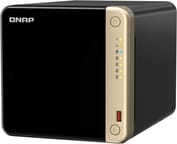 QNAP TS-464 | QNAP TS-464 | |
| Price | List Price: $639.00 Amazon Prices: Loading prices... | List Price: $549.00 Amazon Prices: |
| Version | 8GB DDR4, diskless | 4GB DDR4, diskless (legacy) |
| Drive Bays | 4 x 3.5-inch SATA (2.5-inch compatible) Hot-swap, tool-less trays | 4 x 3.5-inch SATA (2.5-inch compatible) Hot-swap, tool-less trays |
| M.2 Slots | 2 x M.2 NVMe, cache or storage pool PCIe 3.0 x1 each | 2 x M.2 NVMe, cache or storage pool PCIe 3.0 x1 each |
| Max Raw Capacity | 96 TB | 96 TB |
| Included Drives | None (diskless) | None (diskless) |
| System Drive | 4GB flash | 4GB flash |
| Processor | Quad-core 2.00 Ghz (max 2.90 Ghz) Intel Celeron Processor N5095 | Quad-core 2.00 Ghz (max 2.90 Ghz) Intel Celeron Processor N5095 |
| Hardware Transcoding | Yes (Intel Quick Sync (UHD Graphics)) | Yes (Intel Quick Sync (UHD Graphics)) |
| RAM | 8 GB DDR4 SO-DIMM Max 16 GB, 2 slots Some 8GB units have fixed memory | 4 GB DDR4 SO-DIMM Max 16 GB, 2 slots 4GB SO-DIMM; upgradable to 16GB |
| ECC Memory | No | No |
| Network Ports | 2 x 2.5GbE RJ45 | 2 x 2.5GbE RJ45 |
| PCIe Slot | Yes (PCIe 3.0 x2; takes 5GbE, 10GbE, or M.2 cards) | Yes (PCIe 3.0 x2; takes 5GbE, 10GbE, or M.2 cards) |
| Expansion Unit | TL-D1600S (12 x 3.5-inch plus 4 x 2.5-inch bays) and USB expansion units | TL-D1600S (12 x 3.5-inch plus 4 x 2.5-inch bays) and USB expansion units |
| Operating System | QTS 6 or QuTS hero | QTS 6 or QuTS hero |
| Third-Party OS | No (QuTS hero is QNAP's own ZFS alternative) | No (QuTS hero is QNAP's own ZFS alternative) |
| File Systems | ext4, ZFS (ext4 on QTS, ZFS on QuTS hero; external drives also NTFS, FAT32, HFS+, exFAT) | ext4, ZFS (ext4 on QTS, ZFS on QuTS hero; external drives also NTFS, FAT32, HFS+, exFAT) |
| USB Ports | 2 USB 3 Front: USB-A 10Gbps. Rear: USB-A 10Gbps, 2x USB 2.0 | 2 USB 3 Front: USB-A 10Gbps. Rear: USB-A 10Gbps, 2x USB 2.0 |
| Thunderbolt Ports | No | No |
| HDMI | 1 | 1 |
| WiFi | No | No |
| Idle Power | 19 W (Four 8TB drives in standby, Club386) | 19 W (Four 8TB drives in standby, Club386) |
| Load Power | 55 W (Four 8TB drives active, measured at the wall, Club386) | 55 W (Four 8TB drives active, measured at the wall, Club386) |
| Power Supply | 90W external | 90W external |
| Noise | -- | -- |
| Dimensions width x length x thickness | 6.69 x 8.92 x 6.5 inches (169.93 x 226.57 x 165.1 mm) | 6.69 x 8.92 x 6.5 inches (169.93 x 226.57 x 165.1 mm) |
| Weight | 4.98 lbs (2.26 kg) | 4.98 lbs (2.26 kg) |
| Released | September 2022 at $549.00 | September 2022 at $549.00 |
| In the Box | Main unit, 90W power adapter, power cord, Ethernet cable, drive screws, quick installation guide. | Main unit, 90W power adapter, power cord, Ethernet cable, drive screws, quick installation guide. |
| Expandability | RAM to 16GB (2x SO-DIMM; some 8GB units are fixed). 2x M.2 NVMe, PCIe 3.0 x1. PCIe 3.0 x2 slot. | RAM to 16GB (2x SO-DIMM). 2x M.2 NVMe, PCIe 3.0 x1. PCIe 3.0 x2 slot. |
Four hot-swap bays and two single-lane M.2 slots
The TS-464 measures about 6.5 x 6.7 x 8.9 inches and weighs 5 pounds without drives, with a plastic outer case over a metal frame. A removable plastic door covers the SATA bays, which take 3.5-inch hard drives or 2.5-inch SSDs. Four 24TB drives give 96TB raw, or 72TB in RAID 5. The TL-D1600S expansion unit can add twelve more hard drives, but it connects through a QXP PCIe card, so it takes the only PCIe slot.
The two M.2 2280 slots take NVMe SSDs for a cache, a Qtier tier that moves frequently used data to the SSDs, or a separate SSD storage pool. Each slot gets one PCIe 3.0 lane, so a single SSD tops out near 1,000 MB/s. M.2 drives cannot be swapped with the power on, and QNAP recommends a heatsink on them. QNAP does not limit hard drives or M.2 SSDs to its own brand.
Memory on the 8GB model varies by unit
Android Police, Geeknetic, and NASCompares each describe 8GB units with fixed memory, and QNAP’s user guide calls the TS-464-8G non-expandable. QNAP’s hardware specifications give units from January 2024 an 8GB SO-DIMM, two slots, and a 16GB maximum. In a 2025 QNAP forum thread, one owner of a new 8GB unit described one installed module and what seemed to be a second slot. QNAP’s documents conflict, and replies in that thread advised checking the serial number.
Treat 8GB as the amount you will have unless the unit you receive shows a free slot. The older 4GB model uses a removable SO-DIMM and two slots, and QNAP now marks it as legacy.
Two 2.5GbE ports, with a PCIe slot for 10GbE

Link aggregation raises the combined ceiling of the built-in ports to about 5Gbps. For the PCIe 3.0 x2 slot, QNAP offers 5GbE and 10GbE cards, QM2 cards that add M.2 slots, and one combination card with a 10GbE port and two M.2 slots. The slot’s two lanes cap it near 2,000 MB/s, which NASCompares points out can limit a fully loaded card.
The front has a 10Gbps USB-A port beside a one-touch copy button. The rear has another 10Gbps USB-A port, two USB 2.0 ports, and an HDMI port that QNAP rates for 4K at 60Hz. There is no USB-C or Thunderbolt.
Power draw stays near 20 W with drives in standby
Club386 measured about 19 W with four 8TB drives in standby and about 55 W from the wall with all four active. Geeknetic reported about 40 W with all drives in use and under 20 W with them suspended. QNAP rates the unit at 21.6 W in disk standby and 40.5 W in typical operation. Power comes from a 90 W external adapter, and one 120mm fan cools the case.
The Celeron N5095 scores about a quarter below an Intel N100

QNAP specifies the Intel Celeron N5095, a 2021 chip with four cores, four threads, and a 2.9 GHz burst. Some reviews and retailers name its N5105 sibling, and Club386 lists the N5105 on its test unit. The N5095’s PassMark score is about 4,000, against roughly 5,300 for the Intel N100 and N150 in newer NAS units.
Its Intel UHD Graphics add Quick Sync for video. In Geeknetic’s Plex tests, 4K H.264 ran at 32% CPU with GPU help, while 4K H.265 got no GPU help, reached 87% CPU, and skipped frames.
QuTS hero adds ZFS and needs at least 8GB of RAM
QTS is the default system, with apps for backup, virtual machines, containers, and surveillance. QuTS hero adds RAID-Z, inline compression, and deduplication. QNAP asks for 16GB for inline deduplication, so a fixed 8GB unit falls short of that figure, and the 4GB model needs a memory upgrade before QuTS hero runs at all.
Ransomware attacks hit QNAP units from 2020 to 2022, according to NASCompares, which suggests skipping QNAP’s own cloud services and reaching the unit through Tailscale or a third-party VPN.
Reviewer Insights
The reviews below agree on the hardware and split on QTS. Most tested the 4GB model; Geeknetic tested the fixed-memory version.
StorageReview
StorageReview tested four WD Gold 22TB drives against the older TS-453D with four WD Red 14TB drives. Over SMB, the TS-464 reached 2,437 IOPS in 4K random reads against 292 for the older model, and 54,894 IOPS in 8K sequential reads against 29,180. Its 128K SMB reads were 6.8% lower. The summary: “The TS-464 meets or beats the older model TS-453D, which shouldn’t be too surprising.”
Club386
Parm Mann of Club386 ran four 8TB IronWolf drives in RAID 10, measured a little over 290 MB/s on 2.5GbE, and copied 16.4GB of large files in 62 seconds. He wrote: “It’s nice to have the choice, and from a hardware perspective, TS-464 is without doubt one of the most impressive four-bay solutions we’ve experienced.” His list of cons names the single-lane M.2 slots and the inconsistent interface, which he described this way: “Desktop icons appear comically large and blurry on a 4K monitor, and if you think Windows can be inconsistent, QTS takes things to another level when mixing font sizes.”
Android Police
Richard Edmonds of Android Police scored it 8 out of 10 in June 2023. His cons were the price and cloud support that trails Synology. He found that “QTS is snappy with the Intel Celeron processor, thanks to its high clock speeds and four physical cores.” The review’s verdict reads: “So long as you’re set to take advantage of and fully utilize what’s on offer with the QNAP TS-464, it’s a fantastic NAS to buy.”
Geeknetic
Geeknetic, a Spanish outlet, tested the 8GB model in 2023 and reported that its memory cannot be expanded. It measured 232 MB/s reads and 231 MB/s writes on one 2.5GbE link, and 497 MB/s reads and 482 MB/s writes on both ports together. It found the unit makes almost no noise and named the high price and paid app licenses as the main drawbacks.
NASCompares
In his April 2022 hardware review, Rob Andrews of NASCompares praised the front copy port and said “this is by far the best flagship SMB prosumer NAS in this tier I’ve ever seen.” His five reasons video said “it’s actually surprisingly lower noise than you think it might be,” with the caveat that drives above 8TB and enterprise drives are louder. It also noted the plastic case shows dust and fingerprints.
A year later, he said “this to me is still a great NAS device” while noting that QNAP’s security reputation remained a concern. In his two-year revisit he warned that buying online had become a gamble because recent units had fixed memory, said “QTS still has that inconsistency vibe to it,” and pointed to more power-efficient options for buyers prepared to go DIY. His 2025 comparison with the Synology DS925+ rated DSM as the smoother system and gave QuTS hero the longer feature list, saying “it is a great software platform and arguably is more feature-rich than that of the Synology side.”
Who it’s for
The TS-464 suits someone who wants ZFS and a PCIe slot in a ready-made box and is willing to manage QTS or QuTS hero to get them.
The 2021 chip and the extra cost of a 10GbE card count against it. The UGREEN NASync DXP4800 Plus includes 10GbE and a newer Pentium Gold chip, and gives up the PCIe slot, while the TerraMaster F4-425 Plus has two 5GbE ports and a third M.2 slot. The Synology DS925+ runs DSM, which NASCompares rates as the smoother system, and has no hardware transcoding for Plex; our Synology alternatives guide compares QTS with other NAS systems. The NAS comparison chart lines up the rest.
Frequently Asked Questions
Can the memory in the QNAP TS-464 be upgraded?
The 4GB model can, up to 16GB across two SO-DIMM slots. The 8GB model depends on the unit. QNAP’s user guide lists it as non-expandable, its hardware specifications list two slots since January 2024, and several reviewers describe fixed memory. Look for a free slot in your own unit before buying more memory.
Does the TS-464 support ZFS?
Yes, on QuTS hero, which replaces the default ext4-based QTS. The 8GB model can run it as sold, while the 4GB model needs more memory first.
Can the TS-464 be upgraded to 10GbE?
A card in the PCIe slot adds it. QNAP quotes reads of up to 1,647 MB/s from its dual-port QXG-10G2TB card with two 10GbE clients attached.
Is the TS-464 good for Plex?
Yes for 4K H.264, which Geeknetic’s Plex test handled with Quick Sync at about a third of the CPU. H.265 went the other way in that test, with the CPU near 87% and dropped frames, so direct play is the safer choice for those files.
Does the TS-464 work with third-party drives?
QNAP does not limit it to its own brand of drives. NASCompares says it supports 24TB third-party hard drives and third-party M.2 SSDs for storage pools.
How much power does the TS-464 use?
Expect about 20 W with the drives asleep and 40 to 55 W in use. Club386’s wall measurement with four 8TB IronWolf drives sets the high figure, and QNAP’s own rating for typical operation sets the low one.