
Starry Hope covers Chromebooks, links to Chromebook products, and generally thinks they are useful devices. We have written about the screen time debate and the parent opt-out movement, including where our own position sits.
On March 29, 2026, New York Times reporter Natasha Singer published an investigation into school laptops. The headline used a phrase that has since become unavoidable: “Chromebook remorse.” Singer visited McPherson Middle School in Kansas, where principal Inge Esping had spent years trying to curb digital distraction. Esping had already banned cellphones, but it was not enough. Students were watching YouTube, playing video games, and using school Gmail accounts to bully classmates, all on the Chromebooks the school had provided to help them learn.
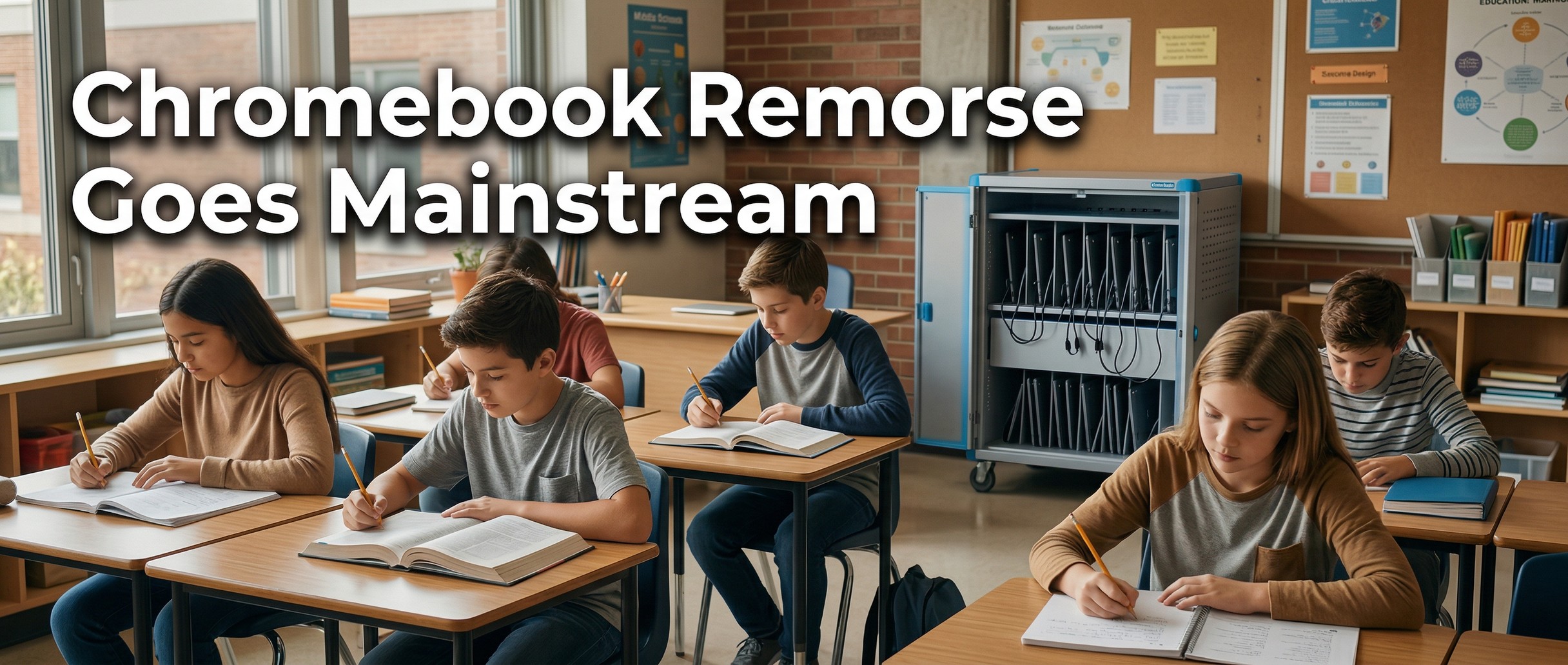
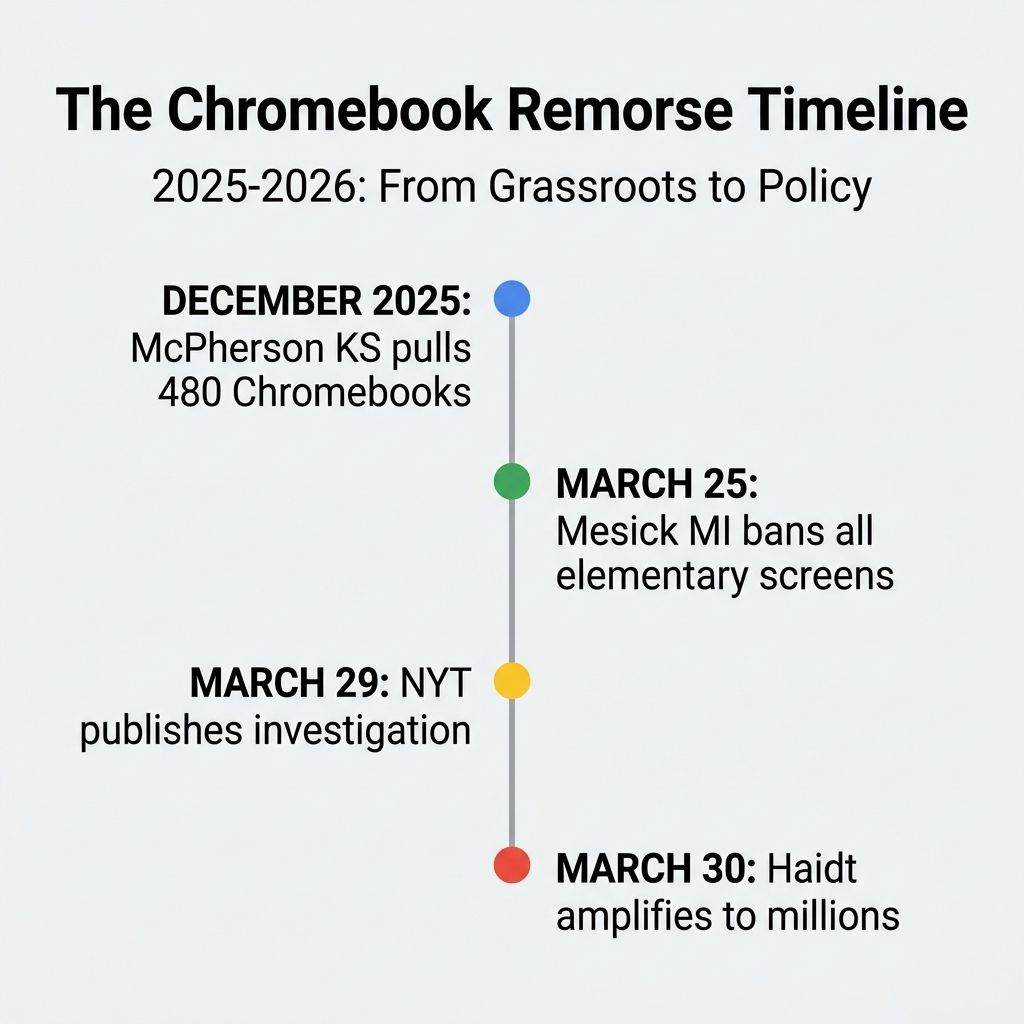
In December 2025, Esping pulled the devices from all 480 sixth through eighth graders and locked them in classroom charging carts. The Chromebooks were still there for specific lessons when teachers needed them, but the days of every student carrying a personal laptop were over.
The story might have remained a local curiosity if it had appeared anywhere else. But this was the New York Times, and within twenty-four hours, Jonathan Haidt amplified it to his millions of followers. “The Chromebook backlash is growing,” he wrote on X. “Many tech execs send kids to screen-free schools. Many college professors now ban all screens in class. They know that students learn less with a multifunction device on their desks.” Digital Trends, Yahoo News, and RealClearEducation picked up the story.
After Kansas, the Institutional Response Picked Up Speed
We have been tracking the school device debate for months. The NYT investigation documented what was already happening and, we think, changed it too. The concerns about school Chromebooks are not new. What is new is the legislative and district-level response.
Before the NYT piece, the backlash was grassroots. Parents were forming opt-out networks and bringing research printouts to school board meetings. Teachers quietly put Chromebooks away in their own classrooms, and researchers like Jean Twenge wrote op-eds that generated conversation but not legislation. The movement had moral energy but lacked institutional weight.
After the NYT piece, the conversation shifted from “should we be worried?” to “what are we going to do about it?” Legislators suddenly had political cover. School administrators who had been hesitant to act could point to the nation’s paper of record validating their concerns. The story did not create the backlash, but it gave it a platform that made ignoring it politically untenable.
Four days before Singer’s piece ran, Chalkbeat reported that Mesick Consolidated Schools in rural Michigan had banned all digital devices at its elementary school, practically overnight. Superintendent Jack Ledford had asked his principal how much teachers read aloud to students in grades K through 5. “That has almost vanished,” she told him. By the end of the week, Chromebooks were piled on bookshelves and stacked in dish racks, replaced by $30,000 worth of physical books and beanbag chairs. Only 18 percent of Mesick’s third graders had scored proficient on the state reading test the previous spring, half the state average.
At Least 16 States Have Introduced Screen Time Bills
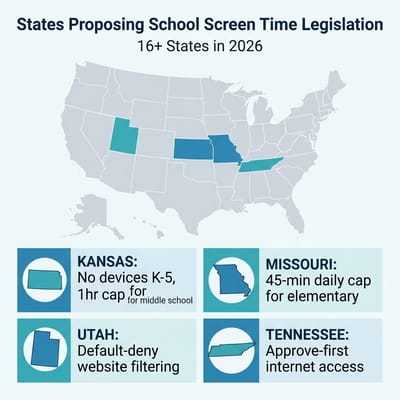
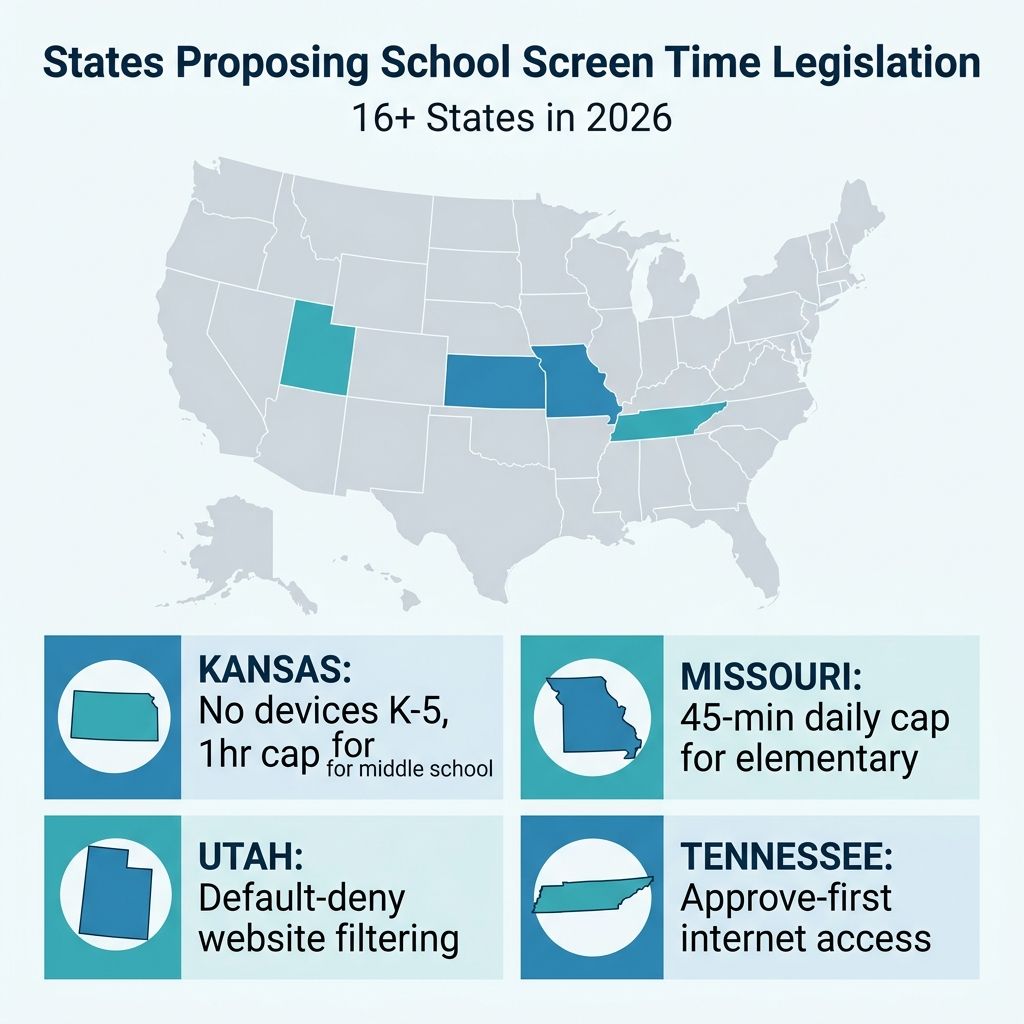
The biggest movement is in state capitols. According to NBC News, at least 16 states have introduced legislation in 2026 to reevaluate screen time or vet educational technology in public schools. At least four states are considering outright prohibitions on devices in elementary school. This is not a red state or blue state phenomenon. Iowa, Vermont, Virginia, Kansas, Utah, Minnesota, Tennessee, Missouri, Oklahoma, and West Virginia all have active proposals.
The bills range from daily time caps to outright bans in the youngest grades.
- Kansas Senate bills would restrict devices in grades K through 5 entirely and cap middle school device use at one hour per day.
- Missouri’s HB 2230, which passed the state House 143 to 10 before crossing to the Senate, would limit elementary screen time to 45 minutes daily. It is among the first statewide bills to cap classroom device time specifically, covering laptops, tablets, and iPads rather than just cellphones.
- Utah and Tennessee have proposed requiring internet filters that ban all websites by default until a school district explicitly approves them.
The Distraction-Free Schools Policy Project has been working with legislators in roughly nine states on what it calls “Safe Schools Technology” legislation. The approach stops short of banning technology and instead requires schools to demonstrate that the digital tools they deploy are safe, effective, and appropriate. It shifts the burden of proof from parents who must justify concern to schools that must justify screen time.
The ed tech industry is not taking this quietly. NBC News reported that industry groups describe the potential outcomes of these bills in dire terms, arguing they would set education back decades, entangle schools in bureaucracy, and leave high school graduates unprepared for the modern workforce. Those arguments have not gained much traction against parent frustration and falling test scores.
Haidt and Horvath Gave the Backlash Its Arguments
Haidt is a social psychologist, not an education researcher, and his 2024 book The Anxious Generation made him the most prominent American voice arguing that smartphones and social media are damaging children. Amplifying the NYT investigation connected the school device debate to a much larger cultural movement around childhood screen exposure. Parents who had read The Anxious Generation and already limited their children’s phone access now had a reason to scrutinize school-issued Chromebooks through the same lens.
Jared Cooney Horvath, an educational neuroscientist whose book The Digital Delusion argues that ed tech has failed to deliver on its promises, has become another key figure. His Senate testimony on screens and learning has been viewed over two million times on C-SPAN’s YouTube page, with clips spreading across social media. Parents are bringing copies of his book to school board meetings in the same way they once brought copies of Haidt’s work. Horvath’s argument that “we are much closer to proving that it’s harmful than we are to proving it’s helping” has become a rallying point for legislative action.
Not everyone agrees the evidence is as clear as the movement’s loudest voices suggest. An eSchool News analysis found “no smoking-gun data showing that ed tech is at the root of, or even contributing to, recent learning declines.” Morgan Polikoff, a professor at USC’s education school, told Chalkbeat that blanket bans are “like taking a hammer when you need a scalpel.” We covered the nuance in the research extensively in February, and none of the fundamentals have changed. The political environment in which that research gets read has shifted.
Districts Are Not Waiting for Legislation
McPherson and Mesick are not outliers.
- Wake County, North Carolina is reconsidering its one-to-one laptop policy.
- LAUSD in Los Angeles introduced a resolution to develop a screen time policy and potentially prohibit one-to-one devices for students through second grade.
- Schools across Virginia, Maryland, and Michigan are experimenting with “Chromebook-free periods” where devices are collected during certain subjects.
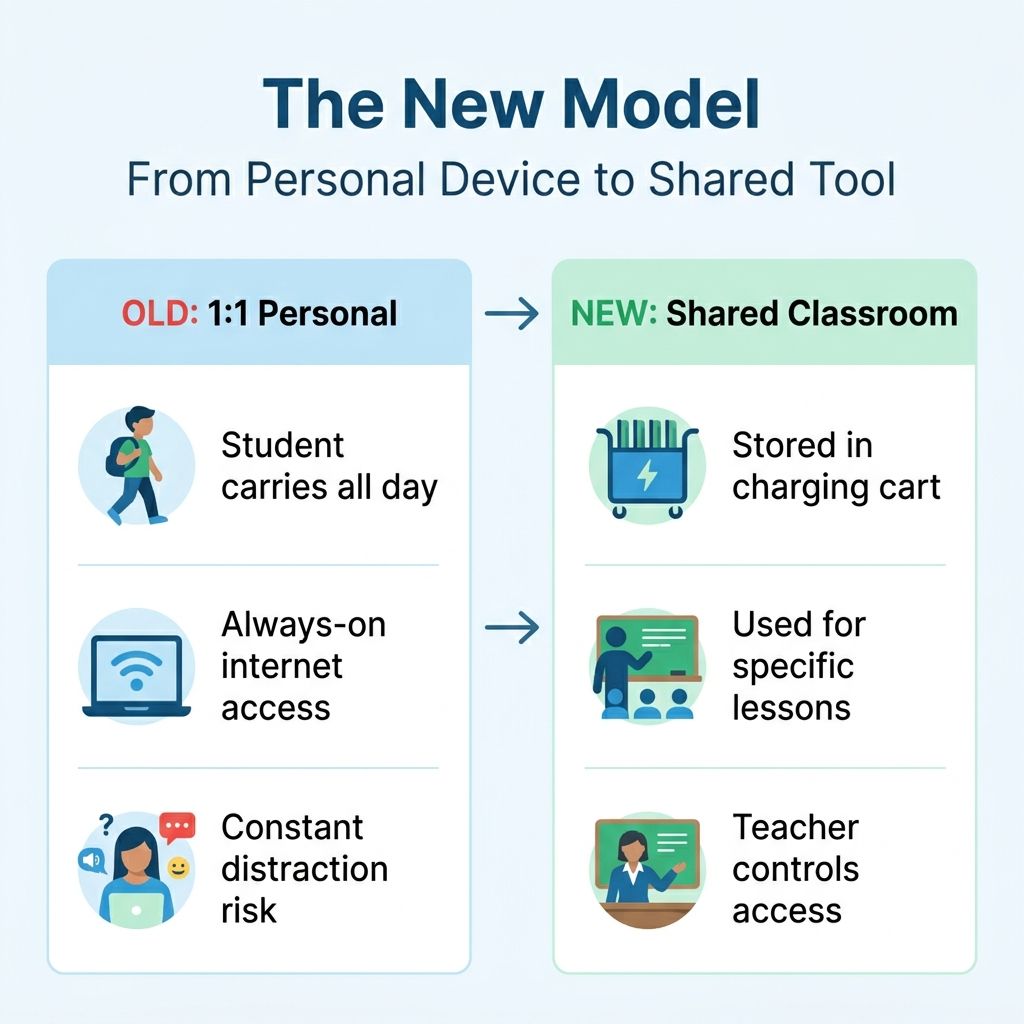
A school bans phones and discovers that the distraction problem persists because students still have school-issued laptops. Administrators realize that the phone ban was necessary but insufficient. Then they face the harder question of what to do about the devices the school itself provided. In McPherson, the answer was to treat Chromebooks as shared classroom tools rather than personal devices, available for specific lessons but stored otherwise. In Mesick, the answer was a complete elementary ban with physical books as the replacement. Both approaches drop the one-to-one model that has dominated American education for the past decade.
These schools are not throwing their Chromebooks in dumpsters. McPherson’s devices sit in charging carts, ready for lessons where the technology adds value. The shift is from personal devices that students carry all day to shared tools that come out when the curriculum calls for them. A Chromebook sitting on the desk for six hours is a standing temptation; a Chromebook handed out for a 45-minute research session is a defined task.
Schools Keep Their Chromebooks as the One-to-One Model Fades
Nine in ten public middle and high schools still operate one-to-one device programs, according to CoSN’s 2026 State of EdTech survey. Google Chromebooks remain by far the most cost-effective option for school fleets, with complete setups running $250 to $350 compared to $400 to $500 for iPads. Chrome OS still gives administrators fleet-wide management capabilities through the Google Admin Console. None of that has changed.
What is changing is the model. The era of “hand every student a personal laptop and hope for the best” appears to be ending. How a school deploys the device matters more than the device, as we have argued for months. Structured, purposeful use of the device for specific educational tasks can improve learning.
For parents reading this who are weighing their options, the practical situation has shifted. If your school is still running an unrestricted one-to-one program, you now have substantial ammunition to push for change. The NYT investigation, the legislative movement in 16 states, and the examples of schools like McPherson and Mesick all provide concrete talking points for school board meetings. Our guide to the opt-out movement covers the individual tactics. What the current moment adds is institutional momentum that makes those conversations easier.
The legislative movement puts school administrators on notice that the status quo is not sustainable. Whether your state passes a bill this year or not, the political direction is established. Developing a coherent device policy now, one that specifies when screens are appropriate and when they are not, is preferable to having one imposed by legislation. The Distraction-Free Schools Policy Project offers model frameworks, and schools like McPherson offer proof that students and teachers adapt quickly to reduced screen time.
Missouri’s HB 2230 explicitly exempts special education devices. Students with IEPs and 504 plans who depend on text-to-speech, screen readers, and adaptive interfaces cannot simply switch to paper. Any screen reduction policy must account for these students, and the legislative proposals generally do. But individual schools acting ahead of legislation should be equally thoughtful.
Families trying to make sense of which Chromebooks hold up best for school use can sort and filter models side by side in our Chromebook Comparison Chart.
Sweden Reversed Course and the United States Is Catching Up
The school device debate has moved faster in the past two months than in the previous two years. Sweden has already reversed its tablet-first policy for young students. Denmark is reconsidering. The UNESCO report that we cited in February recommended limiting non-pedagogical screen time. The United States is now catching up, driven by a convergence of parent frustration, teacher testimony, mainstream media attention, and legislative ambition.
Google, for its part, has invested heavily in classroom management tools and content filtering capabilities. The company has not publicly responded to the NYT investigation or the legislative wave, which may be the wisest possible approach given the political environment. The tools to manage Chromebooks responsibly already exist. What was missing was the institutional will to use them. If the current moment supplies the will, the result could be Chromebook programs that work the way their advocates always said they would.
We will be watching the Missouri Senate, the Kansas committee votes, and the dozens of school districts rethinking their device policies in the weeks ahead.
Frequently Asked Questions
What is Chromebook remorse?
The phrase comes from New York Times reporter Natasha Singer’s March 29, 2026 investigation of school laptops. It describes districts that handed every student a Chromebook and then watched the device feed distraction instead of learning. Singer’s case study was McPherson Middle School in Kansas, where principal Inge Esping had already pulled all 480 devices in December 2025.
Why are schools getting rid of Chromebooks?
Nine in ten public middle and high schools still run one-to-one device programs, so most are not getting rid of the devices. What districts like McPherson are ending is the one-to-one model: the device moves from something every student carries all day to a shared tool handed out for specific lessons. Digital distraction, students using school Gmail accounts to bully classmates, and falling test scores are the complaints driving that change.
What is replacing Chromebooks?
In most districts, the same Chromebooks. McPherson keeps its fleet in charging carts and hands them out when a lesson calls for them. Mesick Consolidated Schools in Michigan went further, spending $30,000 on physical books and beanbag chairs for its elementary school.


