

A disclosure before we begin: Starry Hope covers Chromebooks, links to Chromebook products, and generally recommends them. We have a financial interest in people buying Chromebooks. You should weigh what follows knowing that.
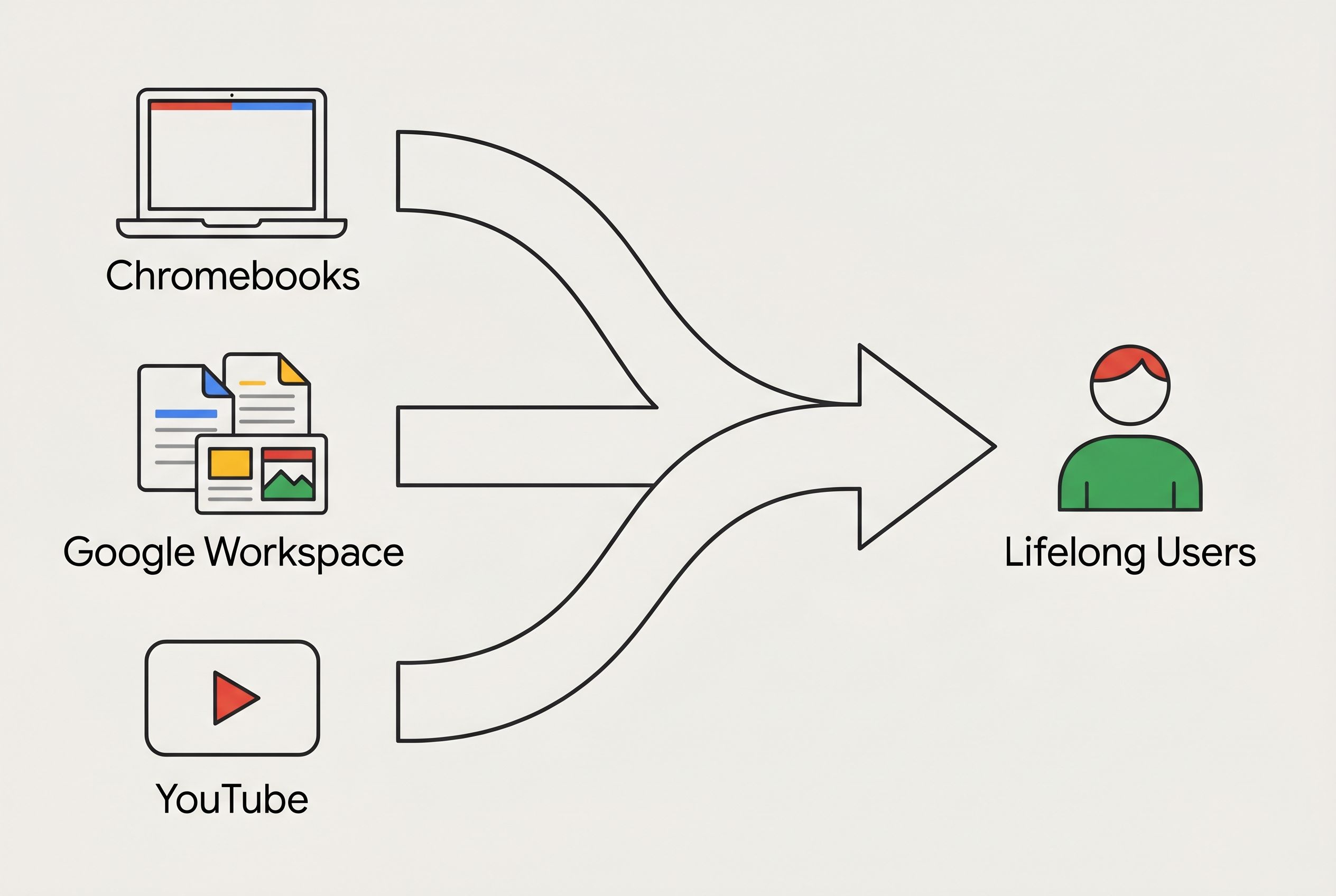
In January 2026, NBC News published an investigation based on internal Google documents filed in federal court. The slides were blunt. One described Google’s growing presence in schools (through Chromebooks, Google Workspace, and YouTube) as building a “pipeline of future users.” Another, from November 2020, spelled out the logic: “You get that loyalty early, and potentially for life.” A third suggested imagining a world where “Parents ask their children ‘Why aren’t you watching more YouTube?’” and “School Administrators shift budgets from Textbooks to YouTube subscriptions.”
Parent advocates called the documents proof that tech companies are using classrooms as customer acquisition channels. Education researcher Spencer Greenhalgh described it as saying the quiet part out loud. Sarah Gardner, CEO of the parent advocacy group Heat Initiative, told NBC News that the documents “confirm that suspicion that there are ulterior motives to companies pushing technology into classrooms.”
Google is not wrong. Schools are a pipeline of future users. That is precisely the problem: not because Google said it, but because the observation is so obviously accurate that it should have been driving school technology decisions all along.
The Documents Frame Schools as a Pipeline to Lifetime Users
The internal documents emerged as part of a federal lawsuit in the U.S. District Court for the Northern District of California, where families, school districts, and state attorneys general are suing Google, Meta, ByteDance, and Snap. The plaintiffs allege these companies purposely marketed addictive platforms to children. Snap settled its portion in January on undisclosed terms. A Kentucky school district will be the first to go to trial in June 2026.
The Google documents, heavily redacted but still revealing, show a company that understood the strategic value of its education program in commercial terms. A 2018 presentation acknowledged that the public viewed YouTube as problematic for students because there was “no way to block unsafe content, comments, ads.” A presentation updated as recently as 2024 noted that survey respondents blamed YouTube for keeping them awake at night and negatively affecting their well-being. Yet other slides framed the education program as a growth strategy, describing how early exposure to Google’s ecosystem would translate into adult loyalty.
Google spokesperson Jack Malon told NBC News that the “documents mischaracterize our work,” adding that Google does not directly market YouTube to schools and that administrators “maintain full control over platform usage.” The company pointed out that schools must obtain parental consent before granting students under 18 access to YouTube.
That response is technically accurate and somewhat beside the point. The documents don’t describe explicit marketing to children. They describe a corporate understanding that getting products into schools creates lifetime customers, paired with a decision to pursue that outcome strategically.
Apple and Microsoft Ran the Same Play with School Devices Before the Cloud
If you are old enough to remember computer labs in the 1990s, you remember rows of Apple Macintoshes. Apple dominated the education market for years through aggressive school discounts and educational programs. The strategy worked exactly as intended. A generation of students who learned on Macs carried that familiarity into adulthood. Microsoft eventually displaced Apple in schools during the 2000s with cheaper Windows PCs, and many of those students became Windows users for life. The playbook isn’t new.
But there’s a meaningful difference between what Apple did in the 1990s and what Google does today. Apple sold computers that stored data locally. A student’s school essays lived on a hard drive that got wiped at the end of the year. Google’s education suite runs entirely in the cloud, creating a continuous digital identity that follows students from kindergarten into the personal Gmail accounts they carry with them as adults.
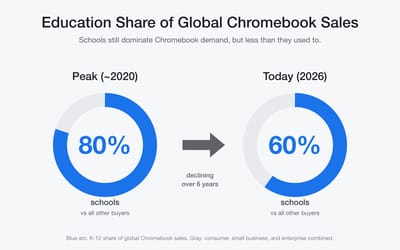
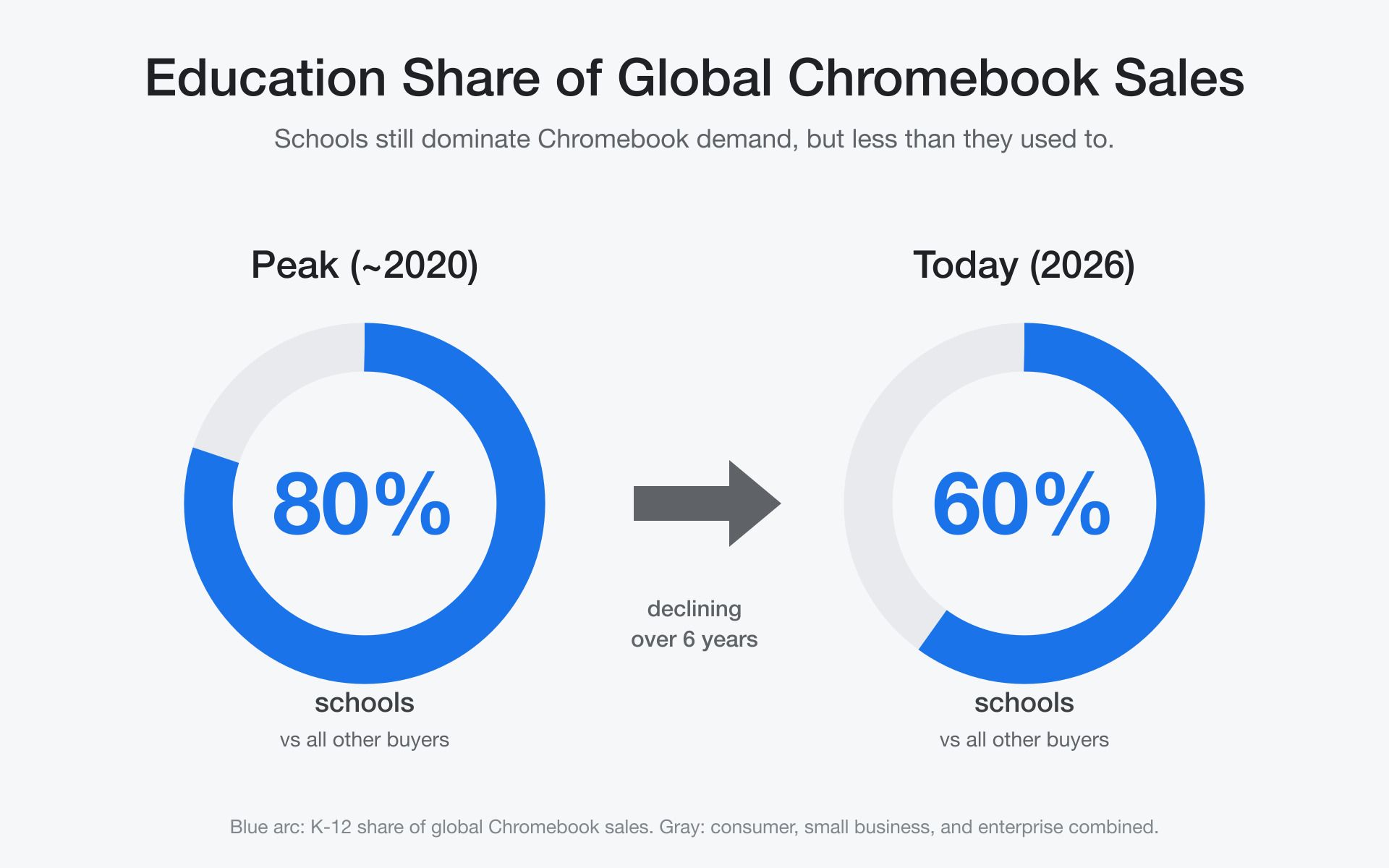
The scale is also on a different order of magnitude. Google Workspace for Education was already serving over 170 million students and teachers worldwide as of 2021, with adoption growing since. Only 11 percent of the district and school leaders EdWeek Market Brief surveyed in fall 2025 said they would not spend anything on Chromebooks in the coming year. Schools have historically dominated Chromebook demand, accounting for roughly 80 percent of global Chromebook sales at the 2020 peak and something closer to 60 percent today as consumer interest in Chromebooks has grown. The pipeline runs internationally too; Japan’s GIGA School program put ChromeOS devices in front of millions of students through a single government procurement.
That scale makes the pipeline metaphor land differently than it did when Apple had a few thousand schools buying desktops. When a single company’s ecosystem is woven into the daily learning experience of most American schoolchildren, “building a pipeline of future users” is both a business strategy and a description of how an entire generation learns to interact with digital tools. Students write in Google Docs and organize their work in Google Classroom. They search with Google and store files in Google Drive. By the time they graduate, switching to anything else means relearning where files live and how work gets shared.
Cognitive neuroscientist Jared Cooney Horvath, who has spoken critically about technology in schools, put it bluntly to NBC News: “These companies speak about learning, but to them, learning is just the cover they’re using for these practices of ‘How do we get customers now’ and ‘How do we keep them for life.’”
Google’s Own Slides Call YouTube Distracting and Disorganized for Learning
An undated internal presentation conceded that using YouTube for learning is difficult because the platform is “distracting and disorganized.” One example showed YouTube recommending “Will Ferrell Hilarious Acceptance Speech” from a user with an obscene username to someone who had searched for content about linear equations.
Teachers already know this. The screen time debate in education has highlighted how school-issued devices often become portals to distraction rather than learning tools. An Education Week survey found that 56 percent of educators say off-task behavior on laptops is a major distraction, ranking above cellphones. Students use school Chromebooks to watch YouTube, play online games, and browse social media during class, exactly the scenario Google’s own documents describe as a risk.
Yet YouTube remains deeply embedded in classroom instruction. Google created Player for Education, which lets teachers embed YouTube videos in course content through Google Classroom. Kathryn Kurtz, YouTube’s global head of youth and learning, acknowledged in a March 2025 deposition that the company had not measured whether YouTube actually improves students’ learning and had no data showing it boosted grades, test scores, or graduation rates. Teachers wanted to show YouTube videos even when schools had blocked access, and Google was working to make that easier.
Google simultaneously acknowledges that YouTube is unsafe and distracting for students while building tools to make it easier for teachers to use YouTube in the classroom. More YouTube usage in schools means more users acclimated to the platform. Whether that serves students’ educational interests is unclear, and Google’s own deposition testimony says it has no data showing that it does.
Chromebooks Stay the Practical Choice, and Google Still Benefits
These leaked documents arrived in the context of broader concerns about technology in schools. A U.S. Senate hearing in January examined the overuse of technology in education, with witnesses arguing that school devices can distract students and that analog methods are often more effective. The two largest teachers unions and fourteen education trade groups wrote a joint letter defending education technology, urging lawmakers not to restrict student access.
None of this changes the fact that Chromebooks are the most practical choice for most school districts. They cost $200 to $350 per device compared to $530 to $730 for an iPad with accessories. Google’s Chrome Education Upgrade gives IT departments fleet management capabilities that no other platform matches at that price point. Microsoft tried to compete with Windows 11 SE and gave up. Even Apple’s aggressive new education pricing falls short once you run the MacBook Neo fleet-cost math for districts. There is no realistic alternative that offers the same combination of affordability, manageability, and software ecosystem for schools operating on thin budgets. For a closer look at how the MacBook Neo stacks up against ChromeOS for students and families, see our MacBook Neo vs Chromebooks comparison.
But practical necessity doesn’t require uncritical acceptance. Parents and educators can acknowledge that Chromebooks serve a real need while also recognizing that Google benefits enormously from the arrangement and that the company’s interests don’t always align with students’ interests. The surveillance capabilities built into school Chromebooks already raise questions about student privacy. Even if a school carefully manages its Chromebook program, raising a generation on Google’s tools serves Google’s long-term business goals.
Concrete Steps Districts Can Take
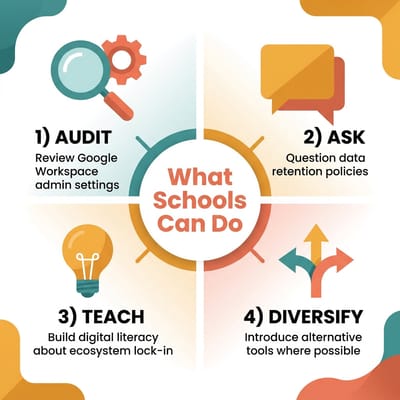
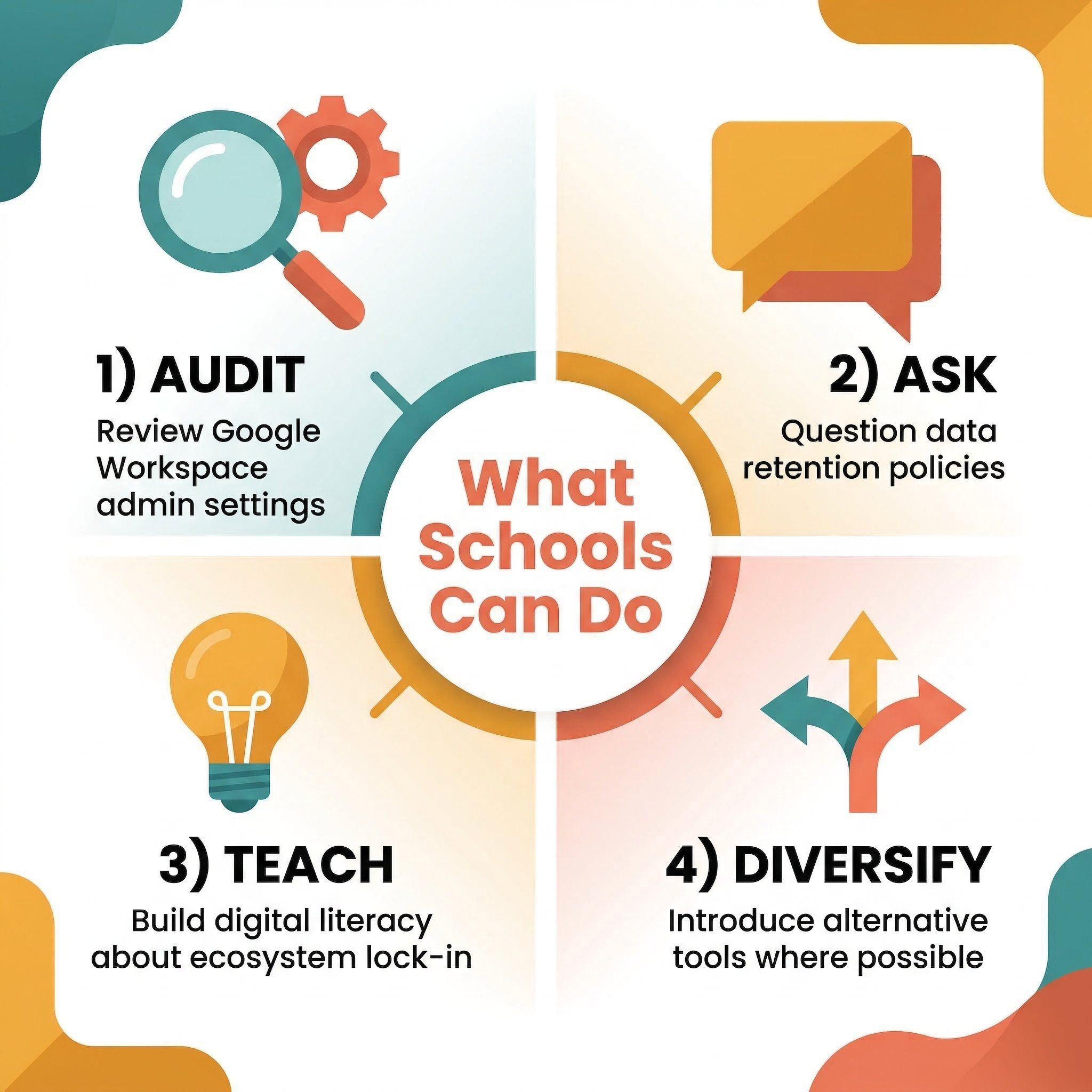
The alternatives are limited, so the leverage sits in how a district runs the Google tools it has already bought.
First, audit your Google Workspace for Education admin settings. Google offers granular controls over what data is collected, how long it’s retained, and which services students can access. Many districts accept the defaults, which are configured for maximum functionality rather than minimum data collection. An IT administrator who spends a day tightening those settings can reduce the data footprint without meaningfully degrading the educational experience.
Second, ask your school board specific questions about data retention policies:
- How long does the district keep student Google Workspace data after a student graduates?
- Who has access to it?
- Does the district use Google’s additional services beyond the core Workspace suite, and if so, what data do those services collect?
Answering them can reveal gaps in policy.
Third, teach students about the ecosystem they’re using. Digital literacy goes beyond staying safe online. It includes understanding that the tools you use shape your habits and preferences, that companies benefit from those habits, and that choosing your tools consciously is a skill worth developing. A student who understands why Google Docs feels natural and LibreOffice feels foreign is better equipped to make informed choices as an adult than one who simply assumes Google is “the way things work.”
Fourth, diversify where possible. Schools don’t have to abandon Google Workspace, but they can introduce students to alternatives in appropriate contexts. Using a classroom set of paper notebooks alongside Chromebooks isn’t Luddism. It’s teaching students that different tools serve different purposes. Schools can also explore whether specific Google services (particularly YouTube) are necessary or merely convenient. As Google’s own internal documents acknowledge, there’s no evidence that YouTube improves learning outcomes.
Schools Outsourced Fundamental Parts of Learning to One Company
The leaked pipeline documents articulate what should have been obvious all along. Google’s education program is simultaneously a product that helps millions of students learn and a business strategy that cultivates lifelong customers. Both things are true. Dismissing the documents as routine business practice, or treating them as proof of cartoon villainy, skips over that.
The education system (the institution we trust to act in children’s best interests) adopted a single company’s ecosystem so thoroughly that the pipeline became inevitable. Schools outsourced fundamental aspects of the learning experience to a company whose internal documents now confirm it viewed that adoption as a customer acquisition strategy.
The e-waste crisis facing school Chromebooks and the surveillance debate both show what happens when schools tie their hardware lifecycle and their students’ digital lives to one company. These pipeline documents explain why that company was so eager to be chosen. None of these problems are unsolvable, but solving them requires parents and educators to accept that the most practical choice for their schools is also the most strategically valuable for Google.
The Kentucky trial begins in June.
If you’re looking for help choosing a specific Chromebook, our Chromebook Comparison Chart lets you filter and compare models by specs, price, and features.
Frequently Asked Questions
Should Chromebooks be used in school?
Yes for most districts, because no other platform combines the price, the fleet management, and the software on a school budget. The leaked Google documents are a reason to use Chromebooks more carefully. Tighten the Workspace data settings, ask the school board about retention policy, and teach students how the ecosystem works.
Why do schools choose Chromebooks over other devices?
$200 to $350 per device, against $530 to $730 for an iPad with accessories. Chrome Education Upgrade adds fleet management that no other platform matches at that price. Microsoft tried to compete with Windows 11 SE and gave up, and Apple’s newer education pricing still falls short once a district runs the full fleet-cost math.
What are the disadvantages of using a Chromebook as a student?
An Education Week survey found 56 percent of educators say off-task behavior on laptops is a major distraction, ranking above cellphones, and school Chromebooks are where students watch YouTube, play games, and browse social media during class. The quieter costs are the surveillance capabilities built into school Chromebooks, a screen time debate that keeps circling back to school-issued devices, and a graduate who has to relearn where files live and how work gets shared after switching platforms.


