Update, September 2026: Apple no longer sells the M4 Mac mini new, and the Mac mini line has moved to the M6 and M5 Pro chips. The advice below dates from April 2026. For the current choice, read our Mac mini M6 vs M5 Pro for local AI comparison.

Every week, a new post appears on Reddit’s r/MacMini: “Should I buy the M4 now or wait for M5?” It is a reasonable question. Apple’s M5 chip has been shipping in MacBook Pros since October 2025, and the M5 Pro and M5 Max arrived in laptops in March 2026. The Mac Mini is the obvious next domino. But when it actually falls (and whether waiting makes financial sense for your specific situation) depends on details that most rumor roundups gloss over.
This article is not another spec comparison between M4 and M5. If you want that, our Mac Mini M4 buyer’s guide covers the hardware in depth. This piece answers one question: given what we know today in late April 2026, should you place your order now or hold out?
What We Know About the Mac Mini M5
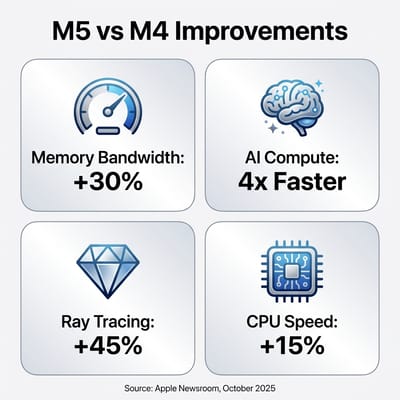
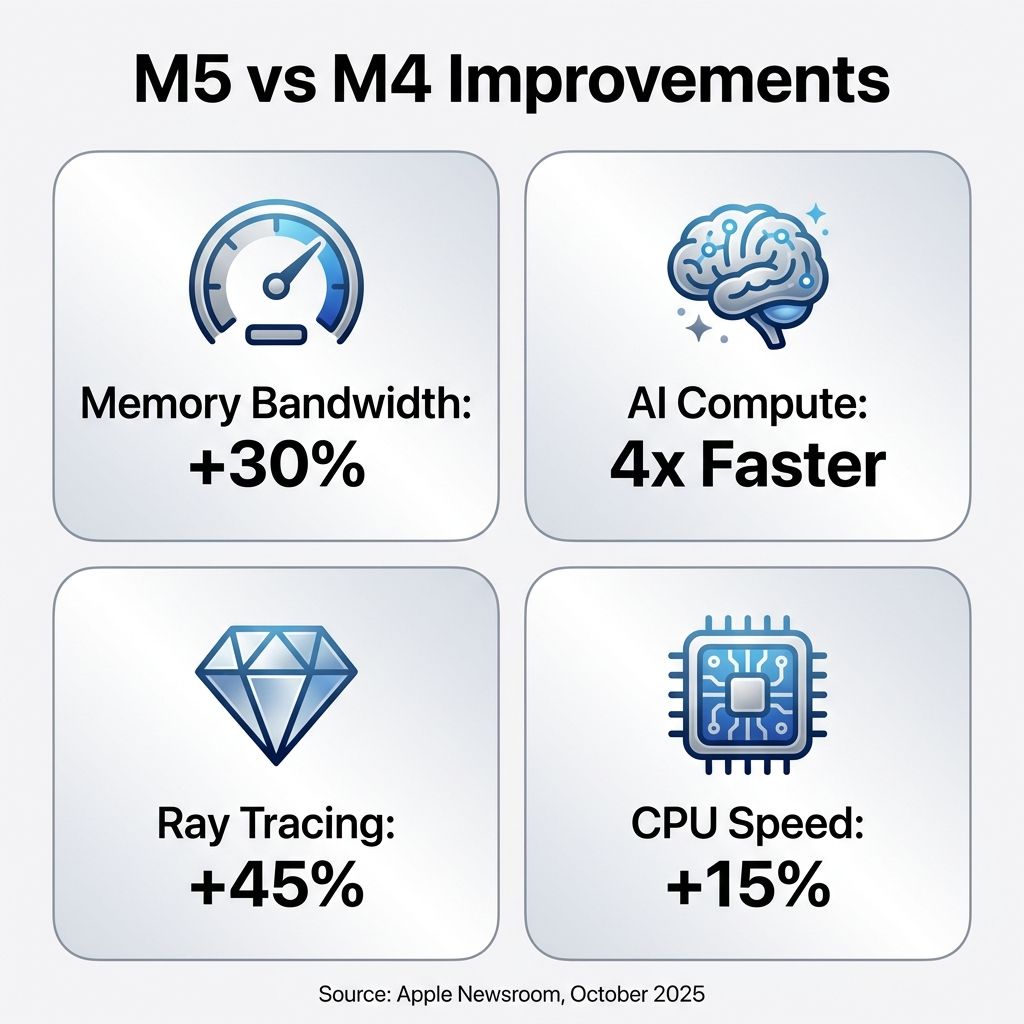
The M5 chip itself is no longer a rumor. Apple announced it in October 2025, and the performance numbers are real and verified by independent reviewers. The base M5 has a 10-core CPU, 10-core GPU with dedicated neural accelerators in each core, and a 16-core Neural Engine. Memory bandwidth jumps nearly 30 percent over M4 to 153 GB/s, and Apple claims over four times the peak GPU compute for AI workloads compared to M4.
Those are genuine improvements, especially for anyone running local AI models through Ollama or Apple’s MLX framework. The 45 percent ray-tracing boost matters for creative work. The 14 to 22 percent CPU improvement is modest but real.
The problem is timing. Earlier this year, most outlets expected the Mac Mini M5 to debut at WWDC in June 2026. That window appears to have closed. Bloomberg’s Mark Gurman reported on April 19 that the Mac Studio has slipped to October due to supply-chain constraints, likely tied to the global DRAM shortage. Some analysts expect the Mac Mini refresh to follow the Mac Studio rather than precede it. A realistic landing zone is September to November 2026, with some analysts suggesting it could slip into early 2027.
That is five to nine months of waiting from today. For a desktop computer purchase, that is a long time to sit on your hands.
The M4 Availability Crisis
Here is the twist that makes this decision more complicated than the usual “wait for next gen” question: you cannot easily buy the M4 Mac Mini you want right now, either. And the situation has gotten worse, not better, in the last few weeks.
In early April, Apple’s online store flagged the 32 GB and 64 GB configurations as “Currently Unavailable” with delivery estimates stretching to one to three months. By April 22, the situation escalated: the base $599 model with 256 GB storage sold out completely on Apple’s site, and the entire 256 GB lineup followed across all RAM tiers. As of this writing, Apple is still quoting six-week delivery on the 512 GB variant, nine to ten weeks on most M4 Pro configurations, and as much as sixteen to eighteen weeks on anything with 32 GB or more of RAM.
Two converging pressures are responsible. The first is the global DRAM shortage that began earlier this year, driven by AI data-center demand swallowing the world’s supply of high-density memory. The second is closer to home: hobbyists and small developers buying Mac Minis as headless hosts for local AI agents, a trend we have written about in the context of always-on Claude-style workers. Demand that Apple did not forecast has collided with supply Apple cannot increase, and the Mac Mini has been hit hardest because its low base price made it the obvious entry point for both groups.
Third-party retailers are not the escape hatch they used to be. Amazon and Best Buy show only M4 Pro variants in stock, with base M4 inventory turning over in hours when it does appear. eBay tells the rest of the story: base M4 units are being resold for $715 to $795, a 20 to 30 percent markup over Apple’s $599 list price, which is unprecedented for the entry-level Mac desktop.
This turns the buy-or-wait question into a three-option problem: grab whatever M4 configuration you can find, accept the wait at retail, or hold out indefinitely for M5 with no guaranteed date. Each option makes sense for a different kind of buyer.
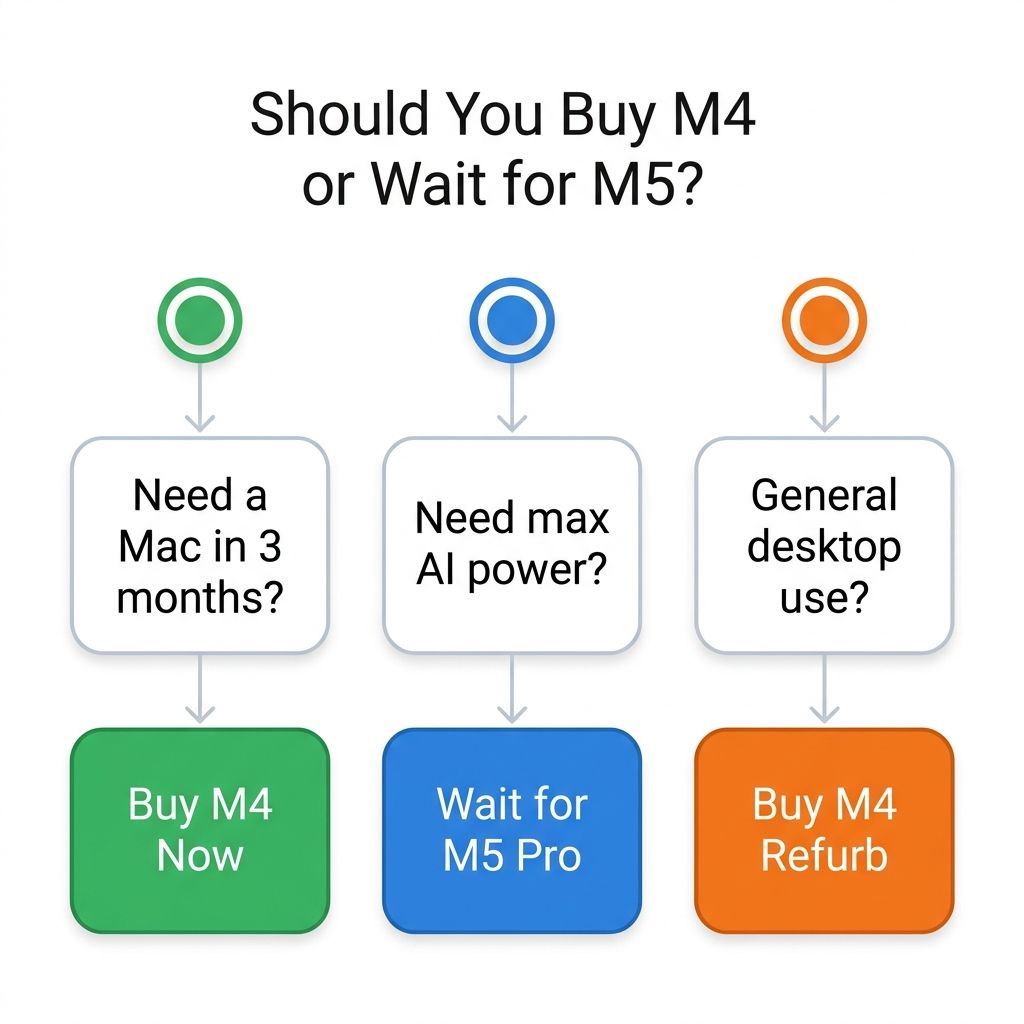
Three Buyers, Three Answers
The AI Tinkerer
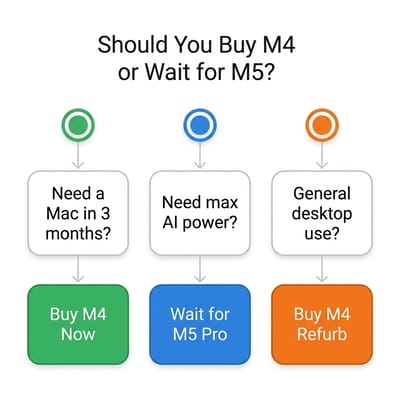
You run Ollama models overnight, fine-tune adapters with MLX, and follow every Apple Intelligence update. You already know that unified memory is the bottleneck for local inference, and you have been eyeing the 48 GB M4 Pro configuration. The M5’s four-times peak GPU compute for AI workloads and 30 percent memory bandwidth increase sound like exactly what you need.
Our take: If your current machine handles your workload acceptably, waiting is defensible here, but set your expectations correctly. The base M5 maxes out at 32 GB of unified memory, the same ceiling as the M4. If you need 48 GB or more, you are actually waiting for the M5 Pro Mac Mini, and that configuration will likely cost north of $1,600. We explored the AI-server use case in depth in our Hyperbox vs DIY comparison, and the math favors getting productive now over optimizing hardware later. If you spot a refurbished M4 Pro at Apple’s 15 percent discount, that is a strong buy even with M5 on the horizon.
The Office and Media User
You edit photos in Lightroom, cut the occasional video in Final Cut, and mostly live in a browser with thirty tabs open. The M4’s 10-core CPU is already overkill for your workflow. You do not run local AI models and have no plans to start.
Mac mini with M4 chip
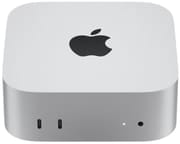
- +Starts at $599
- +16GB unified memory
- +silent operation
- +tiny 5x5 inch footprint
- -RAM not upgradeable
- -256GB base storage is tight
- -limited ports without a dock
Our take: Buy the M4 now. A 15 to 22 percent CPU improvement will not change your Lightroom export times in any way you would notice. The base 16 GB M4 at $599, or roughly $509 from Apple’s refurbished store, gives you everything you need today. Spending five to nine months without a desktop to save $90 in theoretical future value makes no sense. If the M5 Mac Mini does bump base storage to 512 GB (matching the recent MacBook Air strategy), the entry price will likely rise to $699, making the current M4 an even better relative deal.
The Homelab and Server User
You want a Mac Mini as an always-on home server, a Docker host, a Plex box, or a development machine that runs 24/7. Uptime matters more than peak performance. You have been following the trend of Mac Minis as AI agent nodes and want in.
Our take: Buy the M4 base model. The 10-core CPU handles server workloads with headroom to spare, and the M4’s power efficiency is already excellent for always-on operation. The M5’s improvements are weighted toward GPU and neural engine performance, neither of which matters much for a machine serving files, running containers, or hosting a home dashboard. If you are running local LLMs as part of your homelab, see the AI Tinkerer section above; otherwise, the M4 is the right call.
The Resale Value Math
One underappreciated factor in the buy-now calculus is that Apple Silicon Macs hold their value on the secondary market. An M4 Mac Mini purchased today at $599 (or $509 refurbished) will likely resell for $350 to $400 when the M5 version ships. That means your real cost of ownership for six months of productive use is roughly $150 to $200.
Compare that to six months of not having a desktop, or six months of keeping a less capable machine running, and the “waste” of buying now largely evaporates. You are renting a very capable computer for about $30 a month while you wait for the model you actually want.
Where to Find an M4 Right Now
If you have decided to buy now, here is the availability picture as of late April 2026. The base 16 GB / 256 GB configuration is sold out at Apple direct, with no published restock date. The 16 GB / 512 GB variant is the fastest-shipping option Apple still sells, currently quoting roughly six weeks. The Apple Refurbished Store stocks M4 models at a 15 percent discount when they appear, but inventory turns over within hours and refurb queues now run weeks rather than days. Amazon and Best Buy carry mostly M4 Pro variants right now; base M4 stock at third parties is sporadic and often priced above MSRP when it does land. B&H Photo and Adorama are worth checking for the 32 GB and 48 GB configurations Apple cannot ship. Avoid eBay listings priced above retail; the secondary market is being flooded with markups, and the M5 announcement will pop those overnight. Swappa and Back Market remain the best places to find used M4 units at sane prices.
The Mac Mini M4 product page on this site tracks current pricing across retailers if you want to comparison-shop.
A Note on Non-Apple Alternatives
If you are reading this article, you have probably already decided you want a Mac. But it is worth noting that the local AI hardware landscape has shifted significantly in 2026. AMD’s Strix Halo mini PCs offer up to 128 GB of fast unified-style memory for local LLM inference at competitive prices. They will not run macOS, but if your primary use case is AI model serving rather than the Apple ecosystem, they deserve a look before you commit to a six-month wait for M5 Pro.
The Bottom Line
The Mac Mini M5 is real, and it will be a meaningful upgrade, especially for AI and creative workloads. But “meaningful upgrade” does not automatically mean “worth waiting for.” The M5 Mac Mini is likely five to nine months away, stock of the configurations you actually want is already thin, and the M4 at current prices represents the best dollar-per-performance in Apple’s desktop lineup.
For most readers asking the “buy or wait” question, the plain answer is: buy the M4 now, use it productively, and sell it when the M5 ships if the upgrade matters to your workflow. The cost of waiting is almost always higher than the cost of upgrading later.