You had the box in your cart. A Ryzen AI Max+ 395 mini PC, 128GB of unified memory, the thing you have been reading about for a year as the way to run a 70-billion-parameter model on your desk without a rack of GPUs. Then a headline scrolled past: “AMD Ryzen AI Max 400.” A new, bigger number, and the cursor drifted away from the checkout button, because two thousand dollars is a lot to spend on hardware that gets superseded a month later.
The 400 series, codenamed Gorgon Halo, does not supersede your purchase. By almost every measure that affects how a mini PC runs language models, it is the same chip with a new name. Buyers whose models need more than roughly 120GB of memory at once should still wait for it.
Gorgon Halo is a mid-cycle Strix Halo refresh
The Ryzen AI Max 300 (Strix Halo) parts it refreshes have been shipping since early 2025. Tom’s Hardware describes it as a “minor refresh”, and puts it bluntly: every chip in the new lineup uses the same Zen 5 CPU cores, the same RDNA 3.5 integrated graphics, and the same XDNA 2 NPU as Strix Halo. Their own summary is that you could scratch the “4” off the model number, write in a “3,” and the spec sheet would still be accurate.
Notebookcheck’s breakdown of the official lineup covers three Pro-tier chips: the flagship Ryzen AI Max+ 495 Pro, the Ryzen AI Max 490 Pro, and the Ryzen AI Max 485 Pro. The top part gets a 100 MHz clock bump (a 5.2 GHz boost versus 5.1 GHz on the 395), a Radeon 8065S iGPU that runs 100 MHz faster than the 8060S, and a 55 TOPS NPU instead of 50. AMD led with Pro SKUs this time, where Strix Halo debuted with consumer parts. There is still no firm calendar date. AMD says the Ryzen AI Max PRO 400 parts will reach HP, Lenovo, and other OEMs in Q3 2026, which is a window rather than a date you can buy against.
If you were hoping the 400 series meant a new architecture, faster memory bandwidth, or a meaningfully quicker GPU for inference, it does not, at least not based on what AMD has shown so far.
More memory capacity at the same bandwidth
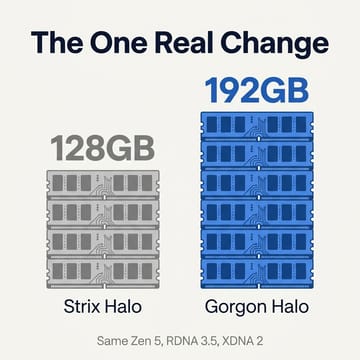
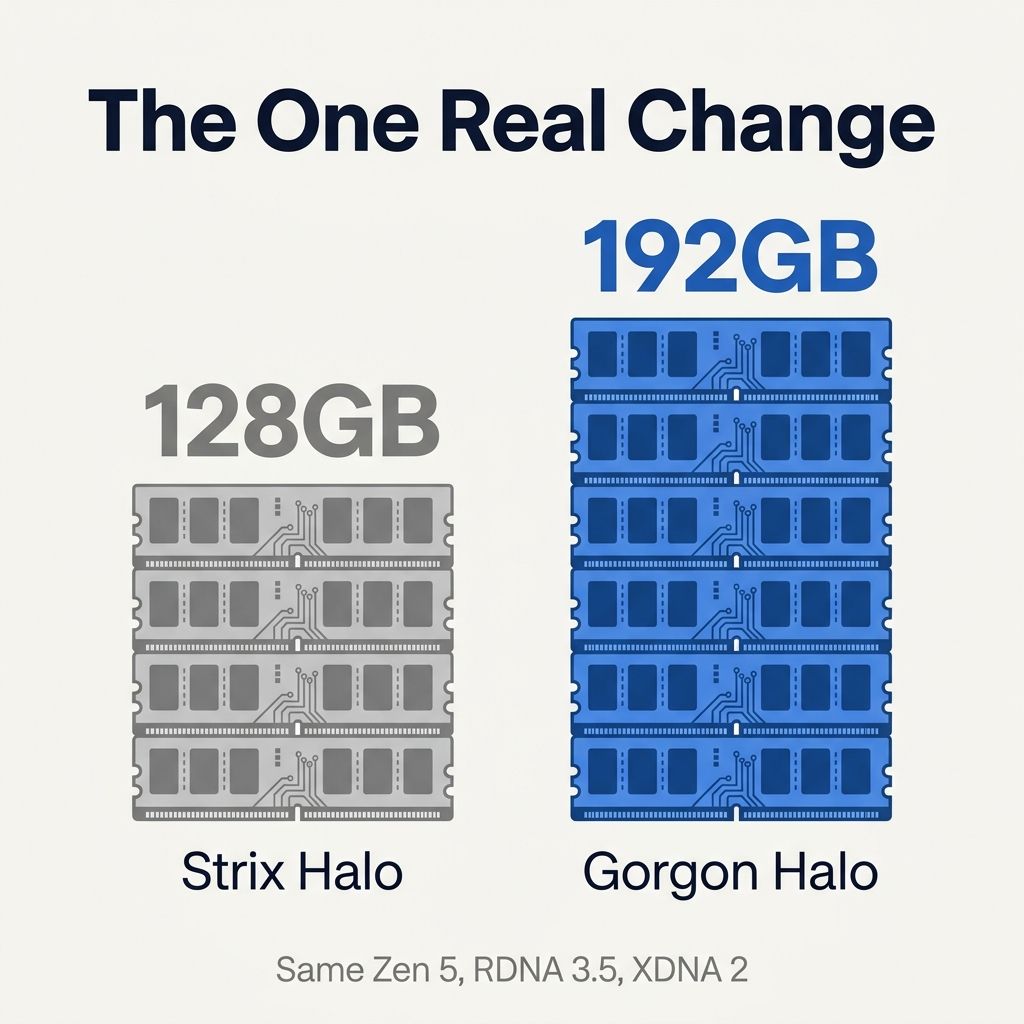
Memory capacity is the only capability Gorgon Halo adds. Strix Halo tops out at 128GB of unified memory with up to 96GB addressable by the GPU through AMD’s standard allocation setting, though Linux setups can assign more (llm-tracker.info runs one with 110GB of GTT memory). Gorgon Halo raises the ceiling to 192GB, of which Notebookcheck reports up to 160GB can be allocated to the integrated GPU. That extra room matters for a narrow set of workloads.
As our practical Strix Halo guide lays out at length, token generation on these chips is almost entirely memory-bandwidth-bound, and the bottleneck sits at roughly 215 GB/s of real-world LPDDR5X throughput. Gorgon Halo runs on the same memory technology, so a larger model that now fits in 192GB still has to be read at the same speed. You can load something bigger; you cannot necessarily run it faster, and models that already fit gain no tokens per second. So “192GB” adds capacity and no speed.
Who should wait for 192GB
If you run very large dense models at higher precision, the kind that spill past 128GB once you account for the key-value cache and a usable context window, the extra headroom is the difference between running them locally and not. The same is true if you want a big Mixture-of-Experts model like a 235B-class system resident at a usable quantization, or if your workflow keeps several large models loaded at once rather than swapping them in and out. People building multi-box Strix Halo clusters for the largest models already run into this ceiling; for them, a single 192GB node can replace a more awkward two-machine setup.
The memory on these chips is soldered, so capacity is decided at purchase. As we covered in the soldered-RAM mini PC trap, you cannot start at 128GB and add more later. So if you know your models need more than roughly 120GB resident, that is a legitimate reason to hold out for a 192GB Gorgon Halo box rather than buy a 128GB one today and regret it.
For everyone else, 128GB is already more memory than the model needs. A 70B model at a sensible quant, a 30B coding assistant, the popular MoE models people run day to day: these live comfortably inside 128GB with room to spare. Buying a machine sized for a model you will never load does not buy headroom you will use; it is overpaying. Our buyer’s guide to local-LLM mini PCs walks through matching the box to the model rather than to the headline number.
The wait is long and the payoff is small
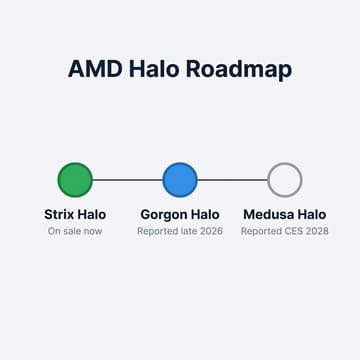
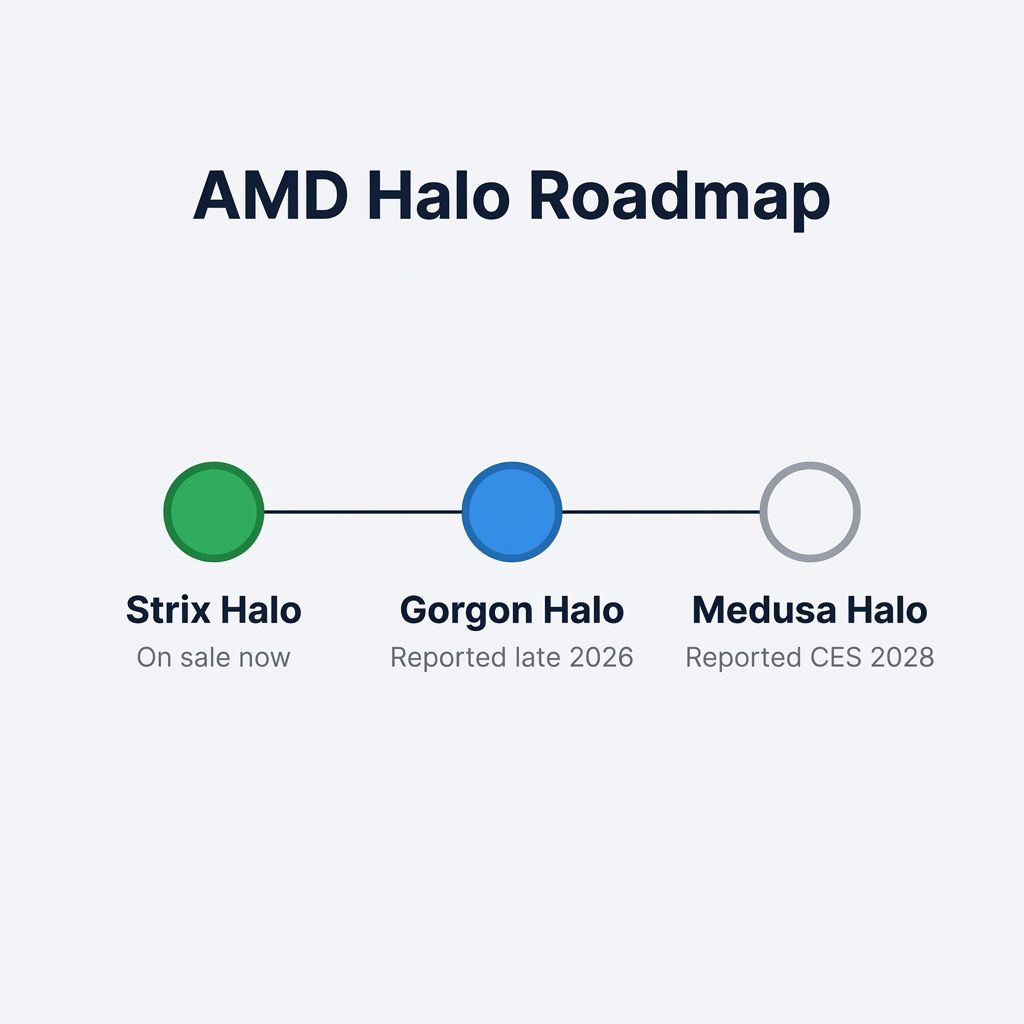
Gorgon Halo has no firm launch date beyond AMD’s Q3 2026 window for OEM systems, and “announced” is a long way from “on a shelf at a price you would pay.” The generational leap after it, Medusa Halo with Zen 6 cores and RDNA 5 graphics, is reportedly not due until CES 2028 according to HWCooling’s read of the leaks, which cites VideoCardz and the leaker Kepler_L2. AMD has not confirmed that date, so treat it as a rumor. Either way, the next architecture is years out, and Gorgon Halo is the stop-gap in between.
Hold off for Gorgon Halo and you wait an unknown number of months for a chip that runs your models at the same speed, to gain capacity most buyers will not use. The part that changes the equation is reportedly not due until 2028, if the leaks hold, so waiting for it means waiting that long. A Strix Halo box bought this week is not about to be leapfrogged; it stays current hardware until that next architecture arrives.
The 192GB part also launches into a memory market in the middle of a sustained price spike, a story we have tracked across the mini PC and single-board world. Tom’s Hardware made the same point about Gorgon Halo, calling a 192GB part arriving mid-shortage poorly timed and noting it would be “a minor miracle” if AMD ships that configuration consistently, pointing to Apple quietly pulling its highest-memory Mac Studio options. That is a second reason not to wait for the 192GB part.
The boxes worth buying right now
Among Strix Halo mini PCs, the right pick comes down to connectivity, form factor, and whether you need enterprise support. Each of these ships with the full Ryzen AI Max+ 395 except the HP build below, a PRO 385 with 32GB (HP also sells PRO 395 and PRO 390 configurations). All of them use the same silicon Gorgon Halo lightly refreshes. Prices below are list-price snapshots as of September 2026 and move with the volatile memory market, so check the live figure before you buy.
GMKtec EVO-X2
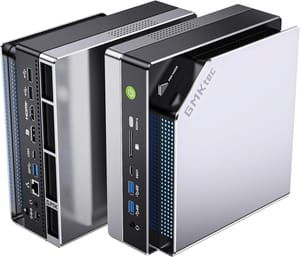
- +Multiple RAM tiers (64/96/128GB)
- +quick-release SSD
- +full Ryzen AI Max+ 395
- +quad 8K display output
- -Dual 2.5GbE rather than 10GbE
- -soldered RAM
- -availability comes and goes
MINISFORUM MS-S1 MAX
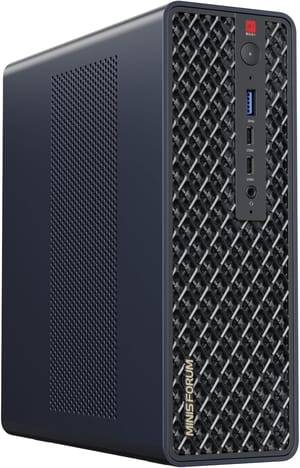
- +USB4 V2 at 80Gbps
- +dual 10GbE
- +built-in 320W PSU
- +PCIe x16 slot
- -Premium price
- -soldered RAM
- -larger footprint than rivals
GMKtec EVO-X3
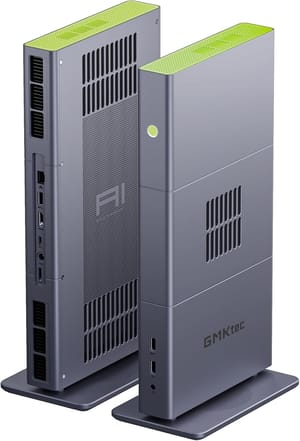
- +128GB of LPDDR5X-8000 as standard
- +OCuLink PCIe Gen4 x4 port for an external GPU
- +USB4
- +Wi-Fi 7
- -Single 2.5GbE port
- -soldered RAM
- -tall vertical chassis
- -power limits cannot be raised in firmware
HP Z2 Mini G1a
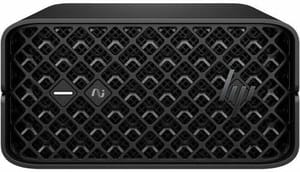
- +HP warranty and support
- +Thunderbolt 4
- +Flex IO customization
- +ISV-certified
- -This PRO 385 build has only 32GB
- -Mini DisplayPort only
- -2.5GbE instead of 10GbE
Before you commit, read our comparison of these boxes against NVIDIA’s DGX Spark for local AI work.