Running a single Strix Halo mini PC with 128GB of unified memory gets you comfortably into 70B parameter models. But LLMs keep growing, and 128GB hits a hard ceiling when you want to run something like Qwen3-235B or GLM 4.6 without aggressive quantization. Sapphire’s answer, demonstrated at Embedded World 2026, is to link two boxes together.
The Sapphire Edge AI Max+ 395 pairs two AMD Ryzen AI Max+ 395 mini PCs via USB-C, creating a combined 256GB memory pool for AI inference. Each unit packs 16 Zen 5 CPU cores, 40 RDNA 3.5 compute units in the integrated Radeon 8060S GPU, and 128GB of LPDDR5X-8000 memory. The demo showed the paired system running 235B parameter class models that would be impossible on a single unit, and Sapphire even hinted at daisy-chaining more than two units for even larger workloads. With Computex 2026 targeted for official launch and an estimated price around $2,700 per unit based on comparable hardware like the GMKtec EVO-X2 in its 128GB configuration, two linked Sapphire units would cost roughly $5,400 total.
Enthusiasts have been building their own two-node Strix Halo clusters for months, and AMD itself demonstrated a four-node cluster running a trillion-parameter model. Sapphire is productizing something that hobbyists have validated independently.
llama.cpp RPC Splits Model Layers Across Two Strix Halo Nodes
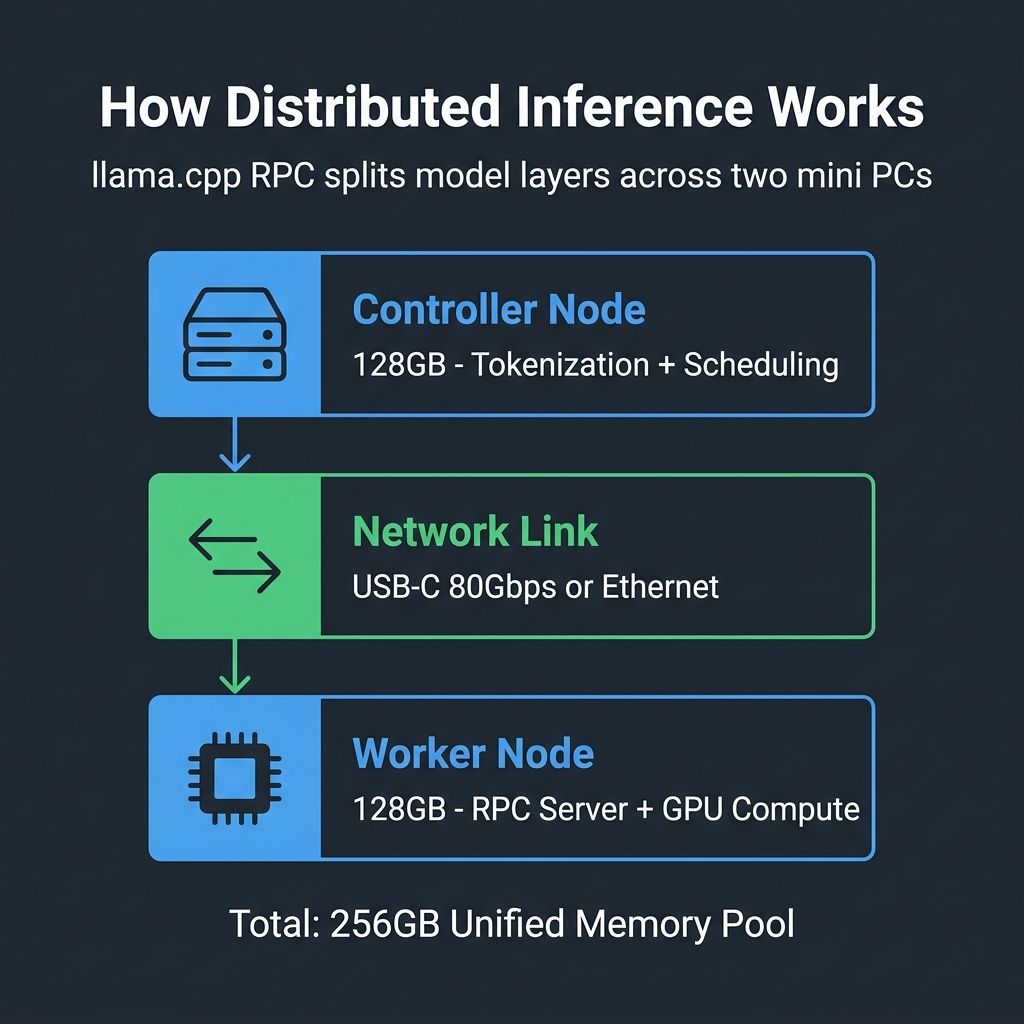
Under llama.cpp’s RPC (Remote Procedure Call) system, one machine acts as the primary controller, handling tokenization and scheduling, while the second runs a lightweight RPC server that exposes its GPU memory and compute resources. When a model is loaded, llama.cpp shards it across both machines at the layer level, placing some layers on the local GPU and the rest on the remote one.
This layer-splitting approach means the model doesn’t need to fit in a single machine’s memory. A 235B parameter model like Qwen3-235B-A22B at Q3_K_S quantization weighs roughly 101GB, well beyond a single 128GB system’s usable GPU allocation of around 96GB. Spread across two nodes with 256GB total, there’s ample headroom for the model weights plus the KV cache needed for context. The network link between the machines carries intermediate activations between layers, which is where the performance overhead lives.
The Framework Community’s kyuz0 documented this process using a Framework Desktop and HP Z2 Mini G1a over Ethernet, running MiniMax-M2 and GLM 4.6 across the two nodes. The setup process was described as “incredibly easy.” Participants noted that latency rather than bandwidth was the primary bottleneck, and that improvements to tensor parallelism in llama.cpp would help multi-node setups further. If you can configure a network connection and run a Docker container, you can build a two-node cluster.
Sapphire’s prototype currently uses USB-C for the inter-node link. Some Strix Halo systems ship with USB4 ports rated at 40-80 Gbps depending on the model, which provides substantially more bandwidth than Gigabit Ethernet. Fudzilla reports that Sapphire plans to switch to Ethernet for the production version, likely with dual LAN ports to support dedicated inter-node networking. Ethernet is more standardized for this kind of distributed computing, and dedicated networking avoids contending with other USB traffic on the same controller.
Qwen3-235B Inference on Two ROCm Nodes Reaches Roughly 10-15 Tokens per Second
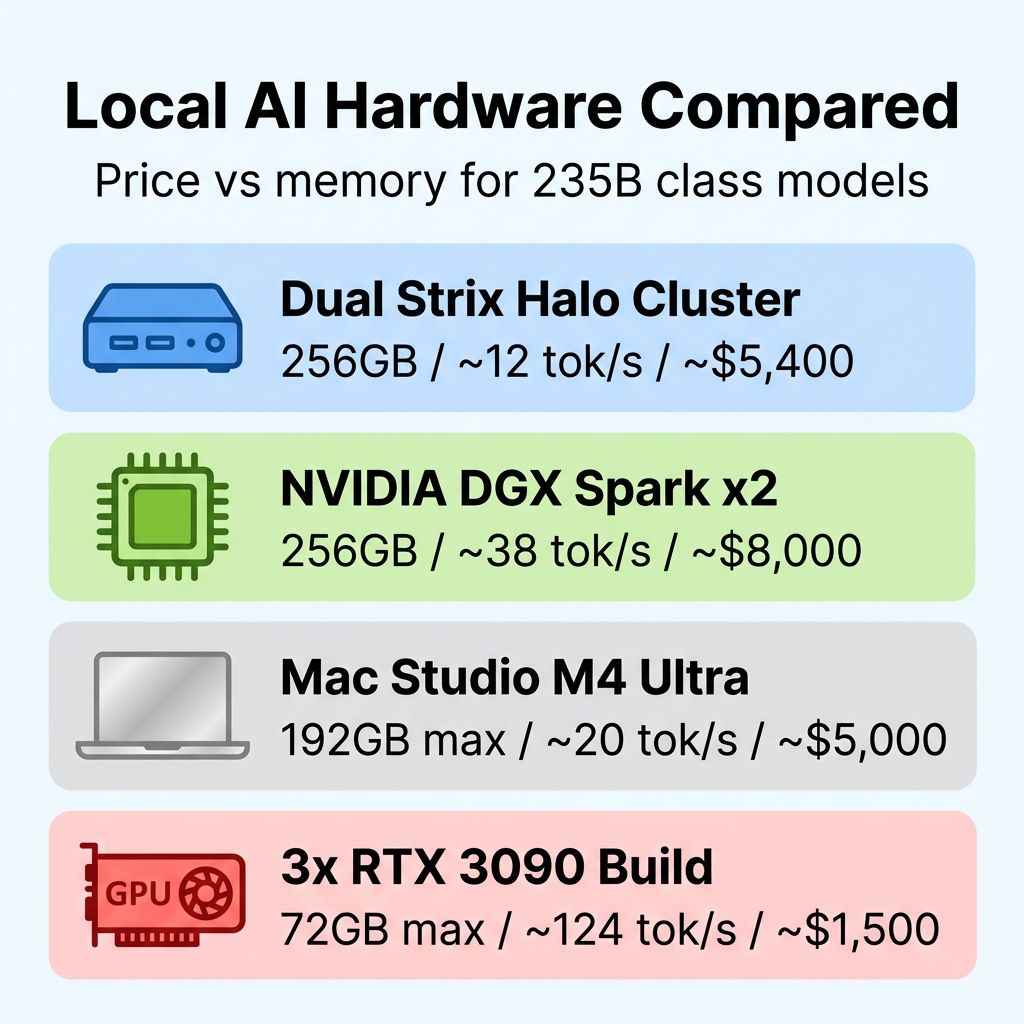
Qwen3-235B-A22B is a Mixture of Experts model with 235B total parameters but only 22B active per token, which makes it particularly well-suited to distributed inference. Because only a fraction of parameters activate per token, community builds on a dual-node cluster with ROCm reach roughly 10-15 tokens per second, fast enough that responses feel conversational rather than painfully slow.
A dense 235B model would be far slower, since every parameter must be read from memory for each token. MoE models like Qwen3-235B activate only a fraction of their parameters per token, so inference speed scales with the active parameter count rather than the total. You need 256GB to store the full model, but the per-token compute load resembles a much smaller model.
Running a fully dense model in the 200B+ parameter range across two nodes would mean much lower generation speeds, likely 3-5 tokens per second depending on quantization. That’s still usable for batch processing or slow-but-steady chat, but it’s approaching the threshold where the experience starts to feel sluggish. For context, our single-node Strix Halo guide documented 5 tokens per second on a 70B dense model as the community’s minimum for tolerable conversation.
The network link between nodes introduces latency that doesn’t exist in a single machine. Each layer transition that crosses the network boundary adds a small delay, and these accumulate across the model’s depth. The overhead varies depending on the network link speed, model architecture, and how layers are distributed, but it’s meaningful enough that Sapphire’s eventual switch to faster Ethernet and potentially dedicated inter-node protocols matters for squeezing out maximum performance.
Two Linked Nodes Undercut DGX Spark, Mac Studio, and Multi-GPU Builds for 235B Models
NVIDIA’s DGX Spark costs roughly $4,000 for a single unit with 128GB of unified memory, enough for 70B models but not 235B class workloads without aggressive quantization. NVIDIA does support linking two DGX Spark units via ConnectX networking, but at $8,000 total, that’s nearly 50% more expensive than the Sapphire pair. The DGX Spark’s advantage is the CUDA software ecosystem, which remains more polished than AMD’s ROCm stack, and significantly faster prompt processing thanks to the Blackwell architecture’s Tensor Cores.
Memory Bandwidth Favors Mac Studio and Used RTX 3090s
Apple’s Mac Studio with M3 Ultra offers up to 192GB of unified memory at around $5,000-6,000, with 819 GB/s of memory bandwidth that roughly doubles what each Strix Halo node provides. For models that fit within 192GB, the Mac Studio will deliver faster single-node inference. But it tops out at 192GB without any official multi-unit clustering option, and the macOS ecosystem for distributed inference across multiple machines is far less developed than the Linux-based llama.cpp RPC stack.
Three used RTX 3090s with 72GB of total VRAM and 936 GB/s of memory bandwidth per card will generate tokens significantly faster than either the DGX Spark or a Strix Halo cluster for models that fit in 72GB. But those models top out at approximately 70B parameters, and the setup draws over 1,000 watts compared to roughly 280W for two Strix Halo mini PCs. For the 235B class specifically, the Strix Halo cluster is the most affordable path to sufficient memory.
AMD Ran a Trillion-Parameter LLM on Four Linked Framework Desktops
Sapphire’s two-unit demo is the modest version of where AMD sees this technology heading. AMD’s own developer team demonstrated a four-node cluster of Framework Desktop systems running distributed inference of the trillion-parameter Kimi K2.5 model using llama.cpp RPC. Four nodes means 512GB of combined memory, enough to load massive models that would otherwise require enterprise hardware costing tens of thousands of dollars.
The AMD walkthrough describes a design that maps extremely well to Ryzen AI Max+ systems: each node contributes a large pool of GPU-addressable memory and compute, and llama.cpp shards the model across all nodes at load time. From the model’s perspective, layers are distributed across all available devices regardless of whether they’re local or remote.
The trajectory suggests Sapphire’s clustering approach is the consumer-facing implementation of a pattern AMD is actively developing and supporting. If the software stack continues to mature and vendors like Sapphire make the hardware plug-and-play, “mini PC clusters” could become a standard approach to scaling local AI, much like how network-attached storage evolved from a hobbyist project to a mainstream product category. For the broader self-hosting picture, see our self-hosting coverage.
Clustering Pays Off Only for Workloads That Need 235B LLMs
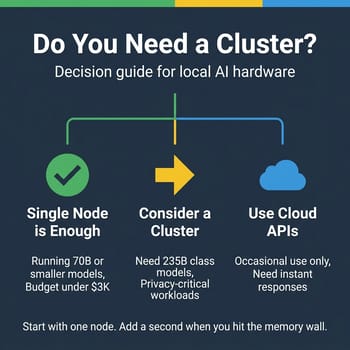
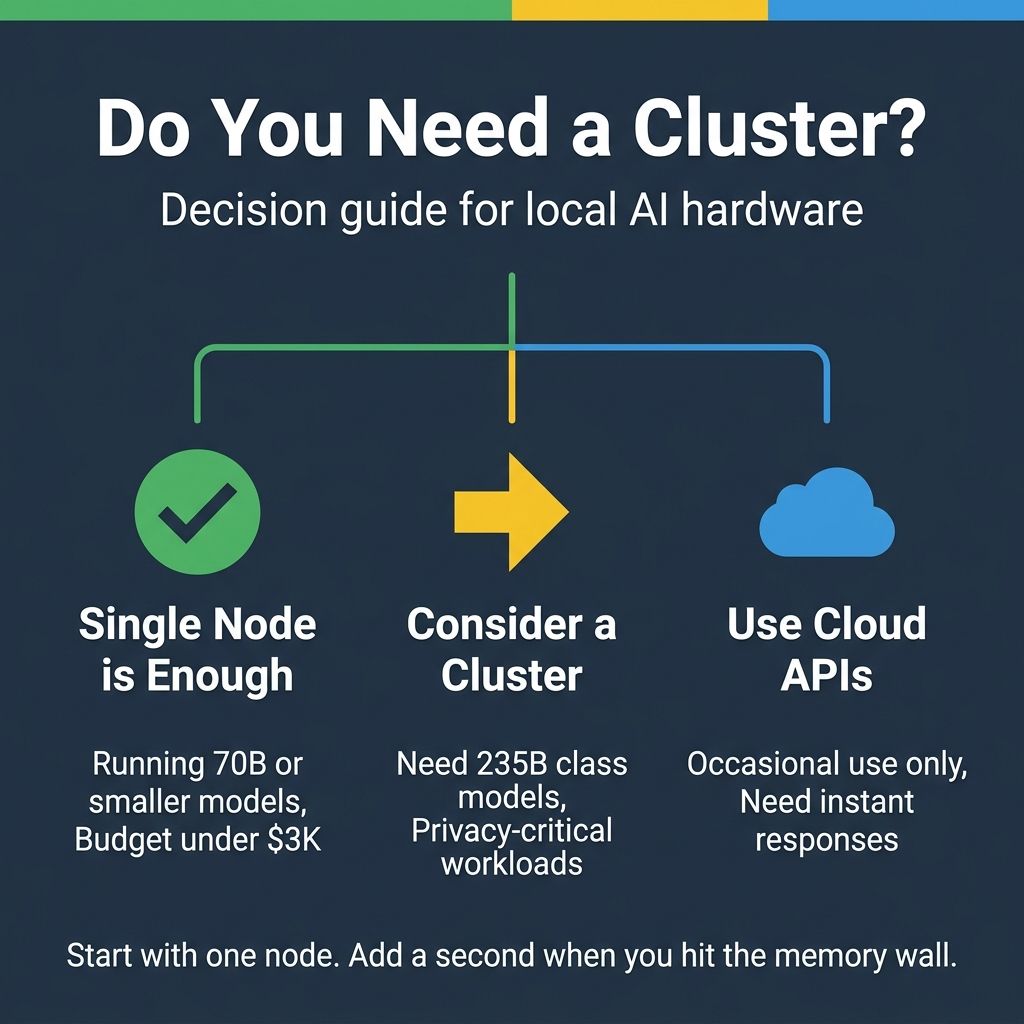
Many practical local AI use cases (coding assistance, document analysis, chatbot development) work perfectly well with 70B or even 30B LLMs on a single Strix Halo system. A quantized 70B model on one box often outperforms a poorly quantized 235B model stretched across two, because quantization quality directly affects output coherence. Look for the smallest model that meets your quality requirements.
Some use cases do need bigger models. The additional memory helps developers building RAG systems with long context windows, since 256GB lets you keep a large model loaded alongside substantial context and vector databases simultaneously. Privacy-sensitive applications in healthcare, legal, or finance may need to run the most capable available models entirely on-premises. And some languages and specialized domains simply perform better with larger models, where no amount of quantization on a smaller model can compensate.
Setup Needs Linux, ROCm, and Container Familiarity
You’ll need Fedora 42 or a recent Ubuntu distribution, working ROCm drivers, and familiarity with running containers. The llama.cpp RPC setup itself is straightforward, essentially starting a server process on one machine and pointing the other machine at it. Community guides walk through the process step by step, and the toolbox containers available for Strix Halo simplify the initial configuration. If you’ve followed our guide on BitNet and 1-bit LLMs on budget hardware, you have more than enough technical background to set up a cluster.
Windows users should understand that this is currently a Linux-first workflow. While llama.cpp runs on Windows, the ROCm stack and RPC server configurations are primarily tested and documented for Linux. AMD’s official cluster demos all use Linux environments, and the community toolboxes that simplify setup are Linux-native. For now, plan on running Linux on at least the worker node.
Price and Interconnect Are Still Unannounced
Sapphire’s Computex 2026 launch should settle final pricing, the production interconnect solution (USB-C, Ethernet, or both), and whether the software experience will be plug-and-play or require manual llama.cpp configuration. The transition from USB-C to Ethernet for the production version suggests Sapphire recognized that USB-C, while adequate for demos, has practical limitations for sustained inter-node communication.
If Sapphire succeeds, other vendors will follow. Multiple mini PC manufacturers already ship Strix Halo systems, and the llama.cpp RPC infrastructure is open source and vendor-agnostic. There’s nothing stopping MINISFORUM, GMKtec, or Beelink from offering their own clustering solutions or simply marketing their existing USB4-equipped systems as cluster-ready. The building blocks exist today for anyone willing to set them up manually.
For readers who want to start experimenting now rather than waiting for Sapphire’s launch, any two Strix Halo mini PCs connected over Ethernet can replicate this setup using llama.cpp RPC.
MINISFORUM MS-S1 MAX
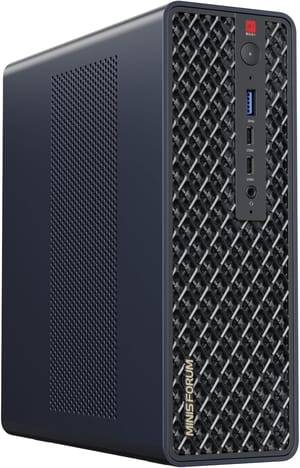
- +Dual 10GbE for cluster networking
- +USB4 V2 80Gbps
- +PCIe x16 expansion
- +Built-in 320W PSU
- -Premium pricing
- -RAM soldered
- -Larger footprint
GMKtec EVO-X2
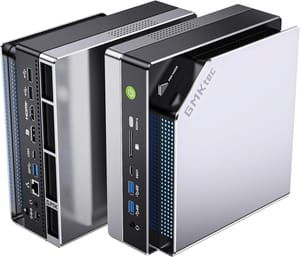
- +Multiple RAM configurations (64/96/128GB)
- +Competitive pricing
- +Quad 8K display output
- -Dual 2GbE only (not 10GbE)
- -RAM soldered
- -Inconsistent availability
Frequently Asked Questions
What is Strix Halo good for?
Local LLM inference. One 128GB unit of AMD’s Ryzen AI Max+ 395 covers 70B parameter models, with roughly 96GB of that memory usable for GPU allocation. Two linked units pool 256GB, enough for 235B class models such as Qwen3-235B-A22B.
What is Strix Halo equivalent to?
One 128GB Strix Halo node matches NVIDIA’s DGX Spark, which also ships 128GB of unified memory for roughly $4,000. On bandwidth it sits below Apple’s Mac Studio with M3 Ultra, where 819 GB/s roughly doubles what each Strix Halo node provides. Two linked units reach 256GB for roughly $5,400, against $8,000 for two DGX Sparks.
Which Strix Halo models are the best for clustering?
The MINISFORUM MS-S1 MAX, for its dual 10GbE ports, which give a two-node cluster dedicated links instead of competing for USB bandwidth. Participants in the Framework community build reported latency rather than bandwidth as the primary bottleneck between nodes. The GMKtec EVO-X2 is the cheaper route at roughly $2,700 for the 128GB configuration, without the 10GbE ports.
Does a two-node cluster need Linux and ROCm?
Yes, on at least the worker node: Fedora 42 or a recent Ubuntu distribution, working ROCm drivers, and familiarity with running containers. llama.cpp runs on Windows, but the ROCm stack and RPC server configuration are primarily tested and documented for Linux.