
NIMO Mini PC AMD Ryzen AI Max+ 395
Updated on

The NIMO Mini PC AMD Ryzen AI Max+ 395 is a 4-liter workstation aimed at local AI processing, content creation, and gaming. AMD’s flagship Strix Halo APU supplies 16 Zen 5 cores and Radeon 8060S graphics with 40 compute units. The 128GB of 8-channel LPDDR5X running at 8000MHz carries the bandwidth and the capacity that model inference needs, and that memory pool is the reason to look at this class of machine at all. Ollama and AI image generation are the workloads it is built for, with 1080p gaming as a secondary use.
Pros and cons
| Pros | Cons |
|---|---|
| AMD Ryzen AI Max+ 395 with 16 Zen 5 cores and a 50 TOPS NPU | RAM is soldered and cannot be upgraded after purchase |
| Radeon 8060S graphics with 40 CUs, which AMD positions against an RTX 4070 | 4L chassis, larger than most mini PCs, to cool a 120W TDP |
| 128GB of 8-channel LPDDR5X at 8000MHz | High cost for the Strix Halo platform |
| WiFi 7 and 2.5GbE networking | Only 2 Amazon ratings so far |
| Dual M.2 slots with up to 8TB storage capacity | No Thunderbolt port |
| Runs local LLMs and image generation without a discrete GPU | Actively cooled, so fan noise rises under load |
NIMO Mini PC AMD Ryzen AI Max+ 395 Comparison Chart
 NIMO Mini PC AMD Ryzen AI Max+ 395 | NIMO Mini PC AMD Ryzen AI Max+ 395 | NIMO Mini PC AMD Ryzen AI Max+ 395 | |
| Price | List Price: $2,499.99 Amazon Prices: | List Price: Amazon Prices: | List Price: Amazon Prices: |
| Version | 128GB/2TB/Ryzen AI Max+ 395 | 128GB/4TB/Ryzen AI Max+ 395 | 128GB/8TB/Ryzen AI Max+ 395 |
| Performance Rating | 8.5 | 8.5 | 8.5 |
| Operating System | Windows 11 Pro | Windows 11 Pro | Windows 11 Pro |
| Processor | Sixteen-core 3.00 Ghz (max 5.10 Ghz) AMD Ryzen AI Max+ 395 | Sixteen-core 3.00 Ghz (max 5.10 Ghz) AMD Ryzen AI Max+ 395 | Sixteen-core 3.00 Ghz (max 5.10 Ghz) AMD Ryzen AI Max+ 395 |
| GPU | Integrated AMD Radeon 8060S | Integrated AMD Radeon 8060S | Integrated AMD Radeon 8060S |
| RAM | 128 GB LPDDR5, 8-channel (8-channel LPDDR5X 8000MHz (soldered)) | 128 GB LPDDR5, 8-channel (8-channel LPDDR5X 8000MHz (soldered)) | 128 GB LPDDR5, 8-channel (8-channel LPDDR5X 8000MHz (soldered)) |
| Internal Storage | 2 TB NVMe SSD | 2 TB NVMe SSD | 2 TB NVMe SSD |
| Dimensions width x length x thickness | 7.4 x 9.7 x 3.8 inches (187.96 x 246.38 x 96.52 mm) | 7.4 x 9.7 x 3.8 inches (187.96 x 246.38 x 96.52 mm) | 7.4 x 9.7 x 3.8 inches (187.96 x 246.38 x 96.52 mm) |
| Weight | 3.64 lbs (1.65 kg) | 3.64 lbs (1.65 kg) | 3.64 lbs (1.65 kg) |
| WiFi | Wi-Fi 7 (802.11be) | Wi-Fi 7 (802.11be) | Wi-Fi 7 (802.11be) |
| Bluetooth | Bluetooth 5.2 | Bluetooth 5.2 | Bluetooth 5.2 |
| Ethernet | 1 Ethernet port at 2.5 Gbps | 1 Ethernet port at 2.5 Gbps | 1 Ethernet port at 2.5 Gbps |
| HDMI | 1 Full-Size HDMI Port | 1 Full-Size HDMI Port | 1 Full-Size HDMI Port |
| DisplayPort | 1 DisplayPort (DisplayPort 1.4) | 1 DisplayPort (DisplayPort 1.4) | 1 DisplayPort (DisplayPort 1.4) |
| VGA | No VGA Ports | No VGA Ports | No VGA Ports |
| USB Ports | 5 USB 3, 2 USB-C (1 USB4) Front: 1x USB4 Type-C, 2x USB 3.2 Gen2 Type-A, SD card slot, audio jack. Rear: 3x USB-A, 1x USB-C, HDMI, DisplayPort, 2.5GbE Ethernet. | 5 USB 3, 2 USB-C (1 USB4) Front: 1x USB4 Type-C, 2x USB 3.2 Gen2 Type-A, SD card slot, audio jack. Rear: 3x USB-A, 1x USB-C, HDMI, DisplayPort, 2.5GbE Ethernet. | 5 USB 3, 2 USB-C (1 USB4) Front: 1x USB4 Type-C, 2x USB 3.2 Gen2 Type-A, SD card slot, audio jack. Rear: 3x USB-A, 1x USB-C, HDMI, DisplayPort, 2.5GbE Ethernet. |
| Thunderbolt Ports | No | No | No |
| OCuLink | No | No | No |
| Internal SATA Ports | No SATA ports | No SATA ports | No SATA ports |
| Card Reader | SD Card Reader | SD Card Reader | SD Card Reader |
| Headphone Jack | combo | combo | combo |
| Fanless | No | No | No |
| VESA Mount | No | No | No |
| In the Box | NIMO AI MiniPC, Power Adapter, HDMI Cable, User Manual. | NIMO AI MiniPC, Power Adapter, HDMI Cable, User Manual. | NIMO AI MiniPC, Power Adapter, HDMI Cable, User Manual. |
| Expandability | Dual M.2 NVMe SSD slots for storage expansion. RAM is soldered (128GB LPDDR5X) and cannot be upgraded. | Dual M.2 NVMe SSD slots for storage expansion. RAM is soldered (128GB LPDDR5X) and cannot be upgraded. | Dual M.2 NVMe SSD slots for storage expansion. RAM is soldered (128GB LPDDR5X) and cannot be upgraded. |
Related Mini PCs
-
 BOSGAME M5The BOSGAME M5 puts the 16-core AMD Ryzen AI Max+ 395 and its Radeon 8060S graphics in a metal…
 -
 GMKtec EVO-X2The GMKtec EVO-X2 is a 3.6-pound upright mini PC built on the AMD Ryzen AI Max+ 395 with Radeon…
 -
 ACEMAGIC M1A Pro+Cube-shaped Strix Halo mini PC with the AMD Ryzen AI Max+ 395, Radeon 8060S, and 128GB of soldered…
 -
 BOSGAME VTA-439The BOSGAME VTA-439 pairs AMD's Ryzen AI 9 HX 470 (Gorgon Point) with Radeon 890M graphics in a…
 -
 Beelink GTR9 ProA high-performance AI Mini PC featuring the AMD Ryzen AI Max+ 395 processor with 126 AI TOPS, 128GB…
 -
 Beelink SER9The Beelink SER9 runs AMD's 12-core Ryzen AI 9 HX 370 (Strix Point) with Radeon 890M graphics, 32GB…
A 4-liter case built around a 120W chip

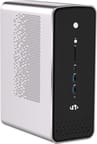
This box measures 9.7 x 7.4 x 3.8 inches, which is large next to an Intel N100 mini PC and matches the 120W TDP of the Ryzen AI Max+ 395. The chassis is silver aluminum with a black front panel, plain enough for an office or a home studio. Up front sit a USB4 Type-C port, two USB 3.2 Gen2 Type-A ports, a full-size SD card slot, and a combo audio jack for headphones and microphones. The rear carries HDMI, DisplayPort 1.4, three more USB-A ports, one USB-C port, and a 2.5 Gigabit Ethernet port.
The Ryzen AI Max+ 395 is AMD’s flagship mobile APU on the Zen 5 architecture, with 16 cores and 32 threads and a boost clock reaching 5.1 GHz, scoring approximately 55,000 on PassMark’s CPU benchmark. Its integrated Radeon 8060S carries 40 RDNA 3.5 compute units and handles modern titles at 1080p; AMD and NIMO position the 8060S as comparable to a dedicated RTX 4070, a framing the NIMO product page repeats. The 50 TOPS NPU accelerates AI workloads including Windows Copilot features and local inference tasks.
Wireless comes from WiFi 7 (802.11be) and Bluetooth 5.2, and the 2.5 Gigabit Ethernet port covers users who want a consistent low-latency wired link. Storage sits on dual M.2 PCIe slots, which take NVMe drives up to 8TB across the pair. The 128GB of LPDDR5X uses an 8-channel architecture for bandwidth, and it is soldered, so it cannot be upgraded later.
The 128GB pool is what local AI work runs on

Because the Radeon 8060S shares the CPU’s LPDDR5X pool, a Strix Halo box can run large language models locally with tools like Ollama that would not fit on a typical discrete GPU. Weighing the cost of this hardware against a hosted option is a separate calculation, and our look at Ollama Cloud versus local AI hardware lays out when the box still earns its keep.
Linux distributions are often the better path for AI development on Strix Halo hardware than Windows, with easier integration of AI tooling and better handling of the shared GPU memory that large models depend on. Our guide to running Gemma on a mini PC covers the 31B dense case for Strix Halo hardware specifically, which is a reasonable first model to load. Beyond inference, the platform also handles image synthesis with Stable Diffusion and other GPU-accelerated creative work.
Customer Reviews
Across just 2 ratings on Amazon, the NIMO Mini PC AMD Ryzen AI Max+ 395 averages 4 stars, so this is a thin sample to read much into. The two scores also split (roughly half are 5-star and half are 3-star), and only one buyer left a written review, so treat the impressions below as one owner’s experience rather than a consensus.
That single review is from Keith Gagnon, a verified purchaser who rated it 5 stars and focused on running large language models locally. He found the box well-suited to LLM work but limited for heavier AI: “Not great for heavy AI but good for large LLMs and great for small LLMs. AMD is limited vs NVIDIA.” He also reported that getting Windows configured was frustrating and that Linux was the better path, writing “I highly recommend if you’re going to use it for AI to load Linux on it,” and he was pleased with thermals, noting it “hardly ever goes over 60°C.” Read more owner reviews on Amazon.
Worth the money only if the memory pool gets used
Local LLM inference and AI image generation are the workloads that use the 128GB pool and the 8060S together; general office work does not, and a cheaper machine will do that job without the Strix Halo premium. Enthusiasts building home AI servers are the other group this hardware suits.
Memory decides the purchase, because 128GB has to be paid for up front whether or not the work uses it. Anyone who needs Thunderbolt connectivity, or plans to hang an external GPU off the machine, should look at hardware that offers those.
For those comparing options, see our Mini PC Comparison Chart to find the best match for your needs.
Frequently Asked Questions
What processor does the NIMO Mini PC use?
The AMD Ryzen AI Max+ 395, AMD’s flagship Strix Halo APU, with 16 Zen 5 cores and 32 threads, a base clock of 3.0 GHz, and boost up to 5.1 GHz. It carries a 50 TOPS NPU for AI acceleration and scores approximately 55,000 on PassMark’s CPU benchmark, which places it among the most powerful mobile processors available.
Can I upgrade the RAM in the NIMO Mini PC?
No. The 128GB of LPDDR5X is soldered directly to the motherboard and cannot be upgraded after purchase. The 8-channel architecture running at 8000MHz provides high bandwidth for AI workloads and gaming, but buyers should be sure 128GB meets their needs, because the configuration is fixed.
What ports does the NIMO Mini PC have?
Up front there is one USB4 Type-C port, two USB 3.2 Gen2 Type-A ports, a full-size SD card slot, and a combo audio jack. The rear adds HDMI, DisplayPort 1.4, three USB-A ports, one USB-C port, and a 2.5 Gigabit Ethernet port. That totals five USB-A and two USB-C ports.
What’s included in the box with the NIMO Mini PC?
The unit ships with a power adapter sized for the 120W TDP processor, an HDMI cable for immediate display connection, and a user manual. Windows 11 Pro comes pre-installed.
Is the NIMO Mini PC good for AI and machine learning?
Yes. The 128GB of high-bandwidth LPDDR5X holds large language models that would not fit on a typical discrete GPU, and the Radeon 8060S with 40 compute units accelerates inference. The single owner review on this page describes running LLMs on the machine and recommends loading Linux for that work.
How does the NIMO Mini PC perform for gaming?
The integrated Radeon 8060S graphics with 40 RDNA 3.5 compute units delivers gaming performance that AMD and NIMO position as comparable to a discrete RTX 4070. In practice that means competitive esports titles run at high frame rates and most modern AAA games are playable at 1080p with adjusted settings.
Can I expand the storage in the NIMO Mini PC?
Yes. Two M.2 PCIe slots take NVMe drives, up to 8TB of total storage across the pair. Factory configurations come in 2TB, 4TB, and 8TB, and a second drive can be added later.
Does the NIMO Mini PC support Linux?
Yes, and Linux is often the better choice here for AI development, because AI tooling integrates more easily and the shared GPU memory that large models depend on is handled better than on Windows. Distributions such as Ubuntu cover LLM inference, image generation, and development work, and the owner review on this page recommends the same path.