Ollama Cloud hosts frontier open-weight models on NVIDIA Blackwell GPUs, accessible through the same ollama run command local users already know, with pricing that starts at free. DeepSeek V4 Pro, GLM-5.3-Flash, Qwen3.5, and Kimi K3 are the same models you would otherwise download and run yourself, now on data center hardware with no local installation required. Ollama’s announcement of DeepSeek V4 Pro on cloud cleared 1,600 likes and 95,000 views in days, and the Qwen 3.5 post hit 1,200 likes and 160,000 views. If the model you wanted to run is now hosted for you, buying hardware to run it needs a reason beyond access.
This site’s March piece asked whether OpenAI’s cheapest API tier had changed the math on local AI hardware. It concluded that cloud AI keeps getting cheaper, local hardware keeps getting faster, and most people in 2026 want some combination of both. That framework assumed two options: run it locally, or call a cloud API. Since late April 2026, there have been three.
Privacy, offline work, and all-day use still favor owning the box. Starry Hope’s local AI hardware cluster was built around a two-option world, and the third option moves the break-even point.
Ollama Cloud’s Main Offering Is Its Model Catalog
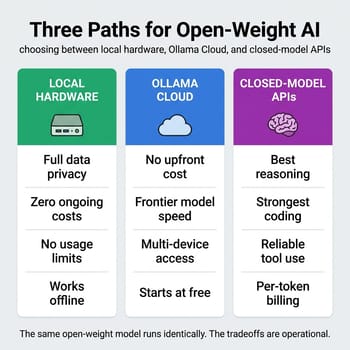
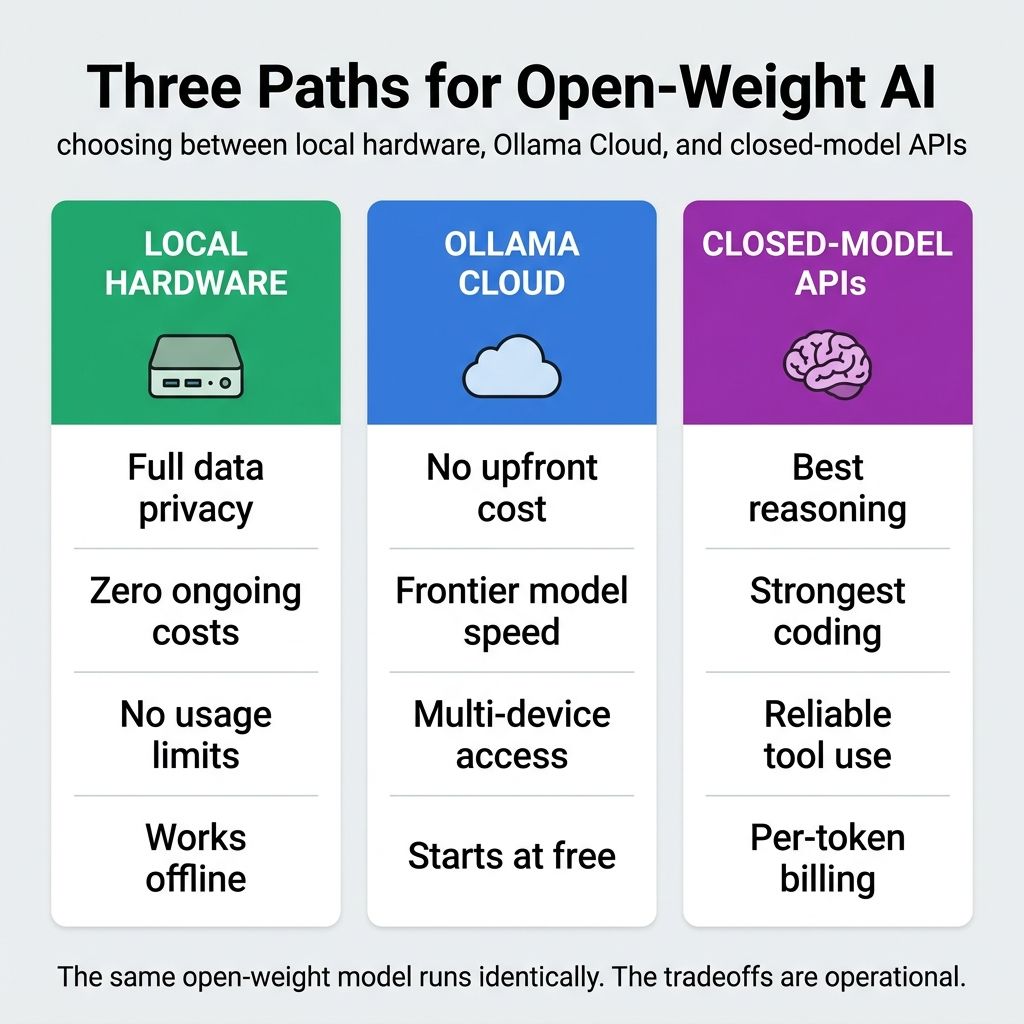
The reason the catalog matters is that most of it will not fit on a machine you would put on a desk. The models Ollama Cloud runs on its Blackwell GPUs are the largest open-weight releases of the year: DeepSeek V4 Pro, refreshed in mid-August, its smaller V4 Flash from July, GLM-5.3-Flash from August 26, the large Qwen3.5 variants, and Moonshot’s Kimi K3. Even the two Flash models are 284 and 320 billion parameters, which at four bits per weight is a 140GB to 160GB download before any context. A 128GB Strix Halo box or Mac mini cannot hold them; the only desktop among these price tiers that can is a Mac Studio with 256GB or 512GB. If you want to use those models at all, the cloud tier is the practical route, and on Ollama they exist only as cloud tags today, with the weights on Hugging Face for anyone who owns the hardware.
What a home machine runs is the small end of the same families, and the sizes are concrete. On a 16GB box, Qwen3.5 9B is a 6.6GB pull and Gemma 4 12B is 7.6GB. A 32GB box opens up Qwen3.5 27B at 17GB, Gemma 4 26B at 19GB, and Nemotron 3 Nano 30B at 24GB. A 128GB box reaches Qwen3.5 122B at 81GB. Those figures are the download sizes printed on the Ollama library pages, and they are the practical ceiling of local hardware at these prices.
Ollama Cloud bills on tokens processed, counting input, cached input, and output tokens, but no tier is capped at a fixed token number because different models use different amounts of compute. The Free tier provides daily usage quotas for experimentation. Pro at $20 per month offers roughly 50 times the Free tier’s capacity. Max at $100 per month delivers five times Pro’s capacity, though Ollama has paused new Max subscriptions as of late August 2026. Each tier’s capacity is published only as a multiple of the tier below it, never as an absolute quota, so costs cannot be compared precisely. Ollama has also revised its usage limits at least twice since launch, so check the official pricing page before making decisions based on the numbers here.
The practical experience mirrors local Ollama almost exactly. You type ollama run deepseek-v4-pro:cloud instead of ollama run deepseek-v4-pro. Your existing workflows, scripts, and API integrations need exactly one change: appending :cloud to the model name.
The limits are per-session concurrency plus a rolling quota. Free-tier users get one concurrent session with rolling quotas that reset every few hours. Pro users get three concurrent sessions and weekly rolling limits that are generous for daily development but will cap heavy production workloads. If you hit your cap mid-workflow, you wait for the next reset, which local hardware never makes you do. Three concurrent sessions will not cover an agent pipeline.
When Local Hardware Still Wins
Privacy is the most obvious advantage and the hardest to argue around. When you run a 70B-class model on a Strix Halo mini PC sitting on your desk, your prompts and the model’s responses never leave your network. For anyone working with proprietary code, patient data, legal documents, or anything subject to regulatory compliance, that is a requirement. The same calculus is why small offices set up fully local private transcription on a mini PC rather than uploading sensitive audio. Ollama Cloud’s privacy policy is reasonable for a cloud service, but your prompts still leave your network.
For certain workflows, latency matters too. A local model responds in milliseconds with no network round-trip. Independent testing shows DeepSeek V4 running at 23 to 26 tokens per second on Apple Silicon via MLX, and Strix Halo systems push around 72 tokens per second on MoE architectures like Qwen3-30B-A3B. Ollama Cloud running on Blackwell will likely match or exceed those raw generation speeds, but the network adds 50 to 200 milliseconds per round-trip depending on your location and connection. For interactive coding completions where you want instant suggestions, local inference feels noticeably snappier. For longer conversations or batch document processing, the network overhead is negligible relative to generation time.
The independent pricing analysis from Pooya Golchian estimates that an RTX 4090 build, amortized to roughly $70 per month, breaks even against Ollama Cloud’s top tier above roughly 25,000 daily requests, though that analysis prices the top tier near $200 per month rather than the $100 Ollama lists today. The same logic applies even earlier to cheaper hardware like a Mac mini. Apple’s new M6 Mac mini starts at $899 with 16GB of unified memory and tops out at 32GB, the M5 Pro model starts at $1,699 with up to 64GB, and both ship September 22; the outgoing M4 model is the used-market bargain now. If you are running AI workflows eight hours a day, five days a week against Ollama Cloud Max at $100 per month, the M6 pays for itself in about nine months and the M5 Pro in about 17. After that, you pay only for power, while the subscription keeps billing.
Some users are better served by a $300 box than by any cloud tier. A $300 Intel N150 mini PC with 16GB of RAM runs 7B models at 6 to 9 tokens per second with no internet connection, no subscription, and no usage limits. For hobbyists experimenting with small models, developers who work offline, or anyone in a region with expensive or unreliable connectivity, that is a complete local AI setup for a one-time investment that would buy 15 months of Ollama Cloud Pro. The same reasoning drives an offline AI survival build. On the budget end, even 1-bit BitNet models running on a CPU give hardware you already own a basic local assistant for nothing. A r/LocalLLaMA thread on the 4B-class models of 2026 shows small models getting more capable while the hardware to run them gets cheaper.
When Ollama Cloud Wins
If you are not running AI workloads all day, buying hardware to do it is like buying a commercial oven because you bake cookies twice a month. The Free tier costs nothing and gives you access to frontier open-weight models that would require thousands of dollars in hardware to run locally at comparable speeds. For developers exploring what DeepSeek V4 Pro or GLM-5.3-Flash can do before committing to a hardware investment, the Free tier costs nothing to try.
At $20 a month, Pro undercuts amortized hardware for anyone not running models daily. Twenty dollars buys you 50 times the Free tier’s capacity with three concurrent sessions and access to the full model catalog running on Blackwell GPUs. A Strix Halo GMKtec EVO-X2 at roughly $2,000 amortized over three years costs about $56 per month before you factor in electricity, maintenance, and the opportunity cost of tying up that capital. If your usage fits comfortably within Pro’s limits, the math does not close for hardware on pure economics.
Portability is where the cloud tier has no local equivalent. A local Strix Halo box is tied to your desk. Ollama Cloud works from any device with an internet connection: a laptop in a coffee shop or a phone in an airport. For developers who work across multiple machines, the ability to run ollama run deepseek-v4-pro:cloud from anywhere without syncing model files or managing local installations is a convenience. The Yage AI buying guide adds that one Ollama subscription covers models from several vendors, replacing separate API accounts and billing dashboards.
There is also a try-before-you-buy path. Spend a month on Ollama Cloud Pro running the exact models you would run locally. Measure what you use, and note whether the concurrency limits bother you. That $20 tells you whether the $2,000 is justified.
When Closed-Model APIs Still Win
For the hardest reasoning and coding tasks, the closed models from Anthropic and OpenAI still lead the open-weight catalog on the benchmarks that track agentic coding, and the tools built on them, Claude Code and Codex, are where that lead shows up in daily work. The March article made that case with the spring’s numbers, and the shape of it has not changed. If you are using AI for complex code refactoring, multi-step debugging, or agentic workflows that demand reliable function calling, the frontier closed models are worth their per-token pricing.
What has changed is the price of the closed side’s cheap tier. OpenAI’s GPT-5.6 line, released July 9 in three tiers, puts its smallest, Luna, at $0.20 per million input tokens and $1.20 per million output tokens since a July 30 cut, down from $1 and $6 at launch and 3.75 times cheaper than the mini tier the March article priced. It is a reasoning model with a one-million-token window (OpenAI’s own long-context tests show its retrieval falling off sharply past 256K), it scores 62.7% on SWE-Bench Pro against the flagship’s 64.6%, and on August 6 it became the default model for free ChatGPT users. Batch and flex pricing halve those rates again.
Ollama’s tiers have no token quota to compare against, so a per-token comparison with Luna cannot be built from its published figures. If your AI use is API calls from scripts and agents, and your data can leave the building, Luna is now cheap enough that neither a $20 subscription nor a $2,000 box wins on cost alone. The open-weight path keeps its other reasons. The weights are yours, the models run offline, and nothing is metered.
Running DeepSeek V4 Pro or GLM-5.3-Flash locally or on Ollama Cloud gives you a capable coding assistant, and Z.ai’s own benchmarks put its Flash model close behind Anthropic’s flagship, but it does not give you a Claude Code or Codex replacement. Those tools are built on frontier closed models because the reliability gap is still wide enough to matter in production workflows. Send your hardest coding and reasoning tasks to a frontier API, and run everything else on Ollama Cloud or local hardware, choosing between those two on privacy, volume, and latency.
The Math at Three Price Points
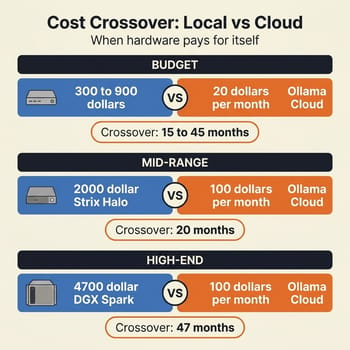
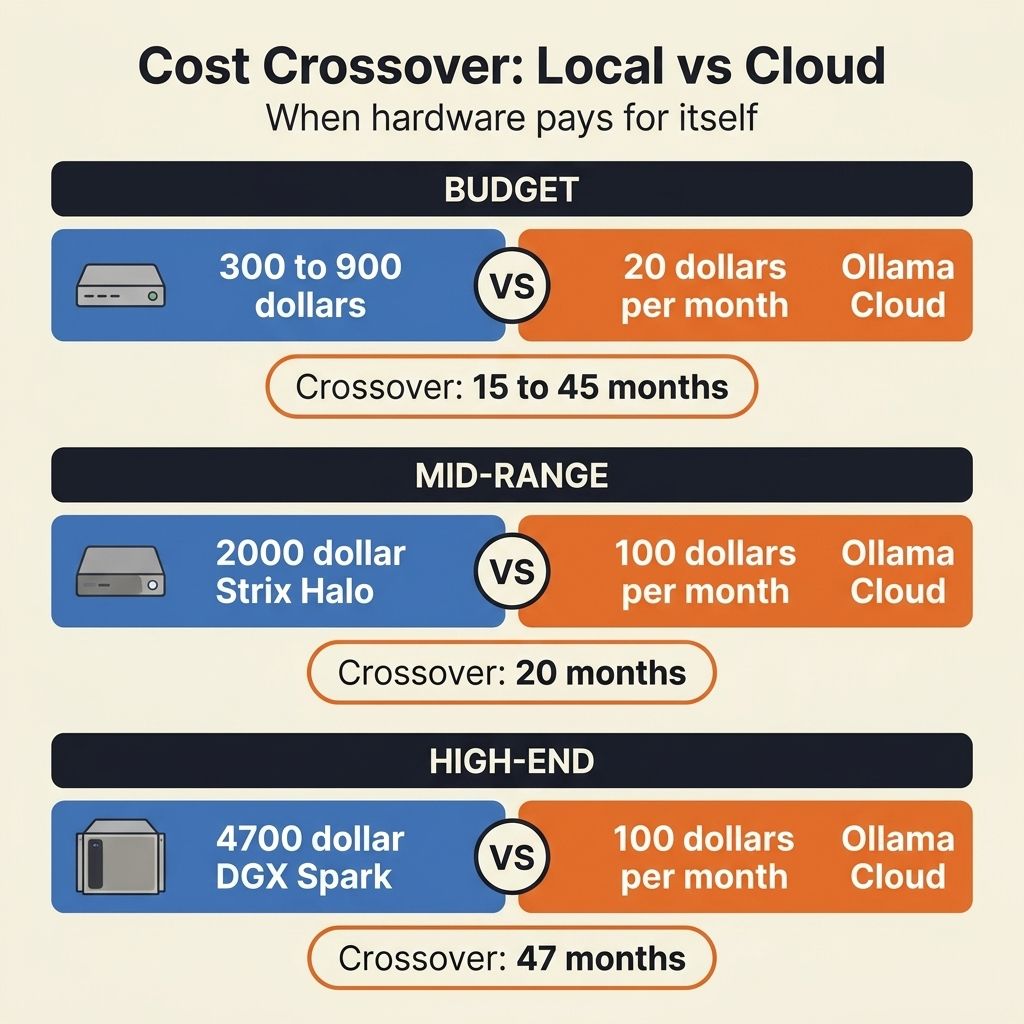
A budget setup between $300 and $900 covers a 16GB Intel N150 mini PC or the new base M6 Mac mini at $899 with 16GB of memory. That is the mini’s highest starting price yet, $300 over the M4’s launch price, which makes a leftover M4 the value pick while stock lasts. Both run 7B to 9B models locally with no ongoing costs. Ollama Cloud Free handles the same models at faster speeds but with usage caps that will frustrate daily drivers. Cloud Pro at $20 per month exceeds both machines’ performance on those same models, and the crossover happens around 15 months for the N150 and 45 months for the M6 mini. The budget local path wins primarily on privacy, offline access, and unlimited usage; the cloud path wins on speed and zero upfront commitment.
GMKtec EVO-X2
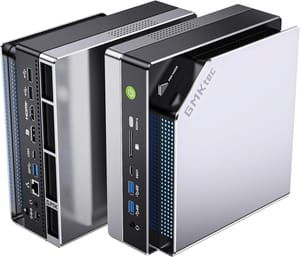
- +Ryzen AI Max+ 395
- +128GB unified LPDDR5X
- +256 GB/s memory bandwidth
- +runs 70B models locally
- -$2
- -000+ price
- -fan noise under AI load
- -Vulkan/ROCm learning curve
The mid-range tier between $2,000 and $2,500 is the closest call. A Strix Halo system runs 70B models locally on 128GB of unified memory, and Apple’s new Mac Studio with M5 Max enters the same bracket at $2,499, configurable to 128GB with 614GB/s of memory bandwidth against the Strix Halo’s 256GB/s, though 128GB is an upgrade, not the base price. Ollama Cloud Max at $100 per month runs the same models on Blackwell (the tier is paused for new subscribers as this update goes out, so read its figures here as list price). The raw crossover is around 20 months, but concurrency changes the answer. Strix Halo delivers about 5 tokens per second on dense 70B models and around 72 tokens per second on MoE architectures. Ollama Cloud on Blackwell will likely outperform on raw generation for dense models. But the Strix Halo has no concurrency ceiling and does not need the network. Linked Strix Halo clusters are the route past one box. If you are running multiple model sessions simultaneously, processing batches overnight, or building agent pipelines that run continuously, local hardware earns its keep well before the 20-month crossover because the Cloud Max subscription cannot serve those workloads without hitting limits.
The high-end tier centers on the DGX Spark at $4,699 after NVIDIA’s February price hike, and now the Mac Studio with M5 Ultra from $5,499, with up to 512GB of unified memory at 1.2TB/s, which Apple pitches as running models with hundreds of billions of parameters entirely on device. It is the only desktop among these three tiers that could hold the 284B and 320B Flash models at four bits per weight, and the memory to do it is expensive: MacRumors puts the 96GB to 256GB step at $4,000, with the 512GB configuration arriving in late October. Against Ollama Cloud Max at $100 per month, the raw crossover is 47 months for the Spark and 55 for the base Studio. The DGX Spark’s edge is CUDA ecosystem depth, fine-tuning performance, and image generation speed; the Studio’s is memory. For most inference-only workloads, the subscription is the better deal. The Spark’s remaining advantage is for developers doing training, fine-tuning, and diffusion workflows where CUDA optimization and local GPU compute outperform hosted inference.
DeepSeek V4 Pro ran a 75% discount on direct API access through May 31, 2026, and the analysis argued the direct API could be cheaper than Ollama Cloud for high-volume token generation while that lasted. With both sides billing per token, the comparison now rests on the per-token rates themselves and on how much capacity each Ollama Cloud tier buys.
Three Questions Decide It
Before this spring, the local AI hardware decision was binary: spend the money and own your compute, or pay per token and rent someone else’s. Ollama Cloud adds a middle path that undercuts local hardware for everyone except heavy daily users and privacy-bound workflows.
Data that must stay on hardware you control means local wins, and no cloud offering changes that. The privacy argument for local AI hardware is as strong as it has ever been. Heavy use, where $20 to $100 per month adds up to more than the amortized cost of the hardware over two years, also means local wins on economics alone. If you need frontier closed-model capability for complex reasoning and coding, those API subscriptions remain necessary regardless of what you choose for open-weight workloads.
Ollama Cloud Pro at $20 per month is the right place to start when none of the three applies; the Strix Halo and Mac Mini recommendations in our hardware guides still hold when the first two do.
Whatever you choose today, plan to reassess in six months. Ollama, Apple, and OpenAI all moved their prices this summer.