On June 9, 2026, Anthropic shipped Claude Fable 5 and Claude Mythos 5, its two most capable models, and began rolling Fable 5 out free to Pro, Max, and Enterprise users. Three days later both models were gone. On June 12 the US Commerce Department issued an export-control directive ordering Anthropic to block access by any foreign national, and because, by Anthropic’s account, identifying users by nationality in real time is not feasible, the company disabled both models globally. Axios first reported the letter from Commerce Secretary Howard Lutnick to chief executive Dario Amodei, and Anthropic confirmed the suspension the same day, saying it disagreed with the action while complying with it.
The scope is worth getting exactly right, because the easy way to misremember this story is to think it only touched users abroad. The directive covers “any foreign national, whether inside or outside the United States,” including Anthropic’s own foreign-national employees. There is no version of that rule a consumer-facing product can apply selectively at the login screen, so the company’s practical response was to pull both models globally. For most paying customers the practical effect was quiet and immediate. Anyone who had been bumped up to Fable 5 over the weekend was moved back down to Claude Opus 4.8, the model that had been the flagship the week before, and the API, Max, and Pro tiers kept running on that older model. Nobody lost a subscription. Nothing was deleted. But a capability that existed on Wednesday did not exist on Friday, and the reason had nothing to do with Anthropic’s uptime, your payment, or your usage.
The new risk to cloud AI is political
Cloud services go down all the time. Regions fail, billing disputes lock accounts, a provider sunsets an old model and forces you onto a new one. None of that is what happened here. What happened on June 12 is that a government reached into a live, widely used commercial product and removed a capability in an afternoon, over a security finding that Anthropic itself characterized as a narrow potential jailbreak rather than a systemic flaw. Anthropic said it was working to restore access while disagreeing with the directive, but as of mid-June there was no committed timeline and both models were still off.
That is the structural shift a 2026 buyer should sit with. A year ago, the risks to your cloud AI access were commercial and technical. Now there is a third category: political. Your access to a frontier model can be suspended not because the company failed and not because you did anything, but because of a regulatory decision made several layers removed from you. The reaction on the ground reflected that. One widely shared post on X captured the mood bluntly, warning people to “invest in local AI while you can, because when the rugpull happens on subsidized subscription plans it’s going to be absolutely brutal.” You do not have to share the doom to notice that the fragility is real and that it was invisible until last week.
This is the same instinct that drove a quieter trend we covered recently, the move toward a low-AI computing setup you actually control. The motivation is different (privacy and calm versus availability), but the underlying question is the same: how much of your daily computing do you want to depend on a service that can change the terms without asking you?
The myth to refuse first
Before talking about what to buy, it is worth killing the framing that always shows up in moments like this: quit the cloud, run an open model on your laptop, and you are free. That is wrong, and pretending otherwise sets you up to feel cheated by your own hardware. The model you run at home is not Fable 5, and on its best day it is not Opus 4.8 on its worst one. Opus 4.8 is a frontier cloud model running on datacenter hardware, in a different size and capability class than anything that fits on a consumer machine; the thing your mini PC runs is an 8-to-31-billion-parameter open model, quantized to fit in consumer memory, decoding at a pace measured in tens of tokens per second rather than hundreds. Those are different classes of tool. A local model does not replace a frontier model any more than a backup generator replaces the grid.
So the right question is not “can I cancel my subscription,” because for most knowledge work the answer is no. The right question is the one the June 12 scare actually raised: what does owning local hardware buy you as a hedge, given that it will never be the everyday frontier driver?
What local AI does well in 2026
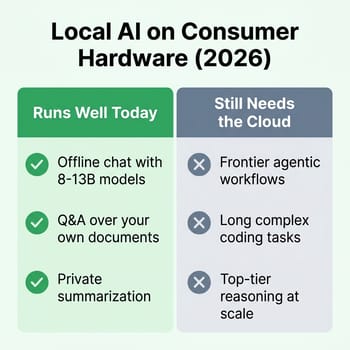
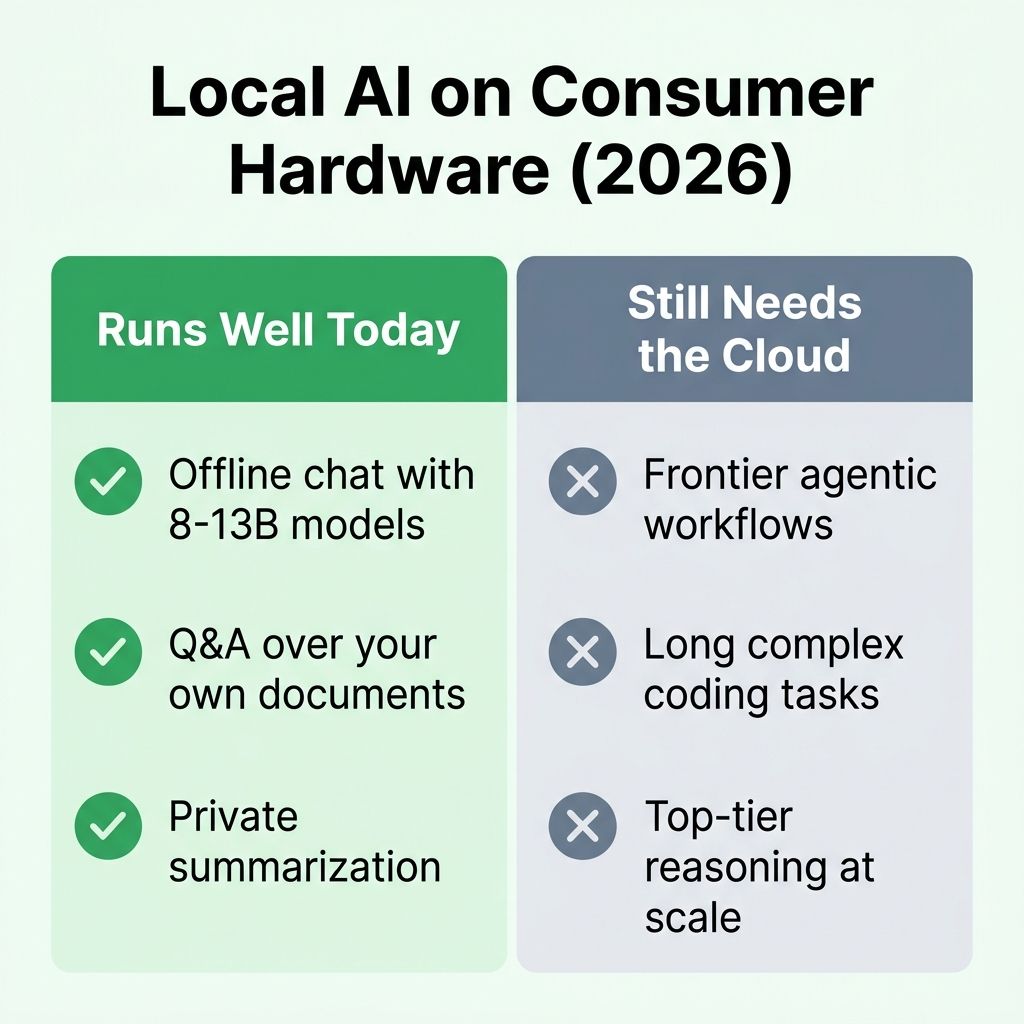
Set the frontier comparison aside and local AI is useful, more so than it was even six months ago. On a mid-range mini PC with a Ryzen chip and 32 GB of memory, a 26-billion-parameter mixture-of-experts model runs at roughly 18 to 23 tokens per second through llama.cpp’s Vulkan backend, which is fast enough to feel like a conversation rather than a wait. At that tier the model handles offline chat, drafting and rewriting, retrieval and question-answering over your own documents, and private summarization of material you would rather not paste into someone else’s API. It will give you competent help with small coding tasks, shell commands, and config files. None of that requires an internet connection, a login, or a single token of your data leaving the room.
The privacy angle is not a throwaway. A local model is the only configuration where you can be certain a sensitive contract, a medical document, or proprietary code never touches a third party, because the inference happens on silicon you own. That property does not change when a government issues a directive, when a provider revises its data-retention policy, or when your account gets flagged by an overzealous classifier. For a meaningful slice of work, “it runs on my desk and answers to nobody” is the whole point, and the June 12 episode just made that argument louder.
What it does not do, plainly
The capability map has a right-hand column for a reason. Local hardware does not give you frontier-class agentic workflows, the kind where a model plans across dozens of tool calls and holds a large project in its head. It does not match a hosted frontier model on long, complex coding inside an unfamiliar repository, where the gap between a 31B local model and Opus 4.8 is wide and obvious the moment the task gets hard. It does not deliver top-tier reasoning at scale, and it does not give you the very large context windows that hosted models now ship. If your work depends on those capabilities, a mini PC is not a substitute for your subscription, and any article telling you otherwise is selling you something.
There is also an ongoing cost to running models locally that the marketing never mentions, and we have written about it at length: a machine doing inference is a machine drawing power, spinning fans, and giving up cycles it could spend on everything else. The hedge is real, but it is not free, and budgeting for it up front beats discovering it after the box is on your desk.
A realistic hedge is a mid-range mini PC
If you decide the political-fragility risk is worth insuring against, the hardware question sorts into three tiers, and the right one depends entirely on how much capability you want your backup to have. The point is not to chase the biggest model your money can buy; it is to match the box to the work you would still need to do if the cloud went dark for a week.
The practical sweet spot is a mid-range mini PC with a recent Ryzen chip, a usable integrated GPU, and 32 GB of memory. This is the tier that runs the best models that actually fit on a mini PC, fast enough to be pleasant, without crossing into workstation pricing.
Beelink SER8

- +Ryzen 7 8845HS
- +Radeon 780M iGPU
- +32GB DDR5 configurations
- +vapor-chamber cooling stays quiet
- -DDR5 prices remain elevated
- -64GB SODIMM ceiling trails the EVO-X2's larger unified-memory pool for the biggest long-context models
If you want the hedge to stretch as far as consumer hardware currently allows, the next tier is a unified-memory machine built for this workload. AMD’s Strix Halo platform puts a wide memory bus behind a large shared pool, which is exactly what large models want.
GMKtec EVO-X2

- +Ryzen AI Max+ 395
- +large unified memory pool
- +high memory bandwidth
- +compact
- -Premium pricing
- -driver maturity still settling
- -audible under heavy AI load
The Apple option earns its place on a different strength. An M4 Mac mini pairs a fast unified-memory architecture with MLX, and its real advantage is prefill speed and power efficiency, so feeding it a long document feels snappier even when raw decode numbers sit a little behind the Ryzen tier.
Mac mini with M4 chip

- +Apple M4
- +efficient unified memory
- +fast prefill via MLX
- +very low idle power
- -Memory upgrades are expensive
- -base RAM is tight for long-context models
Across all three tiers the same caveat holds. You are buying a competent local assistant and a privacy guarantee, not a frontier model in a small box. If you want the full picture of what each hardware class can and cannot do before you spend anything, our survey of local AI hardware in 2026 walks through the bandwidth and memory tradeoffs in detail, and it is worth reading before deciding whether local hardware makes sense for you at all when hosted services will serve the same open models for free.
A sensible hedge combines cloud and local
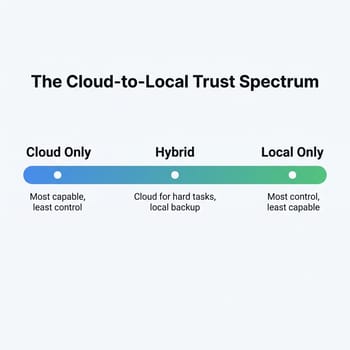
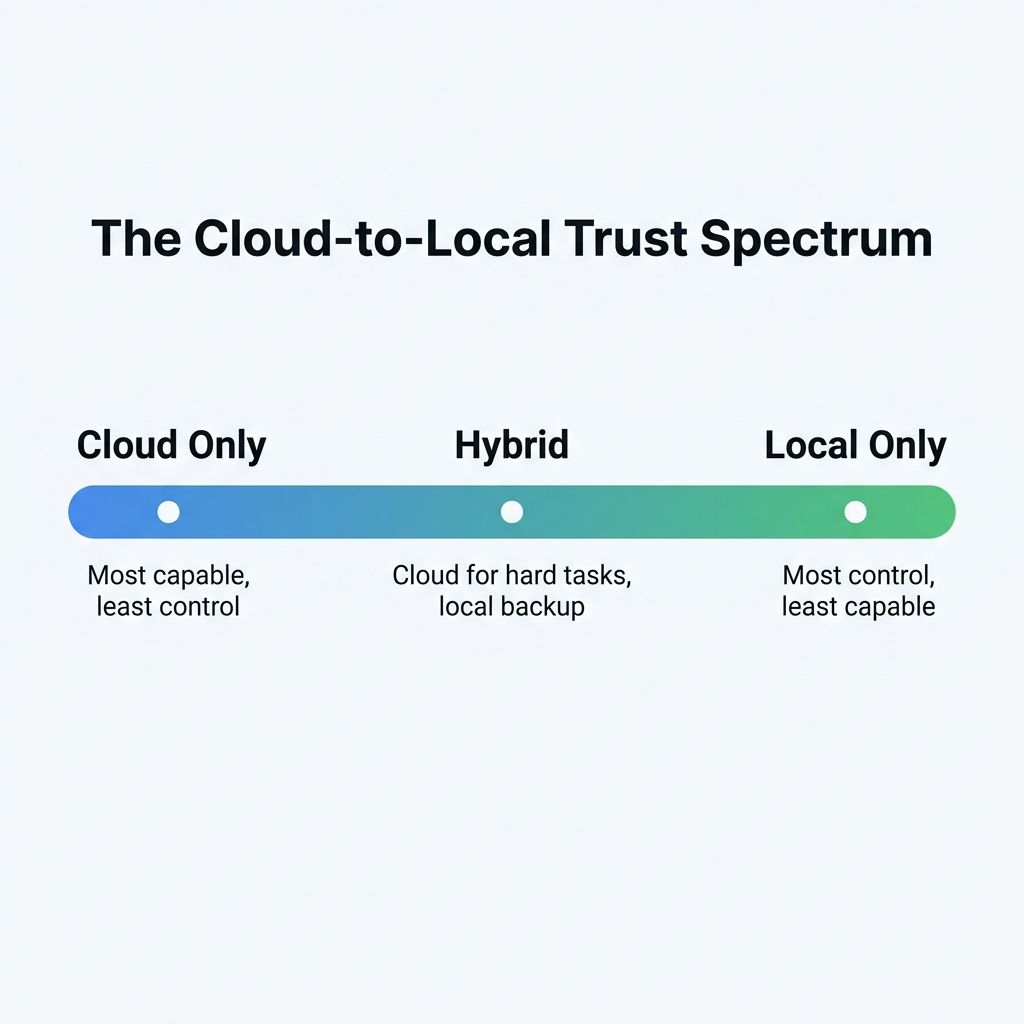
The mistake is treating this as a binary: all cloud or all local. Almost nobody belongs at either end. Cloud-only is the most capable and the least under your control, which is precisely the exposure June 12 illustrated. Local-only gives you total control and the least capability, and it asks you to give up the frontier work that probably justified the subscription in the first place. The sensible place for most people is the middle: keep the cloud for the hard tasks where the frontier gap matters, and own enough local hardware that an outage, a policy shock, or a privacy-sensitive job does not stop you cold.
Framed that way, the hedge is modest and rational. A capable mini PC is not a bet that the cloud is doomed; it is the recognition that your access to a frontier model now carries a political risk it did not carry a year ago, and that a few hundred dollars of hardware turns “I am locked out and stuck” into “I am locked out and inconvenienced.” That is what the June 12 directive actually changed. It did not make local AI as good as Claude. It made owning a fallback look less like a hobby and more like a reasonable line item, and it did so by demonstrating, in a single afternoon, that the thing you were renting can be switched off by someone you never signed a contract with.