OpenAI dropped GPT-5.4 mini and nano on March 17. The mini variant runs more than twice as fast as its predecessor while scoring 54.4% on SWE-Bench Pro, closing most of the gap with the full GPT-5.4 model’s 57.7%. It costs $0.75 per million input tokens and $4.50 per million output tokens. Those numbers raise the question of when cloud AI gets cheap enough that spending $2,000 to $4,000 on dedicated local hardware stops making sense.
That question matters because the local AI ecosystem has been on a tear. AMD’s Strix Halo chips finally put 128GB of unified memory in a mini PC, NVIDIA’s DGX Spark promises desktop-class AI compute, and Microsoft’s BitNet framework runs 1-bit models on budget CPUs with no GPU required. Each of these developments makes local AI more capable. But GPT-5.4 mini represents the other side of the equation: cloud AI getting cheaper and faster too.
OSWorld and Tool Calling Show the Biggest Gains
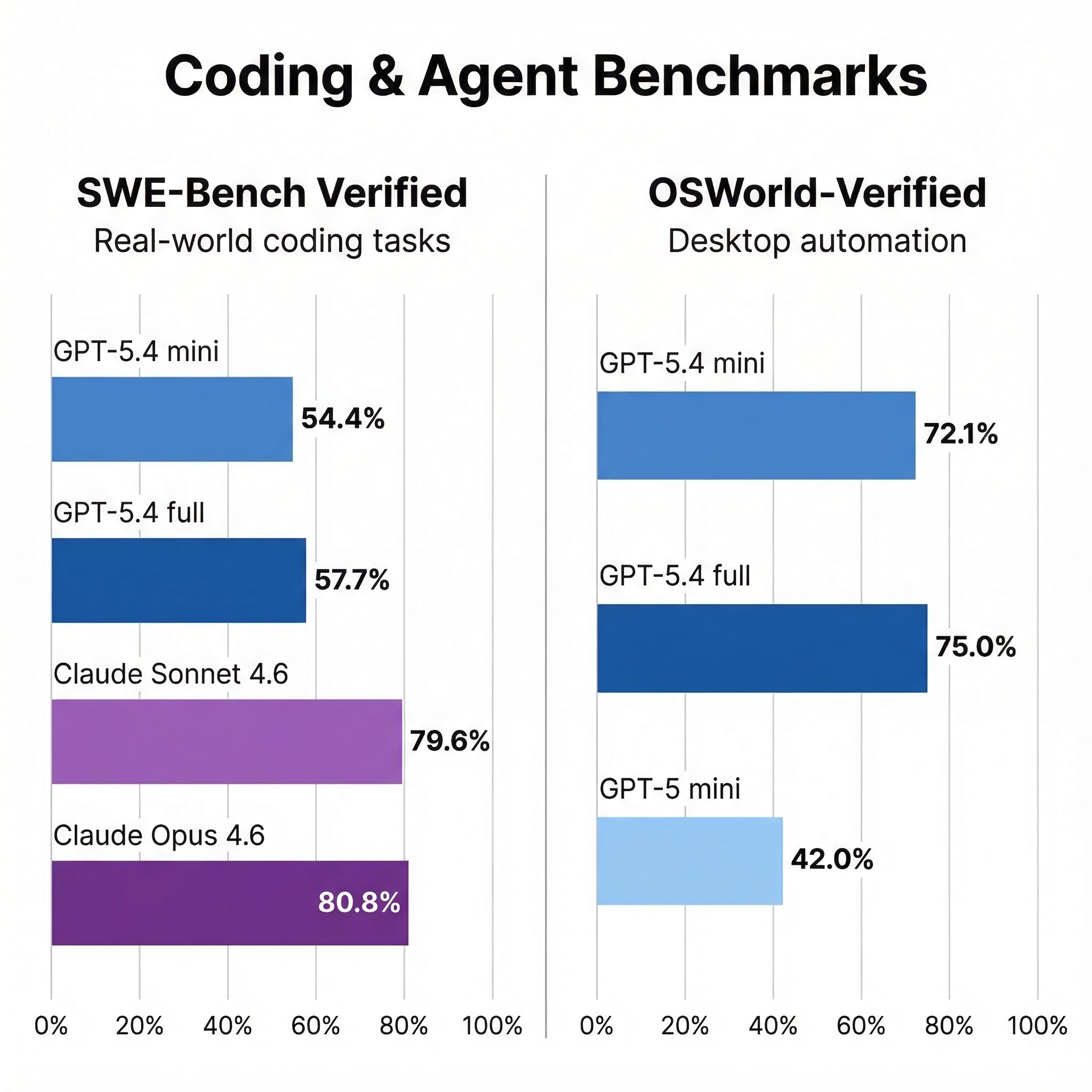
On OSWorld-Verified, which tests a model’s ability to autonomously control a desktop through screenshot interpretation, mini scores 72.1% compared to 42.0% for the previous GPT-5 mini. That puts a $0.75-per-million-token model close to the full GPT-5.4’s 75.0%. Automated workflows that need to interact with desktop applications can run on it at that price.
Tool calling shows a similar pattern. On tau2-bench, a telecom-focused benchmark for structured tool use, mini hits 93.4% compared to GPT-5 mini’s 74.1%. On MCP Atlas, which tests model context protocol integration, it reaches 57.7% versus 47.6%. Reliable tool use is increasingly the bottleneck in agentic AI systems. A model that can consistently call the right function with the right parameters is more valuable in practice than one that writes slightly better prose.
Coding Benchmarks and Long Context Still Favor Frontier Models
On SWE-Bench Pro, GPT-5.4 mini’s 54.4% is respectable for a small model. On SWE-Bench Verified, Claude Opus and Sonnet both score around 80%. Sonnet costs $3 per million input tokens. These are different benchmarks with different difficulty levels, but the directional gap is real: for serious software engineering tasks, frontier models remain far ahead of mini-class models. Mini also falls apart on long-context retrieval: 47.7% on OpenAI’s MRCR v2 benchmark with 8 needles at 64K-128K context, compared to 86.0% for the full GPT-5.4. If your workflow involves analyzing large codebases or tracking many details across long documents, mini is not a replacement for a frontier model.
GPT-5.4 Mini Pricing Versus a One-Time Hardware Buy
The Monthly Bill Depends on Output Volume
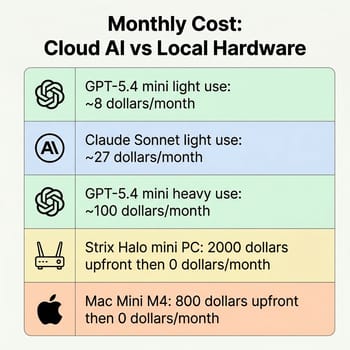
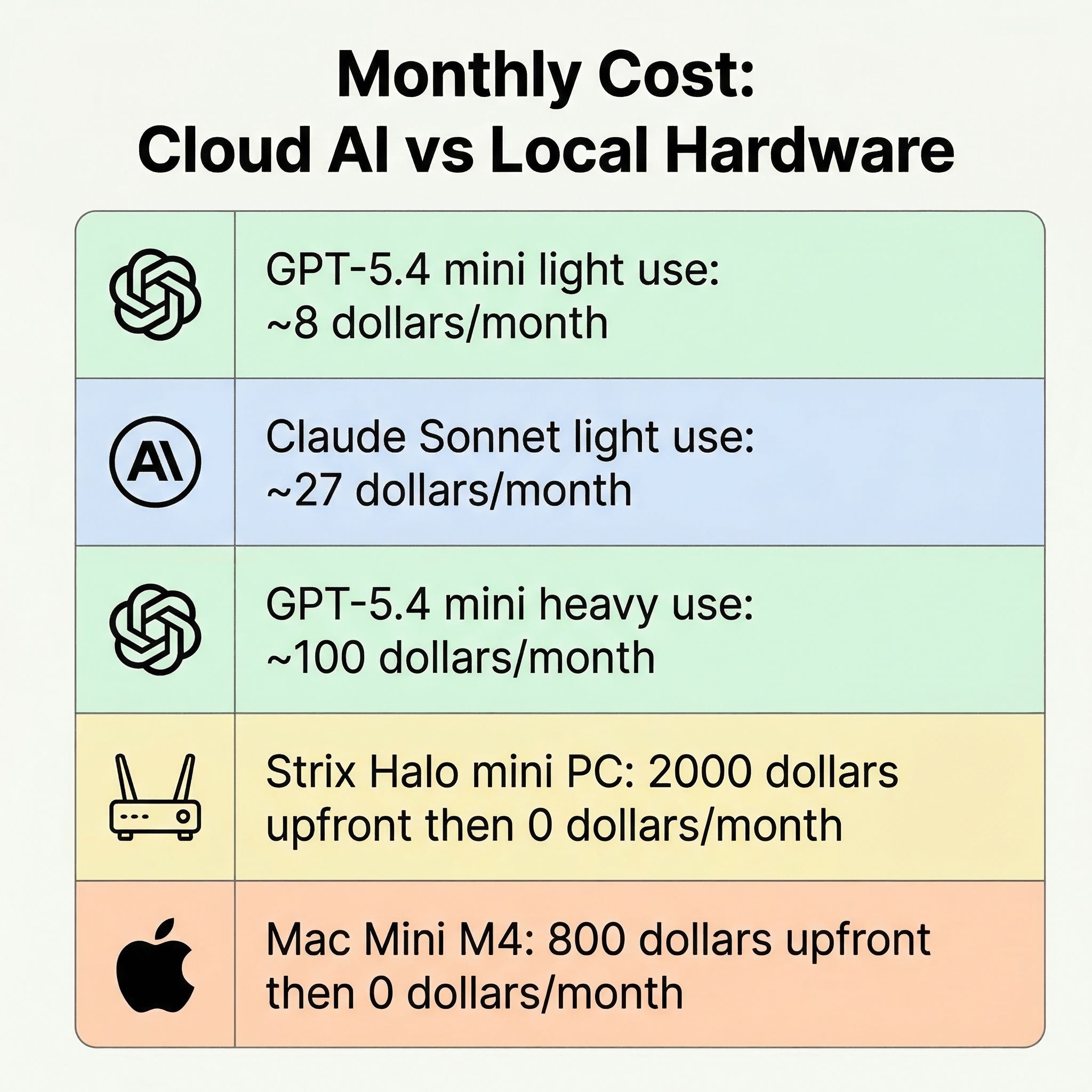
A light user doing 10 to 20 coding sessions per day, each consuming roughly 10,000 input tokens and 2,000 output tokens, would spend about $5 to $10 per month on GPT-5.4 mini once you factor in the $4.50 per million output token cost. The same usage on Claude Sonnet runs $18 to $36, and reflects both higher per-token pricing and substantially stronger performance. A heavy developer generating 50 to 100 sessions daily with longer context windows might spend $50 to $150 per month on mini. Cloud AI is cheap for light to moderate use, but the costs add up faster than the headline input pricing suggests, and heavy users start closing the gap with a one-time hardware investment.
Strix Halo and Mac Mini M4 Are the Local Alternatives
A Strix Halo mini PC with 128GB of unified memory can run 70B-parameter models locally with zero per-token costs, complete data privacy, and no internet dependency. The upfront investment pays for itself in roughly 12 to 24 months for heavy users, and you get hardware that serves many other purposes. A Mac Mini M4 running local models through frameworks like Ollama or LM Studio offers similar economics with excellent energy efficiency. Which generation to buy is its own decision. The choice comes down to which constraint binds harder: upfront cost and hardware limitations, or ongoing costs and privacy tradeoffs.
Mini Models Do the Volume Work in a Subagent Stack
OpenAI is openly encouraging a subagent architecture where a frontier model like GPT-5.4 handles the planning and reasoning while mini agents execute narrower tasks in parallel: searching codebases, reviewing files, processing documents. In Codex, mini uses only 30% of the GPT-5.4 quota, letting developers handle simpler coding tasks at roughly one-third the cost.
This pattern isn’t unique to OpenAI. Claude Code uses a similar approach. The workhorse tier just got more capable. A model that can autonomously navigate desktop applications at 72.1% accuracy and call tools at 93.4% reliability doesn’t need a frontier model supervising every step. That makes the overall system both cheaper and faster, which is the “2x improvement” OpenAI is selling.
A Hybrid Setup Sends the Volume Work to the API
Developers buying Mac Minis to run AI agents 24/7 are the natural fit. Run a local model for sensitive tasks and private data, but offload the high-volume, latency-sensitive subtasks to GPT-5.4 mini or nano through the API. The monthly cost of the cloud portion would be trivial compared to the hardware investment you’ve already made, and you’d get capabilities like computer use that most local models can’t match yet. Running that always-on box managed instead of DIY carries its own tradeoffs.
Where Local AI Still Wins
Some Data Cannot Go to a Cloud API
If you’re working with confidential code, patient data, or anything subject to regulatory compliance, sending tokens to OpenAI’s servers isn’t an option regardless of price. The same boundary is why workflows like local Whisper transcription stay on a mini PC even when a cloud version would be cheaper to set up. Running a 70B model locally on a Strix Halo system gives you full control over your data, and the quality gap between open-source models like Meta’s Llama and cloud APIs has narrowed in the past year.
A Local Model Beats Even a Fast API Call on Latency
Benchmarks also miss latency. A local model responds in milliseconds with no network round-trip. In interactive coding workflows, where you’re completing lines of code or generating quick suggestions, the difference between a local model and even a fast API call is perceptible. Microsoft’s BitNet framework pushes this advantage further by enabling 1-bit models that run quickly on ordinary CPUs, even if the quality tradeoff means they’re best suited to simpler tasks.
Rate Limits and Price Increases Have No Local Equivalent
Reliability matters too. Cloud APIs have rate limits, outages, and pricing changes. OpenAI has raised prices before, and GPT-5.4 mini already costs two to three times more than the GPT-5 mini it replaced. A local setup doesn’t have a terms of service that can change next quarter. That stability has value for AI infrastructure on dedicated hardware.
The Gap Is Narrowing From Both Directions
GPT-5.4 mini is good, and the pricing makes it accessible for a wider range of projects than any previous model at this capability level. The computer use and tool calling improvements are a step change in what small models can do. At $0.75 per million input tokens and $4.50 per million output, mini is difficult to argue against for agentic systems, classification pipelines, or automated workflows.
But calling this a revolution would be overselling it. Claude Opus and Sonnet still dominate software engineering benchmarks by a wide margin. Local AI hardware still wins on privacy, latency, and long-term cost predictability. The $0.75 pricing sounds cheap until you multiply by enterprise-scale token volumes, and the two-to-three-times price increase over GPT-5 mini is a reminder that cloud AI prices don’t always go down.
“Cheap cloud AI” and “expensive local hardware” are converging. Cloud models keep getting cheaper and more capable while local hardware gains memory and inference speed. Managed open-weight services muddy the line further; our local-versus-cloud breakdown digs into where owning the hardware still beats a hosted option serving the same models. In 2026 some combination of both probably works best: a local model for private, latency-sensitive work and a cloud API for everything else.
Frequently Asked Questions
How much does a GPT-5.4 mini token cost?
$0.75 per million input tokens and $4.50 per million output tokens. In practice that is $5 to $10 a month for light coding use and $50 to $150 for a heavy developer working long context windows all day.
Is GPT-5.4 mini cheap?
Yes for light and moderate use. The $4.50 output rate moves the monthly bill more than the $0.75 headline does, and mini costs two to three times more per token than the GPT-5 mini it replaced.
Is GPT-5.4 mini better than GPT-5 mini?
On OpenAI’s published benchmarks it wins across the board: 72.1% on OSWorld-Verified against 42.0%, 93.4% on tau2-bench against 74.1%, 57.7% on MCP Atlas against 47.6%, and more than twice the speed.