
BOSGAME VTA-439
Published on

The BOSGAME VTA-439 is the Vantage-series mini PC built around AMD’s Ryzen AI 9 HX 470. Three M.2 2280 slots sit under a single-screw bottom panel alongside two replaceable DDR5-5600 SO-DIMMs, and the rear panel carries an OCuLink connector wired to PCIe 4.0 x4 for an external GPU. The HX 470 is a clock-speed refresh of last year’s HX 370 rather than a new generation. ETA PRIME benchmarked the two chips at matched TDP and memory and measured single-digit gains; NotebookCheck reads the Zen 5c improvement higher, at up to 15 percent. It ships in one configuration, with 32GB of memory and a 1TB Kingston NVMe drive, in a chassis a shade over six inches square.
Three drive slots and dual LAN, with a chip one step above the HX 370
| Pros | Cons |
|---|---|
| Three M.2 2280 slots with a thermal pad and their own fan | HX 470 lands within roughly 5 percent of the cheaper HX 370 (ETA PRIME) |
| Replaceable DDR5-5600 SO-DIMMs, nothing soldered | Firmware caps the CPU at 88C, which trims sustained multi-core scores (Robtech) |
| OCuLink port wired to PCIe 4.0 x4 for an external GPU | No VESA mount and no SD card reader |
| Dual 2.5GbE, WiFi 7, and Bluetooth 5.4 | No integrated speaker or microphone (NotebookCheck) |
| Quietest idle in NotebookCheck’s comparison group at 25.7 dB(A) | Load noise averaged 44.4 dB(A), louder than most of that same group (NotebookCheck) |
| Surface temperatures under load below the mini PC class average (NotebookCheck) | Bundled Kingston Gen4 SSD is slow for its class (Robtech) |
| Clean Ubuntu 26.04 LTS install with working networking (Phoronix) | Relatively large at 6.06” x 5.98” x 1.97” (NotebookCheck) |
Related Videos
BOSGAME VTA-439 Comparison Chart
 BOSGAME VTA-439 | |
| Price | List Price: $1,169.00 Amazon Prices: Loading prices... |
| Version | 32GB/1TB |
| Performance Rating | 10.3 |
| Operating System | Windows 11 Pro |
| Processor | Twelve-core 2.00 Ghz (max 5.20 Ghz) AMD Ryzen AI 9 HX 470 |
| GPU | Integrated AMD Radeon 890M |
| RAM | 32 GB DDR5 SO-DIMM, 2-channel (2x DDR5-5600 SO-DIMM (dual channel)) |
| Internal Storage | 1 TB PCIe 4.0 NVMe SSD |
| Dimensions width x length x thickness | 6.06 x 5.98 x 1.97 inches (153.92 x 151.89 x 50.04 mm) |
| Weight | 1.68 lbs (0.76 kg) |
| WiFi | Wi-Fi 7 (802.11be) |
| Bluetooth | Bluetooth 5.4 |
| Ethernet | 2 Ethernet ports at 2.5 Gbps |
| HDMI | 1 Full-Size HDMI Port |
| DisplayPort | 1 DisplayPort (DP 1.4 (4K@144Hz); USB4 does 8K@60Hz) |
| VGA | No VGA Ports |
| USB Ports | 2 USB 2.0, 3 USB 3, 2 USB-C (1 USB4) 1x USB4 (8K@60), 1x USB-C 10Gbps (4K@60), 3x USB-A 3.2 Gen2, 2x USB-A 2.0 |
| Thunderbolt Ports | No |
| OCuLink | PCIe 4.0 x4 for eGPU |
| Internal SATA Ports | No SATA ports |
| Card Reader | No Card Reader |
| Headphone Jack | combo |
| Fanless | No |
| VESA Mount | No |
| In the Box | Mini PC, 120W power adapter, HDMI cable, user manual |
| Expandability | RAM: 2x DDR5-5600 SO-DIMM (replaceable, not soldered). 3x M.2 2280 NVMe. OCuLink PCIe 4.0 x4 for eGPU. External 120W adapter. |
Related Mini PCs
-
 BOSGAME M5The BOSGAME M5 puts the 16-core AMD Ryzen AI Max+ 395 and its Radeon 8060S graphics in a metal…
 -
 Beelink SER9The Beelink SER9 runs AMD's 12-core Ryzen AI 9 HX 370 (Strix Point) with Radeon 890M graphics, 32GB…
 -
 MINISFORUM MS-02 UltraThe MINISFORUM MS-02 Ultra is a 4.8-liter box sold with an Intel Core Ultra 9 285HX or 275HX (or a…
 -
 GMKtec EVO-X2The GMKtec EVO-X2 is a 3.6-pound upright mini PC built on the AMD Ryzen AI Max+ 395 with Radeon…
 -
 NIMO Mini PC AMD Ryzen AI Max+ 395The NIMO Mini PC packs the flagship AMD Ryzen AI Max+ 395 with 16 Zen 5 cores and Radeon 8060S…
 -
 ASUS ROG NUC 16The ASUS ROG NUC 16 packs a refreshed Intel Core Ultra 9 290HX Plus and an NVIDIA RTX 5080 Laptop…
Three M.2 slots, dual 2.5GbE, and an 88C thermal ceiling

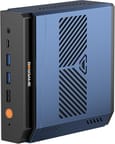
A blue anodized metal shell wraps around a black plastic front and midsection, with a diagonal slash vent pattern stamped into the side panel and a vertical BOSGAME wordmark down the front bezel. NotebookCheck, which measured the unit at 154 x 152 x 50 mm (6.06 x 5.98 x 1.97 inches) and 764 g, called the look “a breath of fresh air to contrast the minimalist look of the Mac Mini or Beelink GTi.” Robtech was blunter about the two-material mix, describing it as “chocolate wrapped in moldy bread” while still counting the result a win over the sea of anonymous black boxes. Both agree it is bigger than the compact norm; NotebookCheck lists “relatively large” among its cons, and Robtech noted it comfortably passes a liter in volume.
Under the shell is the Ryzen AI 9 HX 470, AMD’s Gorgon Point refresh: 12 Zen 5 cores and 24 threads (four full Zen 5 cores to 5.2GHz plus eight Zen 5c cores to 3.3GHz), Radeon 890M graphics with 16 RDNA 3.5 compute units, and a 55 TOPS NPU that BOSGAME markets as part of an 86 TOPS platform figure. PassMark puts the chip around 36,900 on CPU Mark, which is upper-tier for an integrated-graphics mini PC. Phoronix’s Michael Larabel describes the HX 470 as bringing a 200MHz clock bump over the HX 370, a matching 200MHz lift on the Radeon 890M turbo clock, and an NPU that rises from 50 to 55 TOPS, on the same 12-core Zen 5 silicon. ETA PRIME ran the two chips side by side at the same 65W TDP with matched DDR5-5600 memory and measured about 6.7 percent in Geekbench single core, 5.2 percent in multi core, and 3.9 percent in Time Spy. NotebookCheck’s Allen Ngo lands higher, writing that the Zen 5c cores “can perform up to 15 percent faster than the outgoing Ryzen AI 9 HX 370 which, while welcomed, isn’t going to move the needle very much for performance users.” If NPU headroom is not the reason you are shopping, our look at whether the AI tax is worth paying covers the same tradeoff across the category.
NotebookCheck’s verdict puts the expansion first: “The strongest aspects of the Bosgame VTA-439 are its support for up to three full-size M.2 SSDs, removable RAM, and OcuLink whereas most other mini PCs lack many of these features.” One Phillips screw releases the bottom panel, which carries its own fan and a large thermal pad over the drive bay, so the SSDs get a pad plus active cooling. Robtech reported that “the thermal pads plus a fan means its maximum temp held up fine during the thrash test.” His teardown also found the three slots are not identical: one runs PCIe 4.0 x4 and the other two top out at Gen 3 x4, so plan the fastest drive into the Gen 4 slot. The memory is two ordinary SO-DIMMs rather than soldered LPDDR5X, a distinction we have written about at length in the soldered-RAM trap, and Britec09 flagged it as the model’s quiet advantage: “The good thing about this model is not surface mounted memory, it’s actually physical memory which can be upgraded and replaced.”
Two 2.5GbE ports (Realtek RTL8125) support link aggregation, routing, or a NAS build, which is the use case our mini PC as a NAS guide walks through. WiFi 7 comes from a MediaTek RZ717 module, paired with Bluetooth 5.4. The front panel carries a 3.5mm jack, a 10Gbps full-function USB-C port that drives 4K at 60Hz, two USB-A 3.2 Gen 2 ports, a USB 2.0 port, and the power button; the rear adds the dual Ethernet, OCuLink, HDMI 2.1 and DisplayPort 1.4 (both 4K at 144Hz), a USB4 port good for 8K at 60Hz, another USB-A 3.2 Gen 2, a second USB 2.0, a second audio jack, and the barrel power input. Phoronix summed up the layout as “Quite nice connectivity out of this little PC.” OCuLink preserves more bandwidth than USB4 for an external GPU; our eGPU connector comparison shows how much each interface gives back.
NotebookCheck measured a 30.7C average on the upper surface under maximum load against a 32.1C average for the mini PC class, and Chase Brogan reported the chassis was “cool to the touch” after about four hours of AAA gaming. Idle acoustics are a strength too, at 25.7 to 25.8 dB(A) in NotebookCheck’s chamber, quieter than every machine in its comparison group. Under load, Robtech measured the machine below the 40 dBA median he tracks for mini PCs in its out-of-box configuration, while NotebookCheck logged a 44.4 dB(A) load average that its own comparison table ranks behind most of that same set, and Britec09 warned during his stress test that “you will get a bit of fan noise when you’re ramping it up like this.” Robtech observed that “Bosgame has set a hard limit of 88C for thermal throttling,” which explains why its sustained Cinebench multi-core results trail other HX 470 machines, and he found the BIOS performance mode made no measurable difference. Power draw is unremarkable for the class, with NotebookCheck logging 7 to 9W at idle and up to 120.9W at the wall during a combined stress test.
Reviewer Insights

Phoronix
Michael Larabel tested the machine over several weeks for Phoronix. His summary of the platform side was that “Running Ubuntu 26.04 LTS on the BOSGAME VTA-439 was uneventful,” with wired Ethernet and WiFi working on the Linux 7.0 kernel and no surprises given that the Ryzen AI 400 series is an evolution of the 300 series. He also wrote that the VTA-439 is not nearly as powerful as an AMD Ryzen AI Max+ Strix Halo machine while costing roughly a quarter as much. For readers weighing Linux as the primary OS, our Linux mini PC guide covers what to check before buying.
NotebookCheck
NotebookCheck scored the VTA-439 at 81 percent, with Allen Ngo running the full lab suite. The pros list credits support for three M.2 SSDs plus two DDR5 SO-DIMMs, the port selection including OCuLink, the RGB-free industrial design, Zen 5c performance, and the compact 120W adapter. The cons list runs: “no integrated speaker or microphone,” “no USB-C PD or SD card reader,” “servicing is not toolless,” “no VESA support,” and “relatively large.” NotebookCheck’s power delivery note is the one point the other reviews contradict. Phoronix credits the USB4 port with “100W power delivery support,” BOSGAME’s own spec sheet lists 100W PD on that port, and Robtech’s port walkthrough describes power delivery on both Type-C connectors. Ngo also noted that mini PCs built on Intel’s competing Panther Lake platform can offer much faster graphics performance than the Radeon 890M series for buyers who prioritize the iGPU, a comparison we unpack in our Panther Lake mini PC coverage.
Robtech
Robtech benchmarked the VTA-439, took it apart, and measured its thermals and noise. He praised the internal layout: “And here we’ve got easy access to the RAM slots and the three M.2 NVMe slots, which is very rare in a compact form factor like this.” On acoustics he was positive with a qualifier, reporting that “The VTA 439 is pretty good with fan noise under load. In fact, it’s better than most, which is great to see,” while adding that other minis with similar CPUs have managed even lower noise levels. His criticisms were the 88C throttle ceiling holding back long multi-core runs, an unimpressive bundled Kingston Gen4 drive, a LatencyMon failure he flags for anyone considering audio production, and a BIOS performance mode that changed nothing. He still landed positive on value, calling it “the first mini PC in a long time to be at a decent price for a new release, considering the current market.”
ETA PRIME
ETA PRIME framed his hands-on around a direct HX 470 versus HX 370 comparison at matched TDP and memory. His conclusion was that “It’s definitely not a major leap in performance when it comes to CPU and GPU here, but I still want to get into some gaming and see what this thing can do.” On the shopping decision he was direct: “And right now, you can get 370 devices much cheaper than the 470, so keep that in mind if you’re looking for a small form factor unit.” He liked the serviceability, noting that “Boss Game has made it really easy to get in here and do some upgrades,” and measured total system draw at roughly 10W idle, 14W for 4K video playback, and about 87W averaged across AAA gaming. His gaming runs at 1080p put Forza Horizon 6 above 60 fps with FSR and Mortal Kombat 1 near 60 at medium, while Doom: The Dark Ages could not hold 60 and pushed him toward handheld-mode settings.
Britec09
Britec09 covered the unboxing, port walkthrough, teardown, and a benchmark set. His Geekbench 6 run returned 2,983 single core and 15,535 multi core, with an OpenCL score of 43,904; 3DMark Time Spy came back at 4,168 overall and Night Raid at 31,614; CrystalDiskMark measured the bundled Kingston drive at 5,988 MB/s read and 5,107 MB/s write. Under a sustained CPU stress test he reported no thermal throttling with temperatures around 80C, though the fan is audible at full speed. He confirmed on camera that there is no VESA mount on the underside, and he was enthusiastic about the expansion: “The OCuLink means that you can plug in an external graphics card, which is really nice if you want to beef up the graphics performance.” His framing of the machine as a whole was that “This little mini PC packs a punch. It has a Ryzen AI 9 HX470 processor. That is 12 cores and 24 threads.”
Chase Brogan
Chase Brogan focused on AAA gaming and thermals across a multi-hour session. He set the premise as “On paper, that’s one of the most powerful mini PCs that we’ve seen, promising enough horsepower for everything from content creation and AI applications to modern-day AAA gaming,” then ran Delta Force, Warframe, Call of Duty, Halo, and Fortnite at stock settings without dropping the graphics presets. On thermals he said: “After using this for AAA gaming for about 4 hours today… this is cool to the touch. I mean, it feels like this hasn’t been powered on for a couple of days.” He also liked the serviceability detail that “we don’t have to remove the four rubber feet on here to access screws to open everything up,” and flagged the price as the main hesitation.
An expandable Linux and home-lab desktop with a modest chip
Three M.2 2280 slots with active cooling, two replaceable DDR5 SO-DIMMs, an OCuLink port wired to PCIe 4.0 x4, and dual 2.5GbE make this one of the more expandable compact desktops available, and the measured surface temperatures and idle acoustics back up the engineering. Phoronix’s Ubuntu 26.04 LTS testing makes it a sound pick for a Linux desktop or a home server, and Robtech’s 88C throttle ceiling is the counterweight on long multi-core runs.
A discounted HX 370 machine lands within roughly five percent of this one in ETA PRIME’s matched testing, buyers who care most about integrated graphics will find Intel’s Panther Lake parts ahead, and the missing VESA mount, card reader, and speakers make this a poor fit behind a monitor or in a living room. If you want the same silicon in a chassis with a built-in power supply and a card reader, the MINISFORUM AI X1 Pro-470 is the direct alternative, though its pre-built configurations ship single-channel. To line this machine up against the rest of the catalog, use the Mini PC Comparison Chart.
Frequently Asked Questions
How much faster is the Ryzen AI 9 HX 470 than the HX 370?
Estimates vary by test bench, but none of them is large. ETA PRIME tested both chips at a 65W TDP with matching DDR5-5600 memory and measured about 6.7 percent in Geekbench 6 single core, 5.2 percent in multi core, and 3.9 percent in 3DMark Time Spy. Phoronix describes the HX 470 as a 200MHz clock bump over the HX 370 with the same 12 Zen 5 cores and 24 threads, plus an NPU that rises from 50 to 55 TOPS. NotebookCheck puts the Zen 5c gain at up to 15 percent. Both chips use the same Radeon 890M graphics.
How many SSDs can the VTA-439 hold?
Three M.2 2280 NVMe drives, which is unusual for a mini PC of this size. The unit ships with a 1TB Kingston drive installed and two slots free. Robtech’s teardown found the slots are not identical: one runs at PCIe 4.0 x4 and the other two at PCIe 3.0 x4. The bottom panel carries a large thermal pad plus its own fan, so the drives get both passive and active cooling.
Can I upgrade the memory?
Yes. The VTA-439 uses two standard DDR5-5600 SO-DIMM slots rather than soldered memory, and both are reachable after removing a single Phillips screw on the bottom panel. Britec09 confirmed on camera that the modules are replaceable, and Phoronix noted the shipping 32GB is supplied as replaceable SO-DIMMs in a dual-slot configuration.
What is the OCuLink port for?
OCuLink is an external PCIe 4.0 x4 connection used mainly for attaching a desktop graphics card through an external GPU dock. It carries more usable bandwidth than USB4 or Thunderbolt, so a card connected over OCuLink loses less performance. Robtech tested the same games over both interfaces and found OCuLink usually delivered a larger boost thanks to the extra bandwidth. The port is pre-installed on the VTA-439 rather than sold as an add-on module.
Does the VTA-439 run Linux?
Yes. Phoronix ran Ubuntu 26.04 LTS on the Linux 7.0 kernel and reported that both wired Ethernet and the MediaTek RZ717 WiFi 7 adapter worked without intervention. Robtech separately tested the latest Ubuntu release and reported no issues, including wireless support. The machine ships with Windows 11 Pro pre-installed.
How loud does it get?
Very quiet at rest, ordinary under load. NotebookCheck measured 25.7 to 25.8 dB(A) at idle and 44.4 to 47.8 dB(A) under load from 15 cm away; the idle figure beats every machine in its comparison group, while the 44.4 dB(A) load average sits behind most of that same group. Robtech reported that the VTA-439 falls below the 40 dBA median he tracks for mini PCs in its out-of-box configuration, though he noted some machines with similar processors run quieter still. Britec09 described the fan as audible at full speed during stress testing.
Can it be mounted behind a monitor?
No. The VTA-439 has no VESA mounting points, which Britec09 confirmed on the underside and NotebookCheck lists among its drawbacks. It sits flat on rubber feet or stands upright, and the chassis draws air in from the top and exhausts out the rear, so leave clearance in either orientation.