
Mac Studio (2026)
Published on

With the Mac Pro discontinued, the 2026 Mac Studio is Apple’s top desktop, and the choice comes down to two chips in the same 7.7-inch square aluminum case. The M5 Max model suits photographers, video editors, and developers who want a quiet Mac that sits on the desk, and several reviewers called it the sensible pick of the two. The M5 Ultra model doubles the chip for buyers running large AI models locally or rendering for a living, at more than twice the starting price. Memory is fixed when you order, and the SSD is not designed to be upgraded later.
Apple announced both models on August 25, 2026, and they went on sale on September 22. This generation keeps the design of the 2022 original and changes the inside: Wi-Fi 7 and Bluetooth 6 through Apple’s N1 chip, a Neural Accelerator in every GPU core, and an SSD that Apple rates at up to twice the speed of the last generation. Thunderbolt 5 carries over from the 2025 model. A 512GB memory option for the M5 Ultra is due in late October.
Pros and Cons
| Pros | Cons |
|---|---|
| The M5 Max finished AppleInsider’s Xcode compile test in 51 seconds, under half the M4 Max time | Memory cannot be upgraded, and Apple sells no replacement SSDs |
| Macworld found the faster SSD the biggest change, enough to justify an upgrade from the last model | The M5 Max model’s front USB-C ports run at 10Gb/s, not Thunderbolt |
| The M5 Ultra reaches 1.2TB/s of memory bandwidth for large local AI models | Several reviewers called the M5 Ultra’s price hard to justify over the M5 Max |
| Most reviewers found it quiet in daily work, and MacStories could not hear the fan | Alex Ziskind measured over 400 watts and much more fan noise under full GPU load |
| Four Thunderbolt 5 ports (six on the M5 Ultra), 10Gb Ethernet, HDMI 2.1, two USB-A, and an SD card slot | Gaming still trails Windows PCs with discrete GPUs |
| Drives up to five displays on the M5 Max and eight on the M5 Ultra | Middling built-in speaker, and the headphone jack is on the back |
Related Videos
Mac Studio (2026) Comparison Chart
 Mac Studio (2026) | Mac Studio (2026) | |
| Price | List Price: $2499.00 Amazon Prices: Loading prices... | List Price: $5499.00 Amazon Prices: |
| Version | M5 Max/36GB/512GB | M5 Ultra/96GB/1TB |
| Performance Rating | 8.1 | 9.7 |
| Operating System | macOS | macOS |
| Processor | Eighteen-core Apple M5 Max | 30-core Apple M5 Ultra |
| GPU | Integrated M5 Max 32-Core GPU | Integrated M5 Ultra 64-Core GPU |
| RAM | 36 GB (460GB/s; 614GB/s with 40-core GPU) | 96 GB (1.2TB/s bandwidth) |
| Internal Storage | 512 GB SSD | 1 TB SSD |
| Dimensions width x length x thickness | 7.7 x 7.7 x 3.7 inches (195.58 x 195.58 x 93.98 mm) | 7.7 x 7.7 x 3.7 inches (195.58 x 195.58 x 93.98 mm) |
| Weight | 6 lbs (2.73 kg) | 8 lbs (3.64 kg) |
| WiFi | Wi-Fi 7 (802.11be) | Wi-Fi 7 (802.11be) |
| Bluetooth | 6.0 | 6.0 |
| Ethernet | 1 Ethernet port at 10 Gbps | 1 Ethernet port at 10 Gbps |
| HDMI | 1 Full-Size HDMI Port | 1 Full-Size HDMI Port |
| DisplayPort | DisplayPort 2.1 over Thunderbolt 5 | DisplayPort 2.1 over Thunderbolt 5 |
| VGA | No VGA Ports | No VGA Ports |
| USB Ports | 2 USB 3, 6 USB-C (4 USB4) 2 front USB-C (10Gb/s), 4 rear Thunderbolt 5, 2 USB-A (5Gb/s) | 2 USB 3, 6 USB-C (6 USB4) 2 front and 4 rear Thunderbolt 5, 2 USB-A (5Gb/s) |
| Thunderbolt Ports | 4 | 6 |
| OCuLink | No | No |
| Internal SATA Ports | No SATA ports | No SATA ports |
| Card Reader | SD Card Reader | SD Card Reader |
| Headphone Jack | 3.5mm rear | 3.5mm rear |
| Fanless | No | No |
| VESA Mount | No | No |
| In the Box | Mac Studio, power cord | Mac Studio, power cord |
| Expandability | Memory fixed at purchase; the SSD is a removable module, but Apple sells no upgrades. Thunderbolt 5 for external storage, PCIe chassis, and clustering. | Memory fixed at purchase; the SSD is a removable module, but Apple sells no upgrades. Thunderbolt 5 for external storage, PCIe chassis, and clustering. |
Related Mini PCs
-
 BOSGAME M5The BOSGAME M5 puts the 16-core AMD Ryzen AI Max+ 395 and its Radeon 8060S graphics in a metal…
 -
 GMKtec EVO-X2The GMKtec EVO-X2 is a 3.6-pound upright mini PC built on the AMD Ryzen AI Max+ 395 with Radeon…
 -
 NIMO Mini PC AMD Ryzen AI Max+ 395The NIMO Mini PC packs the flagship AMD Ryzen AI Max+ 395 with 16 Zen 5 cores and Radeon 8060S…
 -
 ACEMAGIC M1A Pro+Cube-shaped Strix Halo mini PC with the AMD Ryzen AI Max+ 395, Radeon 8060S, and 128GB of soldered…
 -
 BOSGAME VTA-439The BOSGAME VTA-439 pairs AMD's Ryzen AI 9 HX 470 (Gorgon Point) with Radeon 890M graphics in a…
 -
 Beelink GTR9 ProA high-performance AI Mini PC featuring the AMD Ryzen AI Max+ 395 processor with 126 AI TOPS, 128GB…
M5 Max: the standard model

The standard M5 Max has an 18-core CPU with six super cores and twelve performance cores, a 32-core GPU, a 16-core Neural Engine, and 460GB/s of memory bandwidth. It ships with 36GB of unified memory and a 512GB SSD. Choosing the 40-core GPU at purchase raises bandwidth to 614GB/s and unlocks the 48GB, 64GB, and 128GB memory options; storage goes up to 8TB. The Media Engine has two video encode engines and two ProRes engines.
AppleInsider ran its pro workflow tests on an M5 Max with a 1TB SSD. Its Xcode compile test finished in 51 seconds, less than half the times of the M3 Ultra and M4 Max, and a chemistry simulation took 32 seconds against 46 seconds on the M3 Ultra and 44 seconds on the M4 Max. Macworld measured a 22 percent multi-core gain over the M4 Max in Geekbench and an 8 percent single-core gain, while the M3 Ultra kept a 9 percent multi-core lead. In Cinebench 2024 the M5 Max’s GPU was 33 percent faster than the M4 Max and 10 percent faster than the M3 Ultra.
AppleInsider saw read and write speeds near 10 gigabytes per second on its 1TB unit, and Macworld wrote that “The faster SSD is worth it alone.” The 512GB base model is slower: AppleInsider measured reads peaking at about 6.4 gigabytes per second and writes at about 5.1. Our guide to running Google’s Gemma models on a mini PC covers what 36GB and 128GB of fast memory mean for local models.
M5 Ultra: two M5 Max chips joined
The standard M5 Ultra, two M5 Max chips linked by Apple’s UltraFusion interconnect, has a 30-core CPU (ten super cores and twenty performance cores), a 64-core GPU, and a 32-core Neural Engine, with 96GB of memory and a 1TB SSD. The build-to-order chip has 36 CPU cores and 80 GPU cores. Every M5 Ultra model runs 1.2TB/s of memory bandwidth and takes up to 256GB of memory at launch; 512GB arrives in late October with the 36-core chip. Storage goes up to 16TB. It doubles the Media Engine to four video encode engines and four ProRes engines, and it weighs 8 pounds against 6 pounds for the M5 Max.
Ars Technica found its CPU 80 to 90 percent faster than the M5 Max in many tests and its GPU 50 to 80 percent faster, but its Geekbench multi-core lead was only about 26 percent, and the M5 Max finished a HandBrake H.264 encode faster. Engadget measured the same single-core speed as the M5 Max and multi-core and GPU gains of 20 to 30 percent. Against the M3 Ultra, Ars measured about 30 percent faster single-core, 50 percent faster multi-core, and 33 to 66 percent faster GPU results.
Token generation follows memory bandwidth, so the Ultra’s 1.2TB/s gives it its clearest lead in local AI. Alex Ziskind measured 1,039GB/s of GPU memory bandwidth on a 256GB M5 Ultra, about 85 percent of Apple’s rating and 1.4 times the M3 Ultra, and token generation rose about 1.5 times over the M3 Ultra. Prompt processing was up to about four times faster on long prompts, but only 1.6 times faster on a prompt of about 350 tokens. In a second test against two linked NVIDIA DGX Spark units, the Mac matched or beat them on token generation and was slower at reading long prompts.
Ports, displays, and networking

The back carries four Thunderbolt 5 ports at up to 120Gb/s, two USB-A ports at 5Gb/s, HDMI 2.1, 10Gb Ethernet, the 3.5mm headphone jack, and the power inlet. On the front, the M5 Max model has two USB-C ports at 10Gb/s and a UHS-II SD card slot; the M5 Ultra model replaces those USB-C ports with two more Thunderbolt 5 ports. AppleInsider named the 10Gb/s front ports as the only weakness in the M5 Max’s connectivity, and Bobby Tonelli wished the SD slot had become a CFexpress Type B slot.
The M5 Max drives up to five external displays: four at 6K and 60Hz plus a fifth at 5K over HDMI, or two at 8K and 60Hz plus a third over HDMI. The M5 Ultra drives up to eight displays at 6K and 60Hz, or four at 8K and 60Hz. One Thunderbolt port can carry up to four displays on either chip. Thunderbolt 5 also supports genlock and RDMA clustering, which pools the memory of up to four Mac Studios for models too large for one machine. Wi-Fi 7 and Bluetooth 6 are standard, though AppleInsider recommended 10Gb Ethernet for work traffic.
Noise, heat, and power
The Mac Studio is quiet in most work, and loud only under a sustained full GPU load. MacStories ran local AI agents on an M5 Ultra all day and wrote: “In my day-to-day use, when I was running Flash-Next oQ4e all the time, I could never hear the fan of the Studio on my desk unless I placed my ear directly on top of the computer.” Engadget heard the fan only while gaming, and PetaPixel listed the M5 Max as silent.
Pushed hard, the M5 Ultra runs hotter and draws much more power than the M3 Ultra it replaces. Alex Ziskind measured over 400 watts during heavy GPU work against almost 200 watts for the M3 Ultra, heard the M5 Ultra’s fan first, and found the case running warmer. Wired also listed heat as a con and wrote: “You definitely don’t want to touch it or set anything on top of it.” In Ars Technica’s CPU video transcode, the M5 Max and M5 Ultra both averaged about 75 watts. Apple rates the internal power supply at 480 watts of maximum continuous power.
Reviewer Insights
AppleInsider: the M5 Max is the pick
AppleInsider gave the M5 Max model 5 out of 5. Beyond the Xcode and chemistry results, a CPU-heavy fluid simulation took 5 minutes 12 seconds against 6 minutes on the M3 Ultra and 7 minutes 22 seconds on the M4 Max, and a GPU-heavy image enhancement test finished in 2 minutes 4 seconds. AppleInsider faulted the USB-C front ports, the starting price, and the unchanged design and ports. On which model to buy, it wrote: “For most nearly every Mac Studio buyer with work to do, the M5 Max is the sensible pick.”
Macworld: the SSD is the reason to upgrade
Macworld’s review unit, tested by Roman Loyola, was an M5 Max with the 40-core GPU, 128GB of memory, and a 4TB SSD. He described the CPU and GPU gains as a marginal boost over the last generation and the SSD improvement as dramatic, enough that owners of an M4 Max or M3 Ultra Mac Studio should consider upgrading. His only listed con was memory that cannot be upgraded. He noted that the SSD is removable and can be replaced by the owner, though not easily.
PetaPixel (M5 Max): the best Mac it has tested for photo and video
Jeremy Gray at PetaPixel scored an M5 Max with 128GB of memory and a 4TB SSD 9.5 out of 10. It set a new record in PetaPixel’s Premiere Pro test, came close to the M3 Ultra Mac Studio in Lightroom Classic, and almost matched it in DaVinci Resolve. Gray recommended it over the M5 Ultra for most photographers and video editors. His complaints were the price of memory and storage upgrades and the audio: “If I had to knock the Mac Studio for something, it’s that its built-in speakers are not very good and that I’d prefer a front-facing headphone jack.”
PetaPixel (M5 Ultra): a Mac Pro in a small case
In a separate M5 Ultra review, PetaPixel gave the 36-core, 80-core GPU configuration 10 out of 10 and argued that it replaces the discontinued Mac Pro: “The Mac Pro died in name only.” It led PetaPixel’s Lightroom Classic, Premiere Pro, and DaVinci Resolve results, while Photoshop showed little gain over the M5 Max. The review still pointed most photo and video editors to the M5 Max model and reserved the Ultra for video editors and professionals doing billable work.
Ars Technica: fast local AI at a steep price
Andrew Cunningham at Ars Technica wrote that “The M5 Ultra is, by almost every measure, the fastest Apple Silicon processor built so far,” and found its neural accelerators made locally run models feel more responsive. He used it to run a coding-capable model locally and called the experience fun and useful. He objected to price increases that start at 25 percent over the previous generation, and to an Ultra that has twice the resources of the M5 Max but usually cannot deliver twice the speed.
Engadget: the M5 Max is the better value
Engadget’s review unit, a 36-core M5 Ultra with 256GB of memory and a 2TB SSD, transcribed a 70-minute podcast in 18 seconds in MacWhisper, less than a quarter of the time the M4 Max Mac Studio needed, and it played eight simultaneous 8K ProRes tracks in real time on a 4K timeline with 4K monitoring, though not on an 8K timeline. A game ran at 4K on Ultra settings at an average above 80 fps. Steve Dent scored it 8.9 out of 10 and wrote: “Though incredibly powerful, the leap in performance over the M5 Max-powered Studio can’t justify that extra cash, unless you’re a hardcore power user.”
Tom’s Hardware: local AI strength, gaming weakness
Andrew E. Freedman at Tom’s Hardware found the M5 Ultra ahead of NVIDIA’s DGX Spark in prompt processing and tokens per second, and listed the 1.2TB/s memory throughput, the small quiet design, and the port selection as pros, against pricey memory and SSD upgrades and no upgrades after purchase. Freedman wrote that “Really, its biggest weakness is in gaming, for professionals who may want to do that on the side,” adding: “Discrete GPUs still win there.”
PCMag: Editors’ Choice for CPU speed and memory options
PCMag gave the 36-core M5 Ultra 4.5 out of 5 and an Editors’ Choice award; Brian Westover cited its CPU performance, memory options for local AI, and Thunderbolt 5, Wi-Fi 7, and 10Gb Ethernet. On the downside, he listed upgrade pricing, graphics performance behind flagship NVIDIA GPUs, and no ISV certification for engineering and medical software, noting that “Apple critics will call out that it’s a locked-down system with no upgrade options after purchase and no formal ISV certifications.”
CNET: fast and quiet, limited by fixed memory
Lori Grunin at CNET rated the M5 Ultra model 9.3 and called it fast, quiet, compact, and able to cluster. She faulted memory that cannot be upgraded, with no option between 96GB and 256GB, and two fewer Thunderbolt ports on the M5 Max model; she also found memory upgrades costly. She added: “None of this would be a big problem if you could upgrade the memory in the Studio.” She also noted that few Mac games can use the GPU’s power.
MacStories: local AI agents on the M5 Ultra
MacStories tested a 256GB M5 Ultra against an M3 Ultra and an RTX 5090 gaming PC over four days. Token generation was about 70 percent faster than the M3 Ultra on average and prompt processing about 150 percent faster, which made local models usable as the reviewer’s default agent models. The RTX 5090 PC stayed faster on both measures, but the Mac was smaller and quieter and could run larger models in its unified memory.
Wired: fast for local AI, hot under load
Wired’s 9 out of 10 from Luke Larsen came with heat listed as a con. He found the M5 Ultra model fast for local AI and gaming and small for its power. He wrote that “The astounding part about the Ultra is that, in some cases, it really doubles performance over the Max.” GPU performance behind NVIDIA and cheaper dedicated AI boxes were his other complaints.
Bobby Tonelli: more machine than photo work needs
Bobby Tonelli tested a 36-core M5 Ultra with 256GB of memory and 4TB of storage against an M3 Ultra Mac Studio. The Blender Classroom scene rendered in 1 minute 39 seconds against 1 minute 59 seconds, and a roughly seven-minute 4K DaVinci Resolve project exported to H.264 in 43 seconds against 59 seconds. For photo work and light video editing, he said: “It’s kind of like having an F1 car and going to the grocery store.” He said you can get by with an M5 Max, do a really good job with it, and probably save some money, while local AI work justifies the Ultra.
Alex Ziskind: developer and local LLM tests
Alex Ziskind ran the M5 Ultra and M3 Ultra side by side with the same llama.cpp and MLX builds. His prompt processing results matched Apple’s four-times claim on long prompts, and his token generation results tracked the bandwidth gain. On developer work alone, he said: “if you’re buying this machine just for developer tasks, let me tell you something, it’s overkill.” In his DGX Spark comparison, switching a DeepSeek model from llama.cpp to MLX raised the Mac’s generation speed to 53 tokens per second.
Buy the M5 Max unless you run large AI models or bill for render time
The M5 Max model fits photographers, video editors, music producers, and developers who want more than a Mac mini offers. PetaPixel found it close to the M3 Ultra in Lightroom and Resolve, and AppleInsider and Macworld measured much faster storage. Step past the 512GB base SSD if you can, since larger SSDs measured faster and Apple sells no SSD upgrades. If an M5 Pro covers your work, the 2026 Mac mini is smaller and costs far less.
The M5 Ultra model is for local AI work that needs 96GB to 512GB of fast memory, and for video and 3D professionals whose time is billed. Skip either model if you need internal upgrades, Windows games, or a GPU that matches NVIDIA’s best. To compare it with other small desktops, use Starry Hope’s Mini PC Comparison Tool.
Upgrades
Accessories that fit the Mac Studio (2026)'s USB4 or Thunderbolt ports.
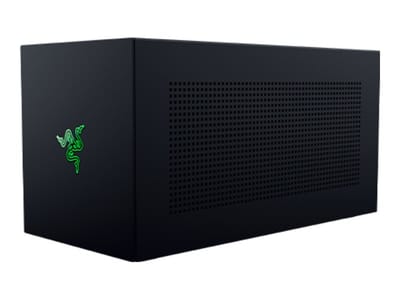
Core X V2
A Thunderbolt 5 enclosure that Razer lists as working with Thunderbolt 4 and USB4 hosts; it fits a four-slot card and needs an ATX power supply.
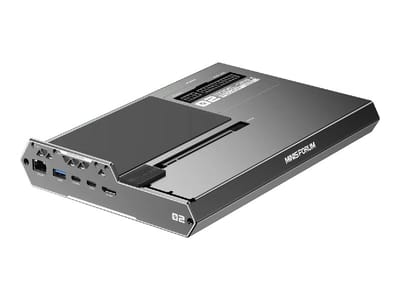
DEG2 eGPU Dock
Connects over USB4 or Thunderbolt 5, with an OCuLink input behind a switch, and adds an M.2 slot; it needs an ATX or SFX power supply.
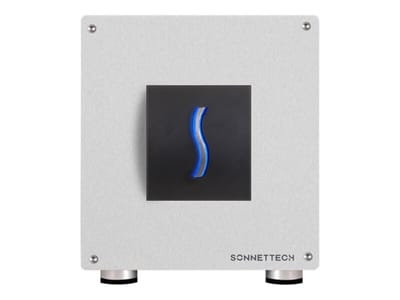
Breakaway Box 850 T5
Has an 850W power supply built in, so only the graphics card is extra, and works with Thunderbolt 4 and USB4 Windows PCs.
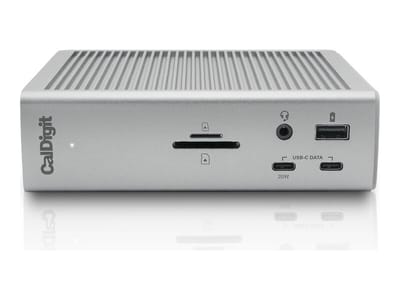
TS4 Thunderbolt 4 Dock
An 18-port dock that CalDigit lists for Thunderbolt 4 and USB4 hosts, with 2.5GbE and a DisplayPort 1.4 output.
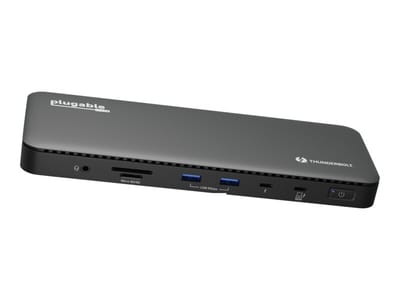
TBT4-UD5 Thunderbolt 4 Dock
Two HDMI ports drive two 4K60 monitors from one Thunderbolt 4 or USB4 port on a Windows PC.
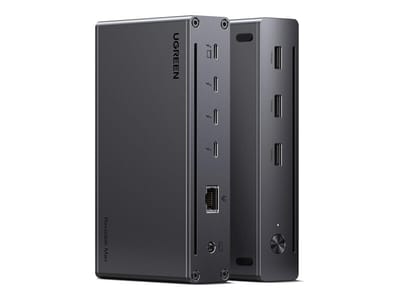
Revodok Max 208 Thunderbolt 4 Dock
Adds three Thunderbolt 4 ports for dual 4K60 displays plus gigabit Ethernet; it has no HDMI port, so monitors connect over USB-C or an adapter.
Frequently Asked Questions
What is the difference between the M5 Max and M5 Ultra models?
The M5 Ultra joins two M5 Max chips. The standard M5 Max has an 18-core CPU, a 32-core GPU, 36GB of memory, and 460GB/s of bandwidth, configurable to a 40-core GPU, 128GB, and 614GB/s. The standard M5 Ultra has a 30-core CPU, a 64-core GPU, 96GB of memory, and 1.2TB/s of bandwidth, configurable to 36 CPU cores, 80 GPU cores, and up to 512GB. The Ultra model also has six Thunderbolt 5 ports instead of four, drives eight displays instead of five, and weighs 8 pounds instead of 6.
Can I upgrade the memory or storage later?
Not the memory, which is part of the chip package. The SSD is a removable module, but Apple does not sell replacements and Macworld described a do-it-yourself upgrade as not simple. Buy the memory and storage you need up front, or plan on external Thunderbolt 5 storage.
Is the Mac Studio good for running local AI models?
Yes, and the M5 Ultra is the stronger choice. Token generation speed follows memory bandwidth, and the M5 Ultra’s 1.2TB/s is about twice the M5 Max’s. Alex Ziskind measured token generation about 1.5 times faster than the M3 Ultra and prompt processing up to about four times faster on long prompts. Memory size sets the largest model you can load: 36GB to 128GB on the M5 Max, 96GB to 512GB on the M5 Ultra.
Is the Mac Studio loud?
Not in most work. MacStories could not hear the M5 Ultra’s fan during all-day AI use, and PetaPixel called the M5 Max silent. Under a sustained full GPU load the M5 Ultra gets louder and warmer: Alex Ziskind measured over 400 watts and heard its fan before the M3 Ultra’s, and Wired listed heat as a con.
How many monitors can it drive?
Up to five on the M5 Max (four at 6K and 60Hz plus one at 5K over HDMI) and up to eight on the M5 Ultra (all at 6K and 60Hz). A single Thunderbolt 5 port can carry up to four displays on either model.
Is it good for gaming?
It runs native Mac games well, and Engadget averaged above 80 fps at 4K on Ultra settings in one game on the M5 Ultra. Tom’s Hardware called gaming its biggest weakness against PCs with discrete GPUs, and CNET noted that few Mac games can use the GPU’s power.
What comes in the box?
The Mac Studio and a power cord. The power supply is built in, and there is no keyboard, mouse, display, or Thunderbolt or display cable in the box.