Microsoft spent its June 2, 2026 Build keynote introducing the Surface RTX Spark Dev Box, and within hours the framing had already gone sideways. The device is compact, it is black, it sits on a desk, and so a wave of coverage filed it under “new NVIDIA mini PC.” That label is doing a lot of quiet damage, because it nudges a particular reader toward a particular mistake: the person who has a Beelink or a Minisforum in their cart, sees the Surface headlines, and wonders whether they should wait. If that is you, the short version is that the Surface Spark and the mini PC in your cart are not competing for the same dollar. They barely belong in the same conversation.
The reason this matters is that the gap between how the Surface Spark looks and what analysts expect it to cost has rarely been this wide. Every fact Microsoft actually confirmed points at a developer workstation that happens to be small, not a desktop that happens to be powerful. Sorting out which tier the Surface Spark lives in is the entire point of this piece, because once you place it correctly, the buying decision answers itself.
Official Surface RTX Spark Dev Box specs
It helps to separate what Microsoft put in writing from what the internet has been guessing. According to Microsoft’s Devices Blog, the Surface RTX Spark Dev Box is built around the NVIDIA RTX Spark superchip, pairing a Blackwell RTX GPU with a Grace CPU to deliver up to one petaflop of AI compute alongside 128GB of unified memory. Microsoft says that is enough to run 120B-parameter models with a one-million-token context locally, or to fine-tune models that previously needed a rented cloud GPU. The Surface product page adds the physical details: a 100W thermal envelope inside an aluminum chassis engineered to double as a heatsink, plus a port array of two USB-C, one USB-A, HDMI, Ethernet, and a headphone jack.
The software story is the tell. This box ships with Windows 11 Pro pre-configured at the image level for developers: dark theme on, widgets removed, Do Not Disturb enabled, Developer Mode on, and PowerShell 7 set as the default shell. Underneath, WSL 2 arrives configured with GPU passthrough and CUDA support, and VS Code, GitHub Copilot, Git, Python, and Node.js are already installed. Microsoft is not shy about who that is for. The blog post calls it “a purpose-built Windows AI developer box,” and it will ship “later this year in the U.S. exclusively on Microsoft.com.” None of that reads like a living-room media box or a budget desktop replacement.
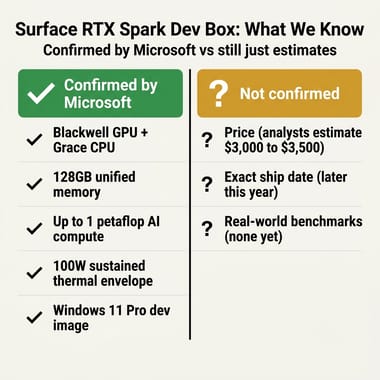
Here is the part that the headlines keep dropping: Microsoft has not announced pricing as of June 2026. The figure you have seen, roughly $3,000 to $3,500, is an analyst and outlet estimate that appears across coverage from BigGo Finance and others, not a Microsoft number. It is a reasonable estimate; PCWorld pointed out that the 128GB of memory alone runs about $1,800 of parts at current prices. But until Microsoft publishes a real figure, treat the price as a well-grounded guess, and treat every conclusion that leans on it as provisional.
Why the form factor is fooling people
A mini PC, in the sense this site usually means it, is a small desktop built to sip power and stay quiet while doing ordinary computing. The defining trait is not size; it is the thermal and power budget. A typical mini PC in the $700 to $1,500 range runs a 15W to 65W mobile or desktop chip, leans on a small fan, and is tuned for bursts of work followed by idle. The Surface Spark inverts that profile. A 100W sustained envelope paired with a chassis deliberately designed as a heatsink is not the signature of a burst-then-throttle consumer box. It is the signature of a machine meant to hold full clocks through long training runs and multi-hour inference jobs without backing off.
That single design choice tells you more about the tier than the price estimate does. That 100W sustained envelope and the heatsink chassis come straight from Microsoft’s own spec sheet; NotebookCheck, which explicitly frames the Spark Dev Box as a Mac Studio rival, adds that the same RTX Spark silicon used in the thinner Surface Laptop Ultra runs at that 100W here because the desktop has the cooling headroom the laptop does not. You do not engineer an aluminum heatsink chassis and a sustained-compute thermal target for a device whose job is to play 4K video and run a browser. You build that for workloads that punish hardware for hours at a time, which is exactly the developer use case Microsoft describes.
The four-tier map
The cleanest way to place the Surface Spark is to stop thinking in form factors and start thinking in price-and-purpose tiers. Form factor tells you how big a machine is; it tells you almost nothing about what the machine is for or what it costs, which are the two things a buyer actually needs to know. Small desktops in 2026 sort into four price-and-purpose tiers, and on its confirmed specs and an estimated price to match, the Surface Spark lines up with the top one.
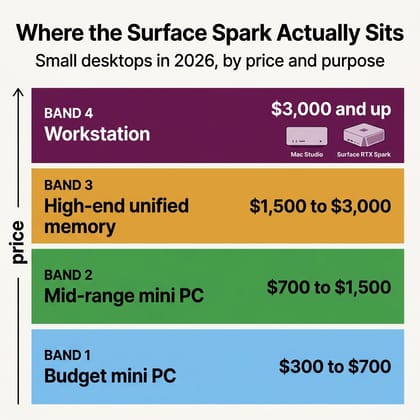
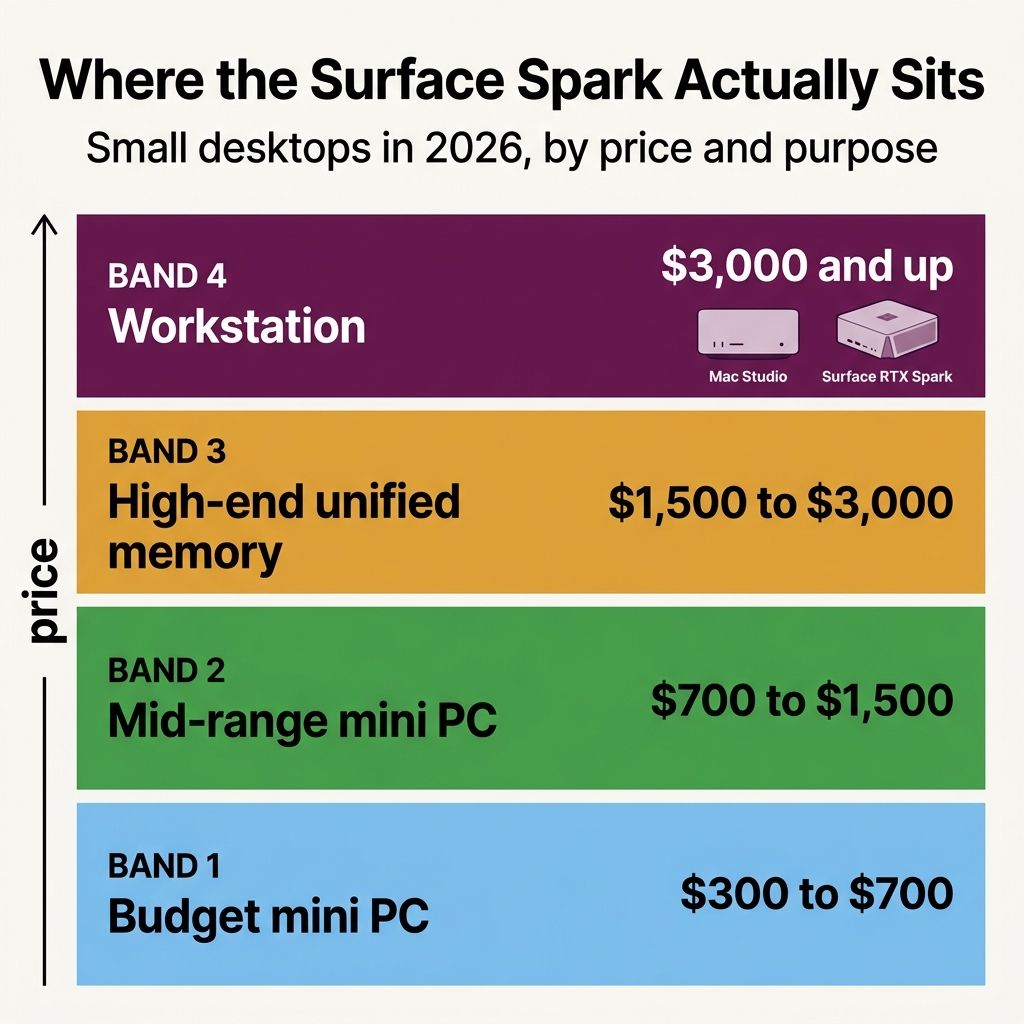
At the bottom sit the budget mini PCs, roughly $300 to $700, the Intel N-series and entry Ryzen boxes that handle a browser, a media library, and light office work. Above them is the mid-range, $700 to $1,500, where most of the good mini PCs live and where a large share of this site’s readers actually shop. The third tier, $1,500 to $3,000, is the high-end unified-memory class: AMD’s Strix Halo boxes and similar machines that exist specifically to run large local models without a discrete GPU. The fourth tier, $3,000 and up, is the workstation, and it is a different animal: dedicated AI silicon, big unified memory pools, sustained-compute cooling, and prices that assume the buyer is making money with the machine.
The Surface Spark is a tier-four product wearing a tier-two silhouette. Its 128GB of unified memory and CUDA-capable Blackwell GPU put it shoulder to shoulder with a fully configured Mac Studio, not with the Beelink or GMKtec boxes the mini PC headlines sit next to. We have already mapped the tier just below it in our Strix Halo guide for local LLM inference, and the broader NVIDIA workstation landscape in our look at the DGX Spark and local AI hardware. The Surface Spark is the Microsoft-branded, consumer-channel entry into that same top tier, not a new floor below it.
The Apple comparison, done correctly
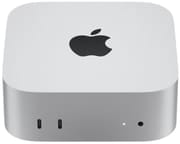
Apple sells the cleanest illustration of the gap, because Apple ships products in both the tier you are shopping and the tier the Surface Spark actually competes in. The Mac Mini is the genuine mini PC: as of early June 2026, Apple’s configurator starts the M4 model at around $799 (Apple raised it from $599 in May and dropped the 256GB storage option amid the memory shortage) and the M4 Pro at around $1,399. That is the tier where a normal desktop buyer lives, and it is the tier the Surface Spark is constantly, wrongly, compared against.
The Mac Studio is the workstation, and that is the real analogue. When the M4 Max Mac Studio launched it offered a 128GB unified-memory option in the neighborhood of $3,500, which is the comparison the Surface Spark’s spec sheet invites. The catch is that the 2026 DRAM shortage has reshaped Apple’s lineup since then. As of early June 2026 the M4 Max Mac Studio tops out at 96GB on apple.com, and the pricier M3 Ultra has been trimmed to a single 96GB configuration as well, which means Apple does not currently sell a 128GB-class unified-memory desktop at all. The direction of travel only sharpens the point. A high-memory unified-memory desktop from Apple is a $3,000-plus workstation that got more expensive in 2026, not less, and the Surface Spark is squaring up against that machine, not against the Mac Mini sitting two tiers down.
Mac mini with M4 chip
Microsoft will sell it to you. That does not move the tier.
One nuance deserves engaging rather than ducking, and it is the strongest argument against the framing in this piece. Microsoft markets the Surface Spark for developers, but the company has been clear that ordinary buyers can purchase one too, which makes it tempting to file the device as a mainstream product after all. Andrew Hill, the Surface corporate vice president, told PCWorld flatly: “We will sell this to consumers for sure.” So this is not a locked-down enterprise-only SKU you need a corporate account to buy.
Consumer-available, though, is not the same as consumer-tier. The fact that Microsoft will take your money does not change what the money buys, and the people who cover Microsoft for a living have been blunt about who the machine is for. Zac Bowden of Windows Central framed it as a Surface mini PC aimed solely at AI developers, and PCWorld’s Michael Crider put it more bluntly still in a piece headlined “The newest Surface is a mini PC, but it’s not for you,” writing that “this Surface is meant for developers, developers, developers, developers. Specifically ‘AI’ developers.” A workstation you are allowed to buy is still a workstation. The buy button does not relocate it into the mini PC tier.
What this means for your shopping list
For the largest group of readers, the practical answer is the simplest one. If your budget is under roughly $2,500 and your workload is general computing, media, a home server, or even mid-size local models, the Surface Spark was never a candidate, and its announcement changes nothing about what you should buy this week. The mini PC you were already considering is still the right call, and waiting for an estimated $3,000-plus developer box to ship “later this year” only delays a purchase that has nothing to do with it. We keep a current shortlist in our guide to the best mini PCs for running local LLMs, and the Surface Spark is deliberately not on that list, because it is not a mini PC recommendation.
The one reader who should pay closer attention is the person already shopping the high-end unified-memory tier, the Strix Halo cross-shopper. For that buyer the Surface Spark is a real alternative, because it lives at the top of the very tier they are weighing. The trade is straightforward: the Surface Spark brings CUDA, NVIDIA’s mature local-AI tooling, and Microsoft’s preconfigured Windows developer image, against a price premium over a $2,000-ish Strix Halo box and the same RTX Spark silicon you can also get in cheaper third-party desktops. That is a genuine decision with real trade-offs, and it is the only version of “should I wait for the Surface Spark” that has a yes hiding inside it. This is the same NVIDIA-on-Windows push we traced through NVIDIA’s N1X ARM laptops; the Surface Spark is its desktop expression.
For everyone else, the headline got the form factor right and the tier wrong, and the correction is the whole point. The Surface RTX Spark Dev Box is a Mac Studio rival, not a Mac Mini one. Place it in the right tier and your mini PC shopping list comes back into focus exactly where you left it.