Jensen Huang walked on stage at NVIDIA’s GTC Taipei keynote on the evening of May 31 ET (June 1 Taipei time), adjacent to Computex 2026, and called the next forty years of PCs into existence. The new processor he held up, branded the RTX Spark superchip and known by its long-rumored codename N1X, is NVIDIA’s first consumer ARM CPU built specifically for personal computers (the company’s prior consumer ARM silicon shipped in set-top boxes like the Tegra X1+ in the 2019 Shield TV refresh and game handhelds like the custom Tegra T239 in the 2025 Nintendo Switch 2, never in laptops or desktops), and the first laptop chip that pairs a 20-core Arm CPU with a Blackwell GPU and up to 128 GB of unified memory on a single package. NVIDIA says more than thirty laptops and ten desktops will ship with the chip starting this fall, fronted by Microsoft, Dell, HP, ASUS, Lenovo, and MSI. That makes the N1X the fourth ARM platform a laptop shopper now has to weigh against the other three, and the only one with the full CUDA software stack inside.
If you have spent the last two years quietly comparing a Snapdragon X Elite Copilot+ machine against a MacBook Air M5, the arrival of RTX Spark adds a new tier above both of them, not next to them. NVIDIA did not announce pricing at the keynote (it promised specifics closer to the fall launch), but industry expectations put the platform’s likely price floor well north of $1,500; the chip is built for sustained AI and graphics workloads rather than fanless silence, and the partner SKUs leaking out of supply-chain channels include a 245-watt power adapter on at least one model. This is not a Snapdragon X replacement. It is the first ARM laptop you might buy because of what it does at the desk rather than what it gets away with on the plane. Here is what NVIDIA actually confirmed at the keynote, what the rest of the spec sheet still depends on leaks, and how to read the new platform against the three tiers already on store shelves.
What NVIDIA Confirmed at the Keynote
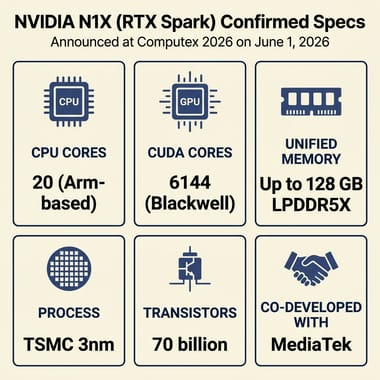
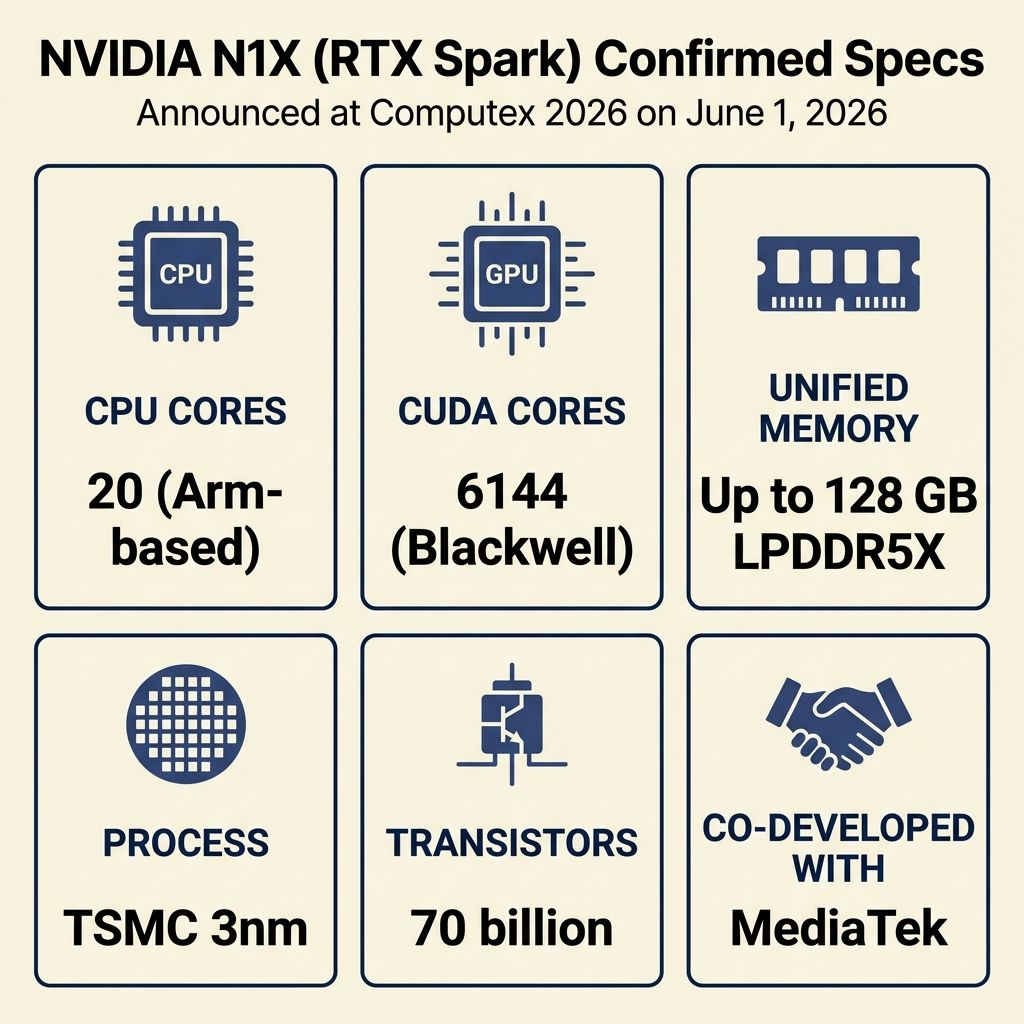
The official specs Huang walked through on stage were the headline numbers, not the full Hot Chips datasheet. The N1X (formally the RTX Spark superchip) pairs a custom 20-core ARM-based “Grace” CPU with a Blackwell GPU carrying 6,144 CUDA cores, the same shader count NVIDIA ships in its desktop RTX 5070 graphics card. The whole package is built on TSMC’s 3-nanometer process, contains 70 billion transistors, and was co-developed with MediaTek, the Taiwanese chipmaker that has spent the last few years building the highest-volume ARM Chromebook silicon on the market. Up to 128 GB of unified LPDDR5X memory sits on the same package, shared by CPU and GPU through NVIDIA’s NVLink C2C interconnect.
NVIDIA’s spokesperson told CNBC that the GPU is “roughly equivalent” to the RTX 5070 laptop GPU, with more specific benchmarks promised closer to the fall launch. The first laptops will be as thin as 14 millimeters, ship “in the fall” (NVIDIA has not committed to a more specific date), and carry a “premium price tag” aimed at creators, AI developers, and gamers shopping for thin-and-light Windows-on-ARM hardware. There will also be a small line of compact desktops in the launch wave, likely the descendants of the DGX Spark and the Grace Blackwell GB10 platform that NVIDIA shipped in late 2025. Microsoft’s own Surface RTX Spark dev box is the most visible example, and it lands closer to a Mac Studio rival than a Mac Mini one.
A few things the keynote did not pin down. NVIDIA has not formally confirmed the chip’s TDP, the exact CPU core layout (the widely reported 10 performance plus 10 efficiency split traces to a Hot Chips 2025 presentation of the desktop GB10 variant rather than to anything Huang said on stage), or the smaller-memory configurations partner OEMs are expected to ship. The Lenovo Legion 7 15N1X11 is rumored to require a 245-watt power adapter, which would put the high-end N1X laptops squarely in gaming-laptop thermals rather than the 18-to-30-watt envelope a Snapdragon X laptop runs in; that figure is a supply-chain leak rather than a Lenovo or NVIDIA confirmation. The companion N1 part for thinner, cheaper laptops (with 12 or 10 CPU cores and either 2,560 or 2,048 CUDA cores in an 18-to-45-watt envelope) shows up in leaked roadmaps but did not appear on Huang’s slides. Treat any TDP, NPU TOPS, or core-split figure you read about the N1X this week as informed inference, not measured specification, until the first reviewer benchmarks land.
The Four ARM Laptop Tiers, After June 1
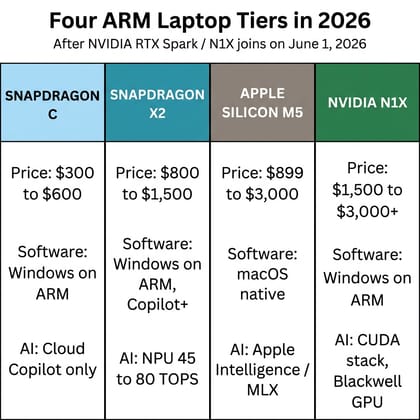
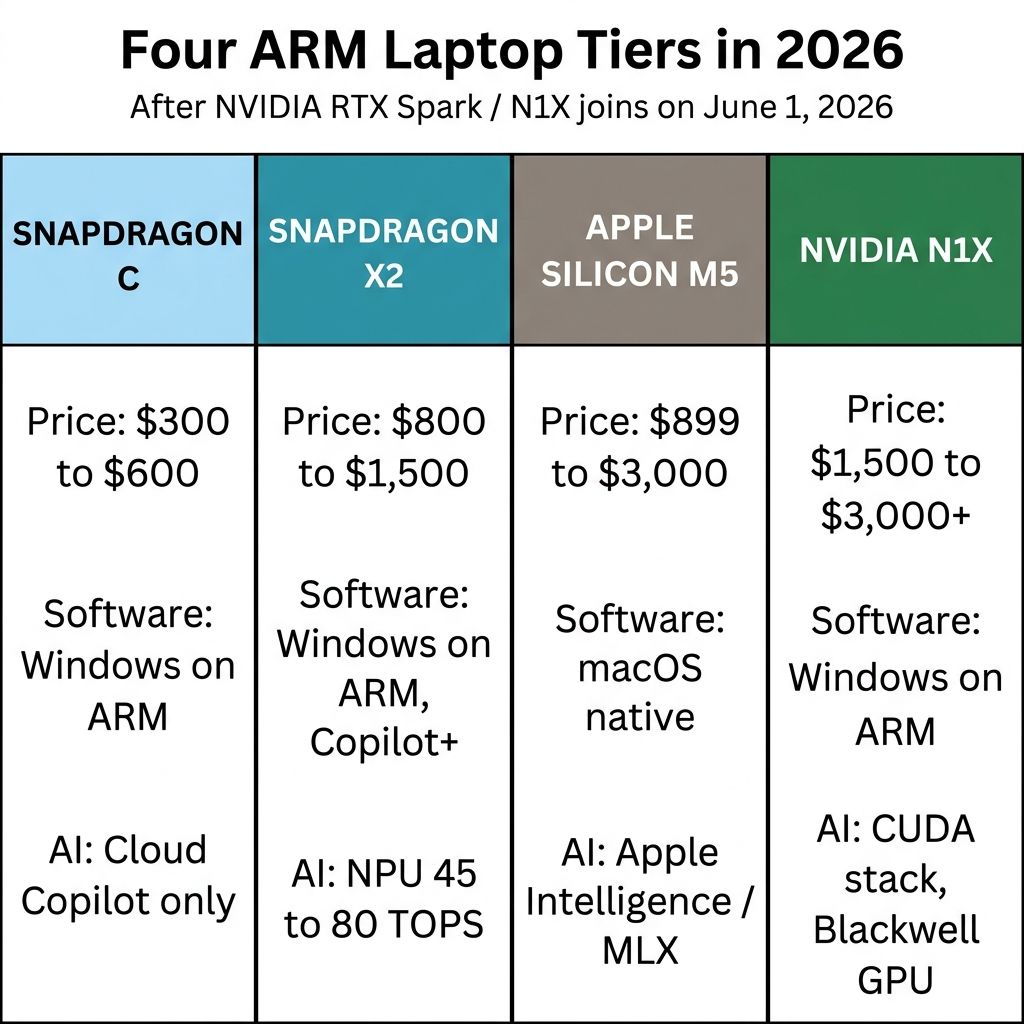
For most of the last decade, “ARM laptop” was a single shelf at Best Buy, occupied first by Chromebooks and then by Apple’s M-series MacBooks. Qualcomm’s 2024 Snapdragon X push added a third tier, and the Snapdragon C platform Qualcomm announced two weeks ago added a fourth. NVIDIA’s entry slots in above all of them, not next to any one specifically, and that is the structural change worth paying attention to.
The first tier is Snapdragon C at around $300 to $600. These are budget Windows-on-ARM laptops aimed at the sub-$600 buyer who would otherwise pick a Chromebook Plus or a MacBook Neo. We covered the structural awkwardness of this tier in the Snapdragon C decision guide: Qualcomm confirmed at announcement that Snapdragon C laptops will not qualify for Microsoft’s Copilot+ program, which means none of the marquee on-device AI features Microsoft has been advertising for two years will work on them. Snapdragon C is a budget second-laptop tier in practice, not a primary-machine competitor to a Chromebook Plus.
The second tier is Snapdragon X / Snapdragon X2 at roughly $800 to $1,500. These are the Copilot+ machines, with 45 to 80 TOPS NPUs, 16 GB-or-more RAM, all-day battery, and fanless thermals on the lighter models. The Snapdragon X2 platform refresh at CES 2026 pushed multi-threaded performance close to Apple’s M5 and lifted the NPU to 80 TOPS, well above the Copilot+ floor. For a productivity laptop with a long battery life and a real on-device AI feature set, this is the tier most shoppers should still default to, though it is worth remembering that those background AI features come with a quiet processor and battery cost no matter which tier you buy.
The third tier is Apple Silicon (M5) at $899 to $3,000-plus, covering everything from a base MacBook Air M5 up to a fully spec’d 16-inch MacBook Pro. Apple’s lead on integrated CPU and GPU efficiency remains real, the macOS app ecosystem is the most mature ARM ecosystem on any platform, and the MacBook Neo’s March 2026 launch extended Apple Silicon down to a $599 retail floor. The trade-off has always been that macOS is macOS: Final Cut and Logic and the Affinity suite and DaVinci Resolve all run natively, but Windows-only software does not run at all without a virtual machine.
The fourth tier, as of this morning, is NVIDIA N1X / RTX Spark at an expected $1,500 to $3,000-plus (NVIDIA has not announced pricing; that figure is the industry’s read of “premium price tag” plus partner SKU leaks). The N1X is not trying to be a Snapdragon X competitor. It is trying to be the first thin-and-light Windows laptop that runs CUDA workloads at desktop-class GPU performance, alongside a Blackwell-class NPU and up to 128 GB of unified memory that the GPU and CPU can both address. That is different from any of the other three tiers, and it is the one piece of the spec sheet that is new.
CUDA on a Windows Laptop Runs the Same Tools as a Desktop
CUDA is the part of NVIDIA’s pitch that does not have a direct equivalent on the other three tiers, and it is the reason this article is not framed as “wait or buy.” A Snapdragon X2 laptop has an excellent NPU and a competent integrated GPU, but the AI software ecosystem on Windows-on-ARM has been built around DirectML and ONNX runtimes, which work but lack the breadth of the CUDA software stack. Apple Silicon runs the LLM ecosystem through MLX and Metal, which is fast on M5 hardware but is a different framework from the one most published research, most local LLM tooling, and most game-engine GPU compute paths target.
CUDA on Windows-on-ARM means that the same tools a developer uses on a Linux workstation or a Windows desktop with an RTX card will run, with minimal changes, on the laptop. PyTorch with CUDA backends. Hugging Face Transformers using the same CUDA kernels. Stable Diffusion, ComfyUI, and the entire stack of local image and video generation tools that have been shipping CUDA-first for the last three years. Blender and DaVinci Resolve using NVIDIA’s OptiX and CUDA accelerators rather than fallback paths. NVIDIA’s pitch to creators and AI developers is that the platform they were using on the desktop now fits in a 14-millimeter laptop, with the same software stack and a GPU shader count equal to a desktop RTX 5070.
For a local LLM developer, the 128 GB unified memory ceiling is the more interesting number. Loading a 70-billion-parameter model in 4-bit quantization takes roughly 40 GB of memory; running it alongside a development environment, a vector database, and a couple of orchestration processes is comfortable inside 128 GB. The N1X is not the first laptop to claim that figure (the Mac Studio platform has been there for a year, and certain Strix Halo gaming laptops are close), but it is the first to claim it with NVIDIA’s full CUDA stack running on the GPU side. For a researcher who has been using a desktop DGX Spark or a Strix Halo mini PC for local model work, the N1X is the first time that same workflow becomes portable.
The same argument applies to gamers who care about ray tracing and DLSS. Snapdragon X2 plays games through Microsoft’s Prism translation layer, which works for many titles but stutters or fails on anything with aggressive anti-cheat or kernel-level driver requirements. Apple’s gaming story remains a small set of high-quality ports rather than a parity ecosystem. The N1X runs Windows-on-ARM the same way Snapdragon X does (with the same Prism layer for x86 titles), but adds a Blackwell GPU and the full DLSS, Reflex, and RTX feature set on the native-ARM side. Whether the early game catalog actually exercises any of that in 2026 is a different question, which leads to the catch.
The Windows-on-ARM Catch That Did Not Go Away
The PCWorld pre-launch piece called the N1X “the jolt Windows laptops need, with one big catch,” and the catch is real even with NVIDIA’s GPU stack involved. Windows-on-ARM still has to emulate x86 to run most of the games and a meaningful chunk of the pro software people actually use, and the pre-keynote PCWorld framing of Prism as a Qualcomm-only emulation story was overtaken by Microsoft’s own post-keynote announcement: in the May 31 Windows blog post introducing RTX Spark, Microsoft confirmed that Prism “has been tuned for the microarchitecture of RTX Spark.” That answers the most-cited concern about the platform on day one: emulation is no longer optimized for Qualcomm cores only. What it does not yet answer is how that tuning translates to measured performance under Easy Anti-Cheat or BattlEye titles or under heavily x86-only pro software, which is the part of the platform that has been a moving target for two years and that only reviewer benchmarks will resolve.
The ecosystem-compatibility scoreboard at mid-2026 reads better than it did at Snapdragon X’s 2024 launch, but it still has gaps. The Adobe suite ships native ARM builds of Photoshop, Lightroom, and Premiere; some of the more specialized tools (After Effects plug-ins, certain Substance integrations) still rely on x86 emulation. Most modern PC games run under Prism, but anything that uses Easy Anti-Cheat, BattlEye, or other kernel-level anti-cheat in modes that have not been re-certified for ARM Windows still does not work. Niche creative and professional tools (CAD packages, certain video plug-ins, older accounting software) are still hit-or-miss. NVIDIA cannot fix this layer of the stack; it ships on top of whatever Microsoft has done to Windows-on-ARM by the time the first RTX Spark laptops reach shelves.
The other catch is thermal. NVIDIA’s pitch of a thin-and-light laptop with a 6,144-CUDA-core GPU and up to 128 GB of unified memory is new, but the early supply-chain rumors of a 245-watt Legion 7 power adapter suggest the high-end SKUs will run hot and loud under sustained load. That is a different machine from the silent, fanless ARM mini PC vision Qualcomm has been pushing on the desktop side. The thinnest 14-millimeter N1X laptops will likely throttle the GPU under any real CUDA workload, which is fine for AI development but is the kind of detail you only learn from reviewer testing two months after launch.
How to Read This If You Are Shopping This Fall
The structural answer for most buyers in the $800 to $1,500 range did not change today. A Snapdragon X2 Copilot+ laptop or a MacBook Air M5 is still the right pick for the vast majority of people who want a thin ARM laptop with great battery life and a mature software story. The N1X does nothing for someone whose workload is mostly browsing, document editing, video calls, and the occasional Lightroom batch. Spending an estimated $1,500-plus (NVIDIA has not announced pricing yet) for a CUDA-capable laptop you do not exercise is a worse outcome than the $999 Snapdragon X2 or the $1,099 MacBook Air M5 you actually use.
If your workload includes any of the following, the calculus changes. You run local language models or image-generation tools and have been waiting for a portable machine that does it without an external GPU. You are a creator whose tools (Blender, DaVinci Resolve, certain plug-in-heavy Adobe workflows) lean on CUDA acceleration on the desktop and you have been carrying a thicker workstation laptop to make it work. You play modern PC games with DLSS and ray tracing on a desktop RTX card and want a single thin laptop that runs the same titles natively. In any of those cases, the first wave of N1X laptops is worth a serious look once independent benchmarks land. Wait for the late-fall and early-2027 review cycle before you click buy, but treat the platform as a genuine option rather than a vapor announcement.
Before committing to local AI hardware at the N1X’s expected price tier, it is worth working through the cloud versus local AI cost question to understand where each approach actually wins; the economics shifted noticeably with the latest generation of cheap cloud models. And for anyone who wants an always-on AI workload host at a desk rather than a portable one, the Mac mini AI server comparison lays out the managed versus DIY tradeoffs before the N1X even enters the picture.
For households watching the budget end, the message is the same as it was for the Snapdragon C tier two weeks ago. The structural Chromebook Plus and MacBook Neo recommendations under $600 do not move because NVIDIA introduced what is expected to be a roughly $2,000-class ARM laptop tier above them. The four tiers are now separate buying problems, with different software stacks, different price floors, and different workloads they are designed to do well. Whatever shifts in tier two and three over the next year (and Apple’s WWDC 2026 keynote in the week after this one will almost certainly answer some of the M-series questions still hanging in the air), the N1X is the addition that changes what “ARM laptop” means in the first place. It is no longer just “the silent, all-day-battery machine without legacy compatibility.” It is also, now, “the laptop with a desktop-class NVIDIA GPU inside.”
That is a real change. It just is not a change that most shoppers in 2026 need to act on.