
ACEMAGIC M1 (Ryzen 7 6800H)
Updated on

The ACEMAGIC M1 with AMD Ryzen 7 6800H processor represents a compelling value proposition in the budget mini PC market. Unlike its Intel-powered siblings, this variant leverages AMD’s Zen 3+ architecture with integrated Radeon 680M graphics, offering notably stronger GPU performance for light gaming and creative work. The DDR5 memory support future-proofs the platform while delivering the bandwidth needed to fully unlock the Radeon 680M’s capabilities, though buyers should note that DRAM prices have surged recently, making pre-configured models better value than upgrading later. At prices starting under $300, it undercuts many competitors while still delivering 8 cores, 16 threads, and enough connectivity for a serious workstation setup.
Pros and Cons of the ACEMAGIC M1 (Ryzen 7 6800H)
| Pros | Cons |
|---|---|
| Radeon 680M delivers GTX 1650-class gaming performance | Quality control inconsistencies reported by some buyers |
| DDR5 RAM provides bandwidth for integrated graphics | Must configure dual-channel RAM for optimal GPU performance |
| Aggressive pricing significantly undercuts competitors | Limited professional review coverage for AMD variant |
| Triple 4K display support via HDMI, DP, and USB-C | Thermal throttling possible under sustained heavy loads |
| 2.5GbE networking ideal for NAS and homelab use | Customer support responsiveness has been criticized |
| Upgradeable RAM (64GB max) and dual storage options | Some units may ship with single-channel RAM configuration |
ACEMAGIC M1 (Ryzen 7 6800H) Comparison Chart
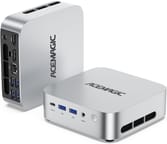 ACEMAGIC M1 (Ryzen 7 6800H) | ACEMAGIC M1 (Ryzen 7 6800H) | ACEMAGIC M1 (Ryzen 7 6800H) | |
| Price | List Price: $279.99 Amazon Prices: Loading prices... | List Price: $319.99 Amazon Prices: Loading prices... | List Price: $429.99 Amazon Prices: Loading prices... |
| Version | 16GB/512GB | 16GB/1TB | 32GB/1TB |
| Performance Rating | 7.7 | 7.7 | 8.4 |
| Operating System | Windows 11 Pro | Windows 11 Pro | Windows 11 Pro |
| Processor | Octa-core 3.20 Ghz (max 4.70 Ghz) AMD Ryzen 7 6800H | Octa-core 3.20 Ghz (max 4.70 Ghz) AMD Ryzen 7 6800H | Octa-core 3.20 Ghz (max 4.70 Ghz) AMD Ryzen 7 6800H |
| GPU | Integrated AMD Radeon 680M | Integrated AMD Radeon 680M | Integrated AMD Radeon 680M |
| RAM | 16 GB DDR5 | 16 GB DDR5 | 32 GB DDR5 |
| Internal Storage | 512 GB | 1 TB | 1 TB |
| Dimensions width x length x thickness | 5.05 x 5.05 x 1.5 inches (128.27 x 128.27 x 38.1 mm) | 5.05 x 5.05 x 1.5 inches (128.27 x 128.27 x 38.1 mm) | 5.05 x 5.05 x 1.5 inches (128.27 x 128.27 x 38.1 mm) |
| Weight | 1.18 lbs (0.54 kg) | 1.18 lbs (0.54 kg) | 1.18 lbs (0.54 kg) |
| WiFi | Wi-Fi 6 (802.11ax) | Wi-Fi 6 (802.11ax) | Wi-Fi 6 (802.11ax) |
| Bluetooth | Bluetooth 5.2 | Bluetooth 5.2 | Bluetooth 5.2 |
| Ethernet | 1 Ethernet port at 2.5 Gbps | 1 Ethernet port at 2.5 Gbps | 1 Ethernet port at 2.5 Gbps |
| HDMI | 1 Full-Size HDMI Port | 1 Full-Size HDMI Port | 1 Full-Size HDMI Port |
| DisplayPort | 1 DisplayPort (1.4) | 1 DisplayPort (1.4) | 1 DisplayPort (1.4) |
| VGA | No VGA Ports | No VGA Ports | No VGA Ports |
| USB Ports | 6 USB 3, 1 USB-C USB-C supports DisplayPort Alt Mode for triple 4K display output | 6 USB 3, 1 USB-C USB-C supports DisplayPort Alt Mode for triple 4K display output | 6 USB 3, 1 USB-C USB-C supports DisplayPort Alt Mode for triple 4K display output |
| Thunderbolt Ports | No | No | No |
| Internal SATA Ports | No SATA ports | No SATA ports | No SATA ports |
| Card Reader | No Card Reader | No Card Reader | No Card Reader |
| Headphone Jack | combo | combo | combo |
| Fanless | No | No | No |
| VESA Mount | Yes | Yes | Yes |
| In the Box | ACEMAGIC M1, Power Adapter, User Manual, VESA Mount Bracket with Screws, HDMI Cable | ACEMAGIC M1, Power Adapter, User Manual, VESA Mount Bracket with Screws, HDMI Cable | ACEMAGIC M1, Power Adapter, User Manual, VESA Mount Bracket with Screws, HDMI Cable |
| Expandability | RAM upgradeable to 64GB DDR5, storage expandable via M.2 NVMe and 2.5-inch SATA bay | RAM upgradeable to 64GB DDR5, storage expandable via M.2 NVMe and 2.5-inch SATA bay | RAM upgradeable to 64GB DDR5, storage expandable via M.2 NVMe and 2.5-inch SATA bay |
Related Mini PCs
-
 ACEMAGICIAN S3AA high-performance mini PC featuring the AMD Ryzen 7 8745HS processor with Radeon 780M graphics,…
 -
 ACEMAGIC M1The ACEMAGIC M1 packs Intel's powerful i9 processors into an incredibly compact 5-inch cube.…
 -
 Paladin WO4The Paladin WO4 packs the AMD Ryzen 7 7735U processor with Radeon 680M graphics into an…
 -
 GEEKOM A6The GEEKOM A6 packs an AMD Ryzen 7 6800H processor and Radeon 680M graphics into a premium aluminum…
 -
 KAMRUI Hyper H1 11 ProA compact gaming-capable mini PC featuring AMD Ryzen 7 6800H, DDR5 memory, dual M.2 slots, and…
 -
 MINISFORUM NAB6 LiteThe MINISFORUM NAB6 Lite packs Intel's 12th Gen i5-12600H into a compact 5-inch chassis with dual…
Detailed Insights into the ACEMAGIC M1 (Ryzen 7 6800H)
The AMD variant shares the same compact 5x5x1.5 inch chassis as the Intel version but swaps the internals for AMD’s mobile platform. The Ryzen 7 6800H brings eight Zen 3+ cores with boost clocks up to 4.7GHz, providing strong multi-threaded performance for productivity workloads. The real star, however, is the integrated Radeon 680M graphics featuring 12 RDNA2 compute units. This GPU significantly outperforms Intel’s Iris Xe, making the AMD M1 capable of handling esports titles at playable framerates and light creative work that would struggle on the Intel variant.
Memory configuration proves critical with this system. The Radeon 680M’s performance scales dramatically with memory bandwidth, meaning buyers should verify their unit ships with dual-channel RAM configuration. Single-channel setups suffer a severe performance penalty, particularly in graphics-intensive tasks. The DDR5 platform supports upgrades to 64GB, and the 2.5-inch SATA bay provides expansion options beyond the M.2 slot, addressing storage flexibility needs for users building media servers or local file storage.
Connectivity matches the Intel version’s generous offering: HDMI 2.0, DisplayPort 1.4, and USB-C with DisplayPort Alt Mode enable triple 4K display configurations. Six USB-A 3.0 ports handle peripherals, while 2.5 Gigabit Ethernet suits network-intensive applications. WiFi 6 and Bluetooth 5.2 round out the wireless capabilities. The included VESA mount bracket enables behind-monitor installation for clean desk setups.
Reviewer Insights on the ACEMAGIC M1 (Ryzen 7 6800H)
YouTube Review Highlights
Gaming tests from multiple reviewers confirm the Radeon 680M handles casual and esports titles smoothly. Asphalt 8 and Disney Speedstorm run without issue, and benchmark results come close to dedicated gaming laptops in some scenarios. The compact cooling system keeps noise manageable during typical use, though sustained heavy loads increase fan activity noticeably.
One reviewer emphasizes the importance of performing due diligence: verifying Windows activation, running malware scans on arrival, and potentially performing a fresh OS installation for optimal results. ACEMAGIC has faced criticism in the past regarding pre-installed software, and while tested units came clean, caution remains warranted.
Value Assessment
At $280-320, the AMD M1 delivers hardware that costs significantly more in competing packages. The Ryzen 7 6800H and Radeon 680M combination typically appears in systems priced $100-200 higher. For buyers willing to verify their configuration and potentially troubleshoot driver issues independently, the value proposition is compelling. Those seeking turnkey simplicity with premium support may prefer established brands at higher price points.
Customer Considerations
Several reviewers note that ACEMAGIC’s website lacks readily accessible drivers for the M1, and customer support response times can be slow. Tech-savvy users comfortable with driver management and potential OS reinstallation will find this a non-issue. Buyers expecting Apple or Dell-level support infrastructure should factor this into their purchasing decision.
The thermal design handles typical workloads effectively, but the 45W TDP Ryzen 7 6800H can push the compact chassis to its limits under sustained all-core loads. Expect thermal throttling during extended rendering or compilation tasks, which effectively reduces peak performance in these scenarios. For typical productivity use, web browsing, and light gaming, the cooling proves adequate.
Conclusion
The ACEMAGIC M1 with Ryzen 7 6800H carves out a distinct niche as a budget powerhouse for users who prioritize value over polish. The AMD platform delivers meaningfully stronger graphics performance than Intel alternatives at lower prices, making it attractive for light gaming, media consumption, and productivity workloads. The DDR5 memory and upgradeable storage provide a platform with room to grow.
Prospective buyers should approach with realistic expectations: this is a budget device from a newer manufacturer, not a premium product with comprehensive support infrastructure. Verify the RAM configuration, consider a fresh Windows installation, and budget for potential DIY troubleshooting. For those comfortable with that trade-off, the M1 delivers impressive hardware at prices that make more established competitors look overpriced.
For users comparing options, the Intel-based ACEMAGIC M1 offers different trade-offs with stronger single-threaded performance but weaker integrated graphics. Starry Hope’s Mini PC Comparison Chart helps evaluate both against the broader market.
Frequently Asked Questions
What processor and graphics does the AMD ACEMAGIC M1 use?
The AMD variant uses the Ryzen 7 6800H processor with 8 cores, 16 threads, and boost clocks up to 4.7GHz. It includes integrated Radeon 680M graphics with 12 RDNA2 compute units, delivering significantly stronger GPU performance than Intel’s Iris Xe found in competing systems.
Can the AMD ACEMAGIC M1 handle gaming?
Yes, the Radeon 680M integrated graphics delivers performance comparable to a dedicated GTX 1650. Esports titles and casual games run smoothly at 1080p with appropriate settings. AAA games at high settings will struggle, but many modern titles are playable with reduced quality settings.
Why is dual-channel RAM important for this system?
The Radeon 680M GPU shares system memory, making memory bandwidth critical for graphics performance. Dual-channel DDR5 provides roughly double the bandwidth of single-channel, resulting in dramatically higher frame rates in games. Some units may ship with single-channel configuration, so verify before purchase.
How does the AMD M1 compare to the Intel M1?
The Intel versions (i9-13900HK and i9-11900H) offer stronger single-threaded CPU performance and use proven DDR4 memory. The AMD version with Ryzen 7 6800H provides substantially better integrated graphics performance via Radeon 680M and uses newer DDR5 memory, typically at lower prices. Choose Intel for pure productivity, AMD for balanced productivity with light gaming.
What storage and RAM upgrades are possible?
RAM can be upgraded to 64GB using DDR5 SO-DIMM modules. Storage expansion includes the M.2 NVMe slot (2280 form factor) and a 2.5-inch SATA bay for additional drives. Both RAM slots and storage bays are user-accessible.
How many displays can the AMD ACEMAGIC M1 support?
The system supports up to three simultaneous 4K displays at 60Hz. Display outputs include HDMI 2.0, DisplayPort 1.4, and USB-C with DisplayPort Alt Mode for flexible multi-monitor configurations.