
Beelink EQR7
Updated on

The Beelink EQR7 represents an interesting evolution in the budget-to-midrange mini PC market, offering serious computing power in a surprisingly compact package. Built around the AMD Ryzen 7 7735HS processor with eight cores and sixteen threads boosting up to 4.75GHz, this system delivers performance that rivals many full-sized desktop computers while fitting in the palm of your hand. What sets the EQR7 apart from many competitors is its built-in 85W power supply, eliminating the need for a bulky external power brick and making desk setups cleaner and more portable. The integrated AMD Radeon 680M graphics provide capable 4K output through dual HDMI ports, making this an attractive option for home offices, media centers, or anyone seeking powerful computing in a minimal footprint.
Pros and Cons of the Beelink EQR7
| Pros | Cons |
|---|---|
| Built-in 85W PSU eliminates external power brick | RAM is soldered and not upgradeable |
| Dual Gigabit Ethernet with network isolation | USB-C is data-only, no video output |
| Near-silent 32dB operation under load | Limited professional review coverage |
| AMD Ryzen 7 7735HS with strong multi-threaded performance | Only one YouTube video available for reference |
| Dual M.2 PCIe 4.0 slots support up to 8TB storage | LPDDR5 RAM slightly slower than DDR5 in some workloads |
| Compact 5-inch square footprint saves desk space | No Thunderbolt or USB4 connectivity |
Related Videos
Beelink EQR7 Comparison Chart
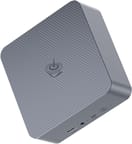 Beelink EQR7 | Beelink EQR7 | |
| Price | List Price: $449 Amazon Prices: Loading prices... | List Price: $479 Amazon Prices: Loading prices... |
| Version | 24GB/500GB | 24GB/1TB |
| Performance Rating | 8.2 | 8.2 |
| Operating System | Windows 11 Pro | Windows 11 Pro |
| Processor | Octa-core 3.20 Ghz (max 4.75 Ghz) AMD Ryzen 7 7735HS | Octa-core 3.20 Ghz (max 4.75 Ghz) AMD Ryzen 7 7735HS |
| GPU | Integrated AMD Radeon 680M | Integrated AMD Radeon 680M |
| RAM | 24 GB LPDDR5 | 24 GB LPDDR5 |
| Internal Storage | 500 GB nvme | 1 TB nvme |
| Dimensions width x length x thickness | 4.96 x 4.96 x 1.74 inches (125.98 x 125.98 x 44.2 mm) | 4.96 x 4.96 x 1.74 inches (125.98 x 125.98 x 44.2 mm) |
| Weight | 1.15 lbs (0.52 kg) | 1.15 lbs (0.52 kg) |
| WiFi | Wi-Fi 6 (802.11ax) | Wi-Fi 6 (802.11ax) |
| Bluetooth | Bluetooth 5.2 | Bluetooth 5.2 |
| Ethernet | 2 Ethernet ports at 1 Gbps | 2 Ethernet ports at 1 Gbps |
| HDMI | 2 Full-Size HDMI Ports | 2 Full-Size HDMI Ports |
| DisplayPort | No DisplayPort | No DisplayPort |
| VGA | No VGA Ports | No VGA Ports |
| USB Ports | 1 USB 2.0, 3 USB 3, 1 USB-C 3x USB 3.2 Gen 2 (10Gbps), 1x USB 2.0, 1x USB-C (10Gbps data only, no video output) | 1 USB 2.0, 3 USB 3, 1 USB-C 3x USB 3.2 Gen 2 (10Gbps), 1x USB 2.0, 1x USB-C (10Gbps data only, no video output) |
| Thunderbolt Ports | No | No |
| Internal SATA Ports | No SATA ports | No SATA ports |
| Card Reader | No Card Reader | No Card Reader |
| Headphone Jack | combo | combo |
| Fanless | No | No |
| VESA Mount | Yes | Yes |
| In the Box | Mini PC, user manual, HDMI cable, power cable with regional adapter options (US/EU/UK/AU/JP) | Mini PC, user manual, HDMI cable, power cable with regional adapter options (US/EU/UK/AU/JP) |
| Expandability | Soldered LPDDR5 RAM (not upgradeable), 2x M.2 2280 PCIe 4.0 slots for NVMe storage (max 8TB total), built-in 85W power supply | Soldered LPDDR5 RAM (not upgradeable), 2x M.2 2280 PCIe 4.0 slots for NVMe storage (max 8TB total), built-in 85W power supply |
Related Mini PCs
-
 Beelink SER5 MAX Mini PCPowered by an AMD Ryzen, the Beelink SER5 MAX Mini PC offers top-tier performance in a compact…
 -
 Beelink SER6 6900HXIntroducing the Beelink SER6 Mini PC: featuring a robust AMD Ryzen 9 6900HX, integrated Radeon 680M…
 -
 BOSGAME M4The BOSGAME M4 packs AMD Ryzen 7 8745HS power into a compact 5-inch chassis with standout features…
 -
 GMKtec Nucbox K2Packing an AMD Ryzen 7 7735HS, Radeon 680M graphics, and up to 64GB DDR5 RAM, the GMKtec Nucbox K2…
 -
 GMKtec NucBox K3 ProPacking a punch in a surprisingly small footprint, the GMKtec NucBox K3 Pro Mini PC features a…
 -
 MINISFORUM M1-1295The MINISFORUM M1-1295 packs a desktop-class Intel Core i9-12950HX processor into a compact…
Detailed Insights into the Beelink EQR7

The EQR7’s design follows Beelink’s established compact form factor, measuring just 4.96 x 4.96 x 1.74 inches and weighing only 1.15 pounds. The chassis houses the MSC 2.0 cooling system, which combines a heat pipe, aluminum heat dissipation fins, a silent fan, and an SSD heatsink to maintain thermal performance while keeping noise levels at an impressive 32dB under load. This near-silent operation makes the EQR7 suitable for quiet home office environments, living room setups, or anywhere where noise pollution is a concern. The build quality is consistent with Beelink’s other models, featuring a dark gray finish that blends unobtrusively into most desk setups.
Performance-wise, the AMD Ryzen 7 7735HS brings significant processing power to this compact chassis. With eight Zen 3+ cores running on a 6nm process, base clocks of 3.2GHz boost up to 4.75GHz when thermal headroom allows. The integrated AMD Radeon 680M with 12 graphics cores at 2200MHz handles everyday graphics tasks admirably and can even manage light gaming at reduced settings. The 24GB of soldered LPDDR5 memory provides ample headroom for multitasking, though users seeking 32GB should note that RAM upgrades are not possible on this platform. For storage expansion, dual M.2 2280 PCIe 4.0 slots offer excellent upgrade potential with support for up to 8TB total capacity.
The connectivity options on the EQR7 are comprehensive for its class. Three USB 3.2 Gen 2 ports deliver 10Gbps transfer speeds, complemented by a single USB 2.0 port for peripherals like keyboards or mice. The USB-C port provides 10Gbps data transfer but notably lacks video output or Power Delivery capabilities, which may disappoint users hoping for USB-C display connectivity. Dual HDMI 2.0 ports support 4K output at 60Hz, enabling productive dual-monitor setups. The networking configuration is particularly noteworthy, with dual Gigabit Ethernet ports featuring Realtek RTL8111H chipsets and network isolation capability, making this system appealing for networking enthusiasts or those requiring secure network segmentation. WiFi 6 via the Intel AX200 module and Bluetooth 5.2 round out the wireless connectivity options.
Reviewer Insights on the Beelink EQR7

The Beelink EQR7 is a relatively new entry to the market, having launched in late 2024. As a result, professional review coverage remains limited at this time. The single YouTube review currently available comes from Askdeb Reviews, offering a brief four-minute overview of the system. This lack of comprehensive review coverage is fairly typical for newer Beelink models, which often take several months to accumulate detailed third-party testing and analysis.
According to NotebookCheck, the EQR7 represents Beelink’s latest compact offering with particular emphasis on the near-silent operation and built-in power supply design. The publication highlights the 32dB noise level as a key selling point and notes the competitive pricing structure with only a modest premium separating the Ryzen 5 and Ryzen 7 variants.
Android PC TV provides additional context, noting that the EQR7 maintains the exterior design language of the popular Beelink EQR6 while integrating an efficient power supply and quiet ventilation system. The publication positions the EQR7 as suitable for general Windows computing, office productivity, and casual 3D gaming with appropriately adjusted graphics settings.
Given the limited independent review data, potential buyers may want to consider the strong track record of Beelink’s similar models in the SER and EQR series when evaluating this system. The warranty terms include one year of coverage with lifetime technical support, providing some assurance for early adopters.
Customer Reviews of the Beelink EQR7
Amazon customer feedback for the EQR7 paints a generally positive picture, with ratings hovering around 4.5 to 4.6 stars across the available variants. With over 600 combined reviews across the different storage configurations, buyers consistently praise the system’s compact size and quiet operation. Many customers highlight the built-in power supply as a significant convenience factor, appreciating the cleaner cable management compared to systems requiring external power bricks.
Common positive themes include the impressive performance for everyday productivity tasks, smooth 4K video playback, and the ability to handle moderate workloads without noticeable fan noise. Home office users frequently mention the dual Ethernet ports as valuable for network flexibility, whether for failover redundancy or running home lab configurations. The initial setup experience receives mostly positive marks, with Windows 11 Pro preinstalled and ready to use out of the box.
On the critical side, some customers note that the 24GB RAM configuration, while adequate for most tasks, cannot be upgraded for those who might want more memory in the future. Given that DRAM prices have spiked sharply, the fixed memory is less of a drawback than it might seem since upgrading any system’s RAM has become more expensive. A handful of reviews mention initial Windows setup quirks, with Beelink recommending users avoid connecting to WiFi until the operating system completes its initial configuration. Overall, the customer sentiment suggests solid value for the price point, particularly for users prioritizing compact size and quiet operation.
Conclusion
The Beelink EQR7 occupies a compelling niche in the mini PC market, offering genuine Ryzen 7 performance in an impressively compact and quiet package. Its standout features include the built-in 85W power supply that eliminates cable clutter, dual Gigabit Ethernet with network isolation for advanced networking scenarios, and near-silent operation at just 32dB under load. For home office workers, media enthusiasts, or anyone seeking a capable daily driver that won’t take over their desk, the EQR7 delivers meaningful value.
That said, prospective buyers should carefully consider the trade-offs. The soldered 24GB RAM cannot be upgraded, the USB-C port lacks video output, and there’s no Thunderbolt or USB4 for high-speed external expansion. Users requiring maximum future upgradeability or USB-C display connectivity may want to explore alternatives. Additionally, the limited professional review coverage means buyers are placing some trust in Beelink’s established reputation rather than extensive third-party validation.
For those whose needs align with its capabilities, the EQR7 represents solid value starting at $449 for the 500GB variant or $479 for the 1TB configuration. The dual M.2 slots provide excellent storage expansion potential, and the Ryzen 7 7735HS should remain capable for years of productive use. For those looking to compare options, Starry Hope’s Mini PC Comparison Chart provides a valuable resource for evaluating the EQR7 against other systems in its class.
Frequently Asked Questions
Can I upgrade the RAM in the Beelink EQR7?
No, the RAM in the Beelink EQR7 is soldered directly to the motherboard and cannot be upgraded. The system comes with 24GB of LPDDR5 memory configured as two 12GB modules. If you anticipate needing more than 24GB of RAM, you should consider a different system with user-upgradeable memory.
Does the Beelink EQR7 require an external power supply?
No, one of the EQR7’s distinctive features is its built-in 85W power supply. This eliminates the need for an external power brick, resulting in cleaner cable management and improved portability. You simply connect a standard power cable directly to the unit.
How many monitors can I connect to the Beelink EQR7?
The EQR7 supports up to two monitors through its dual HDMI 2.0 ports, each capable of outputting 4K resolution at 60Hz. Note that the USB-C port is data-only and does not support video output, so you cannot use it as a third display connection.
Is the Beelink EQR7 quiet enough for a bedroom or living room?
Yes, the EQR7 is designed for near-silent operation with its MSC 2.0 cooling system achieving only 32dB under load. This is comparable to a whisper and should be barely noticeable in quiet environments. The system is well-suited for living rooms, bedrooms, or any space where noise is a concern.
What storage upgrade options does the EQR7 offer?
The EQR7 includes two M.2 2280 PCIe 4.0 slots that can accommodate NVMe SSDs up to a combined total of 8TB. One slot is occupied by the included 500GB or 1TB drive depending on your configuration, leaving the second slot available for expansion. There is no 2.5-inch SATA bay in this model.
Why does the EQR7 have two Ethernet ports?
The dual Gigabit Ethernet ports offer flexibility for various networking scenarios. They support network isolation, allowing you to connect to separate networks for security purposes, or use one for WAN and one for LAN in router configurations. They also provide redundancy for mission-critical applications or can be bonded for increased bandwidth in supported configurations.
Can the Beelink EQR7 handle gaming?
The EQR7 can handle casual and older games reasonably well thanks to its AMD Radeon 680M integrated graphics. For modern AAA titles, you will need to significantly reduce graphics settings and resolution expectations. The system is better suited for productivity, media consumption, and light gaming rather than serving as a dedicated gaming machine.