
Beelink GTR7
Published on

The Beelink GTR7 arrived in mid-2023 as one of the first mini PCs to harness AMD’s Phoenix platform, pairing the Ryzen 7 7840HS with RDNA3 integrated graphics in a compact aluminum chassis. Running at a generous 65W TDP rather than the 35W-54W profiles found in handheld devices using the same silicon, the GTR7 delivered desktop-class performance that could handle everything from 4K video editing to respectable 1080p gaming without a discrete GPU. Dual USB4 ports opened the door to eGPU connectivity for users who wanted more graphical horsepower, while dual 2.5GbE Ethernet ports made it appealing for home server and networking enthusiasts. The GTR7 helped establish that AMD’s Phoenix APU belonged in serious desktop machines, not just ultrabooks and handhelds, and its influence can still be seen in the wave of 7840HS-based mini PCs that followed.
Pros and Cons of the Beelink GTR7
| Pros | Cons |
|---|---|
| Strong 65W TDP Ryzen 7 7840HS with RDNA3 integrated graphics | Proprietary magnetic power connector is difficult to replace |
| Dual USB4 ports with eGPU support for graphics expansion | WiFi 6 only, not WiFi 6E (unusual for a flagship) |
| Dual 2.5GbE Intel i225-V Ethernet for networking flexibility | Internal chassis is difficult to open for upgrades |
| Excellent thermal management rarely exceeding 80°C | Fan noise noticeable under sustained heavy loads |
| Fully upgradeable DDR5 SO-DIMM RAM up to 64GB | Ships with budget Crucial P3 Plus SSD |
| Premium aluminum build available in four colors | No longer available through major retailers |
Related Videos
Beelink GTR7 Comparison Chart
 Beelink GTR7 | |
| Price | List Price: Amazon Prices: |
| Version | 32GB/1TB |
| Perfomance Rating | 9.0 |
| Operating System | Windows 11 Pro |
| Processor | Octa-core 3.80 Ghz (max 5.10 Ghz) AMD Ryzen 7 7840HS |
| GPU | Integrated AMD Radeon 780M |
| RAM | 32 GB DDR5 SO-DIMM, 2-channel (Dual-channel DDR5-5600 (2x16GB Crucial)) |
| Internal Storage | 1 TB NVMe PCIe 4.0 |
| Dimensions width x length x thickness | 6.61 x 4.72 x 1.93 inches (167.89 x 119.89 x 49.02 mm) |
| Weight | 1.87 lbs (0.85 kg) |
| WiFi | Wi-Fi 6 (802.11ax) |
| Bluetooth | Bluetooth 5.2 |
| Ethernet | 2 Ethernet ports at 2.5 Gbps |
| HDMI | 1 Full-Size HDMI Port |
| DisplayPort | 1 DisplayPort (DisplayPort 1.4, supports 4K@120Hz) |
| VGA | No VGA Ports |
| USB Ports | 2 USB 2.0, 3 USB 3, 2 USB 4, 1 USB-C |
| Thunderbolt Ports | No |
| Internal SATA Ports | No SATA ports |
| Card Reader | No Card Reader |
| Headphone Jack | combo |
| Fanless | No |
| VESA Mount | Yes |
| In the Box | Mini PC, 100W magnetic power adapter, 2x HDMI cables (short and long), VESA mounting bracket with screws, user manual. |
| Expandability | Dual-channel DDR5 SO-DIMM RAM upgradeable to 64GB, dual M.2 2280 NVMe slots, replaceable M.2 2230 WiFi card, eGPU support via USB4. |
Related Mini PCs
-
 Beelink SER7 Mini PCPacked with an AMD Ryzen 7 7840HS, Radeon 780M GPU, and dual M.2 SSD slots, the Beelink SER7 Mini…
 -
 Beelink EQR7The Beelink EQR7 combines AMD Ryzen 7 7735HS power with a unique built-in PSU design, dual Gigabit…
 -
 ACEMAGIC M1The ACEMAGIC M1 packs Intel's powerful i9 processors into an incredibly compact 5-inch cube.…
 -
 AYANEO Retro Mini PC AM02The AYANEO Retro Mini PC AM02 channels classic NES aesthetics into a modern mini PC with a unique…
 -
 BOSGAME P5 Mini PCThe BOSGAME P5 Mini PC, featuring an AMD Ryzen 7 6800H with Radeon 680M graphics, 32GB DDR5 RAM,…
 -
 GEEKOM A5The GEEKOM A5 Mini PC packs punch with an AMD Ryzen 7 5800H, Vega 8 Graphics, and up to 64GB RAM,…
Detailed Insights into the Beelink GTR7

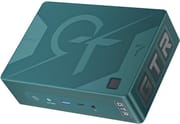
The Beelink GTR7 measures 6.61 x 4.72 x 1.93 inches and weighs just 1.87 pounds, making it noticeably larger than the ultra-compact SER-series but still remarkably small for the performance it delivers. The aluminum chassis came in four color options including Black Jade Green, Tourmaline Blue, Space Gray, and Hermes Orange, with a mesh ventilation panel on top replacing the fabric covering of the previous GTR6. The front panel houses a USB-C 3.2 Gen 2 port, a USB-A 3.2 port, and a 3.5mm headphone jack, while the rear packs dual USB4 ports, two USB 3.2 Type-A ports, two USB 2.0 ports, HDMI 2.1, DisplayPort 1.4, dual 2.5GbE Ethernet, and a second 3.5mm audio jack. A fingerprint reader integrated into the power button on top provides Windows Hello authentication, though ServeTheHome discovered it stops functioning when an eGPU is connected. Beelink’s vapor chamber cooling system keeps the processor well within thermal limits, with multiple reviewers reporting temperatures rarely exceeding 80°C during sustained workloads.
At the heart of the GTR7 lies the AMD Ryzen 7 7840HS with 8 Zen 4 cores and 16 threads, boosting up to 5.1 GHz at a 65W TDP. The integrated Radeon 780M GPU based on RDNA3 architecture with 12 compute units brings a transformative level of graphics performance to the mini PC form factor. Retro Game Corps found the GTR7 capable of running modern titles at playable framerates, calling it “a pretty compelling buy” for anyone seeking a desktop solution without a dedicated graphics card. MobileTechReview’s Lisa Gade compared the gaming experience to PlayStation-level performance, noting you could game comfortably if you stuck to 1080p at medium settings. The CPU scores approximately 28,872 on PassMark’s benchmark, and Tek Syndicate was surprised to find it rivaled the original AMD Threadripper in multi-threaded rendering tasks like Handbrake AV1 encoding while drawing a fraction of the power.
Connectivity on the GTR7 set a new standard for mini PCs at its launch. The dual Intel i225-V 2.5GbE controllers provide a combined 5Gbps of wired networking bandwidth, making it well-suited for NAS duties or network-intensive tasks. WiFi 6 (802.11ax) and Bluetooth 5.2 handle wireless connectivity, though several reviewers noted the omission of WiFi 6E was disappointing for a flagship product. The two USB4 ports on the rear deliver 40Gbps throughput each and support Thunderbolt 3 compatibility, enabling eGPU enclosures for users who need dedicated graphics performance. Storage expansion comes via dual M.2 2280 PCIe 4.0 x4 NVMe slots, each with a dedicated cooling fan and heatsink, and the DDR5 SO-DIMM slots support upgrades to 64GB of RAM.
Reviewer Insights on the Beelink GTR7

ServeTheHome’s Perspective
Patrick Kennedy at ServeTheHome conducted a thorough technical review including a complete teardown of the GTR7. He praised the redesigned chassis as a significant improvement over the GTR6, noting “this GTR7 I can say took all the feedback that we had from the previous gen units and made something that is absolutely special.” The dedicated internal cooling with a separate fan and shroud for the RAM and NVMe drives impressed him, though he found the internal screws required an annoyingly thin screwdriver to access.
Kennedy identified a notable firmware bug where the fingerprint reader stops functioning when an eGPU is connected, and experienced occasional system reboots when disconnecting and reconnecting external GPUs. He also pointed out that the proprietary magnetic power connector, while convenient for its snap-on design, would be difficult to replace if lost or damaged. Despite these issues, his overall assessment was positive, highlighting the GTR7 as a meaningful leap forward for the GTR series.
Retro Game Corps’ Gaming Focus
Retro Game Corps tested the GTR7 extensively as a gaming machine, emphasizing that the 65W TDP configuration allows the 7840HS to significantly outperform the same chip in battery-limited handhelds like the ROG Ally. “The big difference is that the GTR7 isn’t tethered down by battery life… this thing runs like a dream,” he explained. The all-metal construction earned praise for its sturdy build quality, though the reviewer found the extensive GTR branding on multiple sides “just a little bit gaudy.”
His gaming benchmarks demonstrated solid 1080p performance across a range of titles, making the GTR7 a compelling option for users who want a compact gaming-capable desktop. He noted the cooling system kept temperatures stable at 83°C even during extended stress tests, and fan noise was “perfectly acceptable” if not completely silent under load. The inclusion of both long and short HDMI cables for different desk and VESA mounting setups was a practical touch he appreciated.
MobileTechReview’s Professional Assessment
Lisa Gade at MobileTechReview evaluated the GTR7 as a professional productivity machine and was impressed by its versatility. “This is quality stuff and well packaged and well made. It’s got a metal casing, aluminum chassis, rigid, nice looking,” she observed. Her thermal testing confirmed the excellent cooling performance, with the CPU rarely exceeding 80°C during demanding workloads.
She highlighted the GTR7 as an important alternative to Intel NUCs, noting “it’s nice to see an alternative to Intel mini PCs or NUCs that has Ryzen inside and a current generation with this level of performance and wattage.” The dual USB4 ports with eGPU support and the highly upgradeable internals with two RAM slots and two M.2 slots made it particularly appealing for users who want room to grow. The turnkey 32GB DDR5 and 1TB SSD configuration also meant buyers could start working immediately without needing to source their own components.
TechHut’s Linux Perspective
TechHut reviewed the GTR7 primarily as a Linux desktop machine, praising the AMD platform’s excellent Linux compatibility. He noted that “this platform of mini PCs is still my choice for daily computing” and appreciated the improved rear I/O compared to the GTR6, which had traded versatility for four HDMI ports. The dual 2.5GbE Ethernet and strong integrated graphics made it his preferred compact Linux workstation.
He did criticize the proprietary magnetic power connector and found the chassis more difficult to open than competing designs, requiring specific tools and patience to access the internals. Fan noise at full load reached approximately 60 decibels, which he noted was definitely audible if the machine was sitting on your desk. He also observed that the new mesh ventilation panel on top showed dust buildup more visibly than the fabric covering on the GTR6.
Tek Syndicate’s Rendering Tests
Tek Syndicate found an unexpected use case for the GTR7 as a dedicated rendering node. “I didn’t expect a mini PC to be faster than any Threadripper, even the old original Threadripper… that’s pretty respectable performance,” he noted after running Handbrake encoding benchmarks. He praised the GTR7 as an efficient overnight rendering machine that consumed far less power than a full desktop while delivering competitive performance.
For emulation enthusiasts, he found the GTR7 handled demanding CRT shader filters smoothly, calling it an ideal living room machine for retro gaming. He described the cooling as “probably one of the quietest systems that I’ve heard,” noting it was inaudible with headphones on or with background ambient noise, though a high-pitched whine became noticeable at 100% CPU utilization.
TechRadar
According to TechRadar, the Beelink GTR7 is “an incredibly well-rounded machine that will appeal as one of the best mini PCs for gaming enthusiasts and creative professionals.” The review highlighted the M.2 storage performance as exceptional, with transfer speeds that helped the GTR7 punch above its weight in video editing and gaming scenarios. They were particularly impressed with its capability as a 4K video editing solution, noting it provided “substantial power to edit 4K Log3 footage with relative ease, effects and all.” TechRadar praised the sleek design and build quality while noting the premium price tag and somewhat limited port selection as drawbacks.
Reviewer Consensus
Across all six reviews, the consensus points to the GTR7’s 65W TDP performance, build quality, and dual 2.5GbE networking as its primary strengths. The proprietary magnetic power connector appears consistently as a concern, with nearly every reviewer mentioning it as a potential inconvenience. WiFi 6 instead of WiFi 6E was noted by multiple reviewers as a surprising omission for a flagship device. The cooling system earned universal praise for keeping the powerful processor well within thermal limits, though opinions on fan noise ranged from “barely noticeable” to “definitely audible” depending on the testing scenario and reviewer expectations.
Conclusion
The Beelink GTR7 arrived at an important moment in the mini PC market, proving that AMD’s Phoenix APU could deliver a compelling desktop experience in a compact, well-built package. Its combination of a 65W Ryzen 7 7840HS, RDNA3 integrated graphics, dual USB4 with eGPU support, and dual 2.5GbE networking made it one of the most versatile mini PCs of its generation. For anyone who picked one up, it remains a highly capable machine for productivity, light gaming, content creation, and even serving as a compact home server.
The GTR7 is no longer available through major retailers, having been superseded by newer models in Beelink’s lineup. Users looking for similar performance today should consider the Beelink SER8 or Beelink SER9 with newer AMD processors, or explore our Mini PC Comparison Chart to find the best current option for their needs.
Frequently Asked Questions
What processor does the Beelink GTR7 use?
The Beelink GTR7 is powered by the AMD Ryzen 7 7840HS, featuring 8 Zen 4 cores and 16 threads with a base clock of 3.8 GHz and boost up to 5.1 GHz. Configured at a 65W TDP in the GTR7, this processor handles demanding multi-threaded workloads and scores approximately 28,872 on PassMark’s CPU benchmark. The integrated AMD Radeon 780M GPU based on RDNA3 architecture provides capable graphics for 1080p gaming and 4K video editing.
Can I upgrade the RAM in the Beelink GTR7?
Yes, the Beelink GTR7 uses two DDR5 SO-DIMM slots with a maximum capacity of 64GB. The standard configuration ships with 2x16GB DDR5-5600 modules from Crucial. Both RAM modules are user-replaceable, though accessing the internals requires removing the bottom panel screws and an internal shroud, which reviewers noted needs a thin screwdriver.
What ports does the Beelink GTR7 have?
The Beelink GTR7 features a comprehensive port selection across front and rear panels. The front includes one USB-C 3.2 Gen 2 (10Gbps), one USB-A 3.2, and a 3.5mm headphone jack. The rear provides two USB4 ports (40Gbps each), two USB 3.2 Type-A ports, two USB 2.0 ports, HDMI 2.1, DisplayPort 1.4, dual 2.5GbE Ethernet ports, and a second 3.5mm audio jack. It supports up to four simultaneous displays using all video outputs.
What’s included in the box with the Beelink GTR7?
The Beelink GTR7 comes with the mini PC unit, a 100W magnetic power adapter, two HDMI cables of different lengths (one short for VESA mounting and one standard length), a VESA mounting bracket with screws, and a user manual. The inclusion of two HDMI cables is a thoughtful touch that accommodates different desk setups and mounting configurations.
Can the Beelink GTR7 connect to an external GPU?
Yes, the Beelink GTR7’s two rear USB4 ports support Thunderbolt 3 compatibility and can connect to eGPU enclosures for significantly enhanced graphics performance. ServeTheHome confirmed eGPU functionality in their review, though they noted a firmware bug that disables the fingerprint reader when an eGPU is connected, and occasional system reboots can occur when disconnecting and reconnecting external GPUs.
Is the Beelink GTR7 still available to purchase?
The Beelink GTR7 has been discontinued and is no longer readily available through major retailers like Amazon. It may occasionally appear through third-party sellers or refurbished markets. Users looking for similar performance should consider newer Beelink models like the SER8 or SER9, which offer updated processors and improved features while maintaining a similar form factor.
How loud is the Beelink GTR7 during operation?
Noise levels on the Beelink GTR7 vary by workload. During light tasks and idle operation, the system is very quiet and largely inaudible in a typical room environment. Under sustained heavy loads, fan noise becomes noticeable, with TechHut measuring approximately 60 decibels at close range during stress testing. Tek Syndicate described it as one of the quietest systems they’d tested, noting the fans were inaudible with headphones on, while Retro Game Corps called the noise “perfectly acceptable” under heavy gaming loads.