
Bmax B6
Updated on

The Bmax B6 puts a laptop-class Intel chip into a chassis 4.9 inches wide and 1.4 inches thick. The base build pairs a dual-core Core i3-1000NG4 with 12GB of LPDDR4 and a 512GB NVMe SSD, while the step-up builds move to the Core i5-1030NG7 or the Core i7-1060NG7 with 16GB of memory. Two HDMI ports drive 4K displays at 60Hz, and two M.2 NVMe slots leave room to add storage. Windows 11 Pro ships pre-installed even though the board carries no TPM 2.0, and the wireless stops at Wi-Fi 5 and Bluetooth 4.2.
| Pros | Cons |
|---|---|
| Intel Core i3 base tier, with i5 and i7 builds available | Lacks TPM for Windows 11, raising compatibility concerns |
| 12GB RAM and 512GB NVMe SSD | Uses older Wi-Fi 5 and Bluetooth 4.2 technology |
| Supports three 4K displays at 60Hz | RAM is soldered and non-upgradeable |
| Near-silent fan and a 43°C case under sustained load | No VESA mount for behind-the-monitor installation |
| Expandability options with two M.2 NVMe slots | The second M.2 slot runs at a single PCIe lane |
Related Videos
Bmax B6 Comparison Chart
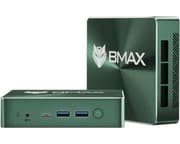 Bmax B6 | Bmax B6 | Bmax B6 | |
| Price | List Price: $239.99 Amazon Prices: | List Price: $379.99 Amazon Prices: | List Price: $199.99 Amazon Prices: Loading prices... |
| Version | 16GB/512GB/Intel Core i5-1030NG7 | 16GB/1TB/Intel Core i7-1060NG7 | 12GB/512GB/Intel Core i3-1000NG4 |
| Performance Rating | 5.2 | 5.3 | 4.2 |
| Operating System | Windows 11 Pro | Windows 11 Pro | Windows 11 Pro |
| Processor | Quad-core 1.10 Ghz (max 3.50 Ghz) Intel Core i5-1030NG7 | Quad-core 1.20 Ghz (max 3.80 Ghz) Intel Core i7-1060NG7 | Dual-core 1.10 Ghz (max 3.20 Ghz) Intel Core i3-1000NG4 |
| GPU | Integrated Intel Iris Plus Graphics | Integrated Intel Iris Plus Graphics | Integrated Intel Iris Plus Graphics |
| RAM | 16 GB | 16 GB | 12 GB |
| Internal Storage | 512 GB | 1 TB | 512 GB |
| Dimensions width x length x thickness | 4.9 x 4.4 x 1.4 inches (124.46 x 111.76 x 35.56 mm) | 4.9 x 4.4 x 1.4 inches (124.46 x 111.76 x 35.56 mm) | 4.9 x 4.4 x 1.4 inches (124.46 x 111.76 x 35.56 mm) |
| Weight | unknown | unknown | unknown |
| WiFi | Wi-Fi 5 (802.11ac) | Wi-Fi 5 (802.11ac) | Wi-Fi 5 (802.11ac) |
| Bluetooth | Bluetooth 4.2 | Bluetooth 4.2 | Bluetooth 4.2 |
| Ethernet | 1 Ethernet port at 1 Gbps | 1 Ethernet port at 1 Gbps | 1 Ethernet port at 1 Gbps |
| HDMI | 2 Full-Size HDMI Ports | 2 Full-Size HDMI Ports | 2 Full-Size HDMI Ports |
| DisplayPort | No DisplayPort | No DisplayPort | No DisplayPort |
| VGA | No VGA Ports | No VGA Ports | No VGA Ports |
| USB Ports | 3 USB 3, 1 USB-C | 3 USB 3, 1 USB-C | 3 USB 3, 1 USB-C |
| Thunderbolt Ports | No | No | No |
| OCuLink | No | No | No |
| Internal SATA Ports | No SATA ports | No SATA ports | No SATA ports |
| Card Reader | No Card Reader | No Card Reader | No Card Reader |
| Headphone Jack | combo | combo | combo |
| Fanless | No | No | No |
| VESA Mount | No | No | No |
| In the Box | Mini PC, power cable, ethernet cable, USB thumb drive | Mini PC, power cable, ethernet cable, USB thumb drive | Mini PC, power cable, ethernet cable, USB thumb drive |
| Expandability | Additional storage via NVMe slots, potential for software changes | Additional storage via NVMe slots, potential for software changes | Additional storage via NVMe slots, potential for software changes |
Related Mini PCs
-
 Bmax B4 PlusThe BMAX B4 Plus is an Intel N100 mini PC with a 2.5-inch SATA drive bay next to its M.2 slot, so a…
 -
 Bmax B4 UltraThe Bmax B4 Ultra is an ultra-compact mini PC featuring Intel's N150 processor, 12GB LPDDR5 RAM,…
 -
 ACEMAGIC S1 Mini PCThe ACEMAGIC S1 is a compact Intel N95 mini PC with 16GB of DDR4, dual M.2 slots, dual gigabit…
 -
 Beelink Mini S13A roughly $200 mini PC built around the Intel N150 with 16GB DDR4, dual M.2 PCIe 2280 slots, dual…
 -
 GMKtec NucBox G5The GMKtec NucBox G5 is a palm-sized Intel N97 mini PC with 12GB of LPDDR5, dual HDMI 2.0 (4K60),…
 -
 MOREFINE M6S Mini PCThe MOREFINE M6S is a 2.83-inch-square Intel N100 mini PC with 12GB of DDR5, a 512GB NVMe drive in…
Soldered memory caps a box that is otherwise easy to expand
The Core i3-1000NG4 runs at a 1.10 GHz base clock and turbos to 3.20 GHz, with Intel Iris Plus Graphics driving the displays. That combination covers light photo editing and media playback. PassMark rates the i5-1030NG7 and i7-1060NG7 builds higher still.
Two HDMI ports, three USB 3.0 ports, and one USB-C port cover peripherals and displays, with a combo headphone jack alongside them. Gigabit Ethernet handles wired networking. The Wi-Fi 5 radio is a step behind Wi-Fi 6 for anyone moving large files over the air, and Bluetooth 4.2 is old enough to matter for newer wireless peripherals.
At 4.9 inches wide, 4.4 inches deep, and 1.4 inches thick, the chassis fits behind a keyboard or inside a media cabinet, though there is no VESA mount for hanging it off a monitor. The two M.2 NVMe slots take a second drive when 512GB runs short. The LPDDR4 is soldered to the board, so the 12GB or 16GB you buy at the outset is what the machine keeps for its whole life, which is the ceiling on how long it stays useful for heavier work.
Reviewer Insights
The reviews below all cover the unit BMAX markets as the B6 Plus: the Intel Core i3-1000NG4 configuration with 12GB of LPDDR4 and a 512GB NVMe SSD. The i3-1000NG4 is an Ice Lake part that launched in the second quarter of 2020, which makes it roughly six years old in 2026, and it is dual-core. PassMark rates it at about 3,652, which sits below a current Intel N100 (about 5,643), despite the Amazon listing’s claim that the machine “Beats N150/N97/N100/N95.” That marketing line only holds for the step-up configurations: the i5-1030NG7 (PassMark about 5,743) and the i7-1060NG7 (about 6,588) do clear the N-series, but the i3 the base unit ships with does not.
Carey Holzman
Carey Holzman unboxed and tore down the B6 Plus live on 2023-08-10. He was first taken with the value, calling it “an incredible deal for what you’re getting” and “a crazy good deal,” since an i3 paired with 12GB of RAM was a step above the Celeron and N-series chips that dominated the price bracket. His teardown found the RAM soldered, the Realtek Wi-Fi 5 and Bluetooth 4.2 sharing one soldered module, and the second M.2 slot wired for a single PCIe lane instead of four. Inside Windows he found 11.7GB of the 12GB usable (the rest reserved for the integrated graphics) and noted the BIOS exposed a 35-watt power-limit setting, well above the chip’s 9-watt rating. He ran CrystalDiskMark on the bundled NVMe SSD and measured 2,491 MB/s sequential reads and 1,953 MB/s sequential writes, calling the result “decent at a gen 3 Drive.”
The review turned sharply when the PC Health Check flagged a missing TPM 2.0, even though the machine shipped with Windows 11 Pro (build 22H2). Holzman called it “a very serious problem, one that should not be taken lightly,” described BMAX shipping it this way as “unacceptable” and “disgraceful,” and advised running Windows 10 or Linux instead until the manufacturer clarified. You can watch the full review here.
Jim KJ3N
Jim KJ3N took the same B6 Plus and zeroed in on the two M.2 slots, pointing out that the case itself labels one slot “nvme 4X” and the other “nvme 1X,” so the second drive runs at a quarter of the bandwidth. Testing a drive in that single-lane slot, he measured “somewhere around 800 815 megabytes per second.” He then installed XigmaNAS booted from a USB stick and configured two 4TB NVMe drives as a ZFS mirror (RAID 1). Copying to the finished share over the unit’s gigabit Ethernet, CrystalDiskMark reported 118 MB/s, which he worked out to 94% of the 125 MB/s a 1GbE link can theoretically deliver: “that’s a winner in my book.” He closed by calling the build “a neat project.” Jim’s full review can be viewed here.
heise.de
Jonas Bettger benchmarked the machine for the German outlet heise.de. In his test of the B6 Plus, the system scored 3,155 points in PCMark 10, which he noted edged out some higher-priced quad-core machines such as the Nipogi AK1 Pro. CrystalDiskMark on the NVMe SSD returned 3,072 MB/s read and 1,986 MB/s write. Under a Prime95 load Bettger measured a case temperature of only 43°C using a Pixel 8 Pro thermal sensor, while cautioning that the figure is a rough reference rather than a lab measurement, and he described the fan as “quasi nicht messbar” (virtually unmeasurable), near silent even after more than an hour of Prime95. heise initially awarded four stars, then cut the score to two and advised against buying after security problems surfaced: c’t colleagues found a trojan in the firmware file BMAX offers for download and an improperly licensed Windows install. Bettger also flagged that, as of late 2026, the older i3 reaches the end of Windows 11 security updates that October.
The storage is quick for the class, at roughly 2,500 to 3,100 MB/s reads, and the cooling holds the case at 43°C under sustained load with a fan you have to press your ear to the chassis to hear. The dual M.2 slots make the box flexible, with the caveat that the second one is single-lane. Against that sit the missing TPM 2.0 and the licensing and firmware concerns heise raised, which together cost BMAX two stars there. For a buyer in 2026 the dual-core i3 also trails current N100 boxes on raw CPU throughput, so the B6 makes the most sense as a quiet, expandable home-server or light-desktop host running Windows 10 or Linux.
Customer Reviews
Amazon feedback is thin. Across just 2 ratings the B6 averages 2 stars, so treat that as a small, mixed sample rather than a settled verdict. The ratings split between 3-star and 1-star scores, with nothing in the 4-star or 5-star range, so no owner has come away enthusiastic.
A verified buyer using the handle GS left a 3-star review titled “Does not have TPM” and wrote: “Without TPM, this mini PC does not meet Windows 11 requirements. No certainty if the product would continue to receive OS updates if MS decides to enforce strict adherence to hardware requirements in the future.” If you plan to run Windows 11 on this machine, weigh that TPM gap before buying. Read more owner reviews on Amazon.
Best kept as a quiet home server or a light desktop on Windows 10 or Linux
The missing TPM 2.0 decides this machine for most buyers. Windows 11 Pro arrives pre-installed, the PC Health Check fails, and nothing guarantees continued updates if Microsoft enforces its hardware requirements. Installing Windows 10 or a Linux distribution sidesteps the problem, and the rest of the hardware suits an always-on role well: near-silent cooling, gigabit Ethernet, two M.2 NVMe slots, and a chassis small enough to tuck out of sight.
Everyday work runs fine on the i3 build, from web browsing and document editing through to media streaming, and the i5-1030NG7 and i7-1060NG7 builds add headroom at 16GB of memory for heavier loads. Anyone who needs official Windows 11 support, Wi-Fi 6, memory they can swap, or a VESA mount should look at a newer model.
Starry Hope’s Mini PC Comparison Tool puts the B6 alongside other models on specifications and features.
Frequently Asked Questions
Q: What operating system comes pre-installed on the Bmax B6?
A: Windows 11 Pro. The board carries no TPM 2.0, so the PC Health Check flags the machine as unsupported even though the operating system is already installed.
Q: Does it support Wi-Fi and Bluetooth?
A: Yes, Wi-Fi 5 and Bluetooth 4.2, both on a single soldered Realtek module.
Q: Can I upgrade the RAM?
A: No. The LPDDR4 is soldered to the board, so choose between the 12GB and 16GB builds at purchase.
Q: What storage options are available?
A: Two M.2 NVMe slots, one wired for four PCIe lanes and one for a single lane. The base build ships with a 512GB NVMe SSD.
Q: Can it drive multiple displays?
A: Up to three 4K displays at 60Hz, with the two HDMI ports handling the first two.
Q: Can it work as a home NAS?
A: Owners have done it. Jim KJ3N booted XigmaNAS from a USB stick and ran two 4TB NVMe drives as a ZFS mirror, reaching 118 MB/s over the gigabit link.
Q: What known issues should I be aware of?
A: The absence of a TPM 2.0 module, which Windows 11 requires. heise.de also reported a trojan in the firmware file BMAX offers for download and an improperly licensed Windows install.
Q: What processor is included?
A: The base build uses the Intel Core i3-1000NG4, a two-core, four-thread chip with a 1.10 GHz base speed and a 3.20 GHz maximum. The i5-1030NG7 and i7-1060NG7 are the step-up options.