
Bmax B6
Updated on

The Bmax B6 Mini PC is a compact computing solution that stands out for its balance between performance and size. Equipped with an Intel Core i3-1000NG4 processor, the Bmax B6 offers a solid performance foundation for everyday tasks. It includes 12GB of LPDDR4 RAM and a 512GB NVMe SSD, providing ample memory and fast storage. The Mini PC supports dual HDMI for 4K displays at 60Hz, catering to users who require high-resolution outputs. While it operates on the latest Windows 11 Pro, there is a notable discrepancy regarding the system’s compatibility with the OS, specifically concerning the Trusted Platform Module (TPM) requirements. The Bmax B6 also features Wi-Fi 5 and Bluetooth 4.2 connectivity, although these are not the latest versions.
| Pros | Cons |
|---|---|
| Intel Core i3 processor offers good performance | Lacks TPM for Windows 11, raising compatibility concerns |
| 12GB RAM and 512GB NVMe SSD | Uses older Wi-Fi 5 and Bluetooth 4.2 technology |
| Supports three 4K displays at 60Hz | RAM is soldered and non-upgradeable |
| Competitive pricing for the specifications | No VESA mount for behind-the-monitor installation |
| Expandability options with two M.2 NVMe slots | Fan-cooled design may not be as quiet as fanless alternatives |
Related Videos
Bmax B6 Comparison Chart
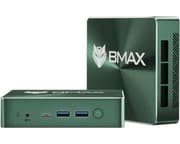 Bmax B6 | Bmax B6 | Bmax B6 | |
| Price | List Price: $239.99 Amazon Prices: | List Price: $379.99 Amazon Prices: | List Price: $199.99 Amazon Prices: Loading prices... |
| Version | 16GB/512GB/Intel Core i5-1030NG7 | 16GB/1TB/Intel Core i7-1060NG7 | 12GB/512GB/Intel Core i3-1000NG4 |
| Performance Rating | 5.2 | 5.3 | 4.2 |
| Operating System | Windows 11 Pro | Windows 11 Pro | Windows 11 Pro |
| Processor | Quad-core 1.10 Ghz (max 3.50 Ghz) Intel Core i5-1030NG7 | Quad-core 1.20 Ghz (max 3.80 Ghz) Intel Core i7-1060NG7 | Dual-core 1.10 Ghz (max 3.20 Ghz) Intel Core i3-1000NG4 |
| GPU | Integrated Intel Iris Plus Graphics | Integrated Intel Iris Plus Graphics | Integrated Intel Iris Plus Graphics |
| RAM | 16 GB | 16 GB | 12 GB |
| Internal Storage | 512 GB | 1 TB | 512 GB |
| Dimensions width x length x thickness | 4.9 x 4.4 x 1.4 inches (124.46 x 111.76 x 35.56 mm) | 4.9 x 4.4 x 1.4 inches (124.46 x 111.76 x 35.56 mm) | 4.9 x 4.4 x 1.4 inches (124.46 x 111.76 x 35.56 mm) |
| Weight | unknown | unknown | unknown |
| WiFi | Wi-Fi 5 (802.11ac) | Wi-Fi 5 (802.11ac) | Wi-Fi 5 (802.11ac) |
| Bluetooth | Bluetooth 4.2 | Bluetooth 4.2 | Bluetooth 4.2 |
| Ethernet | 1 Ethernet port at 1 Gbps | 1 Ethernet port at 1 Gbps | 1 Ethernet port at 1 Gbps |
| HDMI | 2 Full-Size HDMI Ports | 2 Full-Size HDMI Ports | 2 Full-Size HDMI Ports |
| DisplayPort | No DisplayPort | No DisplayPort | No DisplayPort |
| VGA | No VGA Ports | No VGA Ports | No VGA Ports |
| USB Ports | 3 USB 3, 1 USB-C | 3 USB 3, 1 USB-C | 3 USB 3, 1 USB-C |
| Thunderbolt Ports | No | No | No |
| OCuLink | No | No | No |
| Internal SATA Ports | No SATA ports | No SATA ports | No SATA ports |
| Card Reader | No Card Reader | No Card Reader | No Card Reader |
| Headphone Jack | combo | combo | combo |
| Fanless | No | No | No |
| VESA Mount | No | No | No |
| In the Box | Mini PC, power cable, ethernet cable, USB thumb drive | Mini PC, power cable, ethernet cable, USB thumb drive | Mini PC, power cable, ethernet cable, USB thumb drive |
| Expandability | Additional storage via NVMe slots, potential for software changes | Additional storage via NVMe slots, potential for software changes | Additional storage via NVMe slots, potential for software changes |
Related Mini PCs
-
 Bmax B4 PlusThe BMAX B4 Plus Mini PC delivers Intel N100 performance with a unique 2.5-inch SATA expansion bay…
 -
 Bmax B4 UltraThe Bmax B4 Ultra is an ultra-compact mini PC featuring Intel's N150 processor, 12GB LPDDR5 RAM,…
 -
 ACEMAGIC S1 Mini PCThe ACEMAGIC S1 is a compact Intel N95 mini PC with 16GB of DDR4, dual M.2 slots, dual gigabit…
 -
 Beelink Mini S13A roughly $200 mini PC built around the Intel N150 with 16GB DDR4, dual M.2 PCIe 2280 slots, dual…
 -
 GMKtec Nucbox G5The GMKtec NucBox G5 is a palm-sized Intel N97 mini PC with 12GB of LPDDR5, dual HDMI 2.0 (4K60),…
 -
 HIGOLE GOLE 2 PROPacking an Intel Celeron N5095, Intel UHD Graphics, and extensive connectivity including Wi-Fi 5…
Detailed Information about the Bmax B6
The Bmax B6 Mini PC is designed for users who need a space-saving computer without compromising performance. The Intel Core i3-1000NG4 processor, with a base speed of 1.10 GHz and a max turbo frequency of 3.20 GHz, is a notable upgrade from the typical Celeron and N-series processors in many mini PCs. This processor, combined with Intel Iris Plus Graphics, makes the Bmax B6 suitable for various tasks, including light photo editing and media consumption.
Regarding connectivity, the Bmax B6 offers a variety of ports, including two HDMI ports, three USB 3.0 ports, and one USB-C port, providing users with multiple options for peripherals and displays. Including Ethernet and Wi-Fi 5 ensures that users can connect to the internet via cable or wirelessly, although the absence of the latest Wi-Fi 6 may be a drawback for some.
The Bmax B6’s small footprint, measuring 4.9 inches in width, 4.4 inches in length, and 1.4 inches in thickness, makes it an ideal choice for environments where desk space is at a premium. Despite its compact size, the Bmax B6 offers additional storage expansion through its two M.2 NVMe slots, allowing users to increase storage capacity or add a high-speed drive for improved performance. However, potential buyers should note that the RAM is soldered onto the motherboard, which means memory is not upgradeable, potentially limiting the Mini PC’s lifespan for more demanding applications in the future.
Reviewer Insights on the BMAX B6
The reviews below all cover the unit BMAX markets as the B6 Plus: the Intel Core i3-1000NG4 configuration with 12GB of LPDDR4 and a 512GB NVMe SSD (the i3 variant tracked on this page). A note on the chip first. The i3-1000NG4 is an Ice Lake part that launched in the second quarter of 2020, which makes it roughly six years old in 2026, and it is dual-core. PassMark rates it at about 3,652, which actually sits below a current Intel N100 (about 5,643), despite the Amazon listing’s claim that the machine “Beats N150/N97/N100/N95.” That marketing line only holds for the step-up configurations: the i5-1030NG7 (PassMark about 5,743) and the i7-1060NG7 (about 6,588) do clear the N-series, but the i3 the base unit ships with does not. Keep that gap in mind alongside the measured results below.
Carey Holzman
Carey Holzman unboxed and tore down the B6 Plus live on 2023-08-10. He was first taken with the value, calling it “an incredible deal for what you’re getting” and “a crazy good deal,” since an i3 paired with 12GB of RAM was a step above the Celeron and N-series chips that dominated the price bracket. His teardown confirmed what the spec sheet implies: the RAM is soldered, the Realtek Wi-Fi 5 and Bluetooth 4.2 share one soldered module, and the second M.2 slot is wired for a single PCIe lane rather than four. Inside Windows he found 11.7GB of the 12GB usable (the rest reserved for the integrated graphics) and noted the BIOS exposed a 35-watt power-limit setting, well above the chip’s 9-watt rating. He ran CrystalDiskMark on the bundled NVMe SSD and measured 2,491 MB/s sequential reads and 1,953 MB/s sequential writes, calling the result “decent at a gen 3 Drive.”
The review turned sharply when the PC Health Check flagged a missing TPM 2.0, even though the machine shipped with Windows 11 Pro (build 22H2). Holzman called it “a very serious problem, one that should not be taken lightly,” described BMAX shipping it this way as “unacceptable” and “disgraceful,” and advised running Windows 10 or Linux instead until the manufacturer clarified. You can watch the full review here.
Jim KJ3N
Jim KJ3N took the same B6 Plus and zeroed in on the two M.2 slots, pointing out that the case itself labels one slot “nvme 4X” and the other “nvme 1X,” so the second drive runs at a quarter of the bandwidth. Testing a drive in that single-lane slot, he measured “somewhere around 800 815 megabytes per second.” Rather than run the machine as a desktop, he installed XigmaNAS booted from a USB stick and configured two 4TB NVMe drives as a ZFS mirror (RAID 1). Copying to the finished share over the unit’s gigabit Ethernet, CrystalDiskMark reported 118 MB/s, which he worked out to 94% of the 125 MB/s a 1GbE link can theoretically deliver: “that’s a winner in my book.” He closed by calling the build “a neat project.” Jim’s full review can be viewed here.
heise.de
The German outlet heise.de is the one source with bench-grade numbers. In Jonas Bettger’s test of the B6 Plus, the system scored 3,155 points in PCMark 10, which he noted edged out some higher-priced quad-core machines such as the Nipogi AK1 Pro. CrystalDiskMark on the NVMe SSD returned 3,072 MB/s read and 1,986 MB/s write. Under a Prime95 load Bettger measured a case temperature of only 43°C using a Pixel 8 Pro thermal sensor, while cautioning that the figure is a rough reference rather than a lab measurement, and he described the fan as “quasi nicht messbar” (virtually unmeasurable), near silent even after more than an hour of Prime95. heise initially awarded four stars, then cut the score to two and advised against buying after security problems surfaced: c’t colleagues found a trojan in the firmware file BMAX offers for download and an improperly licensed Windows install. Bettger also flagged that, as of late 2026, the older i3 reaches the end of Windows 11 security updates that October.
Across all three reviews a consistent picture emerges. The storage is genuinely quick for the class (roughly 2,500 to 3,100 MB/s reads), the cooling is effective and quiet (43°C under sustained load, a fan you have to press your ear to the case to hear), and the chassis is flexible thanks to the dual M.2 slots, with the caveat that the second one is single-lane. The recurring catch is the missing TPM 2.0 alongside the licensing and firmware concerns heise raised, which together cost BMAX two stars there. For a buyer in 2026, the dual-core i3 also trails current N100 boxes on raw CPU throughput, so the B6 makes the most sense as a quiet, expandable home-server or light-desktop host running Windows 10 or Linux rather than as a Windows 11 daily driver.
Customer Reviews of the Bmax B6
The Bmax B6 has barely any feedback to go on: across just 2 ratings on Amazon it averages 2 stars, so treat that as a small, mixed sample rather than a settled verdict. The ratings split between 3-star and 1-star scores, with nothing in the 4-star or 5-star range, so no owner has come away enthusiastic.
The one written review names a concrete limitation. A verified buyer using the handle GS left a 3-star review titled “Does not have TPM” and wrote: “Without TPM, this mini PC does not meet Windows 11 requirements. No certainty if the product would continue to receive OS updates if MS decides to enforce strict adherence to hardware requirements in the future.” If you plan to run Windows 11 on this machine, weigh that TPM gap before buying. Read more owner reviews on Amazon.
Conclusion
The Bmax B6 Mini PC, with its Intel Core i3-1000NG4 processor, 12GB LPDDR4 RAM, and 512GB NVMe SSD, presents a compelling option for users seeking a compact yet capable computing solution. Its ability to support three 4K displays and the inclusion of multiple USB ports enhance its versatility for various applications, from office work to media consumption.
However, despite lacking TPM support, the Bmax B6’s advertised compatibility with Windows 11 Pro is a significant concern. Users requiring a system for sensitive tasks may need to reconsider or opt for an alternative operating system like Windows 10 to ensure security and stability.
The Bmax B6 is well-suited for users looking for a budget-friendly mini PC with decent performance for everyday tasks like web browsing, document editing, and media streaming. It could also be a compact home server or NAS when repurposed with suitable software. On the other hand, users who prioritize up-to-date security features and official Windows 11 support or who engage in more demanding computing tasks might want to explore other options.
For those interested in comparing the Bmax B6 with other mini PCs on the market, Starry Hope’s Mini PC Comparison Tool offers a convenient way to evaluate different models based on specifications and features.
Frequently Asked Questions
Q: What operating system comes pre-installed on the Bmax B6?
A: The Bmax B6 comes with Windows 11 Pro pre-installed. However, it’s important to note that there have been concerns regarding its compatibility with Windows 11, as some users have reported that it may only meet some of the system requirements.
Q: Does the Bmax B6 support Wi-Fi and Bluetooth connectivity?
A: The Bmax B6 supports Wi-Fi 5 and Bluetooth 4.2, allowing wireless connectivity options.
Q: Can I upgrade the RAM on the Bmax B6?
A: The RAM on the Bmax B6 is soldered and non-upgradeable. It’s crucial to choose a model with adequate RAM for your needs from the start.
Q: What are the storage options available on the Bmax B6?
A: The Bmax B6 features two M.2 NVMe slots for storage expansion. The base model comes with a 512GB NVMe SSD.
Q: Is the Bmax B6 capable of supporting multiple displays?
A: Yes, the Bmax B6 can support up to three 4K displays at 60Hz, thanks to its two HDMI ports.
Q: Can I use the Bmax B6 as a home NAS?
A: While not initially designed for this purpose, some users have successfully repurposed the Bmax B6 as a home NAS by installing open-source storage platforms like XigmaNAS.
Q: Are there any known issues with the Bmax B6 that I should be aware of?
A: Some reviewers have raised concerns about the Bmax B6’s compatibility with Windows 11, specifically regarding the absence of a TPM (Trusted Platform Module), which is a requirement for Windows 11.
Q: What type of processor is included in the Bmax B6?
A: The Bmax B6 is equipped with an Intel Core i3-1000NG4 processor with two cores and four threads, with a base speed of 1.10 GHz and a max speed of 3.20 GHz.