
CTL Chromebook NL7T-360
Updated on

CTL no longer sells the NL7T-360 as a new unit. Only refurbished units are currently available from CTL’s renewed product line. The Chrome OS Auto Update Expiration for this device is June 2027 per Google’s official Chrome Enterprise auto-update policy page, so a working unit is still inside the Chrome OS security-update window for approximately one more year as of mid-2026. This page is maintained for owners and IT departments researching their existing hardware.
The CTL Chromebook NL7T-360 launched in 2018 as part of CTL’s education-fleet NL7 series and was designed end-to-end around K-12 classroom durability rather than consumer specs-sheet competition. The 11.6-inch IPS touchscreen sits behind Corning Gorilla Glass, the 360-degree hinge supports laptop / tent / stand / tablet modes, and CTL drop-tested the chassis from 70 cm. Internally the device runs an Intel Celeron N3350 dual-core Apollo Lake SoC, 4GB of LPDDR4, and 32GB of eMMC storage; externally the port layout is 2x USB-C (charge-capable), 2x USB-A 3.0, a microSD slot, and a combo headphone / microphone jack. CTL sold the device almost exclusively through education and government channels (TD SYNNEX, Ingram Micro, direct district purchasing), and consumer retail availability was always limited.
Variants and the broader NL7 family
This page tracks the single CTL-listed configuration: model number CTLNL7T, 4GB RAM, 32GB eMMC, $249.99 list at launch. CTL revised the chassis during the production run to a slightly thicker, heavier “stronger rear cover” version (CTL’s own education spec sheet lists the updated version at 2.8 lbs and 0.84 inches thick at a $355.95 institutional price); the frontmatter dimensions on this page reflect the original 2018 launch spec at 2.49 lbs and 0.78 inches.
The broader NL7 line covered three sibling SKUs that all shared the same general chassis and Apollo Lake silicon:
| Model | Form factor | Stylus | Notable difference |
|---|---|---|---|
| NL7 | Standard clamshell (no touch) | None | Lowest-cost SKU; no 360-degree hinge |
| NL7T-360 | 360-degree convertible (touch) | None | The variant tracked on this page |
| NL7TW-360 | 360-degree convertible (touch) | Wacom EMR | Adds Wacom EMR stylus support for note-taking |
All three SKUs sit on Google’s Chrome OS auto-update policy at the same June 2027 expiration date. CTL also sold an LTE-capable NL7 follow-on (the NL71 series, AUE June 2029) and later NL72 / NL73 generations with newer silicon and longer AUE windows.
Hardware and connectivity
The Intel Celeron N3350 is the entry-level Apollo Lake dual-core part: 2 cores / 2 threads, 1.10 GHz base clock, 2.40 GHz Intel Burst boost, 6W TDP, with Intel HD Graphics 500 on the same die. It is a 2016-era SoC that aimed at low-power, fanless K-12 Chromebooks rather than performance. In practice it handles Chrome OS web workloads (Google Workspace for Education, classroom web apps, modest Android apps) at the 2-3 tab range with light slowdowns past five or six tabs, especially as web applications have grown more complex through the device’s support lifetime.
Memory is 4GB of soldered LPDDR4 in a single-rank configuration; the 32GB eMMC is also soldered. Neither is user-upgradable. CTL marketed the device with a sealed-chassis education repair model that pushed serviceable parts (battery, keyboard) into their own warranty program rather than expecting field upgrades.
Connectivity is a mix that was forward-looking for 2018 in some respects and conservative in others:
- 2x USB Type-C (both charge-capable): unusual at this price point in 2018 and useful because schools could deploy a single USB-C charging cart and not worry about cable orientation
- 2x USB Type-A 3.0: standard education-class peripheral ports
- microSD card slot: the primary storage expansion path past the 32GB eMMC
- Combo 3.5mm headphone / microphone jack
- No HDMI: display output runs through USB-C with DisplayPort Alt Mode
- No Ethernet jack: schools wanting wired networking attach a USB Ethernet adapter to one of the USB-A or USB-C ports
Wireless is an Intel Dual Band 3265 module: 2x2 802.11ac on 2.4 GHz and 5 GHz with Bluetooth 4.0. That is a reasonable 2018 spec; the lack of Wi-Fi 6 was expected at the price point.
The build quality story is where CTL puts the most effort. The chassis has a water-resistant keyboard, reinforced ports, reinforced hinges, and a reinforced power plug. CTL ships the unit with drop-test rating from 70 cm (a typical school-desk fall) and Corning Gorilla Glass over the touchscreen. The device has two HD cameras (a 1MP front-facing camera for video conferencing and a 5MP rear camera for hands-on science / inquiry activities), a configuration that was specifically pitched at the science-class market. The newer-revision chassis adds a retractable carrying handle on the rear edge for students moving between classes.
The fanless thermal design keeps the unit completely silent. The 6W N3350 does not need active cooling, and the closed chassis without a fan vent reduces dust ingress in long-term classroom deployment.
CTL rated the device for up to 12 hours of battery life under their own test profile. Real-world battery on a well-aged unit in 2026 will land lower depending on the specific cells in the SKU and how often the device has been charged.
CTL’s education channel and why the page is archived
CTL is a Beaverton, Oregon-based education-channel OEM rather than a retail consumer brand. Their entire go-to-market is built around K-12 and higher-ed IT procurement: dedicated account managers, custom warranty and accidental-damage programs, two-way RMA shipping, in-house US-based support, and bulk-deploy / repair-credit programs (CTL even runs a student Chromebook repair training program that uses real units as teaching hardware). That distribution model is why professional consumer-press reviews of CTL devices are essentially nonexistent: the addressable buyer is a school district IT director, not a TechRadar reader.
ChromeOS support is not the limiting factor here: the device is still inside its Auto Update window through June 2027 as of mid-2026. The reason it reads as a past-tense product is that CTL has retired the NL7T-360 from new-unit production and now lists it only as a Certified Renewed unit, alongside the more recent NL71, NL72, and NL73 generations. This page stays up as a reference for owners and IT departments that still have these in their fleet.
Auto Update Expiration: what June 2027 means for owners
Google’s published auto-update policy for the NL7T-360 / NL7TW-360 is June 2027 with an asterisk indicating Google extended the date past the original 2024 estimate as part of the broader 2023 Chrome OS extended-support expansion. Practically:
- Until June 2027, the device continues to receive Chrome OS security updates and feature releases on the standard Chrome OS update channel.
- After June 2027 the device stops receiving updates. The hardware still boots and Chrome still loads, but the frozen Chrome version no longer ships patches for newly disclosed vulnerabilities, and an increasing list of web platform features falls out of support.
For a school district that bought NL7T-360 units in 2018 / 2019, the practical question is whether to refresh now (before June 2027) or coast on the existing fleet until Chrome OS support actually expires. Both paths are reasonable; CTL’s own product roadmap (NL71, NL72, NL73) gives a direct in-channel upgrade path.
For an individual owner who acquired one after the district refresh cycle, the post-2027 path is the same as any AUE Apollo Lake Chromebook: either keep the device on a constrained, trusted-network workload (a kids’ first browser, a kitchen recipe browser, a guest-network kiosk) or reflash. The Apollo Lake CORAL / CANDY firmware family is supported by the MrChromebox firmware utility; a school IT department or a hobbyist owner can flash a UEFI / coreboot firmware and install a current Linux distribution after removing the write-protect screw. The 32GB eMMC is tight for a desktop Linux install, so an SD card or USB drive is effectively required for working storage.
Strengths and weaknesses
| Strengths | Weaknesses |
|---|---|
| 360-degree convertible hinge supports four use modes | 1366x768 panel resolution feels coarse in 2026 |
| Drop-tested to 70 cm; Corning Gorilla Glass touchscreen | Intel Celeron N3350 is entry-level Apollo Lake silicon |
| Dual USB-C ports both charge-capable (rare for 2018) | 4GB RAM soldered; not user-upgradeable |
| 12-hour rated battery, fanless silent operation | 32GB eMMC soldered; expansion only via microSD |
| Education-class warranty, US-based support, RMA shipping | No HDMI port; external display via USB-C only |
| Dual HD cameras (1MP front + 5MP rear) for science classes | Only Bluetooth 4.0 |
| Chrome OS auto-update support through June 2027 | CTL retired new sales; refurbished only |
CTL Chromebook NL7T-360 Comparison Chart
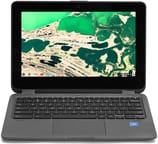 CTL Chromebook NL7T-360 | |
| Price | List Price: $249.99 Amazon Prices: |
| Model number | CTLNL7T |
| Performance Rating | 2.8 |
| Chromebook Plus | No |
| Processor | Dual-core 1.10 Ghz (max 2.40 Ghz) Intel Celeron N3350 |
| RAM | 4 GB |
| Internal Storage | 32 GB eMMC |
| Screen Size | 11.6" |
| Screen Resolution | 1366x768 |
| Screen Type | IPS |
| Touch Screen | Yes |
| Stylus / Pen | No Stylus Support |
| Dimensions width x length x thickness | 12.13 x 8.27 x 0.78 inches (308.1 x 210.06 x 19.81 mm) |
| Weight | 2.49 lbs (1.13 kg) |
| Backlit Keyboard | No |
| Webcam | HD |
| WiFi | 802.11 a/b/g/n/ac (2x2) |
| Bluetooth | Bluetooth 4.0 |
| Ethernet | No |
| Cellular Modem | No |
| HDMI | No HDMI |
| USB Ports | 2 USB 3, 2 USB-C |
| Thunderbolt Ports | No |
| Card Reader | microSD Card Reader |
| Battery | unknown |
| Battery Life | 12.0 hours |
| Fanless | Yes |
| Auto Update Expiration Date | June, 2027 |
Related Chromebooks
-
 ASUS Chromebook Flip CR1The ASUS Chromebook Flip CR1 (CR1100FKA) is a rugged 11.6-inch education convertible on an Intel…
 -
 Acer Chromebook Spin 11 CP311The Acer Chromebook Spin 11 combines functionality and portability with its 11.6-inch touch IPS…
 -
 Lenovo Flex 3 ChromebookThe Lenovo Flex 3 Chromebook hits the sweet spot with its 11.6-inch IPS touchscreen, 4GB RAM, and…
 -
 ASUS Chromebook Flip C214The ASUS Chromebook Flip C214 combines versatility with a 360° hinge, 11.6-inch anti-glare…
 -
 Acer Chromebook 15The Acer Chromebook 15 stands out with a 15.6" FHD IPS touch display, backlit keyboard, and up to…
 -
 Samsung Chromebook Plus v2The Samsung Chromebook Plus v2 boasts a versatile 12.2" touch LED screen, dual cameras, and pen…
If you are weighing options across the current Chromebook lineup, the Chromebook Comparison Chart lets you sort and filter specs side by side.
Frequently asked questions
Q: When does the CTL Chromebook NL7T-360 reach end of life?
A: Google’s Chrome Enterprise & Education auto-update policy lists the Chromebook NL7T-360 / NL7TW-360 at June 2027 (extended from the original Apollo Lake date). Until then the device continues to receive Chrome OS security updates and feature releases. An earlier revision of this page incorrectly listed the AUE as November 2023; that has been corrected.
Q: Is the CTL Chromebook NL7T-360 still sold new?
A: No. CTL has retired the SKU from new-unit production. CTL still sells it as a Certified Renewed product through their refurbished line. Schools or buyers looking for a current CTL Chromebook should look at the NL71, NL72, or NL73 generations with longer AUE windows.
Q: What processor does the CTL Chromebook NL7T-360 have?
A: The CTL Chromebook NL7T-360 uses the Intel Celeron N3350, an Apollo Lake dual-core SoC with a 1.10 GHz base clock, a 2.40 GHz Intel Burst boost, and Intel HD Graphics 500 on-die. The chip is fanless at its 6 W TDP.
Q: Is the CTL Chromebook NL7T-360 a touchscreen?
A: Yes. The 11.6-inch IPS panel is a 10-point multi-touch touchscreen with Corning Gorilla Glass. Combined with the 360-degree hinge, the device can be used in laptop, tent, stand, and tablet modes.
Q: What is the battery life of the CTL Chromebook NL7T-360?
A: CTL rated the NL7T-360 for up to 12 hours on their test profile. Real-world battery on an aged classroom unit in 2026 lands lower depending on screen brightness, workload, and battery cycle count. The battery is field-serviceable through CTL’s standard repair program.
Q: Can you expand storage on the CTL Chromebook NL7T-360?
A: The 32GB internal eMMC is soldered and not upgradeable. The microSD card slot is the primary expansion path; an SD card can be mounted as the Linux home directory under the Crostini Linux container or as bulk storage for downloaded files.
Q: What is the difference between the CTL NL7T-360 and NL7TW-360?
A: Both are 360-degree convertible touchscreens on the same Apollo Lake platform. The NL7T-360 has the entry-level Intel Celeron N3350; the NL7TW-360 ships with the slightly faster Intel Celeron N3450 (4 cores instead of 2) and adds Wacom EMR stylus support for drawing and digital note-taking. Both share the same June 2027 Google AUE.
Q: Can I install Linux on a CTL Chromebook NL7T-360?
A: Yes, but with caveats. The Apollo Lake platform on the N3350 is in the CORAL / CANDY firmware-target family supported by the MrChromebox firmware utility, which means an owner can flash a UEFI or coreboot firmware after removing the write-protect screw and install a current Linux distribution. The 32GB eMMC is small for a full desktop Linux install, so an SD card or external USB drive for working storage is effectively required. None of this is officially supported by CTL or Google.