
Beelink SER9 Max
Updated on

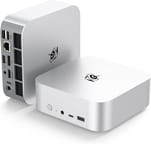
The Beelink SER9 Max is a 5.31-inch aluminum box built around an AMD Ryzen 7 H 255, an 8-core, 16-thread chip that boosts to 4.9GHz. Its 10Gbps Ethernet port does more to define the machine than the processor does, and USB4 at 40Gbps, triple 4K output at 240Hz, and two DDR5 slots reaching 128GB fill in around it. The H 255 build comes with 32GB or 64GB of memory and a 1TB drive. Beelink also sells the same chassis with a Ryzen AI 7 H 350, a Zen 5 chip with Radeon 860M graphics and a 50 TOPS NPU, in 32GB and 64GB builds with a 1TB drive, and with a Ryzen 7 260 (Beelink calls it the H 260), a Zen 4 chip with the same Radeon 780M graphics and a 5.1GHz boost, in a 64GB/1TB build. Every build leaves the second NVMe slot open for upgrades. Proxmox virtualization and 4K video editing both fall inside what it handles.
Networking and cooling win, the CPU does not
| Pros | Cons |
|---|---|
| 10Gbps Ethernet with auto-downspeed to 2.5GbE | Realtek NIC incompatible with VMware ESXi |
| USB4 40Gbps with Power Delivery and DisplayPort Alt Mode | No NPU on the H 255 build |
| MSC 2.0 vapor chamber stays relatively quiet under load | WiFi 6, not WiFi 6E or 7 |
| Dual M.2 PCIe 4.0 slots supporting up to 8TB total | Pre-installed bloatware (Wondershare software) |
| DDR5 memory upgradable to 128GB | No pure performance gain over previous SER8 |
| Low 8W idle power consumption | The H 350 build’s Radeon 860M has 8 compute units to the 780M’s 12 |
Related Videos
Beelink SER9 Max Comparison Chart
5 configurations
| Configuration | Processor | RAM | GPU | Performance | List price | Amazon price | Compare |
|---|---|---|---|---|---|---|---|
| 32GB/1TB/AMD Ryzen 7 H 255 | Ryzen 7 H 255CPU Mark 28,290 | 32 GB | AMD Radeon 780M | 5.6 | $679 | Details
| |
| 32GB/1TB/AMD Ryzen AI 7 H 350 | Ryzen AI 7 H 350CPU Mark 26,236 | 32 GB | AMD Radeon 860M | 5.4 | $1,029.00 | Loading... | Details
|
| 64GB/1TB/AMD Ryzen AI 7 H 350 | Ryzen AI 7 H 350CPU Mark 26,236 | 64 GB | AMD Radeon 860M | 5.6 | $1,369.00 | Details
| |
| 64GB/1TB/AMD Ryzen 7 H 255 | Ryzen 7 H 255CPU Mark 28,290 | 64 GB | AMD Radeon 780M | 5.7 | $1,149.00 | Loading... | Details
|
| 64GB/1TB/AMD Ryzen 7 260 | Ryzen 7 260CPU Mark 27,924 | 64 GB | AMD Radeon 780M | 5.7 | $1,239.00 | Details
|
Specs shared by every configuration
| Operating System | Windows 11 Pro |
|---|---|
| Internal Storage | 1 TB |
| Dimensions width x length x thickness | 5.31 x 5.31 x 1.76 inches (134.87 x 134.87 x 44.7 mm) |
| Weight | 1.72 lbs (0.78 kg) |
| WiFi | Wi-Fi 6 (802.11ax) |
| Bluetooth | Bluetooth 5.2 |
| Ethernet | 1 Ethernet port at 10 Gbps |
| HDMI | 1 HDMI Port |
| DisplayPort | 1 DisplayPort (1x DP 2.1; USB4 adds DP 1.4 Alt Mode) |
| VGA | No VGA Ports |
| USB Ports | 2 USB 2.0, 3 USB 3, 2 USB-C (1 USB4) |
| Thunderbolt Ports | No |
| OCuLink | No |
| Internal SATA Ports | No SATA ports |
| Card Reader | No Card Reader |
| Headphone Jack | combo |
| Fanless | No |
| VESA Mount | No |
| In the Box | Mini PC unit, power adapter (19V 5.26A), HDMI cable, user manual |
| Expandability | 2x DDR5 SO-DIMM slots (32GB or 64GB installed by build, upgradable to 128GB), 2x M.2 2280 PCIe 4.0 x4 NVMe (supports up to 8TB total) |
See every AMD Ryzen 7 H 255 configuration in the chartSee every AMD Ryzen AI 7 H 350 configuration in the chart
Related Mini PCs
-
 Beelink GTi12 UltraThe Beelink GTi12 Ultra is a Core i9-12900H mini PC with two DDR5 slots (64GB max), two PCIe 4.0…
-
 Beelink GTi14 ProThe GTi14 Pro is Beelink's GTi14 with the two 2.5GbE ports swapped for two 10GbE ports. It keeps…
-
 AOOSTAR MACOThe AOOSTAR MACO is a 5.9-inch aluminum mini PC with OCuLink, two USB4 ports, two 2.5GbE ports and…
-
 GEEKOM A7The GEEKOM A7 runs an AMD Ryzen 9 7940HS or Ryzen 7 7840HS with Radeon 780M graphics in a 0.5-liter…
-
 GEEKOM XT1 MegaThe GEEKOM XT1 Mega is a compact Meteor Lake mini PC (Intel Core Ultra 5 125H or Ultra 9 185H,…
-
 GMKtec NucBox K11The GMKtec NucBox K11 is a Ryzen 9 8945HS mini PC with Radeon 780M graphics, two DDR5 slots (96GB…
10-gigabit Ethernet, USB4, and room for 128GB of DDR5

The aluminum chassis measures 5.31 x 5.31 x 1.76 inches and weighs 1.72 pounds, small enough to sit out of the way on a desk. Beelink lists no VESA bracket in the box, and Robtech counted VESA mounting among the missing features. The rear panel carries 1x HDMI 2.1, 1x DisplayPort 2.1, 2x USB-A 2.0, and the 10Gbps Ethernet port. The front panel puts 2x USB-A 3.2 Gen2 (10Gbps), 1x USB-C 3.2 Gen2 (10Gbps), and a combo headphone jack within reach. The USB4 port runs at 40Gbps with Power Delivery and DisplayPort 1.4 Alt Mode, so an external GPU enclosure is an option when the integrated graphics run short.
In Tek Syndicate’s Geekbench 6 run the AMD Ryzen 7 H 255 scored 2,554 single-core and 12,750 multi-core. The integrated Radeon 780M carries 12 RDNA 3 compute units at 2600MHz, enough for 1080p gaming and for hardware-encoded 4K video work. The MSC 2.0 vapor chamber cooling system is rated by Beelink to keep the chip stable at 65W, and Tek Syndicate measured around 46.5 dB under load while still describing the unit as relatively quiet. Idle draw sits at roughly 8.5W (VirtualizationHowto’s measurement), low enough to leave the machine running as an always-on home server.
The Ryzen AI 7 H 350 build swaps in a Zen 5 chip with four full Zen 5 cores and four compact Zen 5c cores, 16 threads, and a 5.0GHz boost. PassMark’s CPU Mark puts it around 26,236, a little below the H 255, so the newer chip does not add multi-threaded speed. What it adds is an XDNA 2 NPU that AMD rates at 50 TOPS, which the H 255 lacks. Its Radeon 860M has 8 RDNA 3.5 compute units, against 12 on the 780M, and scores about 4,877 on PassMark’s G3D Mark, roughly 70 percent of the 780M’s score, so the H 255 build is the better pick for games.
The two DDR5 SO-DIMM slots come populated with 32GB or 64GB, depending on the build, at 5600MHz and take up to 128GB according to Beelink’s specifications. Two M.2 2280 PCIe 4.0 x4 NVMe slots hold up to 8TB between them, though there is no 2.5-inch SATA bay for an older drive. Wireless comes from an Intel AX210 with WiFi 6 and Bluetooth 5.2. The 10Gbps Ethernet port auto-downspeeds to 2.5Gbps when connected to slower switches, a feature that many dedicated 10G NICs lack.
Reviewer Insights

VirtualizationHowto: Proxmox runs clean, ESXi needs a driver
VirtualizationHowto’s review (Brandon Lee) focused on the SER9 Max’s home lab potential, and for him the 10-gigabit port was the headline: “10 gig is still not something you see a lot” in mini PCs, and he built the review around it. His Proxmox VE Server 9 testing confirmed the system runs virtualization workloads without issues, though he cautioned that “the Beelink SER9 Max has a Realtek NIC so VMware won’t install” without a workaround. He measured idle power draw “really good at around 8.5 watts,” found the unit “very quiet” under the redesigned MSC 2.0 vapor chamber cooler, and confirmed the 10-gig port “will down speed to 2.5 GbE” on slower infrastructure, a feature many 10G cards lack.
Tek Syndicate: quiet under load, bloated out of the box
Tek Syndicate tested the Ryzen 7 255 and described it as “very similar to the 8745HS,” with eight cores and sixteen threads landing it in performance “somewhere in between” that chip and a Ryzen 9. On the Radeon 780M, Cyberpunk 2077 ran around 46 fps at medium settings, which he put at about the level of the more expensive Ryzen 9 HX 370. He measured 46.5 dB under load (“relatively quiet, pleasant sound”) and said he heard almost no noise from it between benchmarks. His one sharp criticism was the out-of-box software: Beelink ships it with pre-installed bloatware (Wondershare and similar “ai slop stuff”), which left him recommending a clean Windows reinstall.
Robtech: among the quietest at its performance level, with a weaker iGPU
Robtech found his Ryzen AI 7 H 350 unit (32GB, 1TB) “one of the quietest minis out of the box on the market for this performance caliber,” drawing 8W at idle and 90 to 100W at maximum depending on the power mode. Graphics went the other way: in 3DMark the previous generation’s Radeon 780M “still beats the 860M by up to double-digit percentages,” though the H 350 came out ahead on CPU tests. The metal chassis “gives off the most premium vibes of any mini PC I’ve tested,” but the rubber feet are glued over the screw holes (“They’re awful to peel off”), the power supply is bulky, and he found no barebones option, no VESA mounting, and no wake-on-LAN setting in the BIOS. Unless you need the 10-gigabit port, he said, “you’re better off with something like the SER8 which comes in at a lower price.”
Buy it if the 10-gigabit port will get used
A home lab running Proxmox on this box gets a network link that keeps up with the storage behind it, and the same holds for pulling 4K footage off a NAS. The Ryzen 7 H 255 has the headroom to run those virtualization workloads at the same time, and the Radeon 780M covers casual gaming and hardware video encoding alongside them.
Coming from a Beelink SER8 or another Ryzen 8000-series system, the processor side gives back little, so the money only pays off when the 10Gbps port is doing work. The H 255 build listed at $679 with 32GB, and the 64GB build lists at $1,149. The Ryzen 7 260 build lists at $1,239 with 64GB, and the H 350 builds list at $1,029 with 32GB and $1,369 with 64GB. The Ryzen 7 260 pairs the H 255’s Zen 4 cores and Radeon 780M with a 5.1GHz boost, and PassMark’s CPU Mark puts it around 27,924, level with the H 255. The H 350 is slower on graphics than either, so it earns its place only for buyers who want its 50 TOPS NPU or a 32GB build, which Beelink no longer sells with the H 255.
The Mini PC Comparison Chart lines the SER9 Max up against other machines in its performance class.
Frequently Asked Questions
What processor does the Beelink SER9 Max use?
There are three choices. The AMD Ryzen 7 H 255 is an 8-core, 16-thread Zen 4 chip with boost speeds up to 4.9GHz. Tek Syndicate described it as very similar to the Ryzen 7 8745HS. The Ryzen 7 260, which Beelink lists as the H 260, is the same Zen 4 design with the same Radeon 780M graphics and a 5.1GHz boost. The Ryzen AI 7 H 350 is an 8-core, 16-thread Zen 5 chip that boosts to 5.0GHz, with Radeon 860M graphics and an NPU that AMD rates at 50 TOPS.
Does the Beelink SER9 Max support 10 gigabit Ethernet?
Yes. The port uses a Realtek 10G NIC and auto-downspeeds to 2.5GbE on slower network infrastructure, which many dedicated 10G network cards will not do. That covers home lab setups and NAS connections.
How much RAM can the Beelink SER9 Max support?
Two SO-DIMM slots take up to 128GB of DDR5. The machine ships with 32GB of DDR5-5600MHz installed, or 64GB on the larger builds, and both slots are user-accessible for upgrades.
Can the Beelink SER9 Max run Proxmox or ESXi?
The SER9 Max runs Proxmox VE Server 9 without any issues according to VirtualizationHowto. The Realtek 10G NIC is not natively compatible with VMware ESXi, so users wanting to run ESXi will need to use a community driver or add a compatible USB/Thunderbolt Ethernet adapter.
How loud is the Beelink SER9 Max under load?
Tek Syndicate measured around 46.5 decibels under load and still described the unit as relatively quiet. The MSC 2.0 vapor chamber cooling system is rated by Beelink for a 65W power limit, and Beelink says it keeps the fan from ramping up often. At idle, the system is essentially silent with power consumption around 8.5W.
What display outputs does the Beelink SER9 Max have?
Three 4K displays at 240Hz, driven by the HDMI 2.1 port, the DisplayPort 2.1 port, and the USB4 port via DisplayPort Alt Mode. That USB4 port also carries 40Gbps of bandwidth for an eGPU enclosure.
Is the Beelink SER9 Max good for gaming?
For 1080p at medium to low settings, yes. The integrated AMD Radeon 780M carries 12 RDNA 3 compute units, and Tek Syndicate measured around 46 fps in Cyberpunk 2077 at medium settings. The Ryzen AI 7 H 350 build’s Radeon 860M has 8 compute units to the 780M’s 12, so it is the slower of the two for games. Neither will stand in for a dedicated gaming PC, though the USB4 port does allow an external GPU enclosure.
What storage expansion options does the SER9 Max offer?
Two M.2 2280 PCIe 4.0 x4 NVMe slots hold up to 8TB of total storage. A 1TB NVMe drive fills the first slot out of the box, leaving the second free. There is no 2.5-inch SATA bay, so only NVMe drives can be added internally.