
GEEKOM GT15 Max AI
Updated on

The GEEKOM GT15 Max AI puts Intel’s Core Ultra 9 285H into a 0.6-liter chassis, with the NPU, Arc 140T GPU, and CPU cores rated together at 99 TOPS of AI processing. The single configuration pairs 32GB of DDR5 with a 1TB NVMe drive at $1,049. GEEKOM aims it at 4K video editing, local AI models, and heavy multitasking. Reviewers measured fast burst performance and thermal throttling once a load stays on.
Strong connectivity, limited sustained headroom
| Pros | Cons |
|---|---|
| AI performance with 99 TOPS combined processing power | Thermal throttling and audible fan noise under sustained heavy workloads |
| WiFi 7 and dual 2.5GbE networking | $1,049 buys only the 32GB/1TB configuration |
| User-upgradeable RAM up to 128GB DDR5 | No OCuLink port for external GPU expansion |
| Dual M.2 slots for flexible storage expansion | Only one Mini DisplayPort output |
| Drives up to four displays, including one at 8K | Lacks Thunderbolt 4 certification on USB4 ports |
Related Videos
GEEKOM GT15 Max AI Comparison Chart
 GEEKOM GT15 Max AI | |
| Price | List Price: $1,049 Amazon Prices: Loading prices... |
| Version | 32GB/1TB/Core Ultra 9 285H |
| Performance Rating | 6.3 |
| Operating System | Windows 11 Pro |
| Processor | Sixteen-core 3.70 Ghz (max 5.40 Ghz) Intel Core Ultra 9 285H |
| GPU | Integrated Intel UHD Graphics |
| RAM | 32 GB DDR5 SO-DIMM |
| Internal Storage | 1 TB |
| Dimensions width x length x thickness | 4.61 x 4.41 x 1.79 inches (117.09 x 112.01 x 45.47 mm) |
| Weight | 1.31 lbs (0.6 kg) |
| WiFi | Wi-Fi 7 (802.11be) |
| Bluetooth | Bluetooth 5.4 |
| Ethernet | 2 Ethernet ports at 2.5 Gbps |
| HDMI | 2 Full-Size HDMI Ports |
| DisplayPort | 1 DisplayPort (1x Mini DisplayPort 1.4 (8K support)) |
| VGA | No VGA Ports |
| USB Ports | 1 USB 2.0, 3 USB 3, 2 USB-C (2 USB4) 2x USB4 40Gbps ports with DisplayPort Alt Mode and 8K video output support. 3x USB 3.2 Gen 2 Type-A (rear), 1x USB 2.0 Type-A (front) |
| Thunderbolt Ports | No |
| OCuLink | No |
| Internal SATA Ports | No SATA ports |
| Card Reader | SD Card 4.0 |
| Headphone Jack | combo |
| Fanless | No |
| VESA Mount | Yes |
| In the Box | GT15 Max mini PC, 120W power adapter, power cable, HDMI cable, VESA mounting bracket with screws, user manual |
| Expandability | RAM upgradeable to 128GB via 2x DDR5-5600 SO-DIMM slots (32GB included, not soldered LPDDR). Storage: 1x M.2 2280 NVMe PCIe 4.0 x4 slot (1TB included, up to 4TB), 1x M.2 2242 SATA III slot (up to 2TB). IceBlast 2.0 cooling system with dual copper heat pipes. |
Related Mini PCs
-
 GEEKOM A5The GEEKOM A5 is a compact AMD Ryzen 7 5800H (or 5825U or 7730U) mini PC with Radeon Vega 8…
 -
 GEEKOM A8The GEEKOM A8 is a compact AMD mini PC sold with Ryzen 8000-series chips (up to the Ryzen 9 8945HS)…
 -
 ACEMAGIC M1 (Ryzen 7 7735HS)The 7735HS refresh of the ACEMAGIC M1 puts eight Zen 3+ cores, Radeon 680M graphics, and 24GB of…
 -
 ACEMAGIC M1The ACEMAGIC M1 is a 5-inch square Windows 11 Pro box sold in two very different Intel builds: a…
 -
 ACEMAGICIAN W1The ACEMAGICIAN W1 is a 5-inch mini PC built on the AMD Ryzen 7 H 255 with Radeon 780M graphics,…
 -
 Beelink SER9 Max H 255The Beelink SER9 Max H 255 pairs an AMD Ryzen 7 255 with Radeon 780M graphics in a 5.31-inch…
Dual 2.5GbE and swappable DDR5 in a 0.6-liter box

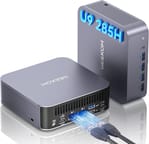
The chassis measures 4.61 x 4.41 x 1.79 inches (117 x 112 x 45.5mm) and weighs 1.31 pounds, keeping GEEKOM’s familiar compact design language. The matte black shell is fingerprint-prone. Its ports include two HDMI 2.0 outputs, a Mini DisplayPort 1.4 capable of 8K resolution, and dual USB4 ports that carry both high-speed data and display output. The front panel carries a 3.5mm combo audio jack, an SD card reader, and one USB 2.0 Type-A port, while the rear concentrates the video outputs alongside dual 2.5 Gigabit Ethernet ports and additional USB connectivity.
The Intel Core Ultra 9 285H is Intel’s Arrow Lake architecture, with 16 cores in a hybrid configuration that can boost up to 5.4GHz. The integrated Intel Arc 140T GPU handles graphics duties competently for productivity tasks and light gaming, though it will not replace a dedicated GPU for demanding 3D workloads. The dedicated NPU, Arc GPU, and CPU cores work together to deliver 99 TOPS of AI performance, which suits the box to running local AI models and accelerating AI-enhanced creative applications. Gemma 4 on mini PCs covers weight sizes, KV cache requirements, and tokens-per-second by hardware tier, worth reading before you choose a model to run locally.
WiFi 7 support with the Intel BE200 chipset is rated up to 5.8 Gbps on 6GHz networks (Liliputing measured 2.29 Gbps in a real transfer, covered below), and Bluetooth 5.4 covers current wireless peripherals. The dual 2.5 Gigabit Ethernet ports offer redundancy for network-critical applications or link aggregation for maximum throughput. Storage expansion is handled through two M.2 slots: a PCIe 4.0 x4 slot for high-speed NVMe drives up to 4TB and a secondary SATA III slot for additional capacity up to 2TB. The two DDR5-5600 SO-DIMM slots are not soldered, so the shipped 32GB can be swapped out and taken as high as 128GB.
Reviewer Insights

Best Buys Reviewed: multi-track edits and compiles ran fast
Best Buys Reviewed positioned the GT15 Max AI as potentially “the most powerful consumer mini PC we’ve ever tested.” Their review emphasized the AI capabilities, noting that the “99 trillions of operations per second AI power actually delivers real results” for creative professionals. They found that video editing workflows were fast, with the Core Ultra 9 285H processor “ripping through multi-track edits like butter.” For developers, compile times were so improved that the reviewer remarked he “thought I broke something.” The review highlighted the quiet operation under most workloads, with the IceBlast 2.0 cooling system maintaining temperatures while staying below 38dB.
TechRadar on the same-chip IT15: desktop-class speed
According to TechRadar, the IT15 (which shares the same processor as the GT15 Max) earned a 4.5/5 rating for its ability to rival desktop machines in a compact form factor. The review praised the powerful Intel Ultra CPU and extensive upgrade options including dual USB4 ports, though noted that the integrated graphics lack the power of dedicated GPUs and fans become noisy during sustained heavy loads.
NotebookCheck found headroom the cooling leaves unused
NotebookCheck’s review awarded the IT15 a 77% rating, describing it as “a competent device with efficient components.” They appreciated the stable build quality, high system performance, fast SD card reader, and the confidence of a 36-month warranty. However, their testing revealed thermal limitations, with the review noting that “a lot of performance potential remains unused” due to aggressive thermal throttling under sustained loads.
Liliputing’s benchmarks land in workstation range
Liliputing’s in-depth analysis provided detailed benchmark data, recording a Cinebench R23 multi-core score of 19,811 and a Geekbench 6 single-core score of 3,066. While praising the productivity performance and WiFi 7 speeds reaching 2.29 Gbps on the 6GHz band, the review cautioned about severe sustained thermal throttling and noted that the NPU’s 13 TOPS is significantly less powerful than AMD’s 50 TOPS implementation, with AI benchmark scores reflecting this disparity.
Customer Reviews
Amazon buyer praise centers on the compact size, quiet operation, and multi-monitor support. Shawn, a verified buyer whose review is titled “Geekom GT15,” wrote that it is “Nice and quiet and runs fine,” and his one complaint was a packaging detail: “Only draw back is that it comes with a European style wall plug with circular prongs.” Another verified buyer, Mixoly, hooked up “three monitor with not effort at all” and called it “Super fast., nice and compact.”
The low ratings cluster around customer support instead of the hardware. A verified one-star reviewer, Diane, titled her review “Cool product NO support at all” and described calling tech support only to get “the old leave your number and will call back,” then waiting “over 6 hours for a call back that never came.” If after-sale support matters to you, weigh those accounts against the largely happy majority.
Strong burst performance at $1,049, with heat as the limit
This is a capable Intel machine for creative work, software development, and local AI models, in a chassis that takes far less desk space than a tower. Two DDR5 slots and two M.2 slots keep it serviceable years after purchase.
Sustained heavy workloads run into thermal throttling. Anyone who keeps a system pinned for hours may prefer an AMD box such as the GEEKOM A9 Max, which reviewers credit with steadier sustained performance. At $1,049 for the 32GB/1TB configuration, the decision comes down to whether the Arrow Lake platform’s AI acceleration and WiFi 7 support are worth the price over more affordable options.
A practical first project is running Whisper locally for private transcription. Before committing to local hardware at all, it is worth reading where Ollama Cloud changes the math. Other Intel and AMD boxes in this price range sit side by side in the Mini PC Comparison Chart.
Upgrades
Accessories that fit the GEEKOM GT15 Max AI's USB4 or Thunderbolt ports.
Core X V2
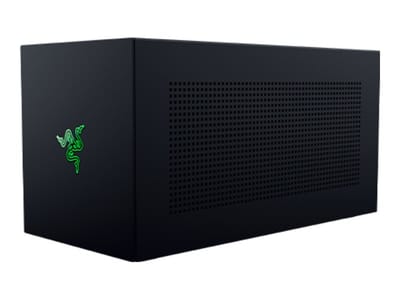
A Thunderbolt 5 enclosure that Razer lists as working with Thunderbolt 4 and USB4 hosts; it fits a four-slot card and needs an ATX power supply.
DEG2 eGPU Dock
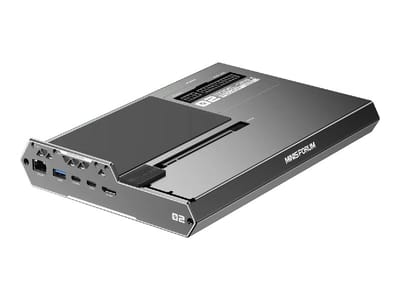
Connects over USB4 or Thunderbolt 5, with an OCuLink input behind a switch, and adds an M.2 slot; it needs an ATX or SFX power supply.
Breakaway Box 850 T5
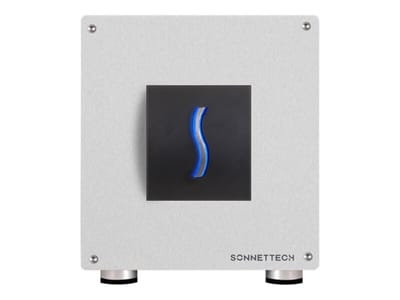
Has an 850W power supply built in, so only the graphics card is extra, and works with Thunderbolt 4 and USB4 Windows PCs.
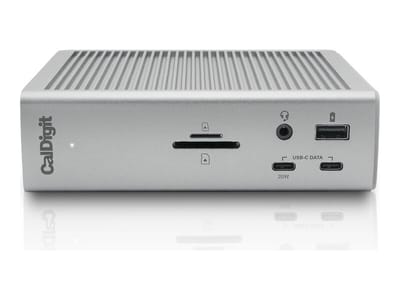
TS4 Thunderbolt 4 Dock
An 18-port dock that CalDigit lists for Thunderbolt 4 and USB4 hosts, with 2.5GbE and a DisplayPort 1.4 output.
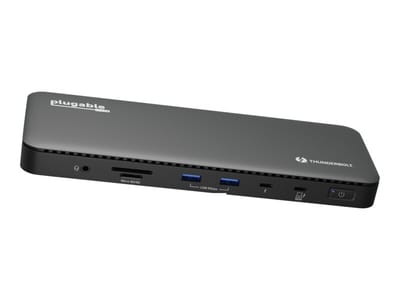
TBT4-UD5 Thunderbolt 4 Dock
Two HDMI ports drive two 4K60 monitors from one Thunderbolt 4 or USB4 port on a Windows PC.
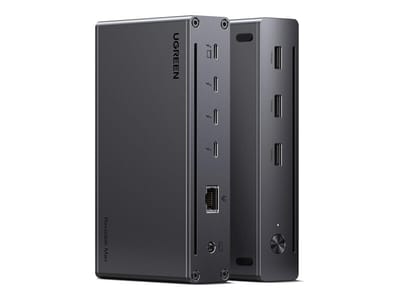
Revodok Max 208 Thunderbolt 4 Dock
Adds three Thunderbolt 4 ports for dual 4K60 displays plus gigabit Ethernet; it has no HDMI port, so monitors connect over USB-C or an adapter.
Frequently Asked Questions
What is the AI performance of the GEEKOM GT15 Max AI?
The NPU contributes 13 TOPS, the Intel Arc 140T GPU 77 TOPS, and the CPU cores 9 TOPS, for 99 TOPS of combined AI processing power. That covers acceleration for AI-powered applications, local large language models, and creative software with AI features. For a broader view of local AI hardware, see our comparison of the DGX Spark, Strix Halo, and multi-GPU alternatives.
How much RAM can the GT15 Max AI support?
Two SO-DIMM slots take up to 128GB of DDR5-5600 RAM. The base configuration includes 32GB of non-soldered DDR5, so the modules can be pulled and replaced with larger ones.
Does the GEEKOM GT15 Max AI support external GPUs?
Dual USB4 ports can technically connect external GPU enclosures, but there is no dedicated OCuLink port and no Thunderbolt 4 certification. eGPU performance will be limited to PCIe Gen 3 x4 speeds through USB4, which may not fully use high-end graphics cards.
How many monitors can I connect to the GT15 Max AI?
Up to four simultaneous displays run from the two HDMI 2.0 ports, one Mini DisplayPort 1.4, and USB4 ports with DisplayPort Alt Mode. The output can be a single 8K display or multiple 4K displays.
What storage expansion options does the GT15 Max AI offer?
Two M.2 slots handle storage: one M.2 2280 slot supporting PCIe 4.0 x4 NVMe drives up to 4TB, and one M.2 2242 SATA III slot for drives up to 2TB. The base configuration fills the primary slot with a 1TB NVMe SSD, leaving the secondary slot available for expansion.
Is the GEEKOM GT15 Max AI suitable for gaming?
Casual and esports gaming at 1080p works on the Intel Arc 140T integrated graphics. Demanding AAA titles at high settings are beyond it, and the thermal limitations under sustained load mean gaming performance may decrease during extended sessions. For dedicated gaming, consider a mini PC with discrete graphics or a gaming-focused build.
What networking features does the GT15 Max AI include?
Networking covers WiFi 7 (Intel BE200) on the 2.4GHz, 5GHz, and 6GHz bands with speeds up to 5.8 Gbps, Bluetooth 5.4 for wireless peripherals, and dual 2.5 Gigabit Ethernet ports for wired connectivity. The pair of Ethernet ports can be used for network redundancy or link aggregation.