
BOSGAME E7
Published on

The BOSGAME E7 is a desk-side office box for people who want more CPU than an Intel N-series mini PC gives them without moving up to a Ryzen or Core Ultra machine. The Intel Core 3 100U inside carries six cores and eight threads, and the chassis is roughly five inches square and about 1.7 inches tall. It has two Gigabit Ethernet ports and three independent 4K@60Hz display outputs.
Pros and Cons
| Pros | Cons |
|---|---|
| Core 3 100U (6C/8T) scores about 12,600 on CPU Mark, roughly double an Intel N100 | Both Ethernet ports run at 1 Gbps, not the 2.5 Gbps common in this price band |
| Triple 4K@60Hz output via HDMI 2.0, DisplayPort, and USB-C | One M.2 slot only, so storage cannot be split across two drives |
| Full-function front USB-C carries video, 10 Gbps data, and Power Delivery | The M.2 slot is PCIe 3.0 rather than PCIe 4.0 |
| Two DDR4 SODIMM slots take up to 64GB | Intel UHD graphics rule out modern games at native settings |
| Four USB-A 3.2 Gen 2 ports split between the front and rear panels | DDR4-3200 memory instead of DDR5 |
| VESA bracket, HDMI cable, and power adapter ship in the box | No card reader |
BOSGAME E7 Comparison Chart
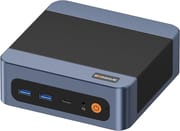 BOSGAME E7 | |
| Price | List Price: $439.00 Amazon Prices: Loading prices... |
| Version | 16GB/512GB |
| Performance Rating | 6.1 |
| Operating System | Windows 11 Pro |
| Processor | Hexa-core 1.20 Ghz (max 4.70 Ghz) Intel Core 3 100U |
| GPU | Integrated Intel UHD Graphics |
| RAM | 16 GB DDR4, 2-channel |
| Internal Storage | 512 GB SSD |
| Dimensions width x length x thickness | 5.08 x 5.04 x 1.73 inches (129.03 x 128.02 x 43.94 mm) |
| Weight | unknown |
| WiFi | Wi-Fi 6 (802.11ax) |
| Bluetooth | Bluetooth 5.2 |
| Ethernet | 2 Ethernet ports at 1 Gbps |
| HDMI | 1 Full-Size HDMI Port |
| DisplayPort | 1 DisplayPort (DP, HDMI 2.0, and USB-C each drive 4K@60Hz) |
| VGA | No VGA Ports |
| USB Ports | 4 USB 3, 1 USB-C 4x USB-A 3.2 Gen 2, 1x front USB-C (4K@60Hz, PD) |
| Thunderbolt Ports | No |
| OCuLink | No |
| Internal SATA Ports | No SATA ports |
| Card Reader | No Card Reader |
| Headphone Jack | 3.5mm |
| Fanless | No |
| VESA Mount | Yes |
| In the Box | Power adapter, VESA mount with screws, HDMI cable, manual |
| Expandability | Up to 64GB DDR4-3200 (2x SODIMM). 1x M.2 2280 PCIe 3.0 x4, up to 4TB |
Related Mini PCs
-
 BOSGAME P4 UltraA compact Ryzen 7 7730U mini PC with dual 2.5GbE LAN, Wi-Fi 6E, two PCIe 3.0 M.2 slots, and a…
 -
 BOSGAME E5 PlusThe BOSGAME E5 Plus pairs a four-core Ryzen 3 5400U with two 2.5GbE ports, two memory slots, and a…
 -
 ACEMAGICIAN AM06 Pro Mini PCThe ACEMAGICIAN AM06 Pro is a compact AMD Ryzen mini PC (Ryzen 7 5700U, 5800U, or Ryzen 5 7430U)…
 -
 Beelink SER3The Beelink SER3 pairs an AMD Ryzen 7 3750H (Radeon Vega 10) with dual 4K HDMI output and extensive…
 -
 Beelink SER5 (5500U)The Beelink SER5 (5500U) is a Ryzen 5 5500U mini PC with 16GB of DDR4 in two slots (64GB max), a…
 -
 Getorli GT103The Getorli GT103 is a Ryzen 5 7430U mini PC with two 2.5 Gigabit Ethernet ports, three display…
Two Gigabit ports, one M.2 slot

The front panel carries two USB-A ports, the USB-C port, a 3.5mm headphone jack, and the power button. The rear holds the DC input, both RJ45 jacks, DisplayPort, HDMI, two more USB-A ports, and a Kensington lock slot. Splitting the USB ports across both faces means a keyboard and mouse can live permanently at the back while a flash drive or a portable SSD goes in the front.
Both Ethernet ports run at 1 Gbps. Two ports at Gigabit still cover network segmentation or a wired link that stays up when the first one drops, which is the usual reason to want two of them.
HDMI 2.0, DisplayPort, and the front USB-C each drive a 4K display at 60Hz, and all three can run at once. That USB-C port is a full-function one: video out, 10 Gbps data, and Power Delivery. Wireless comes from a WiFi 6 (802.11ax) card with Bluetooth 5.2.
Expansion is modest. Two DDR4-3200 SODIMM slots accept up to 64GB total, and a single M.2 2280 slot on PCIe 3.0 x4 takes a drive of up to 4TB. There is no 2.5-inch bay and no second M.2 socket, so internal storage stops at that one drive; anything more goes over USB.
Roughly double an N100, short of Core Ultra

The Intel Core 3 100U is a 15W part with two performance cores and four efficient cores, eight threads in total, 10MB of cache, and a 4.7GHz boost clock. Its CPU Mark score of roughly 12,600 puts it well clear of the Intel N100 (about 5,320) that anchors the cheap end of the mini PC market, and a little behind current Core Ultra mobile parts such as the Core Ultra 5 125U (about 16,900). For office suites, browser-heavy work, video calls, and light media editing that gap matters more than the one at the top.
The integrated Intel UHD Graphics runs at up to 1.25GHz, which is enough for 4K video playback and three desktop displays but not for modern games. It handles casual and older titles at 720p, while current games at native resolution stutter.
Short bursts hit the 4.7GHz boost, and long compiles or exports settle lower, which is normal for a 15W U-series chip in a chassis this size. Buyers who expect to run heavy multi-threaded jobs for hours should look at an H-series or desktop-class mini PC instead.
Who the E7 suits
The E7 is a fit for a home office, a front-desk machine, a meeting-room box, or a second computer that lives behind a monitor on the included VESA bracket. Six cores at 15W, 16GB of upgradeable memory, and three 4K outputs cover that work.
Skip it if you need 2.5 Gbps networking, two NVMe drives, or a discrete GPU. The Mini PC Comparison Chart lists boxes this size with 2.5 Gbps ports.
Frequently Asked Questions
How much RAM does the BOSGAME E7 support?
Up to 64GB. The E7 has two DDR4-3200 SODIMM slots and ships with 16GB installed across both of them, so an upgrade means replacing the existing modules rather than adding to them.
How fast are the two Ethernet ports on the BOSGAME E7?
Both run at 1 Gbps.
Can the BOSGAME E7 run three monitors?
Yes. HDMI 2.0, DisplayPort, and the front USB-C port each support a 4K display at 60Hz, and all three can be used at the same time.
Can you add a second SSD to the BOSGAME E7?
No. There is one M.2 2280 PCIe 3.0 x4 slot and no 2.5-inch drive bay, so the only way to add storage is to fit a larger NVMe drive (up to 4TB) or attach an external one over USB.
Will the BOSGAME E7 run Linux?
BOSGAME lists Ubuntu and other Linux distributions alongside the pre-installed Windows 11 Pro.