
GMKtec NEO-X1 Pro
Published on

The GMKtec NEO-X1 Pro is a compact gaming desktop for buyers who want full-size graphics card performance without a full tower on the desk. It pairs AMD’s Ryzen 9 9955HX3D, a 16-core laptop chip with 128MB of 3D V-Cache, with a desktop GeForce RTX 5070 in a 14.6-liter metal case. The processor is soldered, but the graphics card, memory, and SSDs are standard parts you can replace. The tradeoffs are size, since this is a small tower rather than a mini PC, and the lack of USB4 or Thunderbolt on a machine at this price.
Pros and cons
| Pros | Cons |
|---|---|
| Full-size desktop RTX 5070 with 12GB of GDDR7 | No USB4 or Thunderbolt; the USB-C ports run at 10Gbps and 5Gbps |
| Liquid-cooled 16-core Ryzen 9 9955HX3D runs at 160W in Performance mode, with peaks to 170W | 14.6 liters and about 15 pounds, closer to a small tower than a mini PC |
| Quiet under gaming loads in hands-on reviews | The processor is soldered to the board and cannot be upgraded |
| Standard micro-ATX layout with replaceable GPU, RAM, and SSDs | The BIOS has power modes but no overclocking or memory timing controls |
| Internal 850W SFX power supply, no external brick | The radiator is a tight fit to remove when servicing |
| WiFi 7, Bluetooth 5.4, and 2.5GbE | The 64GB build packs more memory than a gaming PC uses |
Related Videos
GMKtec NEO-X1 Pro Comparison Chart
 GMKtec NEO-X1 Pro | GMKtec NEO-X1 Pro | GMKtec NEO-X1 Pro | |
| Price | List Price: $4,000.00 Amazon Prices: Loading prices... | List Price: $3,199.99 Amazon Prices: Loading prices... | List Price: $2,199.99 Amazon Prices: |
| Version | 32GB/2TB/Ryzen 9 9955HX3D/RTX 5070 | 64GB/2TB/Ryzen 9 9955HX3D/RTX 5070 | NEO-X1: 32GB/1TB/Ryzen 9 9955HX/RTX 5060 Ti |
| Performance Rating | 8.5 | 8.7 | 8.0 |
| Operating System | Windows 11 Pro | Windows 11 Pro | Windows 11 Pro |
| Processor | Sixteen-core 2.50 Ghz (max 5.40 Ghz) AMD Ryzen 9 9955HX3D | Sixteen-core 2.50 Ghz (max 5.40 Ghz) AMD Ryzen 9 9955HX3D | Sixteen-core 2.50 Ghz (max 5.40 Ghz) AMD Ryzen 9 9955HX |
| GPU | Dedicated NVIDIA GeForce RTX 5070 | Dedicated NVIDIA GeForce RTX 5070 | Dedicated NVIDIA GeForce RTX 5060 Ti 8GB |
| RAM | 32 GB DDR5 SO-DIMM, 2-channel (2x 16GB DDR5-5600) | 64 GB DDR5 SO-DIMM, 2-channel (2x 32GB DDR5-5600) | 32 GB DDR5 SO-DIMM, 2-channel (2x 16GB DDR5-5600) |
| Internal Storage | 2 TB NVMe PCIe 4.0 | 2 TB NVMe PCIe 4.0 | 1 TB NVMe PCIe 4.0 |
| Dimensions width x length x thickness | 6.5 x 13.78 x 10.43 inches (165.1 x 350.01 x 264.92 mm) | 6.5 x 13.78 x 10.43 inches (165.1 x 350.01 x 264.92 mm) | 6.5 x 13.78 x 10.43 inches (165.1 x 350.01 x 264.92 mm) |
| Weight | 15.4 lbs (7 kg) | 15.4 lbs (7 kg) | 15.4 lbs (7 kg) |
| WiFi | Wi-Fi 7 (802.11be) | Wi-Fi 7 (802.11be) | Wi-Fi 7 (802.11be) |
| Bluetooth | Bluetooth 5.4 | Bluetooth 5.4 | Bluetooth 5.4 |
| Ethernet | 1 Ethernet port at 2.5 Gbps | 1 Ethernet port at 2.5 Gbps | 1 Ethernet port at 2.5 Gbps |
| HDMI | 2 Full-Size HDMI Ports | 2 Full-Size HDMI Ports | 2 Full-Size HDMI Ports |
| DisplayPort | 4 DisplayPorts (3x DP 2.1b on GPU, 1x DP 1.4 on board) | 4 DisplayPorts (3x DP 2.1b on GPU, 1x DP 1.4 on board) | 4 DisplayPorts (3x DP 2.1b on GPU, 1x DP 1.4 on board) |
| VGA | No VGA Ports | No VGA Ports | No VGA Ports |
| USB Ports | 4 USB 2.0, 2 USB 3, 2 USB-C USB-C 10Gbps rear, 5Gbps front; no USB4 | 4 USB 2.0, 2 USB 3, 2 USB-C USB-C 10Gbps rear, 5Gbps front; no USB4 | 4 USB 2.0, 2 USB 3, 2 USB-C USB-C 10Gbps rear, 5Gbps front; no USB4 |
| Thunderbolt Ports | No | No | No |
| OCuLink | No | No | No |
| Internal SATA Ports | 2 SATA ports (2 SATA headers, no drive bay) | 2 SATA ports (2 SATA headers, no drive bay) | 2 SATA ports (2 SATA headers, no drive bay) |
| Card Reader | No Card Reader | No Card Reader | No Card Reader |
| Headphone Jack | combo | combo | combo |
| Fanless | No | No | No |
| VESA Mount | No | No | No |
| In the Box | PC with internal 850W PSU, power cable, Wi-Fi antennas, HDMI cable, manual | PC with internal 850W PSU, power cable, Wi-Fi antennas, HDMI cable, manual | PC with internal 850W PSU, power cable, Wi-Fi antennas, HDMI cable, manual |
| Expandability | Up to 96GB DDR5-5600 (2x SODIMM), 2x M.2 PCIe 5.0 x4, swappable full-size GPU up to about 12 inches long | Up to 96GB DDR5-5600 (2x SODIMM), 2x M.2 PCIe 5.0 x4, swappable full-size GPU up to about 12 inches long | Up to 96GB DDR5-5600 (2x SODIMM), 2x M.2 PCIe 5.0 x4, swappable full-size GPU up to about 12 inches long |
Related Mini PCs
-
 ASUS ROG GR70The ASUS ROG GR70 packs an AMD Ryzen 9 9955HX3D with 3D V-Cache and an NVIDIA GeForce RTX 5070…
-
 ASUS ROG NUC 16The ASUS ROG NUC 16 packs a refreshed Intel Core Ultra 9 290HX Plus and an NVIDIA RTX 5080 or RTX…
-
 MINISFORUM 139D7An 8.5-liter upright desktop with a 24-core Core i9-13900HX, a PCIe 5.0 x16 slot, and an internal…
-
 MINISFORUM 895D7An 8.5-liter upright desktop with a 16-core Ryzen 9 8945HX, a PCIe 5.0 x16 slot, and an internal…
-
 ACEMAGIC G3AA 3.5-liter workstation with a socketed desktop Core i9-13900F and a low-profile NVIDIA RTX 2000…
-
 GMKtec EVO-X1 ProThe GMKtec EVO-X1 Pro moves the compact EVO-X1 chassis to AMD's Ryzen AI 9 HX 470, with 64GB of…
A 14.6-liter case with a side radiator and a full-size graphics card

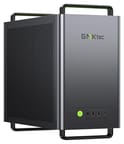
The NEO-X1 Pro measures about 13.8 x 6.5 x 10.4 inches without its handles and weighs about 15 pounds, per GMKtec. A gray metal shell with a lime green top carries two tubular handles, one at the top and one at the bottom. The left side panel is a vented mesh that comes off with two screws. Behind it sits a side-mounted liquid cooler with two 120mm fans, which ETA PRIME judged to be a 240mm unit, since GMKtec does not list the size. Two more fans on top exhaust air, and another fan sits in the floor of the case.
The front panel has the power button, a 3.5mm combo audio jack, two USB 2.0 Type-A ports, and a 5Gbps USB-C port. The rear has two USB 3.2 Gen 2 Type-A ports at 10Gbps, two more USB 2.0 Type-A ports, a 10Gbps USB-C port, a 2.5GbE jack on a Realtek RTL8125 controller, separate mic, line-in, and line-out jacks, and the Wi-Fi antenna connectors. The motherboard has its own HDMI 2.1 port (limited to 4K at 60Hz) and a DisplayPort 1.4 output, but gaming displays connect to the graphics card, which has one HDMI 2.1b and three DisplayPort 2.1b outputs for up to four screens. Neither USB-C port is USB4, a gap TechTablets singled out on a machine at this price.
Wireless runs on WiFi 7 with Bluetooth 5.4. Memory sits in two DDR5-5600 SODIMM slots that take up to 96GB, and the board has two M.2 slots at PCIe 5.0 x4, one of which fits the longer 22110 drives. Review units shipped with a 2TB PCIe 4.0 drive in one slot, from Crucial on the units TechTablets and Toasty Bros opened. The board also has two SATA headers for anyone who can find room for a 2.5-inch drive, though the case has no drive bay. An 850W SFX 80 Plus Gold power supply sits at the front of the case and feeds the graphics card through a 16-pin cable.
A 16-core 3D V-Cache laptop chip and a desktop RTX 5070

The Ryzen 9 9955HX3D is a Zen 5 laptop processor with 16 cores, 32 threads, a 5.4GHz boost clock, and 128MB of L3 cache through AMD’s second-generation 3D V-Cache. It scores about 62,700 on PassMark’s multi-thread test. GMKtec solders it to a custom micro-ATX board and gives the BIOS three power modes: Silent at 54W, Balanced at 85W, and Performance at 160W with peaks to 170W. On the liquid cooler, ETA PRIME and TechDweeb recorded CPU peaks of 72C and 74C in Performance mode.
The RTX 5070 is a standard desktop card with 6,144 CUDA cores and 12GB of GDDR7 on a 192-bit bus. The brand of card varies by unit: most reviewers found a Yeston card, while TechTablets and zWORMz Gaming found a ZOTAC. TechTablets measured about 31cm (roughly 12 inches) of room for the card, enough for some larger cards but probably not a triple-fan RTX 5090 or RTX 4090. GMKtec warns that removing the factory GPU voids the warranty, so check the terms before you swap it.
AMD announced the 9955HX3D in 2025, and NVIDIA released the RTX 5070 the same year. Craft Computing measured the NEO-X1 Pro about 73% faster in 3DMark than the Minisforum G1 Pro with an RTX 5060.
Reviewer Insights
Daniel Owen
Daniel Owen ran the NEO-X1 Pro side by side with his own desktop built on a Ryzen 7 9800X3D and an RTX 5070 Founders Edition, and the two finished within a few percent of each other in every game he ran. At 1440p, Forza Horizon 6 at extreme settings averaged 102 FPS on both machines, 126 FPS against 123 with DLSS Balanced, and 84 FPS against 80 with ray tracing on. Resident Evil Requiem with path tracing and DLSS Balanced ran at 53 FPS on both, and Clair Obscur: Expedition 33 at epic settings ran at 47 FPS against 48, a lead for the desktop. He treated the 2% to 5% gaps as run-to-run variance and put part of them down to the Yeston card in the GMKtec possibly boosting a little higher. He tested in the default Performance mode. On noise, he said “I could hear the fans, but just like any other desktop PC, whereas some mini PCs I’ve tested in the past got really obnoxiously loud.”
He also tested it as a living room PC on a 4K TV. Forza Horizon 6 at its maximum settings with ray tracing and DLSS Performance went past the card’s 12GB of VRAM and stuttered, while the high preset with ray tracing averaged well over 80 FPS. Older games without DLSS, such as Dark Souls III and Divinity: Original Sin 2, ran at native 4K with maximum or ultra settings. Opening the case took two screws, and the only awkward step in pulling the graphics card was reaching the PCIe slot latch, which needed a plastic tool. He thought an RTX 5080 Founders Edition might fit in the case, but he could not angle it into the slot without removing more of the liquid cooler. He would configure a gaming PC differently, with an 8-core 9800X3D and 32GB of RAM, and he estimated that a DIY desktop with about the same gaming performance would cost significantly less. He concluded, “I think that this is a solid PC,” but said “the configuration here is not ideal from a performance per dollar perspective.”
ETA PRIME
ETA PRIME’s review ran the machine in the 160W Performance mode with 64GB of RAM. Cinebench R24 scored 2,212 multi-core and 127 single-core, and 3DMark Time Spy reached 20,755. Every game ran at native 1440p with no DLSS: Forza Horizon 6 at extreme settings averaged over 110 FPS, Red Dead Redemption 2 at ultra averaged about 112 FPS, Crimson Desert at ultra with ray tracing off averaged about 81 FPS, and Doom: The Dark Ages at ultra never dropped under 60 FPS while using more than 10GB of the card’s 12GB. CPU temperatures averaged 59.3C with a peak of 72C, and the GPU averaged 70C with a peak of 75C, with no thermal throttling. He said of the noise: “The acoustics here are great. Even under extreme load when running my games at 1440p, this thing never ramped up to sound like a jet engine.” His verdict: “So far, the GMK Tech Neo X1 Pro is a great performer. It’s putting down amazing CPU performance and GPU performance.”
Craft Computing
Craft Computing tested both CPU power modes. In Cinebench R23 the chip scored about 32,300 multi-core at a 100W cap in Balanced mode, as his unit reported it (GMKtec lists Balanced at 85W), and 39,660 at 165W in Performance mode, within about 7% of AMD’s desktop Ryzen 9 9950X3D. The reviewer recommended leaving the CPU in Balanced mode for gaming, since the higher mode added about 50% to power draw for marginal 3DMark gains. At 1440p, Cyberpunk 2077 with the RT Ultra preset and DLSS averaged 93 FPS, Helldivers 2 at ultra averaged 131 FPS, and Starfield at ultra averaged 98 FPS, while the system drew about 375W from the wall in Balanced mode. He said that “the Ryzen 9955 HX 3D is just otherworldly levels of good inside the Neo X1 Pro” and that the case is easy to service, with the radiator held by two screws.
He objected to the forced 64GB configuration, calling 64GB “a stupid amount of memory to put into a gaming PC,” and said he could not recommend the 64GB build for gaming at its price, outside of content creators, 3D professionals, and buyers who do not mind the cost. He added: “I think some slightly different configuration options and this could be a general market PC.”
zWORMz Gaming
zWORMz Gaming played more than a dozen games at 1440p on a unit with a dual-slot ZOTAC RTX 5070. The X3D cache showed in Counter-Strike 2, where low settings ran at more than 500 FPS on average. In Forza Horizon 6 he got 100 to 110 FPS at native resolution with everything maxed except ray tracing, but the extreme preset with ray tracing showed frame-time spikes as the game ran past the card’s 12GB of VRAM. Cyberpunk 2077 stayed above 60 FPS with the RT Ultra preset and DLSS Quality and dropped to about 40 FPS with path tracing. Alan Wake 2, which he called extremely demanding, hovered around 60 FPS at high settings with no ray tracing until he switched on DLSS Quality. To isolate the processor, he ran Stalker 2 in the Balanced power mode with DLSS Ultra Performance and still saw more than 100 FPS: “This CPU is an absolute beast. And it’s only at 85 watts, as well.” The CPU stayed under about 70C while gaming, and the ZOTAC card reached about 80C at times, a temperature he called fine for an RTX 5070 and put down to that card’s cooler. He called the machine “a really neat package” but found its price “definitely quite steep for a 5070 machine,” and said he would have liked an RTX 5070 Ti at that price.
Major Hardware
Major Hardware put the NEO-X1 Pro against his custom water-cooled desktop with a Ryzen 9 5950X, an RTX 3080 Ti, and 64GB of DDR4. Across several Battlefield 6 maps on a super ultrawide monitor, the NEO-X1 Pro averaged about 80 FPS to the desktop’s 55, and the desktop’s 1% and 0.1% lows were much worse. The bigger water-cooled tower ran cooler, but the NEO-X1 Pro’s CPU sat in the mid 70s C, which he said was nothing to worry about. Inside he found a Yeston RTX 5070 12GB, a GMKtec-branded liquid cooler and fans, and two removable SODIMM slots, and he noted that AMD’s Ryzen Master tuning app does not work with the laptop processor. He removed the cooler’s aluminum and copper cold plate to see whether the processor could come out (it cannot), and after he put it back together the CPU ran slightly warmer than before, so he warned buyers: “So if you buy one of these just know that you cannot update or upgrade the CPU. So do not take that plate off.” He priced a desktop with equivalent parts at well above the NEO-X1 Pro and judged the smaller machine worth the trade of a mobile CPU. On the hardware he said, “Good news is the build quality, good. Cable management, good. Taking it apart, putting it back together, pretty darn easy.” He said it will be his new gaming PC and that “it really gives me a new perspective on what a mini PC is.”
TechTablets
TechTablets tested at 4K. Shadow of the Tomb Raider at the high preset averaged 189 FPS, Cyberpunk 2077 without ray tracing or upscaling averaged 67 FPS, The Witcher 3 at high settings held around 60 FPS, and the Gothic remake at high settings ran at about 48 FPS. The stock card scored about 22,500 in the Time Spy graphics test and nearly 25,000 with a mild overclock. CPU temperatures stayed under 80C at about 166W, and a 10-minute 41-second video project exported in 1 minute 55 seconds. The reviewer said of the build, “The quality, the assembly, I can’t fault it,” and called the machine “an absolute monster as expected,” while noting the BIOS is locked down with no timing or overclocking controls and the top vent has no removable dust filter. He also wished for a 40Gbps USB-C port.
TechDweeb
TechDweeb measured Cinebench R23 multi-core scores of 40,292 in Performance mode, 34,724 in Balanced, and 25,735 in Quiet, with a single-core score of 2,163. The peak temperature was 74C during a stress test at about 170W. At 1440p, Cyberpunk 2077 with path tracing and no frame generation averaged 61 FPS, Kingdom Come: Deliverance 2 at ultra with DLSS Quality averaged about 95 FPS, and Assassin’s Creed Shadows at high settings with ray tracing averaged about 70 FPS. He credited the desktop-size fans for the low noise, saying that “because these are desktop fans instead of tiny mini PC screech wheels, it doesn’t sound annoying.” He found the radiator a tight fit to remove and noted that the two SODIMM slots mean an upgrade replaces the installed kit rather than adding to it. Windows 11 Pro came without third-party bloatware.
Toasty Bros
Toasty Bros found ADATA DDR5 memory, a Crucial SSD, and an 850W SFX power supply inside, and saw the CPU draw 108 to 120W during games. Counter-Strike 2 at 1440p low averaged 740 FPS, and Marvel Rivals at 1440p high with DLSS Balanced averaged 142 FPS. Time Spy scored 22,645 for graphics and 13,950 for the CPU. They pointed out that “this is probably going to run a lot better than most of the little mini PCs we test because they don’t normally have cooling like this,” but concluded that a buyer focused only on gaming can build a mini-ITX PC with similar game performance for less.
Where the reviews agree and differ
Six reviews (ETA PRIME, zWORMz Gaming, Major Hardware, TechTablets, TechDweeb, and Toasty Bros) found the cooling effective, and five (Daniel Owen, ETA PRIME, Craft Computing, TechTablets, and TechDweeb) found the noise acceptable or quiet under load. The 12GB card is the limit two reviewers hit, with Forza Horizon 6 running out of video memory at maximum settings with ray tracing for both Daniel Owen and zWORMz Gaming. Value split the reviews. Daniel Owen and Toasty Bros said a DIY build with similar gaming performance costs less, and TechTablets conceded a DIY build would probably cost less, while Craft Computing found a matching DIY build costs about the same and blamed the forced 64GB configuration, which Daniel Owen also questioned for a gaming PC. Major Hardware came out the other way and called the NEO-X1 Pro worth its price against a full-size desktop.
Who it’s for
The NEO-X1 Pro suits buyers who want 1440p gaming at ultra settings, or 4K at high settings, in a case small enough to carry to a LAN party or set beside a TV. The graphics card, RAM, and SSDs are standard and replaceable, and the 16-core processor also handles video editing and 3D work. Craft Computing called the 64GB in the top build more memory than a gaming PC needs. The NEO-X1 sold alongside it swaps in a Ryzen 9 9955HX and an RTX 5060 Ti 8GB for about $1,000 less.
Daniel Owen, who tested it on a 4K TV, concluded that the latest AAA games need DLSS Performance mode and somewhat lower settings on the 12GB card, while the older games he plays ran at maximum settings. Skip it if you want the most frames for your money, or if you need USB4 or Thunderbolt for docks and fast external drives. The Minisforum AtomMan G1 Pro is a smaller box with a desktop graphics card, a low-profile RTX 5060 in about 3.8 liters, and GMKtec’s EVO-X2 trades the discrete card for a Ryzen AI Max+ 395 with up to 128GB of unified memory.
Frequently Asked Questions
Does the GMKtec NEO-X1 Pro use a laptop GPU or a desktop GPU?
A desktop GPU. The NEO-X1 Pro uses a full-size GeForce RTX 5070 with 12GB of GDDR7 in a standard PCIe slot. The processor is the laptop part: a Ryzen 9 9955HX3D soldered to the motherboard and cooled by a liquid cooler.
Can you upgrade the graphics card in the NEO-X1 Pro?
Physically, yes. The card is a standard desktop part powered by a 16-pin cable from the 850W supply, so a different card fits if it is no longer than about 12 inches. GMKtec says removing the factory card voids the warranty.
What is the difference between the NEO-X1 and the NEO-X1 Pro?
Both share the same 14.6-liter case, cooler, and 850W power supply. The NEO-X1 uses a Ryzen 9 9955HX with 64MB of L3 cache and an RTX 5060 Ti with 8GB of VRAM. The NEO-X1 Pro uses the Ryzen 9 9955HX3D with 128MB of L3 cache and an RTX 5070 with 12GB of VRAM.
Does the NEO-X1 Pro have USB4 or Thunderbolt?
No. It has two USB-C ports, a 10Gbps port on the back and a 5Gbps port on the front, plus two 10Gbps and four USB 2.0 Type-A ports. Displays connect to the graphics card’s HDMI 2.1b and three DisplayPort 2.1b outputs.
How loud does the NEO-X1 Pro get?
Five reviewers found the noise acceptable or quiet for its power. It uses full-size desktop fans and a liquid cooler rather than small mini PC blowers. ETA PRIME reported that it never got loud during 1440p gaming in the 160W Performance mode, with a GPU peak of 75C and no thermal throttling.